
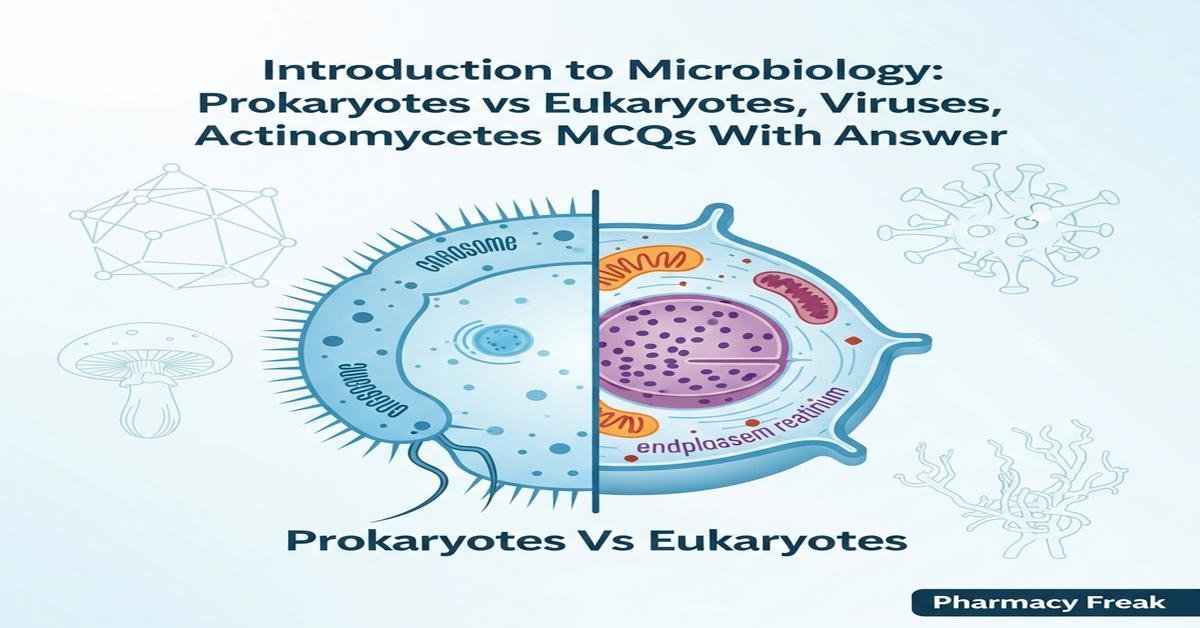
Introduction to microbiology: prokaryotes vs eukaryotes, viruses, fungi, actinomycetes MCQs With Answer
This quiz set is designed for M.Pharm students to consolidate core concepts in microbial and cellular biology. It focuses on distinguishing prokaryotic and eukaryotic cells, viral structure and replication strategies, fungal biology and antifungal targets, and the pharmaceutical importance of actinomycetes. Questions emphasize structural features, biochemical markers, laboratory identification, mechanisms of pathogenicity, and relevance to drug discovery and antimicrobial therapy. Use these MCQs to test understanding of diagnostic approaches, molecular targets for antibiotics/antifungals/antivirals, and the applied role of microbes in producing therapeutics and toxins. Answers are provided to aid revision and exam preparation.
Q1. Which of the following is the defining feature that differentiates prokaryotic cells from eukaryotic cells?
- Presence of membrane-bound nucleus and organelles
- Absence of membrane-bound nucleus and organelles
- Ability to form multicellular tissues
- Presence of linear chromosomes enclosed in nucleus
Correct Answer: Absence of membrane-bound nucleus and organelles
Q2. Which two sugar derivatives form the glycan backbone of bacterial peptidoglycan?
- N-acetylglucosamine (NAG) and N-acetylmuramic acid (NAM)
- Glucose and galactose
- N-acetylneuraminic acid and mannose
- Chitin and glucosamine
Correct Answer: N-acetylglucosamine (NAG) and N-acetylmuramic acid (NAM)
Q3. In Gram staining, which structural feature primarily causes Gram-negative bacteria to appear pink after the procedure?
- Thick multilayered peptidoglycan
- High teichoic acid content
- Thin peptidoglycan layer and an outer membrane containing lipopolysaccharide
- Presence of mycolic acids in the cell wall
Correct Answer: Thin peptidoglycan layer and an outer membrane containing lipopolysaccharide
Q4. Which component of lipopolysaccharide (LPS) is mainly responsible for endotoxic shock in severe Gram-negative infections?
- O-antigen polysaccharide
- Lipid A
- Core oligosaccharide
- Porin proteins
Correct Answer: Lipid A
Q5. What is the composition and sedimentation coefficient of bacterial ribosomes that distinguishes them from eukaryotic ribosomes?
- 80S ribosomes composed of 40S and 60S subunits
- 70S ribosomes composed of 30S and 50S subunits
- 60S ribosomes composed of 20S and 40S subunits
- 90S ribosomes composed of 45S and 45S subunits
Correct Answer: 70S ribosomes composed of 30S and 50S subunits
Q6. Which characteristic best describes actinomycetes relevant to pharmaceutical microbiology?
- Non-filamentous, Gram-negative rods with low GC content
- Filamentous, high G+C Gram-positive bacteria (e.g., Streptomyces) that produce many secondary metabolites
- Obligate intracellular Gram-negative cocci that cannot be cultured on agar
- Fungal-like eukaryotes with chitin cell walls
Correct Answer: Filamentous, high G+C Gram-positive bacteria (e.g., Streptomyces) that produce many secondary metabolites
Q7. Streptomyces species are pharmaceutically important because they are a major natural source of which of the following?
- Polysaccharide vaccines
- Antibiotics such as streptomycin, tetracyclines and erythromycin
- Viral vectors for gene therapy
- Alkaloid toxins produced by plants
Correct Answer: Antibiotics such as streptomycin, tetracyclines and erythromycin
Q8. Which components are characteristic of fungal cells and are targeted by common antifungal drugs?
- Peptidoglycan cell wall and lipoteichoic acids
- Chitin and β-glucans in the cell wall; ergosterol in the cytoplasmic membrane
- Cellulose cell wall and cholesterol in membrane
- LPS in the outer membrane and phosphatidylcholine in membrane
Correct Answer: Chitin and β-glucans in the cell wall; ergosterol in the cytoplasmic membrane
Q9. What defines dimorphic fungal pathogens important in human disease?
- They form bacterial-like endospores under stress
- They grow as yeasts at 37°C in host tissues and as molds (filamentous) at 25°C in the environment
- They are obligate intracellular eukaryotes that replicate only within macrophages
- They lack a defined cell wall and exist as spheroplasts
Correct Answer: They grow as yeasts at 37°C in host tissues and as molds (filamentous) at 25°C in the environment
Q10. Which antifungal drug binds ergosterol directly to form membrane pores, increasing fungal cell permeability?
- Fluconazole, an inhibitor of 14-α-demethylase
- Echinocandins, inhibitors of β-(1,3)-D-glucan synthase
- Amphotericin B, a polyene that binds ergosterol
- Terbinafine, an inhibitor of squalene epoxidase
Correct Answer: Amphotericin B, a polyene that binds ergosterol
Q11. Which family of DNA viruses replicates their genome entirely in the cytoplasm, contrary to most DNA viruses that use the host nucleus?
- Adenoviridae
- Herpesviridae
- Poxviridae
- Papillomaviridae
Correct Answer: Poxviridae
Q12. Enveloped viruses are generally more labile than non-enveloped viruses because:
- They lack nucleic acid genomes
- The envelope contains lipid bilayers derived from host membranes that are disrupted by detergents and desiccation
- They have a rigid protein capsid resistant to environmental stress
- They replicate only in spores
Correct Answer: The envelope contains lipid bilayers derived from host membranes that are disrupted by detergents and desiccation
Q13. Retroviruses (e.g., HIV) are characterized by which of the following replication features?
- Double-stranded DNA genomes that replicate using host DNA polymerase
- Positive-sense single-stranded RNA genomes that are reverse transcribed into DNA and integrated into host genome via reverse transcriptase
- Negative-sense RNA genomes that package host ribosomes upon entry
- Single-stranded DNA genomes that replicate in cytoplasm without integration
Correct Answer: Positive-sense single-stranded RNA genomes that are reverse transcribed into DNA and integrated into host genome via reverse transcriptase
Q14. Which bacteriophage life cycle involves integration of phage DNA into the bacterial chromosome as a prophage?
- Lytic (virulent) cycle
- Lysogenic (temperate) cycle
- Chronic productive cycle without integration
- Transforming bacteriophage cycle that immediately lyses the host
Correct Answer: Lysogenic (temperate) cycle
Q15. The plaque assay is used to quantify which parameter of a viral preparation?
- Total viral protein concentration measured by absorbance
- Number of infectious virus particles expressed as plaque-forming units (PFU)
- Viral genome copy number by mass spectrometry
- Antigenic diversity of viral surface proteins
Correct Answer: Number of infectious virus particles expressed as plaque-forming units (PFU)
Q16. Which sterilization method is considered the most reliable for destroying bacterial endospores in heat-stable materials?
- Dry heat at 160°C for 30 minutes
- Autoclaving (moist heat) at 121°C, 15 psi for 15–20 minutes
- Filtration through 0.45 µm membrane
- UV irradiation for 5 minutes
Correct Answer: Autoclaving (moist heat) at 121°C, 15 psi for 15–20 minutes
Q17. A catalase test differentiates Staphylococcus from Streptococcus because catalase-positive organisms:
- Hydrolyze urea to ammonia and CO2
- Decompose hydrogen peroxide into water and oxygen (bubble formation)
- Reduce nitrate to nitrite
- Ferment lactose with gas production
Correct Answer: Decompose hydrogen peroxide into water and oxygen (bubble formation)
Q18. Acid-fast staining is essential for identifying Mycobacterium species because their cell walls contain abundant:
- Teichoic acids and lipoteichoic acids
- Mycolic acids (long-chain fatty acids) that retain carbol fuchsin after decolorization
- Peptidoglycan cross-bridges rich in D-lactate
- Chitin and mannoproteins
Correct Answer: Mycolic acids (long-chain fatty acids) that retain carbol fuchsin after decolorization
Q19. In the context of drug discovery, why are actinomycetes such as Streptomyces emphasized in M.Pharm curricula?
- They are primary human pathogens causing systemic fungal infections
- They act as eukaryotic model organisms for antiviral screening
- They produce diverse secondary metabolites including many clinically used antibiotics, antifungals and anticancer agents
- They are obligate intracellular bacteria used for vaccine production
Correct Answer: They produce diverse secondary metabolites including many clinically used antibiotics, antifungals and anticancer agents
Q20. Obligate intracellular bacteria such as Chlamydia require which laboratory strategy for propagation because they cannot grow on standard artificial media?
- Enrichment in selective agar with bile salts
- Cultivation in appropriate eukaryotic cell culture or embryonated eggs
- Growth in anaerobic thioglycollate broth only
- Use of MacConkey agar at high salt concentrations
Correct Answer: Cultivation in appropriate eukaryotic cell culture or embryonated eggs

