
Introduction
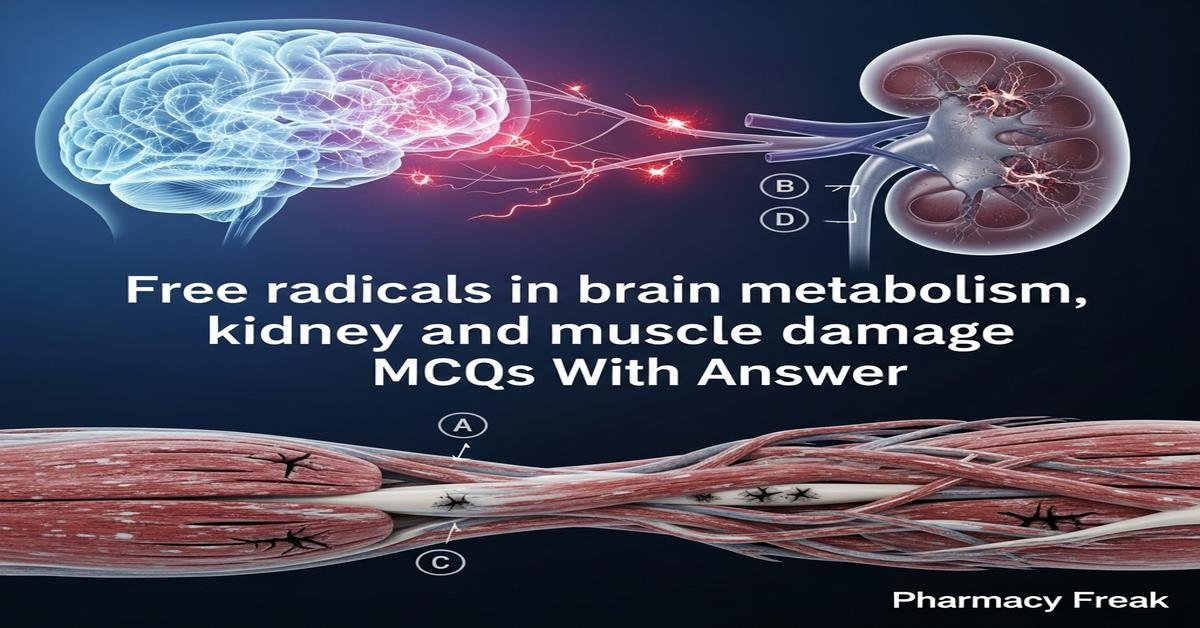
Free radicals play a central role in brain metabolism and are key mediators of oxidative stress that contribute to kidney and muscle damage. Reactive oxygen species (ROS) and reactive nitrogen species (RNS) arise from mitochondria, NADPH oxidase, xanthine oxidase and drug metabolism, causing lipid peroxidation, protein oxidation, DNA damage and mitochondrial dysfunction. Antioxidant defenses—glutathione, superoxide dismutase (SOD), catalase and vitamins C/E—modulate injury. Understanding mechanisms, biomarkers (MDA, 8-OHdG, nitrotyrosine), assays and pharmacological interventions (NAC, allopurinol, mitochondrial antioxidants) is essential for B.Pharm students preparing for therapeutics and toxicology. Now let’s test your knowledge with 30 MCQs on this topic.
Q1. Which organelle is the primary source of reactive oxygen species (ROS) during normal brain metabolism?
- Mitochondria during oxidative phosphorylation
- Endoplasmic reticulum during protein folding
- Lysosomes during autophagy
- Golgi apparatus during trafficking
Correct Answer: Mitochondria during oxidative phosphorylation
Q2. Which reactive species is formed by the rapid reaction of nitric oxide (NO) with superoxide (O2•−)?
- Hydroxyl radical (•OH)
- Peroxynitrite (ONOO−)
- Hydrogen peroxide (H2O2)
- Singlet oxygen (1O2)
Correct Answer: Peroxynitrite (ONOO−)
Q3. Lipid peroxidation in neuronal membranes mainly produces which commonly measured biomarker?
- 8-Hydroxydeoxyguanosine (8-OHdG)
- Malondialdehyde (MDA)
- Nitrotyrosine
- Protein carbonyls
Correct Answer: Malondialdehyde (MDA)
Q4. Which enzyme catalyzes the dismutation of superoxide to hydrogen peroxide?
- Catalase
- Glutathione peroxidase
- Superoxide dismutase (SOD)
- Peroxiredoxin
Correct Answer: Superoxide dismutase (SOD)
Q5. The Fenton reaction produces hydroxyl radicals from hydrogen peroxide in the presence of which metal ion?
- Zinc (Zn2+)
- Magnesium (Mg2+)
- Iron (Fe2+)
- Copper (Cu2+)
Correct Answer: Iron (Fe2+)
Q6. Which antioxidant increases intracellular glutathione (GSH) levels and is used clinically for acetaminophen overdose and as a thiol antioxidant?
- Vitamin E (alpha-tocopherol)
- N-acetylcysteine (NAC)
- Allopurinol
- MitoQ
Correct Answer: N-acetylcysteine (NAC)
Q7. In the kidney, free radical–mediated acute tubular necrosis is most commonly associated with which mechanism?
- Glomerular basement membrane thickening
- Tubular epithelial cell lipid peroxidation and mitochondrial dysfunction
- Increased glomerular filtration rate
- Enhanced proximal tubule protein synthesis
Correct Answer: Tubular epithelial cell lipid peroxidation and mitochondrial dysfunction
Q8. Which assay detects overall lipid peroxidation products as thiobarbituric acid reactive substances (TBARS)?
- Comet assay
- TBARS assay measuring MDA
- Western blot for nitrotyrosine
- ELISA for glutathione
Correct Answer: TBARS assay measuring MDA
Q9. Which isoform of nitric oxide synthase is constitutively expressed in neurons and contributes to neurotransmission but can also produce RNS?
- iNOS (inducible NOS)
- eNOS (endothelial NOS)
- nNOS (neuronal NOS)
- mNOS (mitochondrial NOS)
Correct Answer: nNOS (neuronal NOS)
Q10. Which mechanism best explains statin-associated myopathy involving oxidative stress?
- Increased cholesterol synthesis in muscle
- Mitochondrial complex I inhibition and increased ROS
- Direct lysosomal rupture
- Excessive glycogen storage
Correct Answer: Mitochondrial complex I inhibition and increased ROS
Q11. Xanthine oxidase contributes to ROS generation by producing which reactive molecule during purine metabolism?
- Hydrogen peroxide and superoxide
- Peroxynitrite exclusively
- Nitric oxide
- Singlet oxygen
Correct Answer: Hydrogen peroxide and superoxide
Q12. Which biomarker indicates oxidative DNA damage in brain or kidney tissue?
- Malondialdehyde (MDA)
- 8-Hydroxy-2′-deoxyguanosine (8-OHdG)
- Glutathione peroxidase activity
- Total antioxidant capacity
Correct Answer: 8-Hydroxy-2′-deoxyguanosine (8-OHdG)
Q13. Activation of which transcription factor upregulates antioxidant response elements and helps protect cells from oxidative stress?
- NF-κB
- AP-1
- Nrf2
- p53
Correct Answer: Nrf2
Q14. Which enzyme reduces hydrogen peroxide to water using reduced glutathione as a substrate?
- Catalase
- Glutathione peroxidase (GPx)
- Superoxide dismutase (SOD)
- Glutathione reductase
Correct Answer: Glutathione peroxidase (GPx)
Q15. Peroxynitrite-mediated nitration of tyrosine residues in proteins produces which marker often measured in oxidative injury?
- Nitrotyrosine
- Protein carbonyl
- 8-OHdG
- Glutathionylated proteins
Correct Answer: Nitrotyrosine
Q16. Which pharmacologic agent lowers uric-acid–derived ROS by inhibiting xanthine oxidase?
- Allopurinol
- Apocynin
- NAC
- Deferoxamine
Correct Answer: Allopurinol
Q17. In ischemia–reperfusion injury of muscle, the burst of ROS on reperfusion is primarily due to which source?
- Decreased oxygen delivery only
- Mitochondrial electron transport chain and xanthine oxidase activation
- Increased protein synthesis
- Enhanced antioxidant enzyme activity
Correct Answer: Mitochondrial electron transport chain and xanthine oxidase activation
Q18. Which of the following is a mitochondria-targeted antioxidant designed to accumulate in mitochondria?
- Vitamin C
- MitoQ
- Alpha-lipoic acid only
- Glutathione (GSH)
Correct Answer: MitoQ
Q19. Which clinical condition links oxidative stress, dopaminergic neuron loss and accumulation of α-synuclein?
- Alzheimer’s disease
- Parkinson’s disease
- Myasthenia gravis
- Muscular dystrophy
Correct Answer: Parkinson’s disease
Q20. Which renal pathology is commonly associated with drug-induced oxidative stress from cisplatin therapy?
- Minimal change disease
- Acute tubular necrosis (ATN)
- Membranous nephropathy
- Renal artery stenosis
Correct Answer: Acute tubular necrosis (ATN)
Q21. Which non-enzymatic antioxidant regenerates vitamin E by reducing the vitamin E radical?
- Vitamin A
- Vitamin C (ascorbate)
- Selenium
- Uric acid
Correct Answer: Vitamin C (ascorbate)
Q22. Measurement of the GSH/GSSG ratio is primarily used to assess what cellular parameter?
- Membrane fluidity
- Redox status and oxidative stress
- Protein synthesis rate
- Apoptotic index only
Correct Answer: Redox status and oxidative stress
Q23. NADPH oxidase (NOX) family enzymes generate ROS by transferring electrons from NADPH to which molecule?
- Nitric oxide
- Oxygen to form superoxide
- Hydrogen peroxide directly
- Water producing hydroxide
Correct Answer: Oxygen to form superoxide
Q24. Which laboratory marker is most specific for oxidative protein modification?
- Protein carbonyl content
- Malondialdehyde (MDA)
- 8-OHdG
- Total antioxidant capacity
Correct Answer: Protein carbonyl content
Q25. Which therapeutic approach chelates iron to reduce Fenton chemistry and oxidative injury?
- Apocynin
- Deferoxamine
- Allopurinol
- Statins
Correct Answer: Deferoxamine
Q26. Chronic oxidative stress in the brain promotes which process that contributes to neurodegeneration?
- Increased synaptic plasticity
- Protein misfolding, aggregation and impaired proteostasis
- Enhanced myelination
- Decreased glutamate release
Correct Answer: Protein misfolding, aggregation and impaired proteostasis
Q27. Which enzyme restores reduced glutathione (GSH) from its oxidized form (GSSG) using NADPH?
- Glutathione peroxidase
- Glutathione reductase
- Catalase
- Thioredoxin reductase
Correct Answer: Glutathione reductase
Q28. Which experimental assay directly measures DNA strand breaks due to oxidative damage?
- TBARS assay
- Comet assay (single-cell gel electrophoresis)
- SOD activity assay
- Glutathione peroxidase assay
Correct Answer: Comet assay (single-cell gel electrophoresis)
Q29. Which reactive oxygen species is relatively stable and can diffuse to cause signaling but also oxidative damage?
- Hydroxyl radical (•OH)
- Superoxide (O2•−)
- Hydrogen peroxide (H2O2)
- Singlet oxygen (1O2)
Correct Answer: Hydrogen peroxide (H2O2)
Q30. Which pharmacologic inhibitor targets NADPH oxidase to reduce ROS generation in inflammatory conditions?
- Apocynin
- Deferoxamine
- N-acetylcysteine
- MitoQ
Correct Answer: Apocynin


