
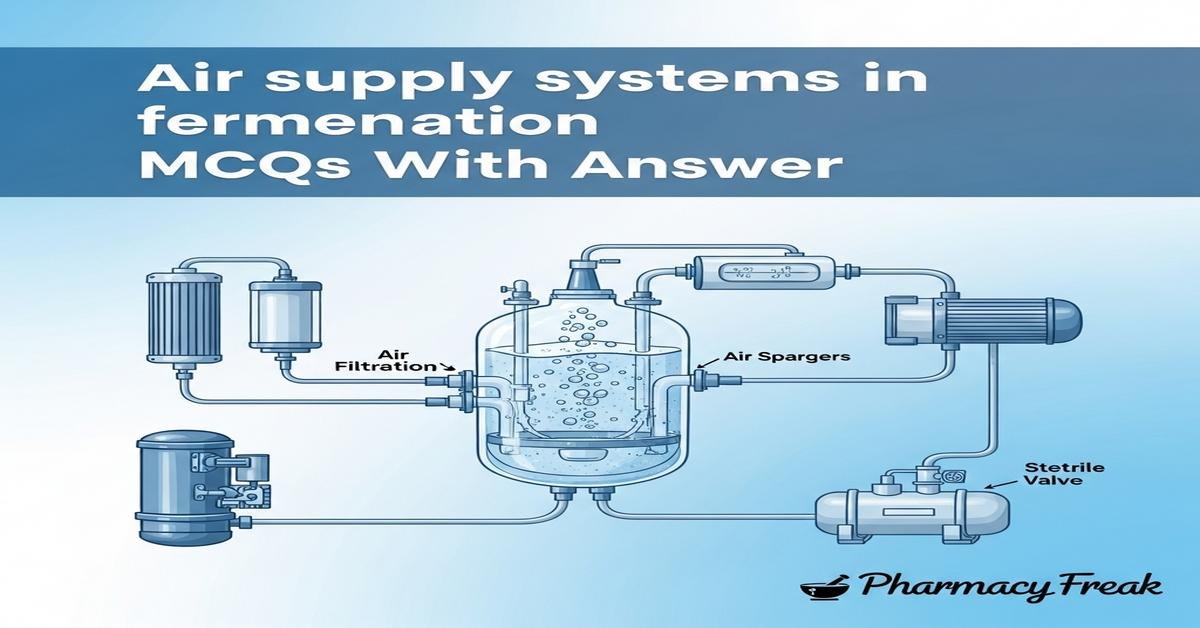
Air supply systems in fermentation MCQs With Answer
This quiz collection is designed for M.Pharm students studying Bioprocess Engineering and Technology. It focuses on air supply systems in aerobic fermentation — covering principles of oxygen transfer, aeration devices, spargers, mass transfer coefficients (kLa), dissolved oxygen control, sterile air handling, oxygen enrichment, and effects of hydrodynamics on cells. Questions range from theoretical definitions and equations to practical design and control considerations used in lab- and pilot-scale bioreactors. Each MCQ includes plausible distractors and the correct answer to help reinforce core concepts, assist exam preparation, and support deeper understanding of how efficient air supply impacts product yield and culture health.
Q1. What is the primary role of air supply in aerobic fermentation?
- Supply oxygen to microorganisms
- Maintain culture pH
- Provide nutrients to cells
- Control bioreactor temperature
Correct Answer: Supply oxygen to microorganisms
Q2. Which term best describes the volumetric mass transfer coefficient used to quantify oxygen transfer from gas to liquid?
- kLa (volumetric mass transfer coefficient)
- Reynolds number
- Henry constant
- Biomass yield coefficient
Correct Answer: kLa (volumetric mass transfer coefficient)
Q3. Which operational parameter most directly increases kLa in a stirred-tank bioreactor?
- Agitation speed / power input
- Medium pH
- Antifoam concentration
- Incubation time
Correct Answer: Agitation speed / power input
Q4. According to Henry’s law, dissolved oxygen concentration in a liquid is proportional to which of the following?
- Partial pressure of oxygen in the gas phase
- Agitation speed
- Cell concentration
- Antifoam agent amount
Correct Answer: Partial pressure of oxygen in the gas phase
Q5. Which type of dissolved oxygen probe is commonly used for on-line DO measurement in fermentation?
- Clark-type polarographic electrode
- Thermistor probe
- Mass spectrometer probe
- pH glass electrode
Correct Answer: Clark-type polarographic electrode
Q6. In a DO cascade control strategy, which manipulated variable is most often adjusted first to maintain the setpoint?
- Agitation speed
- Culture pH
- Incubation temperature
- Feed substrate concentration
Correct Answer: Agitation speed
Q7. Which expression correctly represents the oxygen transfer rate (OTR) in a bioreactor?
- OTR = kLa × (C* – C)
- OTR = μ × X
- OTR = pO2 × Henry’s constant
- OTR = V × Qg (volumetric flow rate)
Correct Answer: OTR = kLa × (C* – C)
Q8. Which method increases dissolved oxygen concentration in a fermenter by changing gas composition?
- Oxygen enrichment (sparging with O2-enriched gas)
- Adding antifoam agents
- Reducing agitation speed
- Increasing sparger orifice size
Correct Answer: Oxygen enrichment (sparging with O2-enriched gas)
Q9. What is the principal function of antifoam agents in aerated fermentations?
- Reduce foam by lowering surface tension
- Increase oxygen solubility
- Sterilize incoming air
- Increase gas holdup
Correct Answer: Reduce foam by lowering surface tension
Q10. Which sparger type typically produces the smallest bubble size and highest interfacial area for oxygen transfer?
- Sintered (microporous) sparger
- Single large-orifice nozzle
- Ring sparger with large holes
- Open-ended pipe sparger
Correct Answer: Sintered (microporous) sparger
Q11. What are the typical units for the volumetric mass transfer coefficient kLa in fermentation literature?
- s⁻¹ (per second)
- L·min⁻¹
- mol·L⁻¹·s⁻¹
- m·s⁻¹
Correct Answer: s⁻¹ (per second)
Q12. Superficial gas velocity (VG) is defined as:
- Volumetric gas flow rate divided by reactor cross-sectional area
- Gas flow rate per unit liquid volume
- Bubble rise velocity in the bulk liquid
- Mass of gas per unit mass of liquid
Correct Answer: Volumetric gas flow rate divided by reactor cross-sectional area
Q13. What is a major downside of increasing agitation speed to improve oxygen transfer in sensitive cell cultures?
- Increased shear stress that can damage cells
- Reduced oxygen solubility according to Henry’s law
- Loss of sterile conditions
- Immediate depletion of medium nutrients
Correct Answer: Increased shear stress that can damage cells
Q14. Why is oxygen enrichment used in large-scale fermentations?
- To increase dissolved oxygen without excessively high gas flow rates
- To sterilize feed streams
- To reduce medium viscosity
- To decrease antifoam requirement
Correct Answer: To increase dissolved oxygen without excessively high gas flow rates
Q15. What is a primary advantage of membrane aeration compared to conventional sparging?
- Minimal bubble formation leading to low shear
- Higher foam generation
- Requires larger gas flow rates for same OTR
- Increased contamination risk
Correct Answer: Minimal bubble formation leading to low shear
Q16. For sterile air supply to a bioreactor, what pore size of membrane filter is routinely used to remove microorganisms?
- 0.22 µm
- 1.0 µm
- 5.0 µm
- 10 µm
Correct Answer: 0.22 µm
Q17. What does the oxygen uptake rate (OUR) represent in a fermentation process?
- Rate of oxygen consumed by the microorganisms
- Rate of oxygen transferred from gas to liquid phase
- Rate of CO2 production only
- Rate of foam formation
Correct Answer: Rate of oxygen consumed by the microorganisms
Q18. Which statement correctly contrasts a bubble column reactor with a stirred-tank reactor?
- Bubble column has no mechanical agitation and relies on gas-induced mixing
- Bubble column always has higher kLa than stirred-tank reactors at same power input
- Stirred-tank reactors cannot be aerated
- Bubble columns require impellers for oxygen transfer
Correct Answer: Bubble column has no mechanical agitation and relies on gas-induced mixing
Q19. Which hydrodynamic factor significantly affects the volumetric mass transfer coefficient (kLa)?
- Gas holdup (εg)
- Buffer capacity of medium
- Antifoam chemical composition only
- Type of incubator shaker used off-line
Correct Answer: Gas holdup (εg)
Q20. When scaling up an oxygen-limited fermentation process, which scale-up criterion is often targeted to preserve oxygen transfer performance?
- Maintain constant kLa between scales
- Maintain constant impeller diameter only
- Maintain constant reactor height
- Maintain constant antifoam concentration
Correct Answer: Maintain constant kLa between scales

