Table of Contents
Introduction
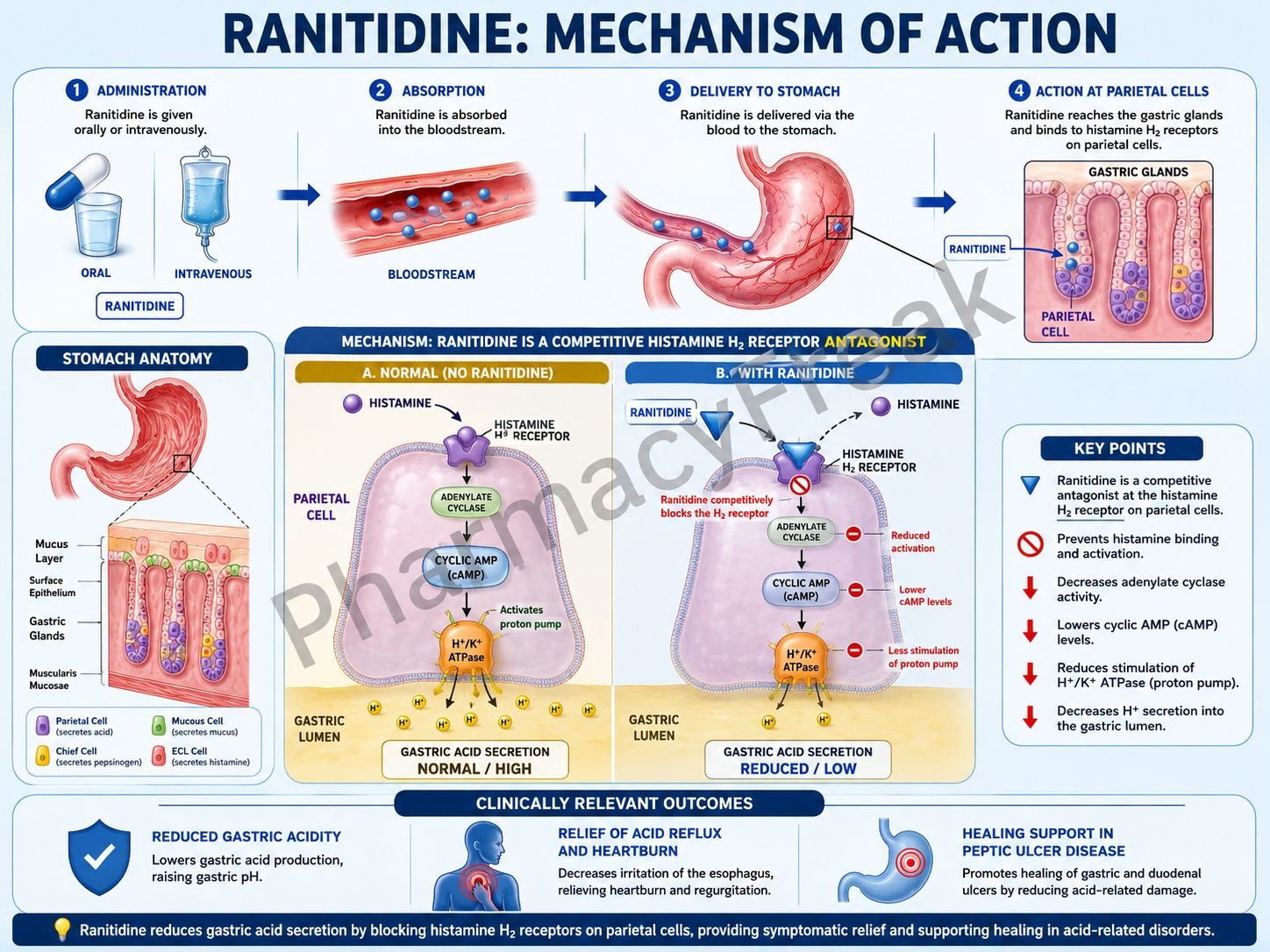
Ranitidine is a histamine H2 receptor antagonist previously used in the treatment of peptic ulcer disease, gastroesophageal reflux disease (GERD), and acid-related disorders. It reduces gastric acid secretion by blocking histamine-mediated stimulation of gastric parietal cells. Although its use has declined in many countries due to concerns regarding NDMA contamination, its pharmacological mechanism remains important in medical education.
Mechanism of Action (Step-wise)
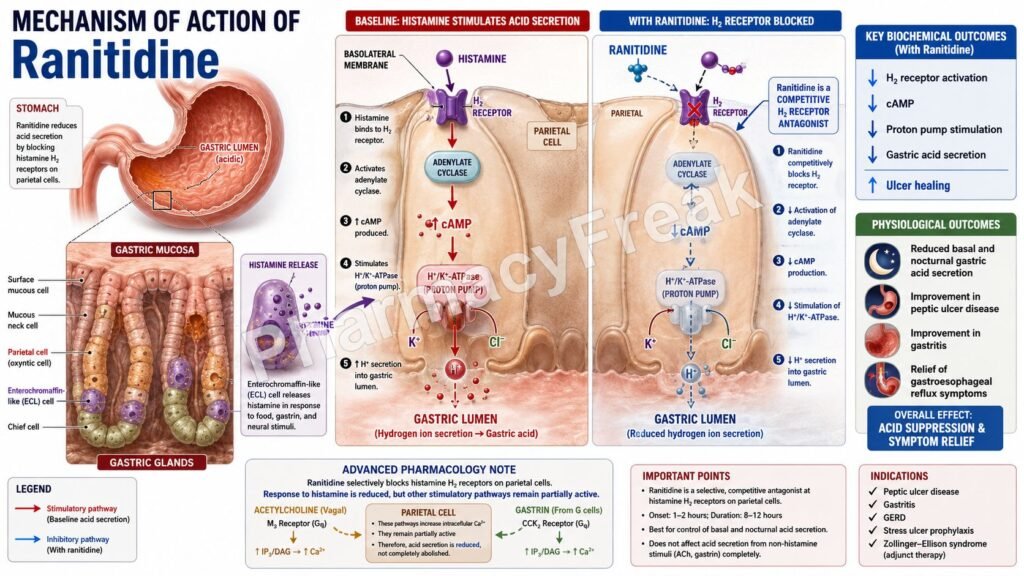
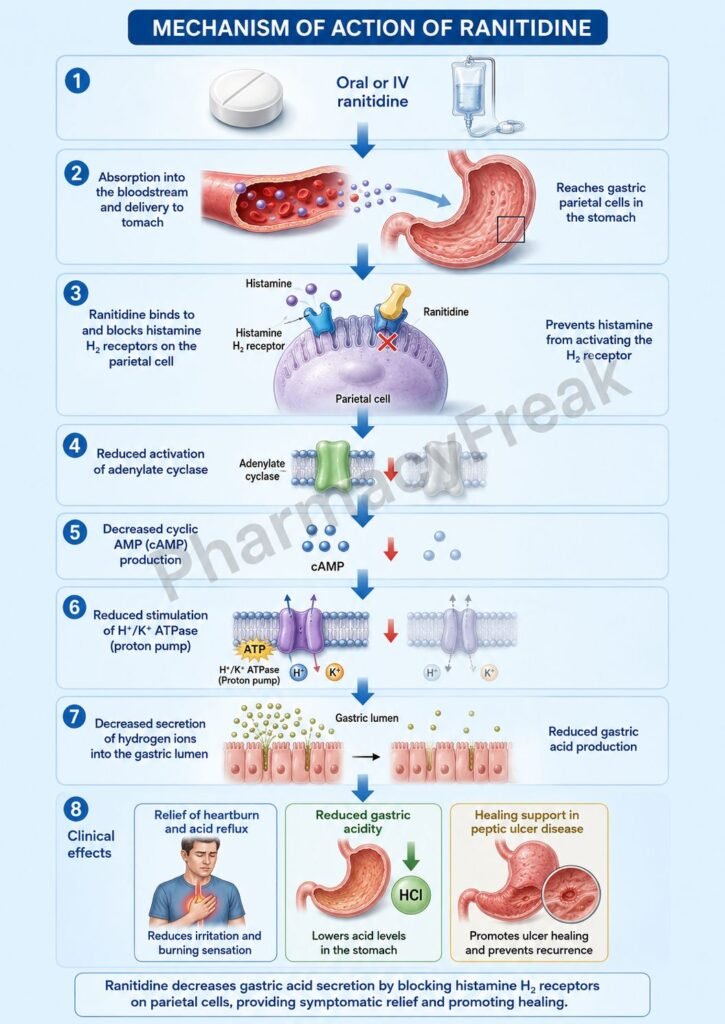
- Ranitidine selectively blocks histamine H2 receptors on gastric parietal cells.
- Histamine normally binds to H2 receptors in the stomach.
- H2 receptors are coupled to Gs proteins.
- Activation of Gs proteins stimulates adenylate cyclase.
- Adenylate cyclase increases intracellular cyclic AMP (cAMP) levels.
- Increased cAMP activates protein kinase pathways that stimulate the H⁺/K⁺-ATPase proton pump.
- The proton pump secretes hydrogen ions into the gastric lumen.
- Ranitidine blocks H2 receptor activation and decreases cAMP production.
- Reduced cAMP decreases proton pump activity.
- Gastric acid secretion decreases, especially basal and nocturnal acid secretion.
- Reduced acidity promotes healing of ulcers and decreases reflux symptoms.
- The overall effect is suppression of gastric acid production.
A key exam point is that ranitidine blocks H2 receptors on gastric parietal cells, reducing gastric acid secretion.
Pharmacokinetics
Ranitidine can be administered orally or intravenously. It is well absorbed and undergoes partial hepatic metabolism. The drug is excreted mainly by the kidneys. Compared with cimetidine, ranitidine has fewer CYP450-related drug interactions.
Clinical Uses
Ranitidine was used in peptic ulcer disease, GERD, Zollinger-Ellison syndrome, stress ulcer prophylaxis, and dyspepsia. It helped reduce gastric acidity and promote mucosal healing.
Adverse Effects
Ranitidine was generally well tolerated. Common adverse effects included headache, constipation, diarrhea, and dizziness. Rare adverse effects included confusion in elderly patients and bradycardia with rapid intravenous administration. Concerns about NDMA contamination led to withdrawal or restriction in several countries.
Comparative Analysis
| Feature | Ranitidine | Omeprazole | Cimetidine |
|---|---|---|---|
| Drug class | H2 receptor blocker | Proton pump inhibitor | H2 receptor blocker |
| Main target | H2 receptor | H⁺/K⁺-ATPase | H2 receptor |
| Acid suppression | Moderate | Strong | Moderate |
| CYP450 inhibition | Minimal | Moderate | Significant |
| Duration | Shorter | Longer | Shorter |
| Hormonal side effects | Rare | Rare | More common |
Ranitidine differs from omeprazole because it blocks histamine-mediated acid secretion rather than directly inhibiting the proton pump. Compared with cimetidine, ranitidine has fewer drug interactions and endocrine adverse effects.
MCQs
- Ranitidine blocks which receptor?
a) H1 receptor
b) H2 receptor
c) Muscarinic receptor
d) Dopamine receptor
Answer: b) H2 receptor
- H2 receptors are mainly located on:
a) Chief cells
b) Parietal cells
c) Goblet cells
d) Pancreatic cells
Answer: b) Parietal cells
- H2 receptors are coupled to:
a) Gi proteins
b) Gs proteins
c) Gq proteins
d) None
Answer: b) Gs proteins
- Activation of H2 receptors normally increases:
a) cAMP
b) Calcium loss
c) Sodium excretion
d) Histamine degradation
Answer: a) cAMP
- Ranitidine decreases activity of which pump?
a) Na⁺/K⁺ ATPase
b) H⁺/K⁺ ATPase
c) Calcium pump
d) Proton-calcium exchanger
Answer: b) H⁺/K⁺ ATPase
- Ranitidine mainly reduces:
a) Gastric acid secretion
b) Insulin secretion
c) Renal filtration
d) Histamine synthesis
Answer: a) Gastric acid secretion
- Ranitidine was commonly used in:
a) Asthma
b) GERD
c) Diabetes mellitus
d) Epilepsy
Answer: b) GERD
- Compared with omeprazole, ranitidine provides:
a) Stronger acid suppression
b) Moderate acid suppression
c) No acid suppression
d) Irreversible proton pump inhibition
Answer: b) Moderate acid suppression
- A common adverse effect is:
a) Headache
b) Hypercalcemia
c) Severe hypertension
d) Bradykinesia
Answer: a) Headache
- Compared with cimetidine, ranitidine has:
a) More CYP450 inhibition
b) Fewer drug interactions
c) More hormonal effects
d) Strong antiandrogen activity
Answer: b) Fewer drug interactions
- Rapid IV administration of ranitidine may cause:
a) Tachycardia
b) Bradycardia
c) Hyperglycemia
d) Bronchospasm
Answer: b) Bradycardia
- Ranitidine reduces gastric acid mainly by blocking effects of:
a) Acetylcholine
b) Histamine
c) Gastrin only
d) Serotonin
Answer: b) Histamine
FAQs
What is the mechanism of action of ranitidine?
Ranitidine blocks H2 receptors on gastric parietal cells, reducing gastric acid secretion.
How does ranitidine decrease stomach acid?
By reducing cAMP-mediated stimulation of the proton pump.
What conditions was ranitidine used to treat?
GERD, peptic ulcers, and acid-related disorders.
How does ranitidine differ from proton pump inhibitors?
It blocks histamine signaling instead of directly inhibiting the proton pump.
Why was ranitidine withdrawn in many countries?
Due to concerns about NDMA contamination.
Does ranitidine have many drug interactions?
No, fewer than cimetidine.
References
Goodman & Gilman’s The Pharmacological Basis of Therapeutics – Drugs for Acid-Peptic Disorders
https://accessmedicine.mhmedical.com/book.aspx?bookid=3191
Katzung: Basic and Clinical Pharmacology – Drugs Used in Acid-Peptic Disease
https://accessmedicine.mhmedical.com/content.aspx?bookid=3382
Tripathi: Essentials of Medical Pharmacology – Antiulcer Drugs
https://www.jaypeedigital.com
Harrison’s Principles of Internal Medicine – Gastroesophageal Reflux Disease and Peptic Ulcer Disease
https://accessmedicine.mhmedical.com