Table of Contents
Introduction
Pseudoephedrine is a sympathomimetic decongestant commonly used to relieve nasal congestion associated with colds, allergies, and sinusitis. It acts primarily by stimulating adrenergic receptors and promoting vasoconstriction in the nasal mucosa. This reduces swelling and improves airflow through the nasal passages.
Mechanism of Action (Step-wise)
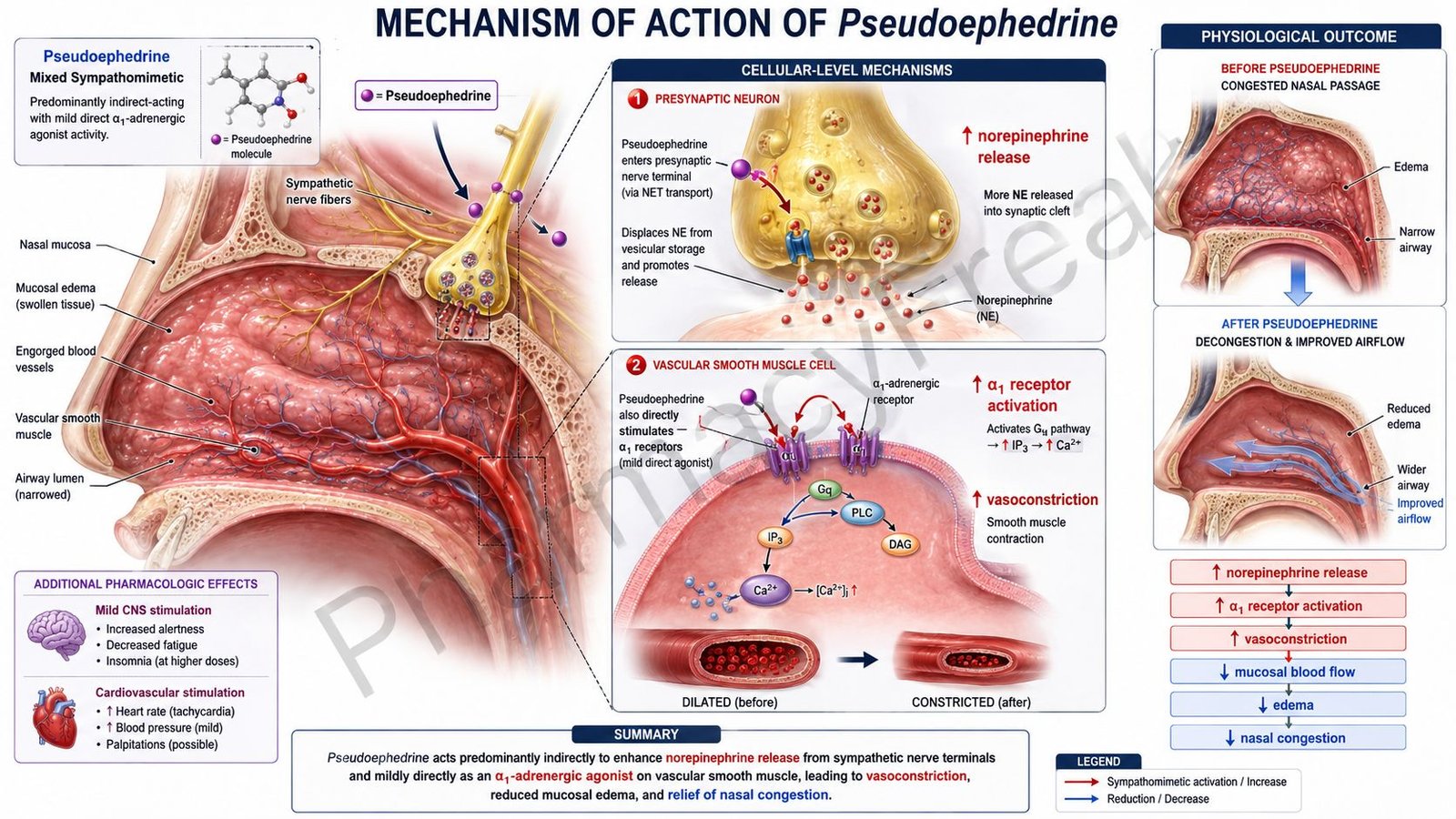
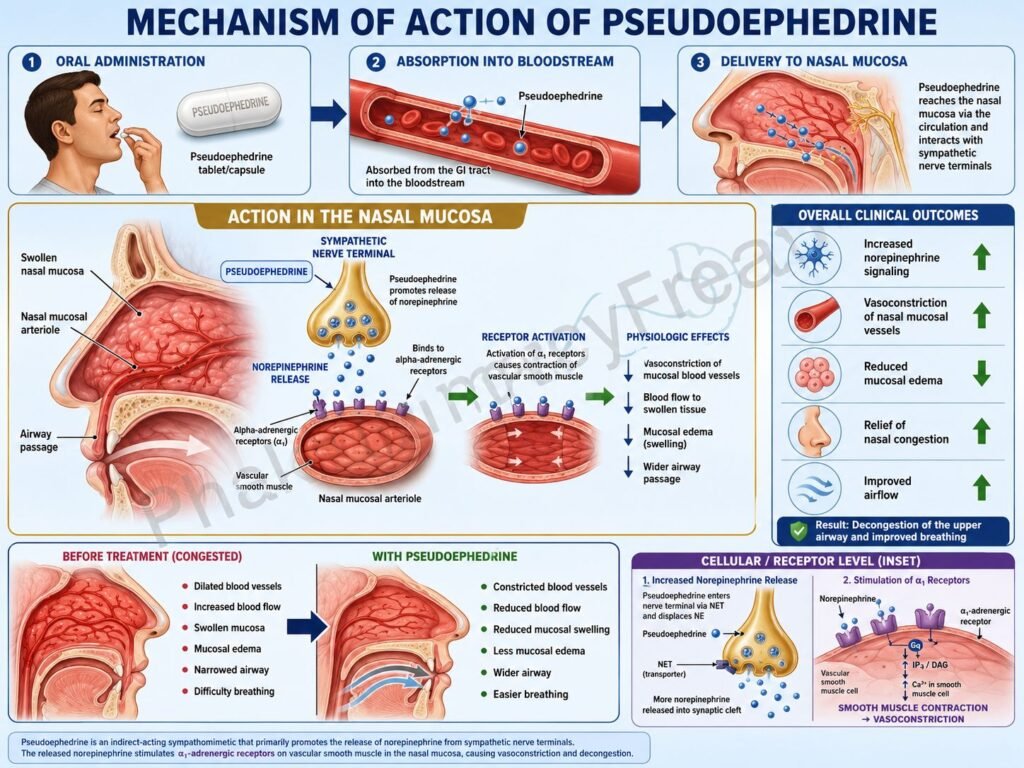
- Pseudoephedrine acts as a sympathomimetic agent.
- It primarily stimulates α-adrenergic receptors in blood vessels.
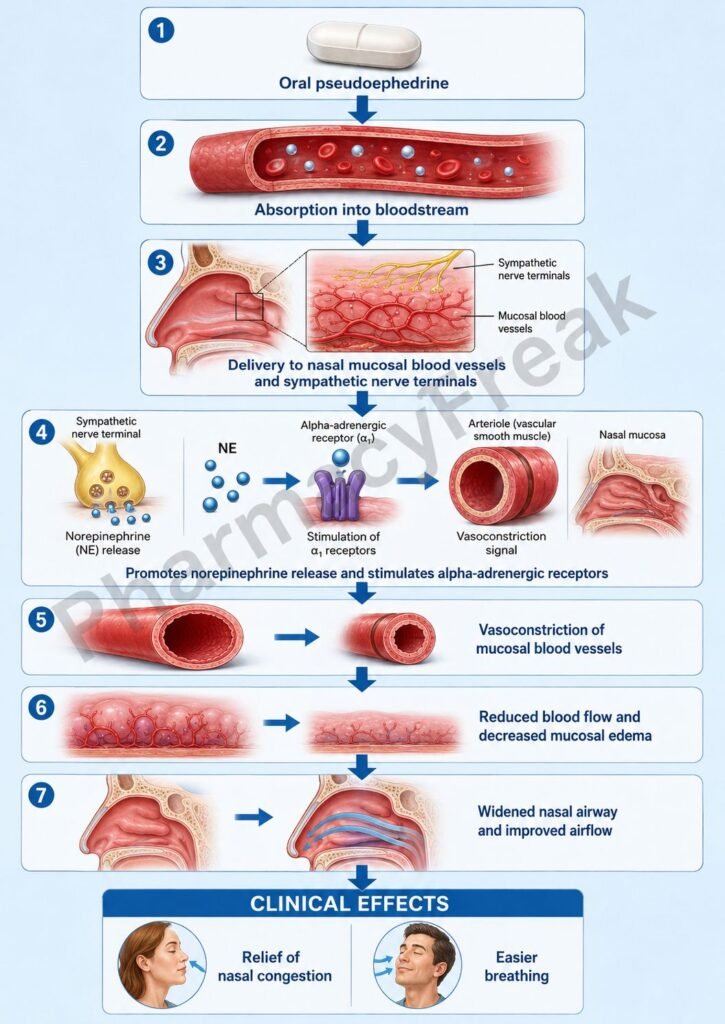
- It also indirectly increases release of norepinephrine from presynaptic nerve terminals.
- Norepinephrine activates α1-adrenergic receptors on vascular smooth muscle.
- α1 receptors are coupled to Gq proteins.
- Activation of Gq proteins stimulates phospholipase C (PLC).
- PLC converts PIP2 into IP3 and DAG.
- IP3 increases intracellular calcium release.
- Increased calcium causes contraction of vascular smooth muscle.
- Vasoconstriction decreases blood flow in nasal mucosal vessels.
- Reduced vascular permeability and edema relieve nasal congestion.
- Mild β-adrenergic stimulation may also increase heart rate and CNS stimulation.
- The overall effect is nasal decongestion and improved airway patency.
A key exam point is that pseudoephedrine relieves nasal congestion by α-adrenergic-mediated vasoconstriction.
Pharmacokinetics
Pseudoephedrine is administered orally and is well absorbed from the gastrointestinal tract. It has good oral bioavailability and a relatively long duration of action. The drug undergoes partial hepatic metabolism and is excreted mainly unchanged in urine. Urinary pH affects elimination.
Clinical Uses
Pseudoephedrine is used as a nasal decongestant in common cold, allergic rhinitis, and sinusitis. It is often included in combination cold and flu preparations.
Adverse Effects
Common adverse effects include insomnia, nervousness, palpitations, tachycardia, and hypertension due to sympathetic stimulation. Excessive use may cause agitation and tremors. It should be used cautiously in patients with cardiovascular disease or hyperthyroidism.
Comparative Analysis
| Feature | Pseudoephedrine | Phenylephrine | Oxymetazoline |
|---|---|---|---|
| Mechanism | Mixed sympathomimetic | α1 agonist | α agonist |
| Route | Oral | Oral/topical | Topical nasal |
| Main effect | Nasal vasoconstriction | Vasoconstriction | Vasoconstriction |
| CNS stimulation | Moderate | Minimal | Minimal |
| Duration | Moderate | Shorter | Long |
| Rebound congestion risk | Lower | Moderate | Higher with prolonged use |
Pseudoephedrine differs from phenylephrine because it has both direct and indirect sympathomimetic effects and greater CNS stimulation. Compared to oxymetazoline, it is administered orally and has lower risk of rebound congestion.
MCQs
- Pseudoephedrine primarily acts as a:
a) Antihistamine
b) Sympathomimetic
c) Corticosteroid
d) Anticholinergic
Answer: b) Sympathomimetic
- Pseudoephedrine mainly stimulates which receptors?
a) Muscarinic receptors
b) α-adrenergic receptors
c) Dopamine receptors
d) Histamine receptors
Answer: b) α-adrenergic receptors
- Pseudoephedrine increases release of:
a) Acetylcholine
b) Norepinephrine
c) Serotonin
d) Histamine
Answer: b) Norepinephrine
- Activation of α1 receptors causes:
a) Vasodilation
b) Vasoconstriction
c) Bronchodilation only
d) Bradycardia
Answer: b) Vasoconstriction
- Pseudoephedrine relieves:
a) Hypoglycemia
b) Nasal congestion
c) Hypercalcemia
d) Bradycardia
Answer: b) Nasal congestion
- α1 receptors are coupled to:
a) Gi proteins
b) Gq proteins
c) Gs proteins
d) None
Answer: b) Gq proteins
- Increased intracellular calcium in vascular smooth muscle causes:
a) Relaxation
b) Contraction
c) Hyperpolarization
d) Sodium loss
Answer: b) Contraction
- A common adverse effect is:
a) Sedation
b) Insomnia
c) Bradycardia
d) Hypotension
Answer: b) Insomnia
- Pseudoephedrine may increase:
a) Heart rate
b) Salivation
c) Potassium excretion
d) Insulin secretion
Answer: a) Heart rate
- Pseudoephedrine is commonly used in:
a) Asthma only
b) Common cold
c) Epilepsy
d) Heart block
Answer: b) Common cold
- Compared with phenylephrine, pseudoephedrine causes more:
a) CNS stimulation
b) Sedation
c) Bronchospasm
d) Mydriasis only
Answer: a) CNS stimulation
- Pseudoephedrine is mainly excreted via the:
a) Lungs
b) Kidneys
c) Skin
d) Liver only
Answer: b) Kidneys
FAQs
What is the mechanism of action of pseudoephedrine?
It stimulates α-adrenergic receptors and promotes norepinephrine release, causing vasoconstriction in nasal mucosa.
How does pseudoephedrine relieve nasal congestion?
By reducing swelling and blood flow in nasal blood vessels.
Why can pseudoephedrine cause insomnia?
Because of mild central nervous system stimulation.
What are common side effects?
Nervousness, insomnia, palpitations, and hypertension.
How does pseudoephedrine differ from phenylephrine?
Pseudoephedrine has both direct and indirect sympathomimetic effects.
Why should pseudoephedrine be used cautiously in hypertension?
Because sympathetic stimulation can increase blood pressure.
References
Goodman & Gilman’s The Pharmacological Basis of Therapeutics – Sympathomimetic Drugs
https://accessmedicine.mhmedical.com/book.aspx?bookid=3191
Katzung: Basic and Clinical Pharmacology – Adrenergic Agonists
https://accessmedicine.mhmedical.com/content.aspx?bookid=3382
Tripathi: Essentials of Medical Pharmacology – Adrenergic Drugs
https://www.jaypeedigital.com
Harrison’s Principles of Internal Medicine – Upper Respiratory Disorders
https://accessmedicine.mhmedical.com