Table of Contents
Introduction
Prednisone is a synthetic glucocorticoid widely used for its anti-inflammatory and immunosuppressive properties. It is commonly prescribed in autoimmune diseases, allergic conditions, inflammatory disorders, and certain malignancies. Prednisone is converted in the liver to its active form, prednisolone, which acts on intracellular glucocorticoid receptors to regulate gene transcription and suppress inflammatory responses.
Mechanism of Action (Step-wise)
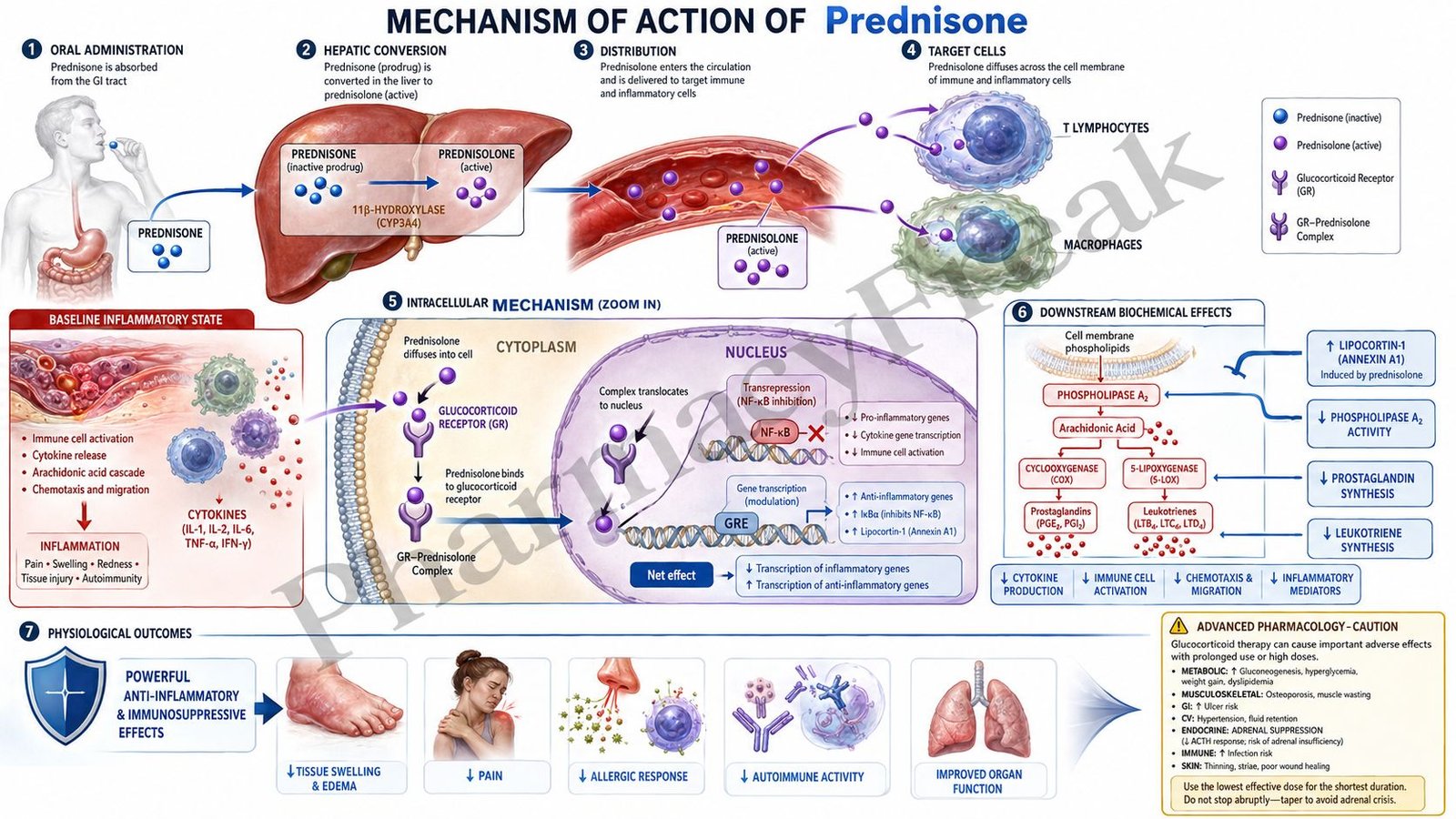
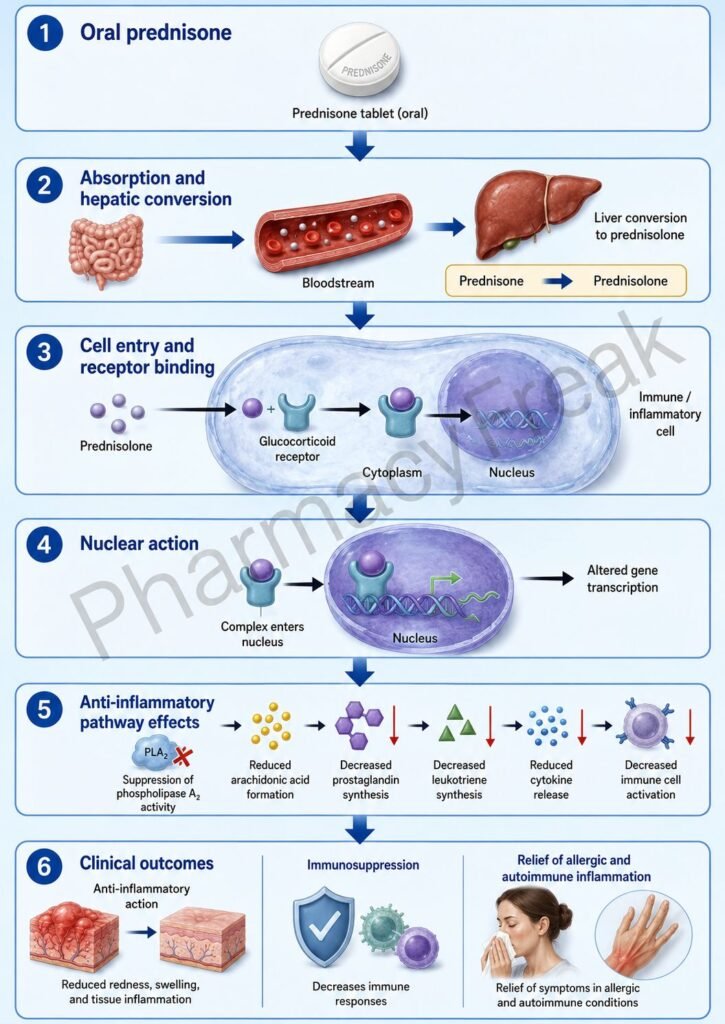
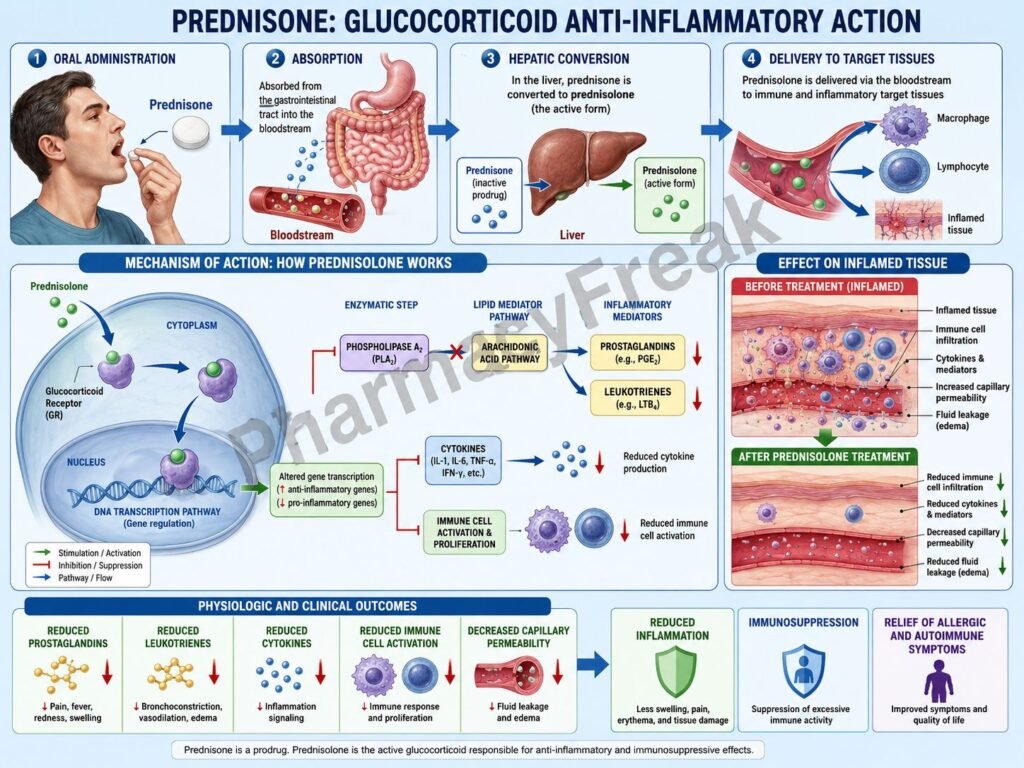
- Prednisone is converted in the liver to prednisolone, its active metabolite.
- Prednisolone diffuses across cell membranes due to its lipophilic nature.
- It binds to intracellular glucocorticoid receptors in the cytoplasm.
- The glucocorticoid receptor complex dissociates from heat shock proteins.
- The activated complex translocates into the nucleus.
- It binds to glucocorticoid response elements (GREs) on DNA.
- This alters transcription of multiple genes involved in inflammation and immunity.
- Prednisone increases synthesis of anti-inflammatory proteins such as lipocortin.
- Lipocortin inhibits phospholipase A2.
- Inhibition of phospholipase A2 reduces arachidonic acid release.
- This decreases synthesis of prostaglandins and leukotrienes.
- Prednisone also suppresses production of inflammatory cytokines such as IL-1, IL-2, and TNF-α.
- It reduces migration and activation of leukocytes.
- The overall effect is potent anti-inflammatory and immunosuppressive action.
A key exam point is that prednisone suppresses inflammatory gene expression through glucocorticoid receptor-mediated transcriptional regulation.
Prednisone pharmacology
Pharmacokinetics
Prednisone is administered orally and is converted to prednisolone in the liver. It is highly protein bound and widely distributed throughout the body. Prednisolone is metabolized hepatically and excreted mainly via the kidneys. Biological effects may persist longer than plasma half-life because of changes in gene transcription.
Clinical Uses
Prednisone is used in asthma, rheumatoid arthritis, systemic lupus erythematosus, inflammatory bowel disease, allergic reactions, autoimmune disorders, and organ transplantation. It is also used in certain hematologic malignancies and adrenal insufficiency.
Adverse Effects
Long-term use may cause Cushingoid features, hyperglycemia, osteoporosis, muscle wasting, hypertension, immunosuppression, cataracts, and adrenal suppression. Mood changes and peptic ulcers may also occur. Abrupt discontinuation after prolonged use can precipitate adrenal crisis.
Comparative Analysis
| Feature | Prednisone | Dexamethasone | Hydrocortisone |
|---|---|---|---|
| Glucocorticoid activity | Moderate | Very high | Moderate |
| Mineralocorticoid activity | Mild | Minimal | Significant |
| Duration | Intermediate | Long | Short |
| Main use | Inflammatory disorders | Cerebral edema, severe inflammation | Adrenal insufficiency |
| Anti-inflammatory potency | Moderate–high | Very high | Lower |
| Adrenal suppression risk | Moderate | High | Moderate |
Prednisone differs from dexamethasone by having shorter duration and mild mineralocorticoid activity. Compared to hydrocortisone, it has stronger anti-inflammatory potency and less mineralocorticoid effect.
MCQs
- Prednisone is converted into which active metabolite?
a) Cortisol
b) Prednisolone
c) Dexamethasone
d) Aldosterone
Answer: b) Prednisolone
- Prednisone acts through which receptor?
a) Membrane receptor
b) Intracellular glucocorticoid receptor
c) Dopamine receptor
d) Histamine receptor
Answer: b) Intracellular glucocorticoid receptor
- Prednisone suppresses inflammation mainly by:
a) Blocking sodium channels
b) Altering gene transcription
c) Inhibiting calcium influx
d) Stimulating histamine release
Answer: b) Altering gene transcription
- Lipocortin inhibits:
a) Cyclooxygenase
b) Phospholipase A2
c) ATP synthase
d) DNA polymerase
Answer: b) Phospholipase A2
- Inhibition of phospholipase A2 decreases synthesis of:
a) Dopamine
b) Prostaglandins and leukotrienes
c) Histamine
d) Acetylcholine
Answer: b) Prostaglandins and leukotrienes
- Prednisone is mainly used for:
a) Inflammatory disorders
b) Hyperthyroidism
c) Parkinson disease
d) Epilepsy
Answer: a) Inflammatory disorders
- Prednisone suppresses cytokines such as:
a) IL-1 and TNF-α
b) Insulin
c) Thyroxine
d) Renin
Answer: a) IL-1 and TNF-α
- A major long-term adverse effect is:
a) Hyperkalemia
b) Osteoporosis
c) Hypoglycemia
d) Bradycardia
Answer: b) Osteoporosis
- Abrupt withdrawal after prolonged use may cause:
a) Hypercalcemia
b) Adrenal crisis
c) Hypertension only
d) Hyperactivity
Answer: b) Adrenal crisis
- Prednisone is classified as a:
a) NSAID
b) Glucocorticoid
c) Antihistamine
d) Antiplatelet drug
Answer: b) Glucocorticoid
- Prednisone reduces leukocyte:
a) Production only
b) Migration and activation
c) DNA synthesis
d) Sodium transport only
Answer: b) Migration and activation
- Compared to hydrocortisone, prednisone has:
a) Lower anti-inflammatory potency
b) Higher anti-inflammatory potency
c) No glucocorticoid effect
d) Greater mineralocorticoid activity only
Answer: b) Higher anti-inflammatory potency
FAQs
What is the mechanism of action of prednisone?
Prednisone binds glucocorticoid receptors and alters gene transcription to suppress inflammation and immunity.
Why is prednisone considered a prodrug?
Because it is converted in the liver to prednisolone.
How does prednisone reduce inflammation?
By inhibiting cytokine production and reducing prostaglandin and leukotriene synthesis.
What is a major adverse effect of long-term use?
Osteoporosis and adrenal suppression.
Why should prednisone not be stopped abruptly?
Because prolonged use suppresses the hypothalamic-pituitary-adrenal axis.
What conditions is prednisone commonly used for?
Autoimmune diseases, allergies, asthma, and inflammatory disorders.
References
Goodman & Gilman’s The Pharmacological Basis of Therapeutics – Adrenocorticosteroids
https://accessmedicine.mhmedical.com/book.aspx?bookid=3191
Katzung: Basic and Clinical Pharmacology – Adrenocorticosteroids
https://accessmedicine.mhmedical.com/content.aspx?bookid=3382
Tripathi: Essentials of Medical Pharmacology – Corticosteroids
https://www.jaypeedigital.com
Harrison’s Principles of Internal Medicine – Glucocorticoid Therapy
https://accessmedicine.mhmedical.com