Table of Contents
Introduction
Pepcid is the brand name for famotidine, a histamine H2 receptor antagonist used to reduce gastric acid secretion. It is commonly used in conditions such as gastroesophageal reflux disease (GERD), peptic ulcer disease, and dyspepsia. Famotidine works by blocking histamine-mediated stimulation of acid secretion in gastric parietal cells.
Mechanism of Action (Step-wise)
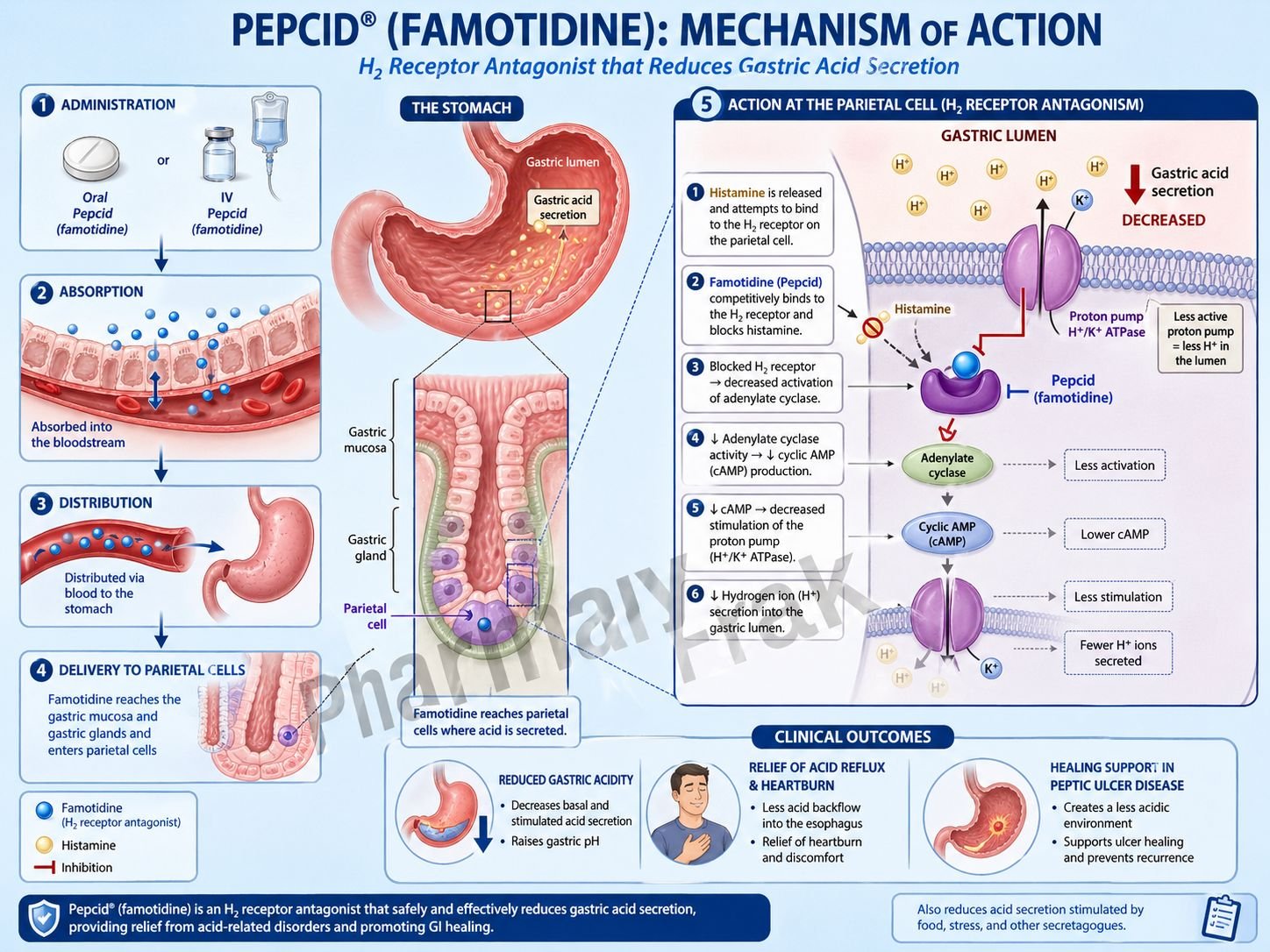
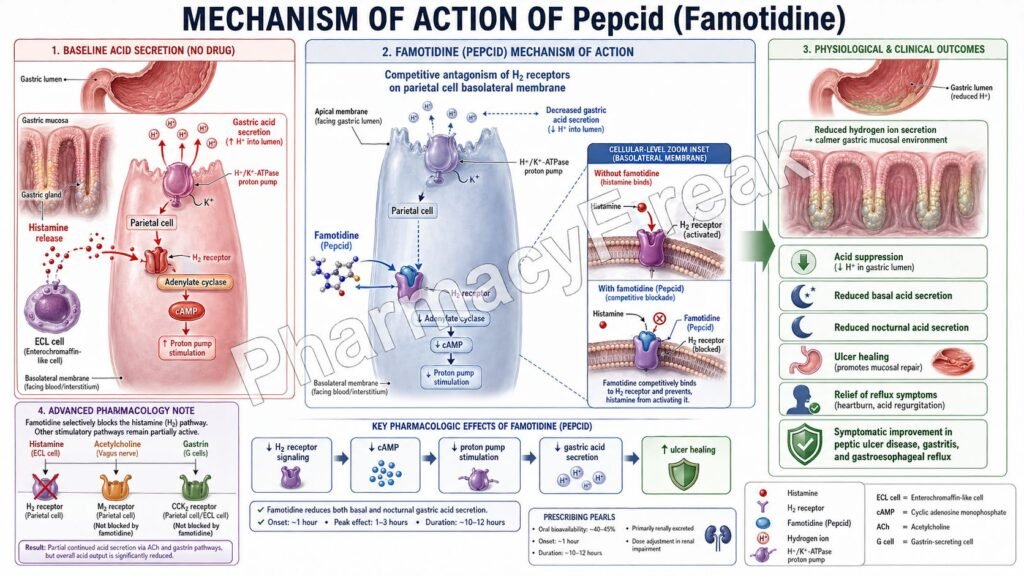
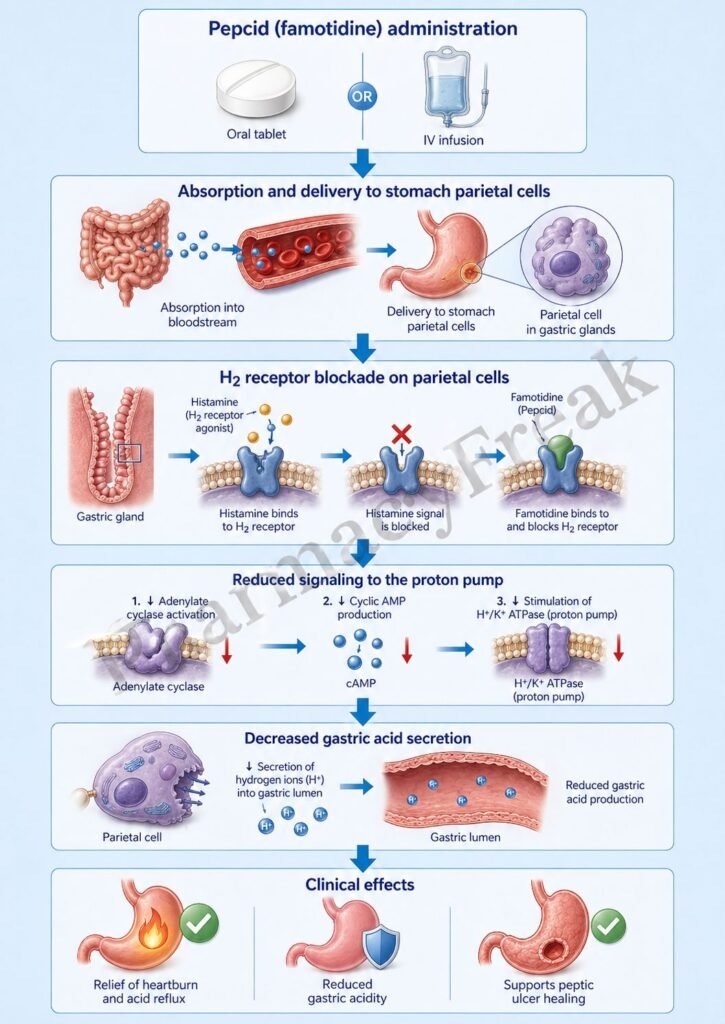
- Famotidine selectively blocks H2 receptors on gastric parietal cells.
- Histamine normally binds to H2 receptors to stimulate acid secretion.
- H2 receptors are coupled to Gs proteins.
- Activation of Gs increases adenylate cyclase activity.
- This raises intracellular cyclic AMP (cAMP) levels.
- Increased cAMP activates protein kinase A (PKA).
- PKA stimulates the H⁺/K⁺-ATPase (proton pump).
- This results in increased secretion of hydrogen ions into the gastric lumen.
- Famotidine blocks H2 receptors, preventing this cascade.
- As a result, cAMP levels decrease.
- Reduced cAMP leads to decreased proton pump activity.
- The overall effect is reduced gastric acid secretion (both basal and stimulated).
A key exam point is that famotidine is an H2 receptor antagonist that reduces gastric acid secretion by decreasing cAMP.
Pharmacokinetics
Famotidine is administered orally or intravenously. It is well absorbed and has moderate bioavailability. It undergoes minimal hepatic metabolism and is primarily excreted unchanged by the kidneys. It has a relatively longer duration of action compared to other H2 blockers, allowing once or twice daily dosing.
Clinical Uses
Famotidine is used in GERD, peptic ulcer disease, and Zollinger–Ellison syndrome. It is also used for prevention of stress ulcers and treatment of dyspepsia. It provides symptomatic relief by reducing acid secretion and promoting mucosal healing.
Adverse Effects
Famotidine is generally well tolerated. Common adverse effects include headache, dizziness, constipation, or diarrhea. Compared to cimetidine, it has fewer drug interactions and minimal endocrine effects. Rarely, confusion may occur in elderly patients.
Comparative Analysis
| Feature | Famotidine (Pepcid) | Cimetidine | Pantoprazole |
|---|---|---|---|
| Class | H2 receptor blocker | H2 receptor blocker | Proton pump inhibitor |
| Mechanism | H2 blockade | H2 blockade | Proton pump inhibition |
| Acid suppression | Moderate | Moderate | Strong |
| Duration | Long | Shorter | Long |
| Drug interactions | Minimal | Significant | Moderate |
| Use | GERD, ulcers | GERD, ulcers | GERD, ulcers |
Famotidine differs from cimetidine by having fewer drug interactions and no antiandrogenic effects. Compared to pantoprazole, it provides less potent acid suppression because it acts upstream of the proton pump.
MCQs
- Pepcid contains which drug?
a) Omeprazole
b) Famotidine
c) Ranitidine
d) Pantoprazole
Answer: b) Famotidine
- Famotidine blocks which receptor?
a) H1 receptor
b) H2 receptor
c) α1 receptor
d) β1 receptor
Answer: b) H2 receptor
- H2 receptors are coupled to:
a) Gi proteins
b) Gq proteins
c) Gs proteins
d) None
Answer: c) Gs proteins
- H2 receptor activation increases:
a) cGMP
b) cAMP
c) ATP
d) ADP
Answer: b) cAMP
- Famotidine reduces:
a) Gastric acid
b) Insulin
c) Calcium
d) Sodium
Answer: a) Gastric acid
- Pepcid is used in:
a) Asthma
b) GERD
c) Diabetes
d) Anemia
Answer: b) GERD
- A common adverse effect is:
a) Bradycardia
b) Headache
c) Hypoglycemia
d) Hypercalcemia
Answer: b) Headache
- Famotidine is excreted via:
a) Liver
b) Kidney
c) Lung
d) Skin
Answer: b) Kidney
- Compared to cimetidine, famotidine has:
a) More drug interactions
b) Fewer drug interactions
c) Same effect
d) No effect
Answer: b) Fewer drug interactions
- Famotidine acts on:
a) Proton pump directly
b) Upstream of proton pump
c) DNA synthesis
d) Calcium channels
Answer: b) Upstream of proton pump
- Acid suppression by famotidine is:
a) Stronger than PPIs
b) Moderate
c) None
d) Variable
Answer: b) Moderate
- Famotidine is administered:
a) Oral and IV
b) Only oral
c) Only IV
d) Intramuscular
Answer: a) Oral and IV
FAQs
What is the mechanism of action of Pepcid?
It blocks H2 receptors on parietal cells, reducing cAMP and gastric acid secretion.
Is Pepcid a proton pump inhibitor?
No, it is an H2 receptor blocker.
Why does famotidine have fewer interactions than cimetidine?
Because it does not significantly inhibit CYP enzymes.
What is its main use?
GERD and peptic ulcer disease.
Does Pepcid completely stop acid secretion?
No, it reduces it moderately.
How does it differ from PPIs?
It acts upstream of the proton pump and is less potent.
References
Goodman & Gilman’s The Pharmacological Basis of Therapeutics – Acid-Suppressing Drugs
https://accessmedicine.mhmedical.com/book.aspx?bookid=3191
Katzung: Basic and Clinical Pharmacology – Drugs for Acid-Peptic Disease
https://accessmedicine.mhmedical.com/content.aspx?bookid=3382
Tripathi: Essentials of Medical Pharmacology – Gastrointestinal Drugs
https://www.jaypeedigital.com
Harrison’s Principles of Internal Medicine – Gastroesophageal Reflux Disease
https://accessmedicine.mhmedical.com