Table of Contents
Introduction
Oxymetazoline is a topical decongestant and vasoconstrictor commonly used in nasal sprays and ophthalmic preparations. It is an imidazoline derivative that acts on adrenergic receptors to reduce mucosal congestion. It provides rapid relief in conditions such as allergic rhinitis, sinusitis, and nasal congestion.
Mechanism of Action (Step-wise)
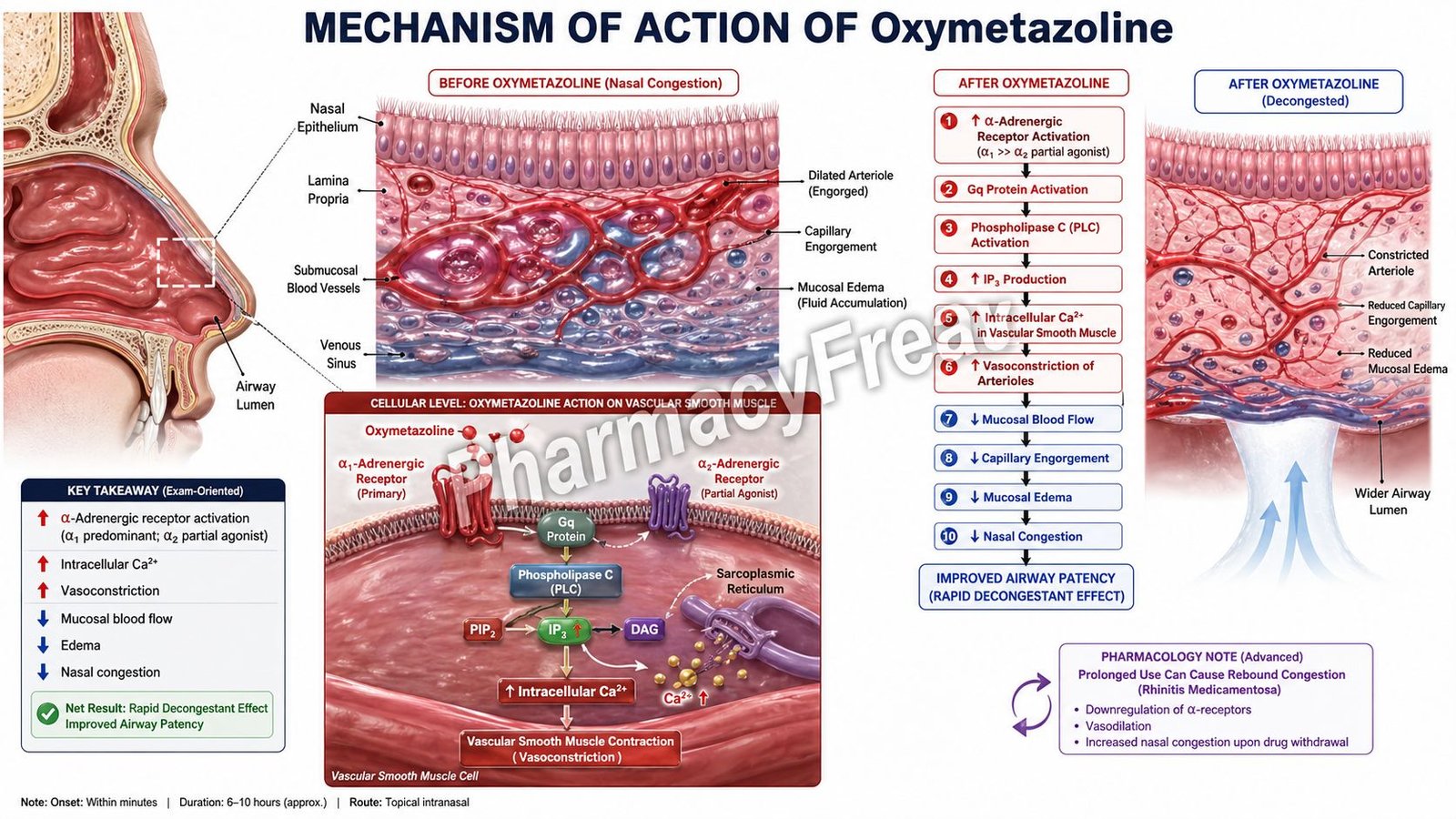
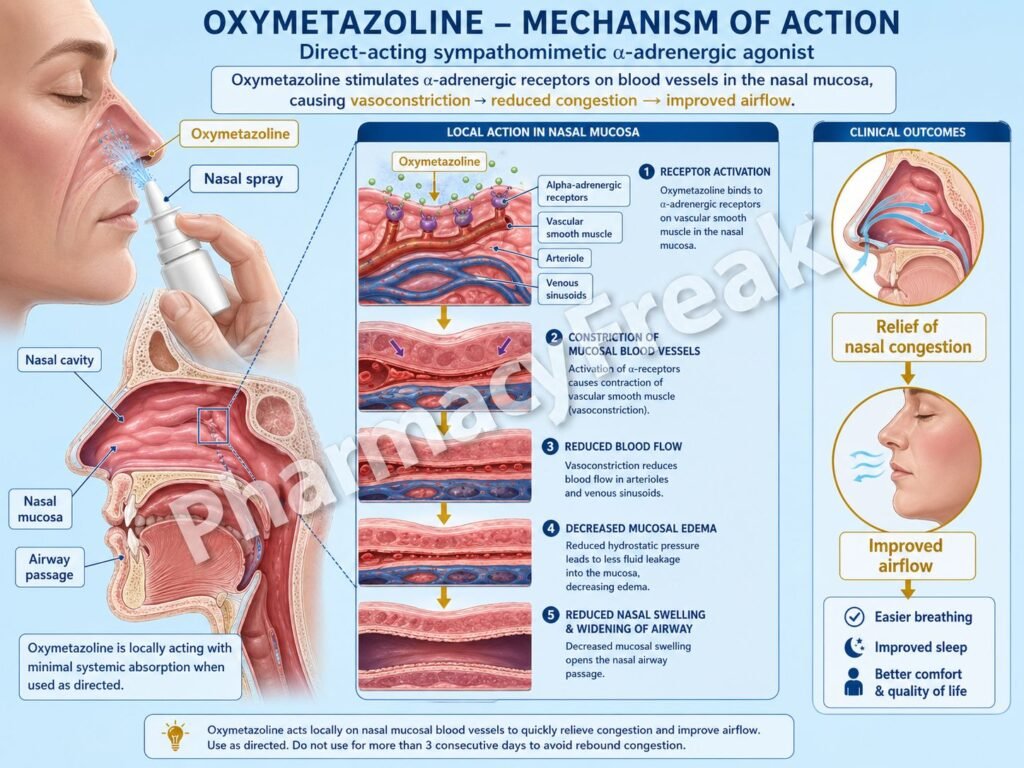
- Oxymetazoline binds to α1-adrenergic receptors on vascular smooth muscle.
- It also has partial agonist activity at α2-adrenergic receptors.
- Activation of α1 receptors stimulates Gq protein signaling.
- This activates phospholipase C (PLC).
- PLC converts PIP2 into IP3 and DAG.
- IP3 increases intracellular calcium release from the sarcoplasmic reticulum.
- Increased calcium leads to contraction of vascular smooth muscle.
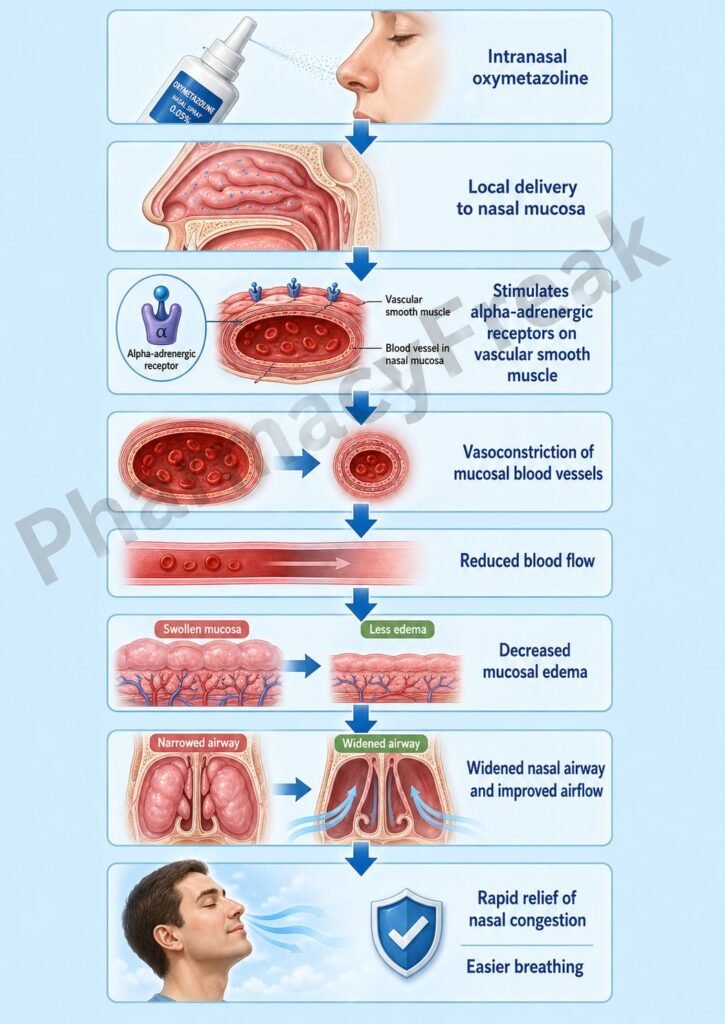
- This causes vasoconstriction of nasal mucosal blood vessels.
- Vasoconstriction reduces blood flow and edema in nasal tissues.
- α2 receptor activation may reduce sympathetic outflow locally.
- The overall effect is decreased nasal congestion and improved airway patency.
A key exam point is that oxymetazoline is an α-adrenergic agonist causing local vasoconstriction in nasal mucosa.
Pharmacokinetics
Oxymetazoline is administered topically as a nasal spray or ophthalmic solution. It has minimal systemic absorption when used appropriately. It provides rapid onset of action and prolonged duration compared to other topical decongestants. Excessive use may increase systemic absorption.
Clinical Uses
Oxymetazoline is used for temporary relief of nasal congestion due to colds, allergies, or sinusitis. It is also used in ophthalmic preparations to reduce redness. Due to its vasoconstrictive action, it helps shrink swollen mucosa and improve airflow.
Adverse Effects
Common adverse effects include local irritation, dryness, and burning sensation. Prolonged use can lead to rebound congestion (rhinitis medicamentosa). Systemic effects such as hypertension and tachycardia may occur with excessive use. It should be used for short durations only.
Comparative Analysis
| Feature | Oxymetazoline | Phenylephrine | Pseudoephedrine |
|---|---|---|---|
| Mechanism | α1 + α2 agonist | α1 agonist | Mixed (α + indirect NE release) |
| Route | Topical | Topical/oral | Oral |
| Duration | Long | Short | Moderate |
| Systemic effects | Minimal (topical use) | Minimal | More systemic |
| Rebound congestion | Yes (with prolonged use) | Yes | Less common |
| Use | Nasal decongestant | Decongestant | Decongestant |
Oxymetazoline differs from phenylephrine by having a longer duration of action due to additional α2 activity. Compared to pseudoephedrine, it acts locally with fewer systemic effects when used appropriately.
MCQs
- Oxymetazoline primarily acts on which receptor?
a) β2 receptor
b) α1 receptor
c) Dopamine receptor
d) Histamine receptor
Answer: b) α1 receptor
- Oxymetazoline also acts on:
a) β receptors
b) α2 receptors
c) Dopamine receptors
d) Serotonin receptors
Answer: b) α2 receptors
- α1 receptor activation leads to:
a) cAMP increase
b) IP3 and DAG formation
c) Sodium influx
d) Potassium efflux
Answer: b) IP3 and DAG formation
- IP3 increases:
a) Sodium
b) Calcium
c) Potassium
d) Chloride
Answer: b) Calcium
- Oxymetazoline causes:
a) Vasodilation
b) Vasoconstriction
c) No effect
d) Capillary leakage
Answer: b) Vasoconstriction
- It is used for:
a) Asthma
b) Nasal congestion
c) Diabetes
d) Anemia
Answer: b) Nasal congestion
- A major adverse effect is:
a) Hypoglycemia
b) Rebound congestion
c) Hypercalcemia
d) Bradycardia
Answer: b) Rebound congestion
- Oxymetazoline is administered:
a) Orally
b) Intravenously
c) Topically
d) Intramuscularly
Answer: c) Topically
- Prolonged use leads to:
a) Increased efficacy
b) Rhinitis medicamentosa
c) Hypotension
d) Hypoglycemia
Answer: b) Rhinitis medicamentosa
- Oxymetazoline reduces congestion by:
a) Increasing mucus
b) Decreasing blood flow
c) Increasing sodium
d) Blocking histamine
Answer: b) Decreasing blood flow
- Compared to phenylephrine, oxymetazoline has:
a) Shorter duration
b) Longer duration
c) Same effect
d) No effect
Answer: b) Longer duration
- Systemic effects occur mainly due to:
a) Normal use
b) Excessive use
c) Low dose
d) Topical application only
Answer: b) Excessive use
FAQs
What is the mechanism of action of oxymetazoline?
It activates α1 and α2 adrenergic receptors causing vasoconstriction in nasal mucosa.
Why does oxymetazoline relieve nasal congestion?
By reducing blood flow and edema in nasal tissues.
What is rebound congestion?
Worsening nasal congestion after prolonged use.
How long should oxymetazoline be used?
Typically not more than 3–5 days.
Does oxymetazoline have systemic effects?
Minimal with proper use, but possible with excessive use.
Why is oxymetazoline long-acting?
Due to combined α1 and α2 receptor activity.
References
Goodman & Gilman’s The Pharmacological Basis of Therapeutics – Adrenergic Drugs
https://accessmedicine.mhmedical.com/book.aspx?bookid=3191
Katzung: Basic and Clinical Pharmacology – Sympathomimetics
https://accessmedicine.mhmedical.com/content.aspx?bookid=3382
Tripathi: Essentials of Medical Pharmacology – Adrenergic Drugs
https://www.jaypeedigital.com
Harrison’s Principles of Internal Medicine – Allergic Rhinitis
https://accessmedicine.mhmedical.com