Table of Contents
Introduction
Mirtazapine is an atypical antidepressant classified as a noradrenergic and specific serotonergic antidepressant (NaSSA). It is commonly used in major depressive disorder, particularly in patients with insomnia, weight loss, or anxiety. Unlike SSRIs and TCAs, mirtazapine enhances neurotransmitter release by blocking inhibitory receptors rather than inhibiting reuptake.
Mechanism of Action (Step-wise)
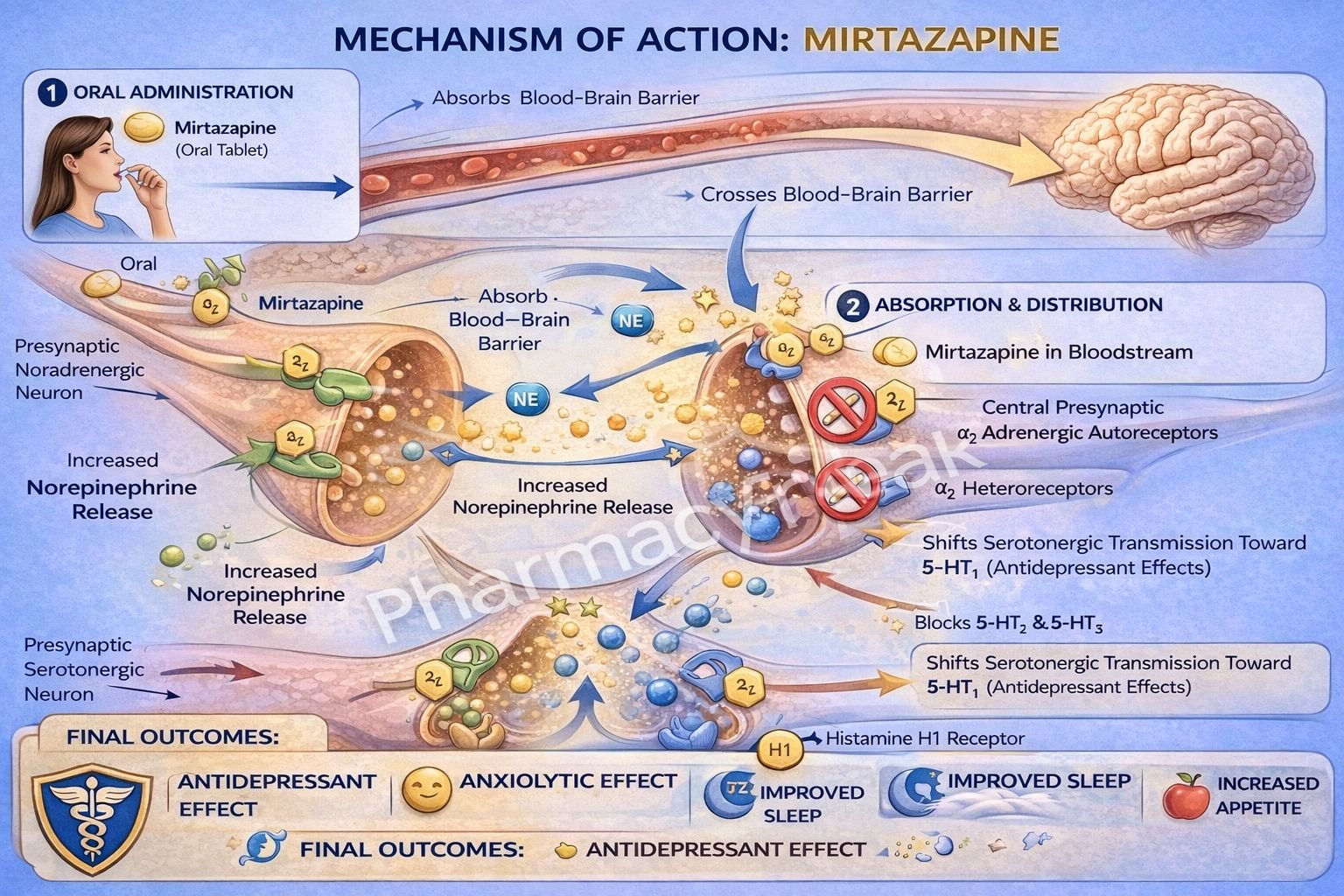
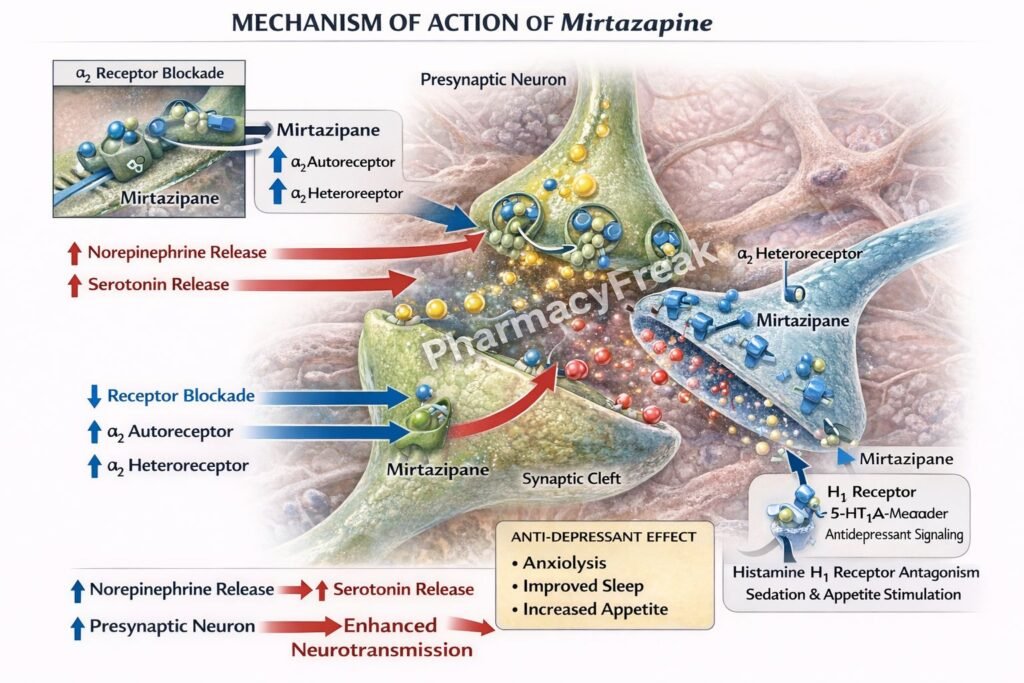
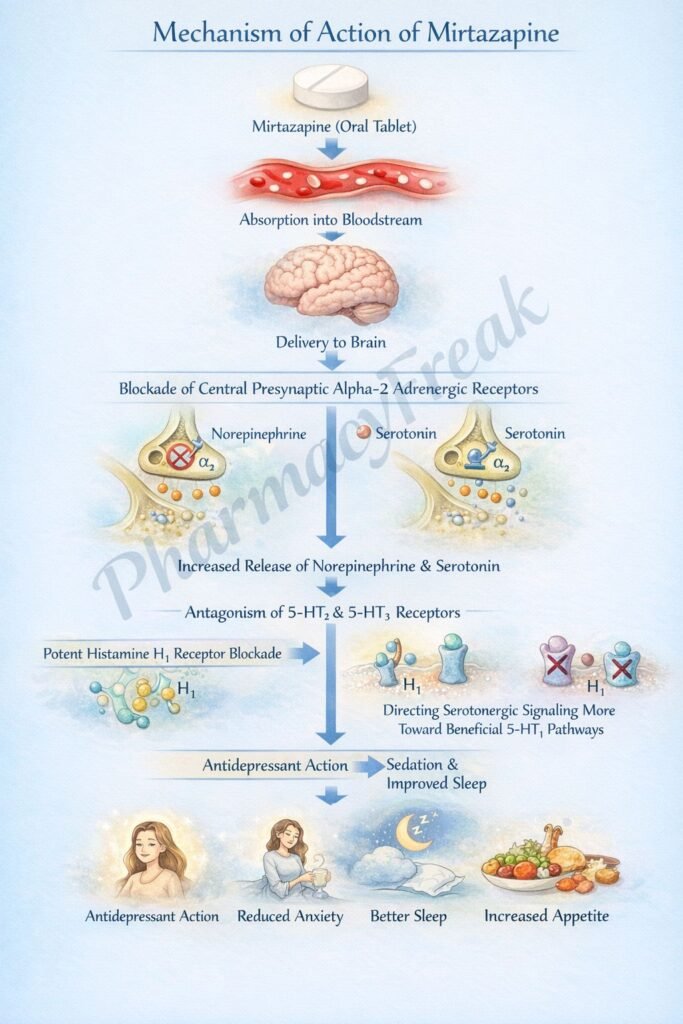
- Mirtazapine blocks presynaptic α2-adrenergic autoreceptors.
- These receptors normally inhibit norepinephrine (NE) release.
- Blocking α2 autoreceptors increases norepinephrine release.
- It also blocks α2 heteroreceptors on serotonergic neurons.
- This increases serotonin (5-HT) release.
- Mirtazapine selectively antagonizes 5-HT2 and 5-HT3 receptors.
- This shifts serotonin activity toward 5-HT1 receptors, enhancing antidepressant effects.
- Blocking 5-HT2 reduces anxiety, insomnia, and sexual dysfunction.
- Blocking 5-HT3 reduces nausea and gastrointestinal side effects.
- Mirtazapine also blocks H1 histamine receptors.
- This contributes to sedation and increased appetite.
- The net effect is increased noradrenergic and serotonergic neurotransmission with improved tolerability.
A key exam point is that mirtazapine increases NE and serotonin release via α2 blockade and selectively blocks 5-HT2 and 5-HT3 receptors.
Pharmacokinetics
Mirtazapine is administered orally and is well absorbed. It has moderate bioavailability and reaches peak plasma levels within a few hours. It is metabolized in the liver via cytochrome P450 enzymes (CYP1A2, CYP2D6, CYP3A4). It has a relatively long half-life, allowing once-daily dosing, usually at night due to its sedative effects. It is excreted via urine and feces.
Clinical Uses
Mirtazapine is used in major depressive disorder, especially in patients with insomnia, anxiety, or poor appetite. It is also useful in elderly patients due to its sedative and appetite-stimulating properties. It may be used in cases where SSRIs are not tolerated or cause significant side effects such as sexual dysfunction.
Adverse Effects
Common adverse effects include sedation, weight gain, and increased appetite due to H1 receptor blockade. Dry mouth and dizziness may also occur. Unlike SSRIs, it has a lower risk of sexual dysfunction. Rare but serious adverse effects include agranulocytosis. Because of sedation, it is typically given at bedtime.
Comparative Analysis
| Feature | Mirtazapine | SSRIs | TCAs |
|---|---|---|---|
| Mechanism | α2 blockade + 5-HT2/3 antagonism | Serotonin reuptake inhibition | NE and serotonin reuptake inhibition |
| Sedation | High | Low | Moderate |
| Weight gain | Common | Rare | Moderate |
| Sexual dysfunction | Low | High | Moderate |
| Anticholinergic effects | Minimal | Minimal | High |
| Use | Depression with insomnia | First-line depression | Alternative |
Mirtazapine differs from SSRIs by increasing neurotransmitter release rather than blocking reuptake and has lower risk of sexual dysfunction. Compared to TCAs, it has fewer anticholinergic effects but more sedation and weight gain.
MCQs
- Mirtazapine belongs to which class?
a) SSRI
b) TCA
c) NaSSA
d) MAOI
Answer: c) NaSSA
- Mirtazapine blocks which receptor to increase NE release?
a) β1 receptor
b) α2 receptor
c) Dopamine receptor
d) H2 receptor
Answer: b) α2 receptor
- Blocking α2 receptors leads to:
a) Decreased NE
b) Increased NE
c) No change
d) Increased dopamine
Answer: b) Increased NE
- Mirtazapine also increases:
a) Dopamine
b) Serotonin
c) Acetylcholine
d) GABA
Answer: b) Serotonin
- Mirtazapine blocks which serotonin receptors?
a) 5-HT1
b) 5-HT2 and 5-HT3
c) 5-HT4
d) 5-HT5
Answer: b) 5-HT2 and 5-HT3
- Blocking 5-HT3 reduces:
a) Anxiety
b) Nausea
c) Sleep
d) Appetite
Answer: b) Nausea
- Sedation is due to blockade of:
a) Dopamine receptors
b) H1 receptors
c) α1 receptors
d) β receptors
Answer: b) H1 receptors
- Mirtazapine is used in:
a) Asthma
b) Depression
c) Diabetes
d) Hypertension
Answer: b) Depression
- A common adverse effect is:
a) Weight loss
b) Weight gain
c) Hypoglycemia
d) Bradycardia
Answer: b) Weight gain
- Compared to SSRIs, mirtazapine causes:
a) More sexual dysfunction
b) Less sexual dysfunction
c) Same effect
d) No effect
Answer: b) Less sexual dysfunction
- Mirtazapine is metabolized in the:
a) Kidney
b) Liver
c) Lung
d) Brain
Answer: b) Liver
- Mirtazapine is usually given at:
a) Morning
b) Noon
c) Night
d) Afternoon
Answer: c) Night
FAQs
What is the mechanism of action of mirtazapine?
It blocks α2 receptors to increase norepinephrine and serotonin release and antagonizes 5-HT2 and 5-HT3 receptors.
Why does mirtazapine cause sedation?
Due to H1 histamine receptor blockade.
Does mirtazapine cause sexual dysfunction?
It has a lower risk compared to SSRIs.
Why is mirtazapine useful in insomnia?
Because of its sedative effects.
What is a major metabolic side effect?
Weight gain and increased appetite.
How does mirtazapine differ from SSRIs?
It increases neurotransmitter release instead of inhibiting reuptake.
References
Goodman & Gilman’s The Pharmacological Basis of Therapeutics – Antidepressants
https://accessmedicine.mhmedical.com/book.aspx?bookid=3191
Katzung: Basic and Clinical Pharmacology – Antidepressants
https://accessmedicine.mhmedical.com/content.aspx?bookid=3382
Tripathi: Essentials of Medical Pharmacology – Antidepressants
https://www.jaypeedigital.com
Harrison’s Principles of Internal Medicine – Depression
https://accessmedicine.mhmedical.com