Table of Contents
Introduction
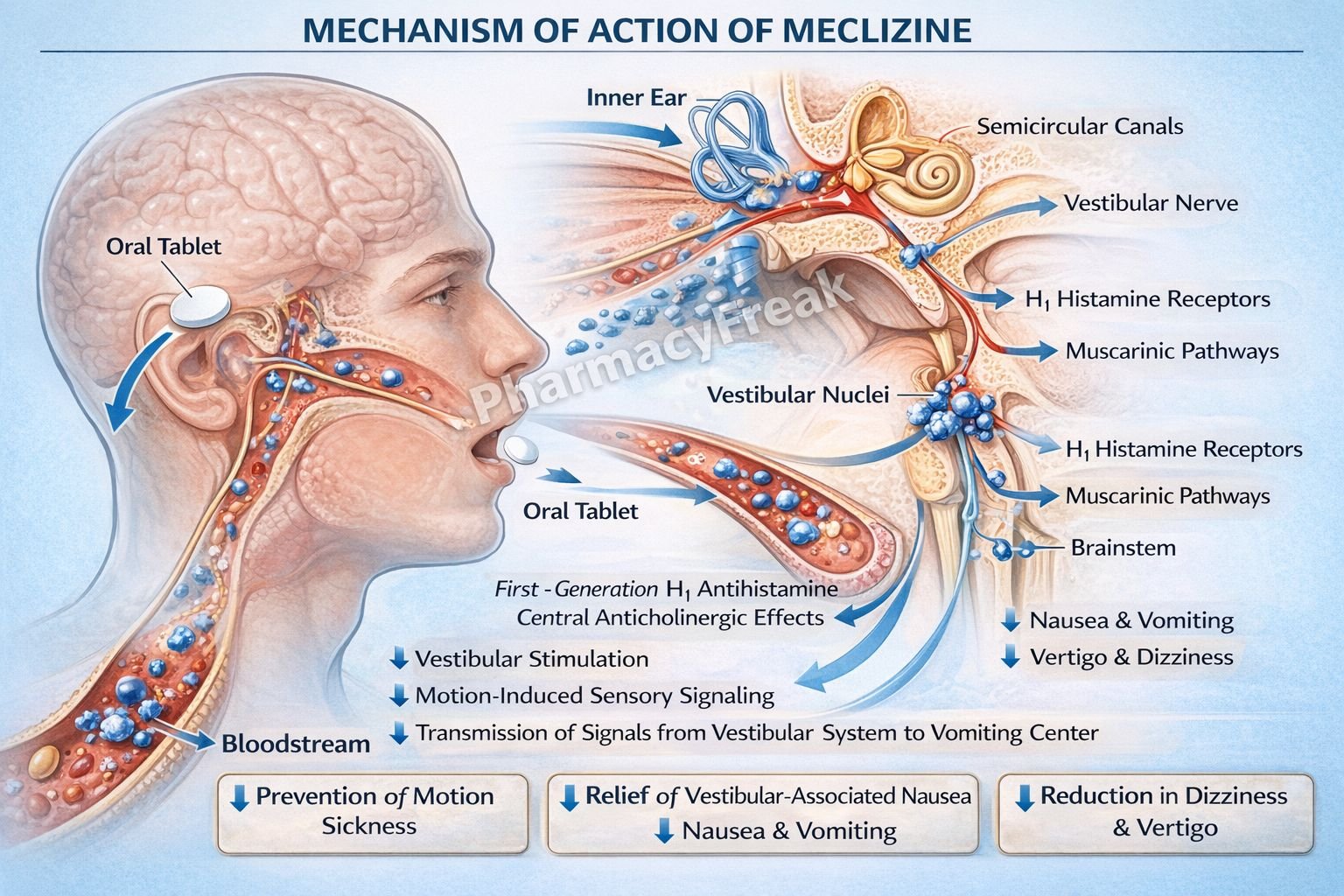
Meclizine is a first-generation antihistamine primarily used for the prevention and treatment of motion sickness and vertigo associated with vestibular disorders. It exerts antiemetic and antivertigo effects by acting on central pathways involved in balance and nausea. In addition to antihistaminic activity, meclizine also has anticholinergic properties that contribute to its therapeutic effects.
Mechanism of Action (Step-wise)
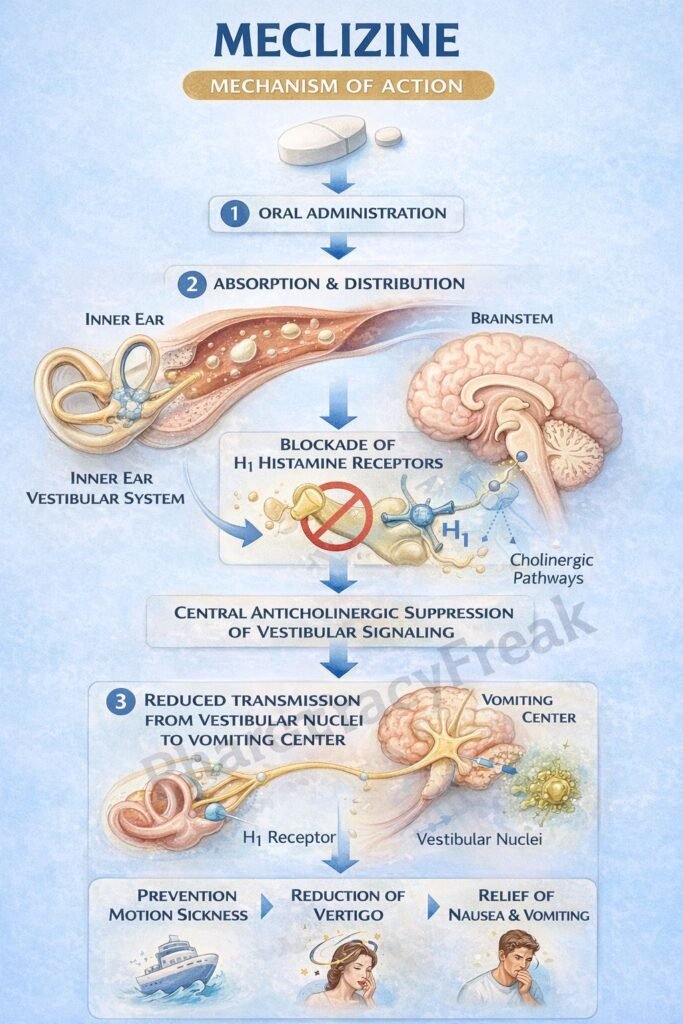
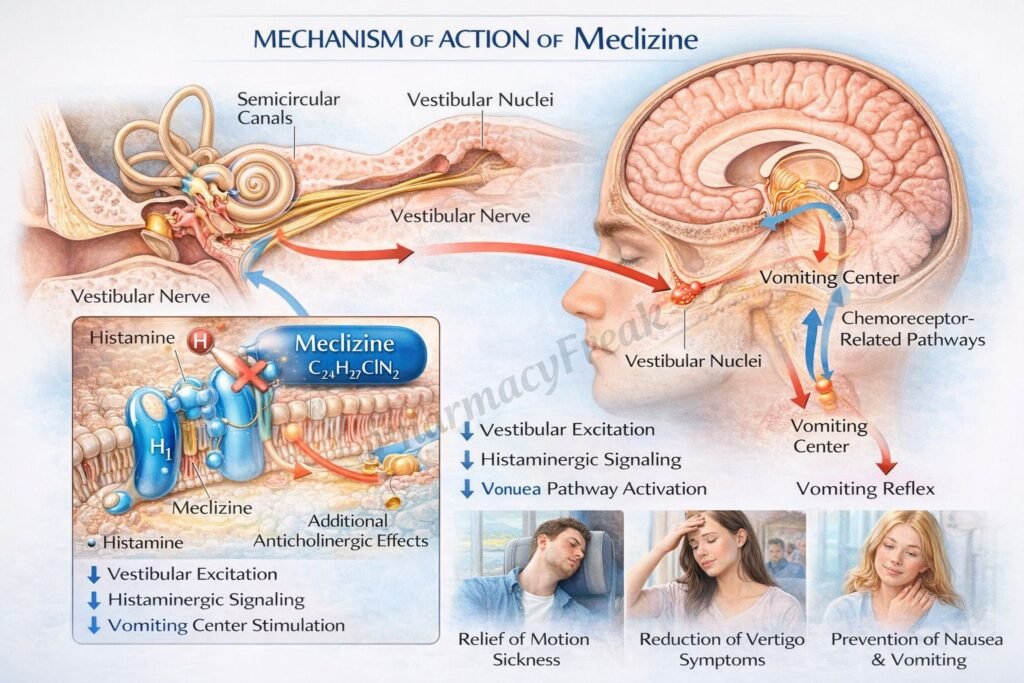
- Meclizine acts as an antagonist at H1 histamine receptors in the central nervous system.
- It blocks H1 receptors in the vestibular nuclei and vomiting center.
- This reduces activation of pathways involved in motion-induced nausea and vertigo.
- Meclizine also has anticholinergic (muscarinic receptor blocking) activity.
- This decreases excitability of the vestibular apparatus and reduces transmission from the inner ear to the brain.
- It suppresses stimulation of the chemoreceptor trigger zone (CTZ) and vomiting center.
- The combined antihistaminic and anticholinergic effects reduce nausea, vomiting, and dizziness.
- Because it crosses the blood-brain barrier, it can cause mild sedation.
A key exam point is that meclizine is an H1 blocker with anticholinergic effects used for motion sickness and vertigo.
Pharmacokinetics
Meclizine is administered orally and is well absorbed from the gastrointestinal tract. It has a relatively slow onset but a long duration of action, making it suitable for once-daily dosing in motion sickness prevention. It is metabolized in the liver and excreted primarily in urine and feces. Due to its lipophilicity, it crosses the blood-brain barrier and exerts central effects.
Clinical Uses
Meclizine is mainly used in the prevention and treatment of motion sickness. It is also used in vertigo associated with vestibular disorders such as Ménière’s disease. It helps relieve symptoms such as dizziness, nausea, and vomiting. It is preferred in some patients due to its longer duration and relatively lower sedative effect compared to other first-generation antihistamines.
Adverse Effects
Common adverse effects include drowsiness, dry mouth, blurred vision, and dizziness. These are primarily due to its central antihistaminic and anticholinergic effects. In elderly patients, it may cause confusion or urinary retention. Caution is advised in patients with glaucoma or prostatic hypertrophy due to its anticholinergic activity.
Comparative Analysis
| Feature | Meclizine | Dimenhydrinate | Scopolamine |
|---|---|---|---|
| Class | H1 antihistamine | H1 antihistamine | Anticholinergic |
| Mechanism | H1 blockade + anticholinergic | H1 blockade | Muscarinic blockade |
| Sedation | Moderate | Higher | Variable |
| Duration | Long | Moderate | Long |
| Use | Motion sickness, vertigo | Motion sickness | Motion sickness (patch) |
| Route | Oral | Oral | Transdermal |
Meclizine differs from dimenhydrinate by having a longer duration and slightly less sedation. Compared to scopolamine, it has both antihistaminic and anticholinergic effects, whereas scopolamine is purely anticholinergic.
MCQs
- Meclizine belongs to which class of drugs?
a) Antidepressants
b) H1 antihistamines
c) Beta blockers
d) Antipsychotics
Answer: b) H1 antihistamines
- Meclizine primarily blocks:
a) H2 receptors
b) H1 receptors
c) Dopamine receptors
d) Serotonin receptors
Answer: b) H1 receptors
- Meclizine is mainly used for:
a) Hypertension
b) Motion sickness
c) Diabetes
d) Asthma
Answer: b) Motion sickness
- Meclizine also has:
a) Beta-blocking activity
b) Anticholinergic activity
c) Calcium channel blocking activity
d) Anticoagulant activity
Answer: b) Anticholinergic activity
- The antiemetic effect is due to action on:
a) Liver
b) Kidney
c) Vestibular system
d) Bone marrow
Answer: c) Vestibular system
- Meclizine crosses the:
a) Placental barrier only
b) Blood-brain barrier
c) Renal barrier
d) Intestinal barrier
Answer: b) Blood-brain barrier
- A common adverse effect is:
a) Hypoglycemia
b) Drowsiness
c) Hypertension
d) Hyperkalemia
Answer: b) Drowsiness
- Meclizine is useful in:
a) Arrhythmia
b) Vertigo
c) Renal failure
d) Hyperthyroidism
Answer: b) Vertigo
- Compared to first-generation antihistamines, meclizine has:
a) More sedation
b) Less sedation
c) Equal sedation
d) No effect
Answer: b) Less sedation
- Meclizine affects which system?
a) Endocrine
b) Vestibular
c) Renal
d) Cardiovascular
Answer: b) Vestibular
- Which receptor blockade contributes to dry mouth?
a) H1
b) Dopamine
c) Muscarinic
d) Serotonin
Answer: c) Muscarinic
- Meclizine is contraindicated in:
a) Diabetes
b) Glaucoma
c) Hypertension
d) Anemia
Answer: b) Glaucoma
FAQs
What is the mechanism of action of meclizine?
It blocks H1 receptors and muscarinic receptors in the CNS, reducing vestibular stimulation and nausea.
Why is meclizine used in motion sickness?
It suppresses vestibular signals responsible for nausea and dizziness.
Does meclizine cause sedation?
Yes, but less than many first-generation antihistamines.
What are the anticholinergic effects of meclizine?
Dry mouth, blurred vision, and urinary retention.
Can meclizine be used in vertigo?
Yes, it is effective in vestibular disorders.
Why should it be used cautiously in elderly patients?
Due to risk of confusion and anticholinergic side effects.
References
Goodman & Gilman’s The Pharmacological Basis of Therapeutics – Antihistamines
https://accessmedicine.mhmedical.com/book.aspx?bookid=3191
Katzung: Basic and Clinical Pharmacology – Antiemetics & Antihistamines
https://accessmedicine.mhmedical.com/content.aspx?bookid=3382
Tripathi: Essentials of Medical Pharmacology – Antihistamines
https://www.jaypeedigital.com
Harrison’s Principles of Internal Medicine – Vertigo & Motion Sickness
https://accessmedicine.mhmedical.com