Table of Contents
Introduction
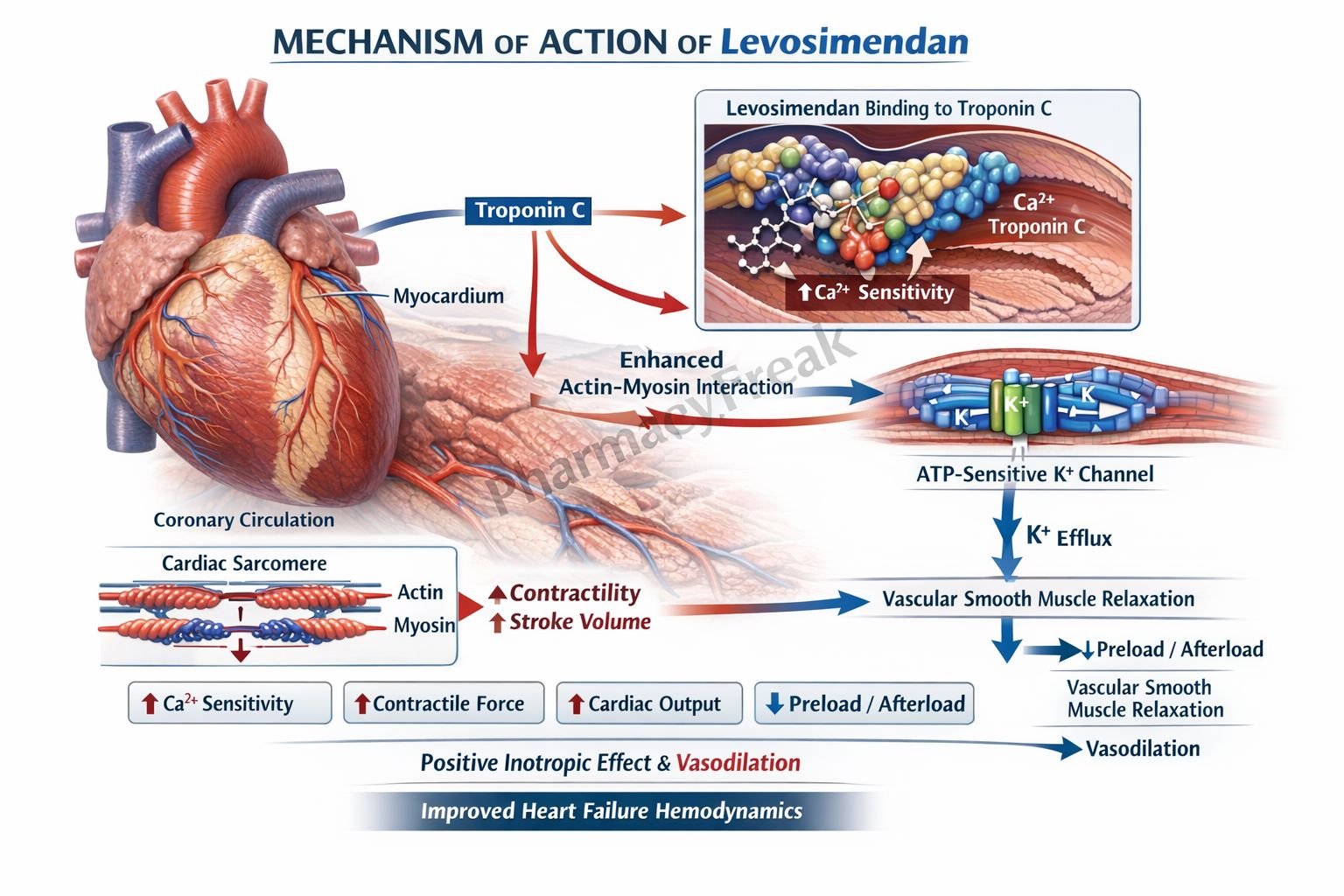
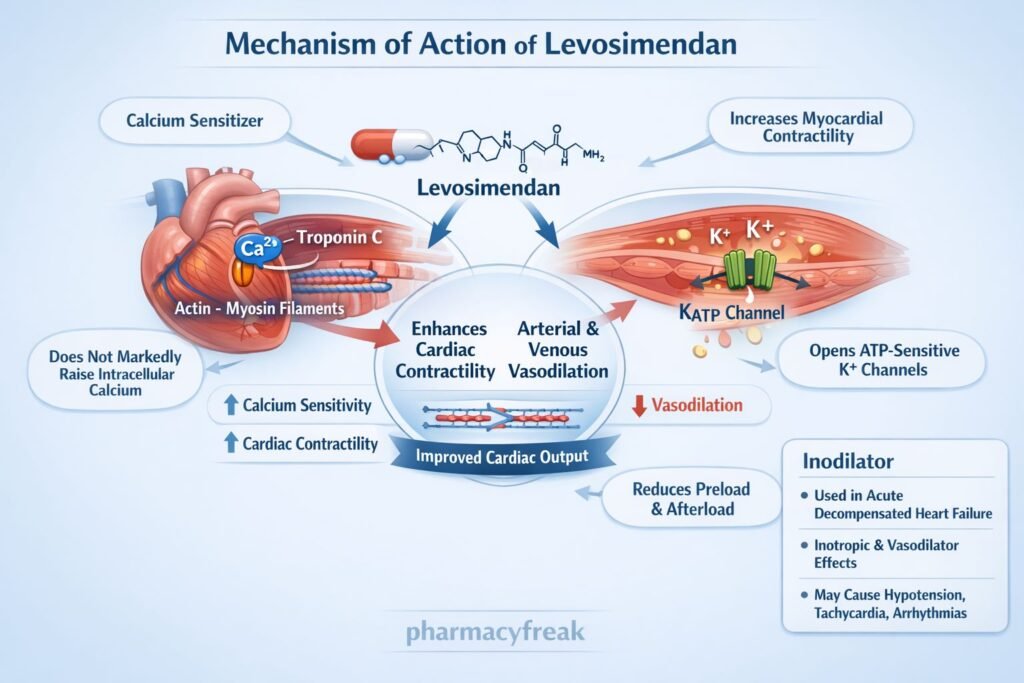
Levosimendan is a calcium sensitizer and inodilator used in the management of acute decompensated heart failure. It improves cardiac contractility without significantly increasing myocardial oxygen demand and produces vasodilation, making it beneficial in patients with reduced cardiac output.
Mechanism of Action (Step-wise)
- Calcium Sensitization of Troponin C
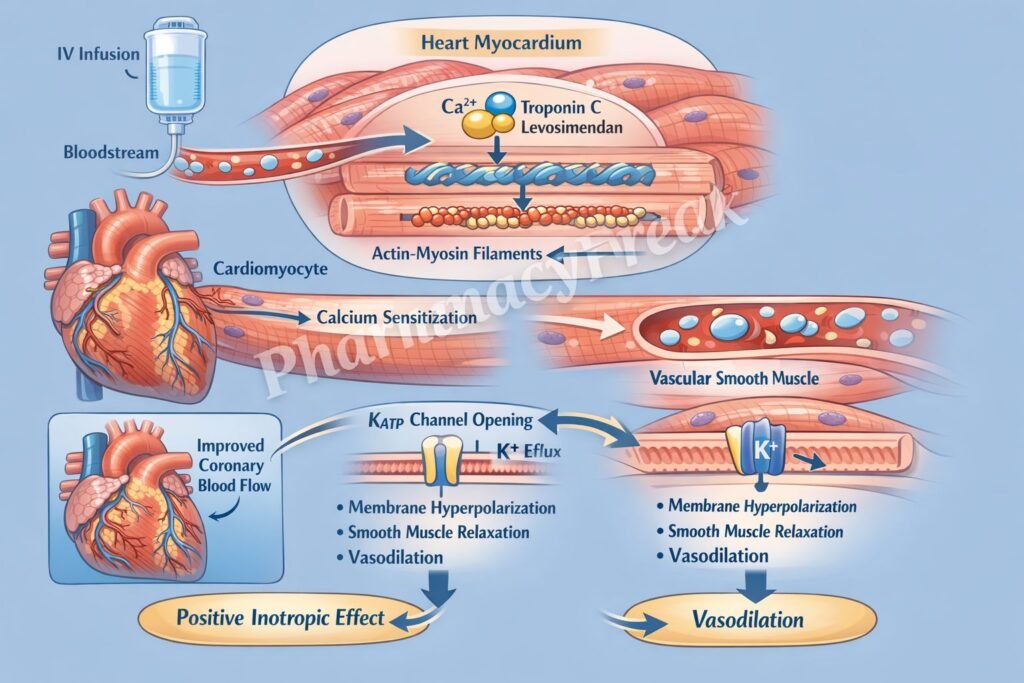
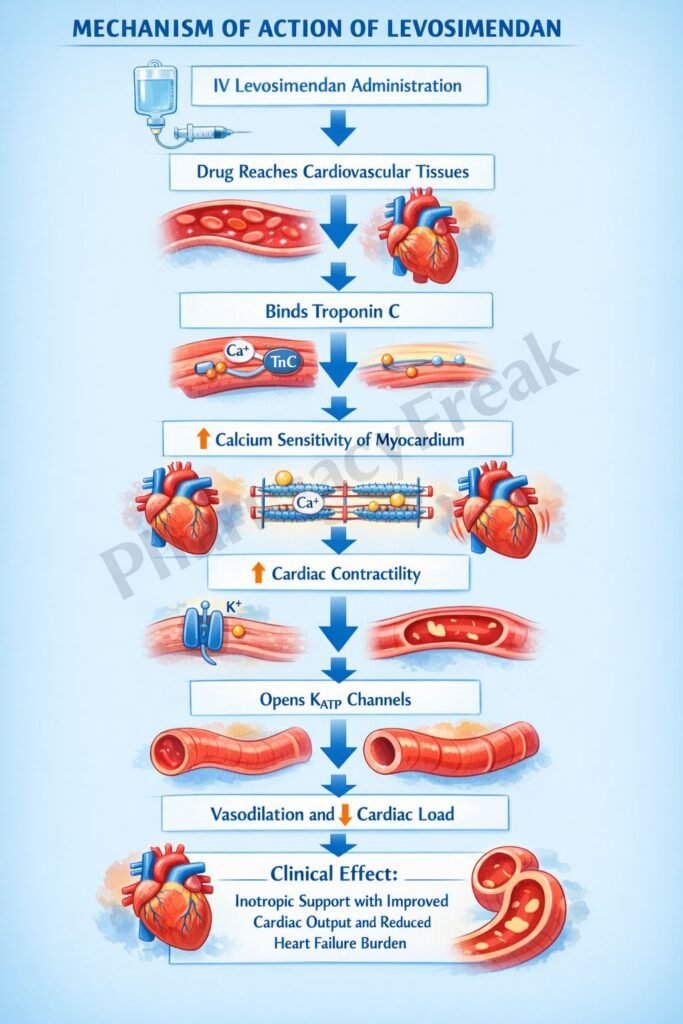
Levosimendan binds to cardiac troponin C in a calcium-dependent manner, enhancing the sensitivity of contractile proteins to intracellular calcium. - Increased Myocardial Contractility (Positive Inotropy)
This increases the force of cardiac contraction without raising intracellular calcium levels. - Opening of ATP-sensitive Potassium (KATP) Channels in Vascular Smooth Muscle
Levosimendan opens KATP channels in vascular smooth muscle cells. - Vasodilation
Opening of KATP channels causes hyperpolarization of vascular smooth muscle, leading to vasodilation and reduced systemic vascular resistance. - Opening of Mitochondrial KATP Channels
It also opens mitochondrial KATP channels, providing cardioprotective effects and reducing ischemic injury. - Improved Cardiac Output with Reduced Preload and Afterload
Combined inotropic and vasodilatory effects improve cardiac output and decrease preload and afterload.
Pharmacokinetics
- Administration: Intravenous
- Onset: Rapid
- Half-life: ~1 hour (active metabolite has prolonged effect ~70–80 hours)
- Metabolism: Hepatic to active metabolite (OR-1896)
- Excretion: Renal and fecal
Clinical Uses
- Acute decompensated heart failure
- Low cardiac output states
- Short-term hemodynamic support
Adverse Effects
- Hypotension
- Headache
- Tachycardia
- Arrhythmias
- Dizziness
Comparative Analysis
| Feature | Levosimendan | Dobutamine | Milrinone |
|---|---|---|---|
| Class | Calcium sensitizer | β1 agonist | PDE3 inhibitor |
| Mechanism | ↑ Ca²⁺ sensitivity | ↑ cAMP | ↑ cAMP |
| Effect on Ca²⁺ levels | No increase | Increase | Increase |
| Vasodilation | Yes | Mild | Strong |
| Oxygen demand | Minimal increase | Increased | Increased |
| Duration | Long (active metabolite) | Short | Moderate |
Levosimendan is unique because it increases contractility without increasing intracellular calcium, reducing the risk of arrhythmias compared to dobutamine and milrinone. Its prolonged effect due to an active metabolite makes it beneficial in sustained hemodynamic support.
MCQs
- Levosimendan primarily acts by:
a) Increasing calcium influx
b) Sensitizing troponin C to calcium
c) Blocking β receptors
d) Inhibiting ACE
Answer: b) Sensitizing troponin C to calcium - Main effect on heart:
a) Decreased contractility
b) Increased contractility
c) Reduced conduction
d) Bradycardia
Answer: b) Increased contractility - Levosimendan opens which channels?
a) Na⁺ channels
b) Ca²⁺ channels
c) KATP channels
d) Cl⁻ channels
Answer: c) KATP channels - Effect on vascular system:
a) Vasoconstriction
b) Vasodilation
c) No effect
d) Increased resistance
Answer: b) Vasodilation - Compared to dobutamine, levosimendan:
a) Increases oxygen demand more
b) Does not increase calcium levels
c) Has no inotropic effect
d) Causes vasoconstriction
Answer: b) Does not increase calcium levels - Used in:
a) Hypertension
b) Acute heart failure
c) Diabetes
d) Asthma
Answer: b) Acute heart failure - Active metabolite:
a) OR-1896
b) SN-38
c) Desipramine
d) Teriflunomide
Answer: a) OR-1896 - Major side effect:
a) Bradycardia
b) Hypotension
c) Hyperglycemia
d) Constipation
Answer: b) Hypotension - Levosimendan affects:
a) Troponin C
b) Actin
c) Myosin only
d) DNA
Answer: a) Troponin C - Type of drug:
a) Diuretic
b) Calcium sensitizer
c) Antibiotic
d) Antiviral
Answer: b) Calcium sensitizer
FAQs
- What is the mechanism of action of levosimendan?
It increases calcium sensitivity of troponin C and opens KATP channels, improving cardiac output. - How is levosimendan different from other inotropes?
It does not increase intracellular calcium levels. - Why is levosimendan considered safer?
It reduces arrhythmia risk compared to other inotropes. - What is the role of KATP channels?
They cause vasodilation and improve blood flow. - Why does levosimendan have prolonged effects?
Due to its long-acting active metabolite. - When is levosimendan used?
In acute decompensated heart failure.