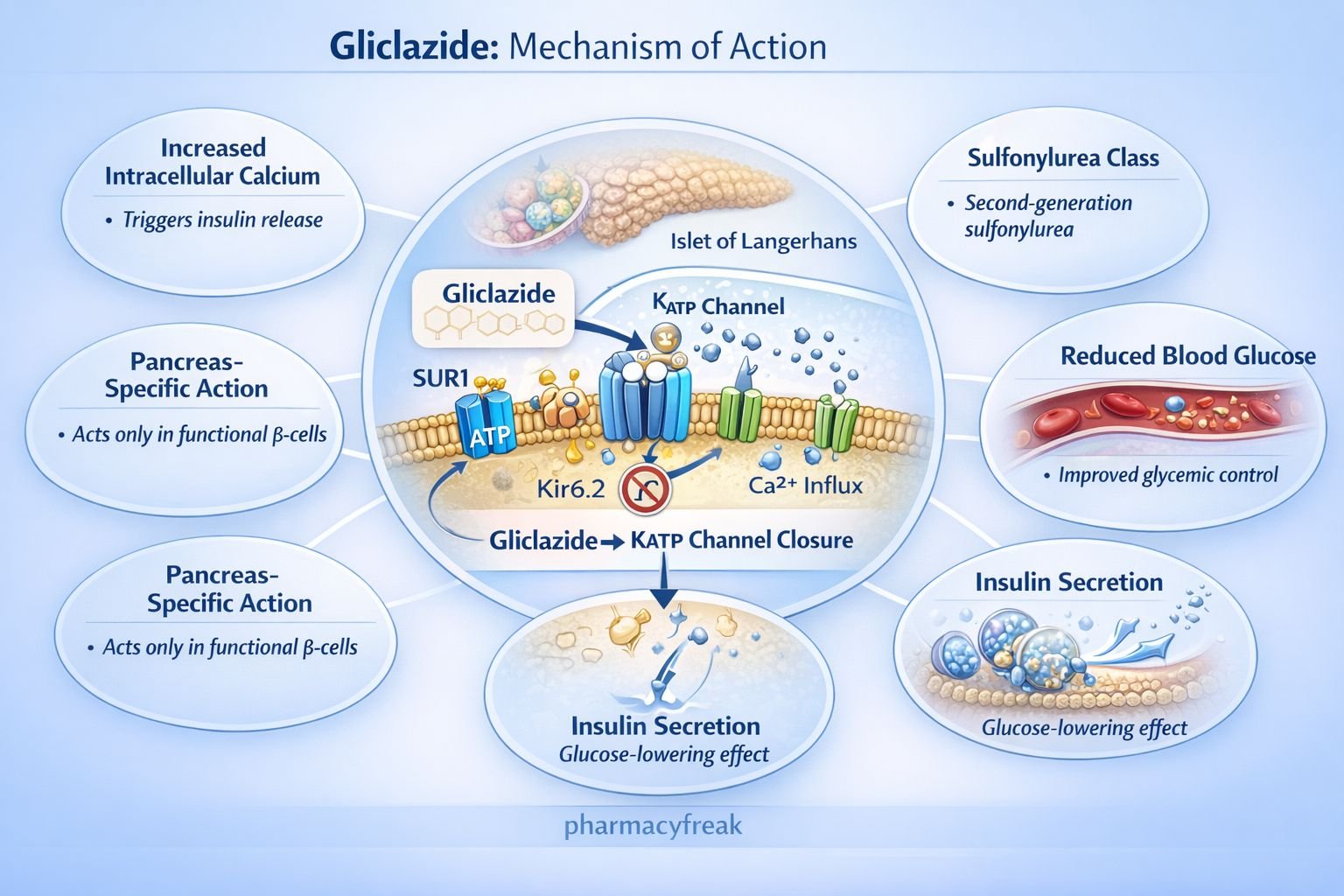
Mechanism of Action of Gliclazide

Introduction

Gliclazide is a second generation sulfonylurea oral hypoglycemic agent used in the management of type 2 diabetes mellitus. It improves glycemic control primarily by stimulating pancreatic insulin secretion. In addition to its insulinotropic effect, gliclazide has favorable hemorheological and antioxidant properties, which may contribute to vascular protection.

It is commonly tested in USMLE, NEET PG, FMGE, PLAB, INICET, NCLEX, and MCCQE under the topic of insulin secretagogues and ATP sensitive potassium channel modulation.

MOA of Gliclazide
Gliclazide pharmacology

Flowchart of Mechanism of Action of Gliclazide
MOA of Gliclazide flowchart

Mechanism of Action (Step-wise)

Gliclazide lowers blood glucose by enhancing endogenous insulin secretion from pancreatic beta cells.

Step 1: Binding to sulfonylurea receptor
Gliclazide binds to the sulfonylurea receptor 1 (SUR1) located on ATP sensitive potassium (K ATP) channels of pancreatic beta cells.

Step 2: Closure of K ATP channels
Binding causes closure of K ATP channels, preventing potassium efflux from the beta cell.

Step 3: Membrane depolarization
Accumulation of intracellular potassium leads to depolarization of the beta cell membrane.

Step 4: Opening of voltage gated calcium channels
Depolarization opens voltage dependent calcium channels, allowing calcium influx.

Step 5: Insulin release
Increased intracellular calcium triggers exocytosis of insulin containing granules.

Overall effect:
Increased insulin secretion leading to reduced blood glucose levels.

Important clinical note:
Sulfonylureas require functional pancreatic beta cells to be effective and are therefore ineffective in type 1 diabetes mellitus.


Pharmacokinetics

Absorption:
Well absorbed after oral administration.

Distribution:
Highly protein bound in plasma.

Metabolism:
Extensively metabolized in the liver.

Excretion:
Metabolites are excreted primarily in urine.

Duration:
Modified release formulations provide prolonged glycemic control with reduced risk of hypoglycemia.


Clinical Uses

  1. Type 2 diabetes mellitus as monotherapy
  2. Combination therapy with metformin
  3. Alternative to other sulfonylureas in patients at risk of hypoglycemia
  4. Patients requiring cost effective oral therapy

Gliclazide is often preferred due to relatively lower risk of severe hypoglycemia compared to older sulfonylureas.


Adverse Effects

Common adverse effects:

  • Hypoglycemia
  • Weight gain
  • Gastrointestinal upset

Rare adverse effects:

  • Allergic skin reactions
  • Hematologic reactions

Precautions:

  • Avoid in severe hepatic or renal impairment
  • Risk of hypoglycemia increases in elderly patients

Comparative Analysis

FeatureGliclazideGlibenclamideMetformin
Drug classSulfonylureaSulfonylureaBiguanide
MechanismCloses K ATP channelsCloses K ATP channelsReduces hepatic glucose production
Hypoglycemia riskModerateHigherMinimal
Weight gainYesYesNeutral or weight loss
Requires beta cellsYesYesNo

Explanation:

Gliclazide and glibenclamide both stimulate insulin secretion via closure of K ATP channels. However, gliclazide has a relatively safer hypoglycemia profile. Metformin differs completely in mechanism, acting primarily by reducing hepatic gluconeogenesis and improving insulin sensitivity without stimulating insulin secretion.


MCQs

  1. Gliclazide belongs to which class?
    a) Biguanide
    b) Sulfonylurea
    c) Thiazolidinedione
    d) DPP 4 inhibitor

Answer: b) Sulfonylurea

  1. Gliclazide acts on which receptor?
    a) GLUT4
    b) SUR1
    c) NMDA
    d) PPAR gamma

Answer: b) SUR1

  1. Closure of K ATP channels leads to:
    a) Hyperpolarization
    b) Depolarization
    c) Inhibition of calcium entry
    d) Reduced insulin release

Answer: b) Depolarization

  1. Gliclazide increases insulin secretion by increasing:
    a) Sodium influx
    b) Potassium efflux
    c) Calcium influx
    d) Chloride efflux

Answer: c) Calcium influx

  1. Sulfonylureas are ineffective in:
    a) Type 2 diabetes
    b) Gestational diabetes
    c) Type 1 diabetes
    d) Prediabetes

Answer: c) Type 1 diabetes

  1. Major adverse effect:
    a) Hyperglycemia
    b) Hypoglycemia
    c) Hyperkalemia
    d) Hypertension

Answer: b) Hypoglycemia

  1. Gliclazide requires functional:
    a) Alpha cells
    b) Beta cells
    c) Hepatocytes
    d) Renal tubules

Answer: b) Beta cells

  1. Compared to glibenclamide, gliclazide has:
    a) Higher hypoglycemia risk
    b) Similar mechanism
    c) No insulin effect
    d) No hepatic metabolism

Answer: b) Similar mechanism

  1. Insulin release occurs due to:
    a) Reduced calcium
    b) Increased calcium
    c) Decreased ATP
    d) Increased glucagon

Answer: b) Increased calcium

  1. Primary site of action:
    a) Liver
    b) Muscle
    c) Pancreatic beta cells
    d) Kidney

Answer: c) Pancreatic beta cells


FAQs

  1. How does gliclazide reduce blood glucose?
    By stimulating insulin secretion through closure of ATP sensitive potassium channels.
  2. Can gliclazide be used in type 1 diabetes?
    No, it requires functional beta cells.
  3. Why does gliclazide cause hypoglycemia?
    Because it increases insulin release independent of blood glucose levels.
  4. Does gliclazide cause weight gain?
    Yes, due to increased insulin mediated glucose storage.
  5. Is gliclazide safer than older sulfonylureas?
    It has a relatively lower risk of severe hypoglycemia compared to some older agents.
  6. Can it be combined with metformin?
    Yes, combination therapy is common in type 2 diabetes.

References

Goodman & Gilman’s Pharmacological Basis of Therapeutics
https://accessmedicine.mhmedical.com/book.aspx?bookID=2189

Katzung BG. Basic and Clinical Pharmacology
https://accessmedicine.mhmedical.com/book.aspx?bookID=2249

Tripathi KD. Essentials of Medical Pharmacology
https://jaypeedigital.com/book/9789354651970

Harrison’s Principles of Internal Medicine
https://accessmedicine.mhmedical.com/book.aspx?bookID=3095

Leave a Comment

PRO
Ad-Free Access
$3.99 / month
  • No Interruptions
  • Faster Page Loads
  • Support Content Creators