Table of Contents
Introduction
Famotidine is a histamine H₂-receptor antagonist (H₂ blocker) used in the management of acid-related gastrointestinal disorders. It suppresses gastric acid secretion by selectively blocking histamine-mediated stimulation of parietal cells. Famotidine is clinically and exam-relevant due to its receptor specificity, reduced drug interaction profile compared to cimetidine, and widespread use in peptic ulcer disease, gastroesophageal reflux disease, and stress ulcer prophylaxis.
Mechanism of Action (Step-wise)
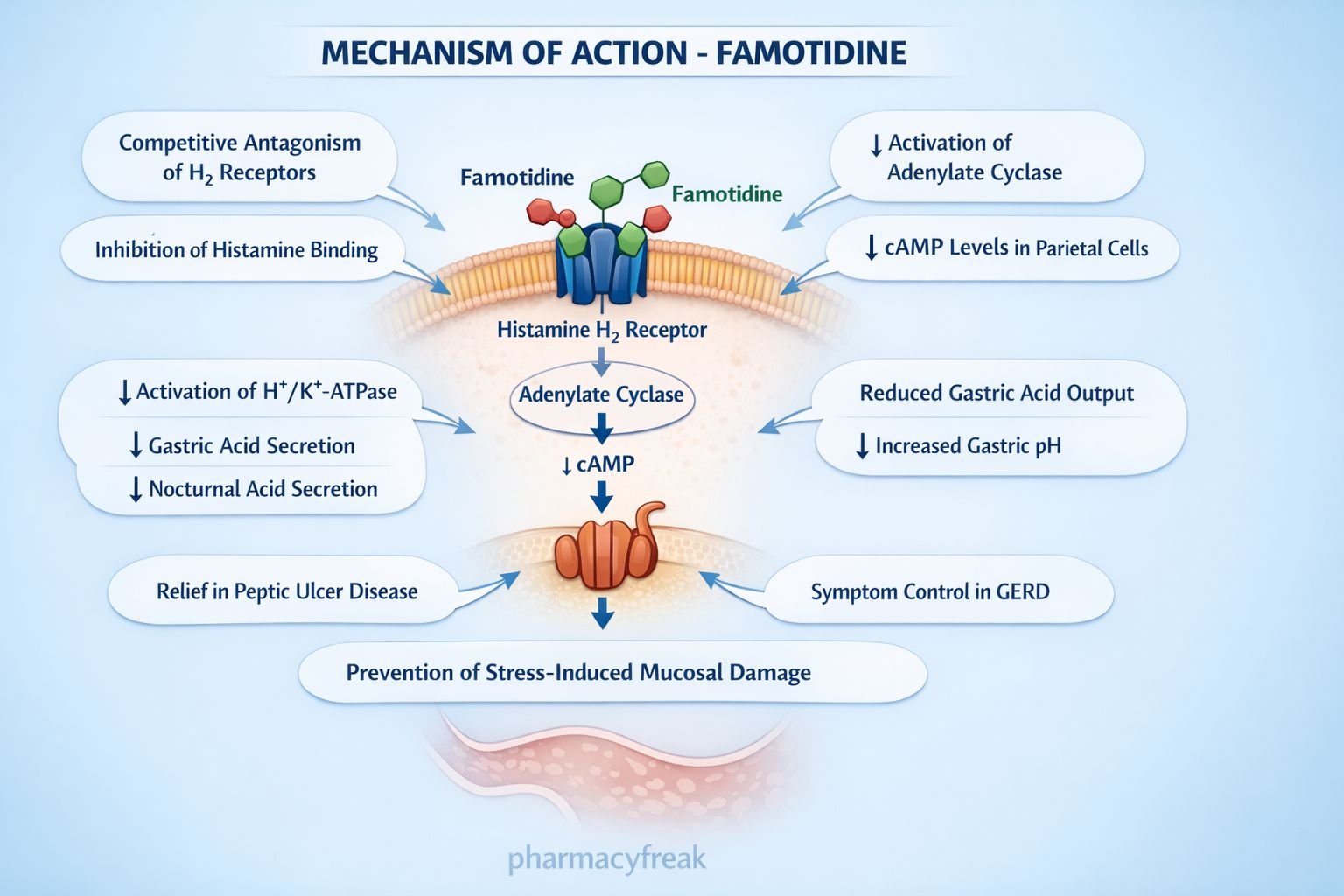
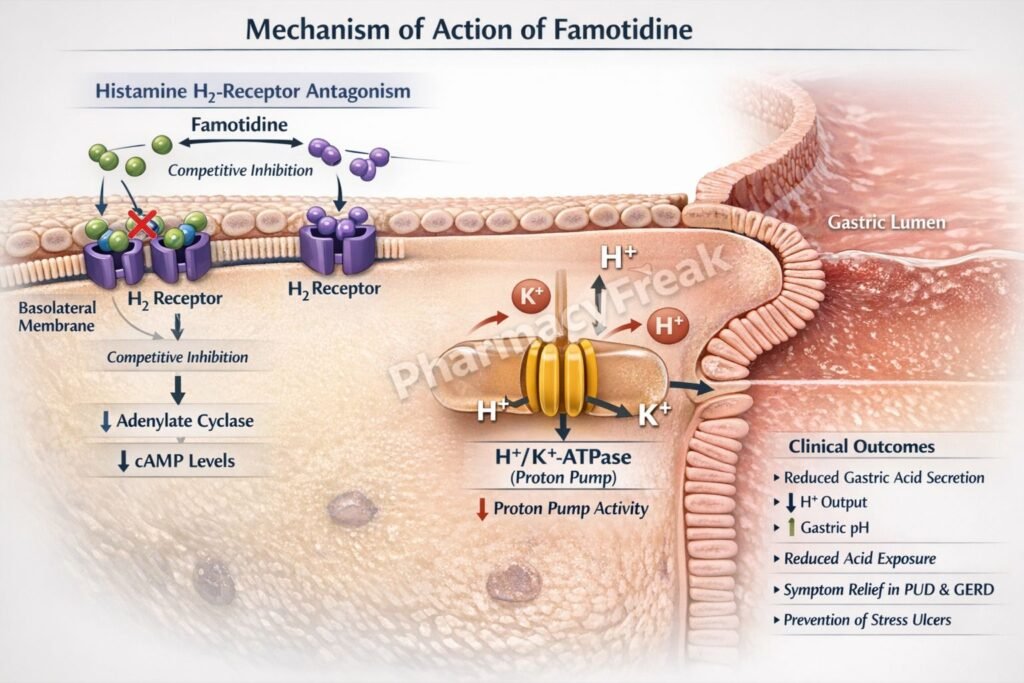
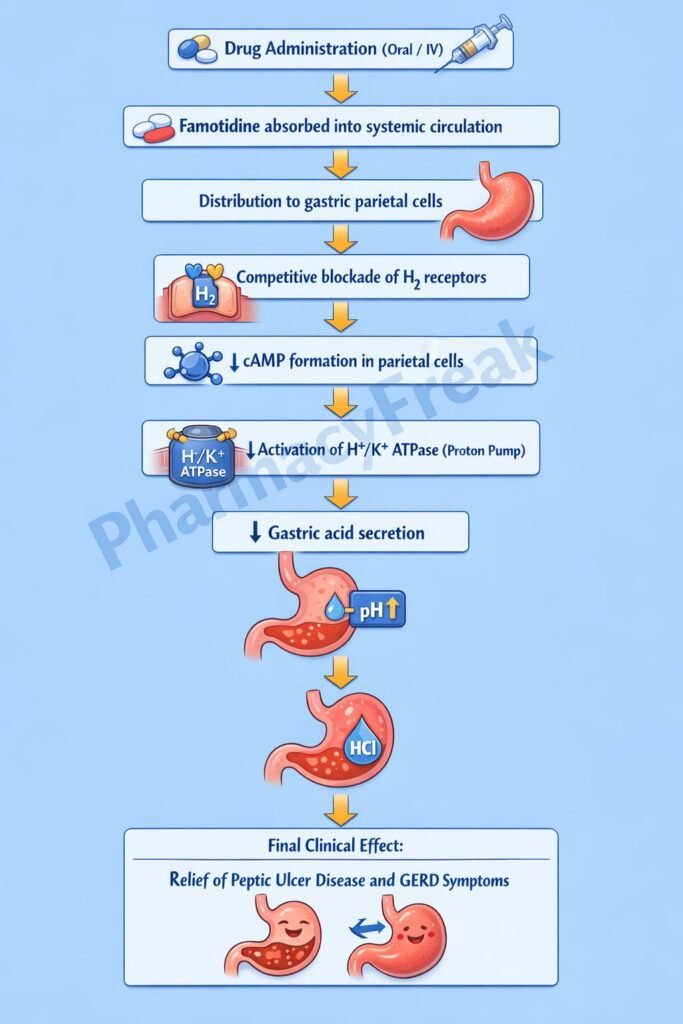
Famotidine reduces gastric acid secretion by inhibiting histamine-mediated signaling in gastric parietal cells.
Step 1: Targeting gastric parietal cells
Famotidine acts on parietal cells located in the gastric mucosa.
Step 2: Selective H₂-receptor blockade
It selectively binds to histamine H₂ receptors on the basolateral membrane of parietal cells.
Step 3: Inhibition of adenylate cyclase pathway
Blocking H₂ receptors prevents activation of adenylate cyclase, leading to reduced intracellular cAMP levels.
Step 4: Decreased proton pump activation
Lower cAMP reduces stimulation of the H⁺/K⁺-ATPase (proton pump).
Step 5: Suppression of gastric acid secretion
This results in decreased basal and nocturnal acid secretion and reduced stimulated acid output.
Exam pearl:
Famotidine inhibits histamine-mediated acid secretion but does not block gastrin or acetylcholine receptors directly.
Pharmacokinetics
- Route of administration: Oral, IV
- Bioavailability: ~40–45%
- Protein binding: ~15–20%
- Distribution: Widely distributed
- Metabolism: Minimal hepatic metabolism
- Half-life: 2.5–3.5 hours
- Excretion: Primarily renal (unchanged drug)
- Dose adjustment: Required in renal impairment
Clinical Uses
- Peptic ulcer disease
- Gastroesophageal reflux disease (GERD)
- Zollinger–Ellison syndrome
- Stress ulcer prophylaxis
- Dyspepsia
- Adjunct in upper GI bleeding management
Famotidine is preferred over cimetidine due to fewer endocrine effects and drug interactions.
Adverse Effects
Common:
- Headache
- Dizziness
- Constipation or diarrhea
CNS (elderly/IV use):
- Confusion
- Delirium (rare)
Hematological (rare):
- Thrombocytopenia
- Leukopenia
Endocrine:
- Minimal (no antiandrogenic effects)
Comparative Analysis
Famotidine vs Ranitidine vs Cimetidine
| Feature | Famotidine | Ranitidine | Cimetidine |
|---|---|---|---|
| H₂ selectivity | High | Moderate | Moderate |
| Potency | High | Moderate | Low |
| CYP450 inhibition | None | Minimal | Strong |
| Endocrine effects | None | None | Present |
| Drug interactions | Minimal | Low | High |
Explanation:
Famotidine offers superior safety due to lack of CYP450 inhibition and absence of antiandrogenic effects seen with cimetidine, making it the preferred H₂ blocker in polypharmacy patients.
MCQs
- Famotidine reduces gastric acid secretion by blocking:
a) H₁ receptors
b) H₂ receptors
c) M₃ receptors
d) Proton pump
Answer: b) H₂ receptors
- Intracellular signaling pathway inhibited by famotidine is:
a) IP₃–DAG
b) cAMP
c) Ca²⁺ influx
d) MAPK pathway
Answer: b) cAMP
- Famotidine reduces acid secretion mainly by decreasing:
a) Gastrin release
b) Acetylcholine release
c) Proton pump activation
d) Pepsin secretion
Answer: c) Proton pump activation
- Famotidine differs from cimetidine because it:
a) Is less potent
b) Strongly inhibits CYP450
c) Has endocrine effects
d) Has minimal drug interactions
Answer: d) Has minimal drug interactions
- Primary route of excretion of famotidine is:
a) Hepatic
b) Biliary
c) Renal
d) Pulmonary
Answer: c) Renal
- Famotidine is most effective in reducing:
a) Daytime acid secretion
b) Nocturnal acid secretion
c) Postprandial insulin
d) Gastric motility
Answer: b) Nocturnal acid secretion
- Famotidine does not directly block:
a) Histamine
b) Gastrin
c) Parietal cells
d) H₂ receptors
Answer: b) Gastrin
- Famotidine is preferred in elderly patients because:
a) Causes sedation
b) Has fewer interactions
c) Causes hypoglycemia
d) Has anticholinergic effects
Answer: b) Has fewer interactions
- Stress ulcer prophylaxis can be done using:
a) Famotidine
b) Metoclopramide
c) Domperidone
d) Sucralfate only
Answer: a) Famotidine
- Famotidine primarily reduces:
a) Pepsin secretion
b) Acid secretion
c) Bile secretion
d) Mucus secretion
Answer: b) Acid secretion
FAQs
1. Why is famotidine preferred over cimetidine?
Because it lacks CYP450 inhibition and endocrine side effects.
2. Does famotidine inhibit the proton pump directly?
No, it indirectly reduces proton pump activity by lowering cAMP.
3. Is famotidine effective in Zollinger–Ellison syndrome?
Yes, at higher doses.
4. Can famotidine cause tolerance?
Yes, reduced efficacy can develop with prolonged use.
5. Is famotidine safe in renal disease?
Dose adjustment is required.
References
- Goodman & Gilman’s The Pharmacological Basis of Therapeutics
https://accesspharmacy.mhmedical.com - Katzung BG. Basic and Clinical Pharmacology
https://accessmedicine.mhmedical.com - Tripathi KD. Essentials of Medical Pharmacology
- Harrison’s Principles of Internal Medicine
https://accessmedicine.mhmedical.com