Table of Contents
Introduction
Ethambutol is a first-line antitubercular drug used as part of combination therapy for the treatment of tuberculosis. It is classified as a bacteriostatic agent and plays a crucial role in preventing the emergence of drug resistance when used with other anti-TB drugs such as isoniazid and rifampicin. Ethambutol is high-yield for examinations because of its unique target in mycobacterial cell wall synthesis and its characteristic, dose-related ocular toxicity.
Mechanism of Action (Step-wise)
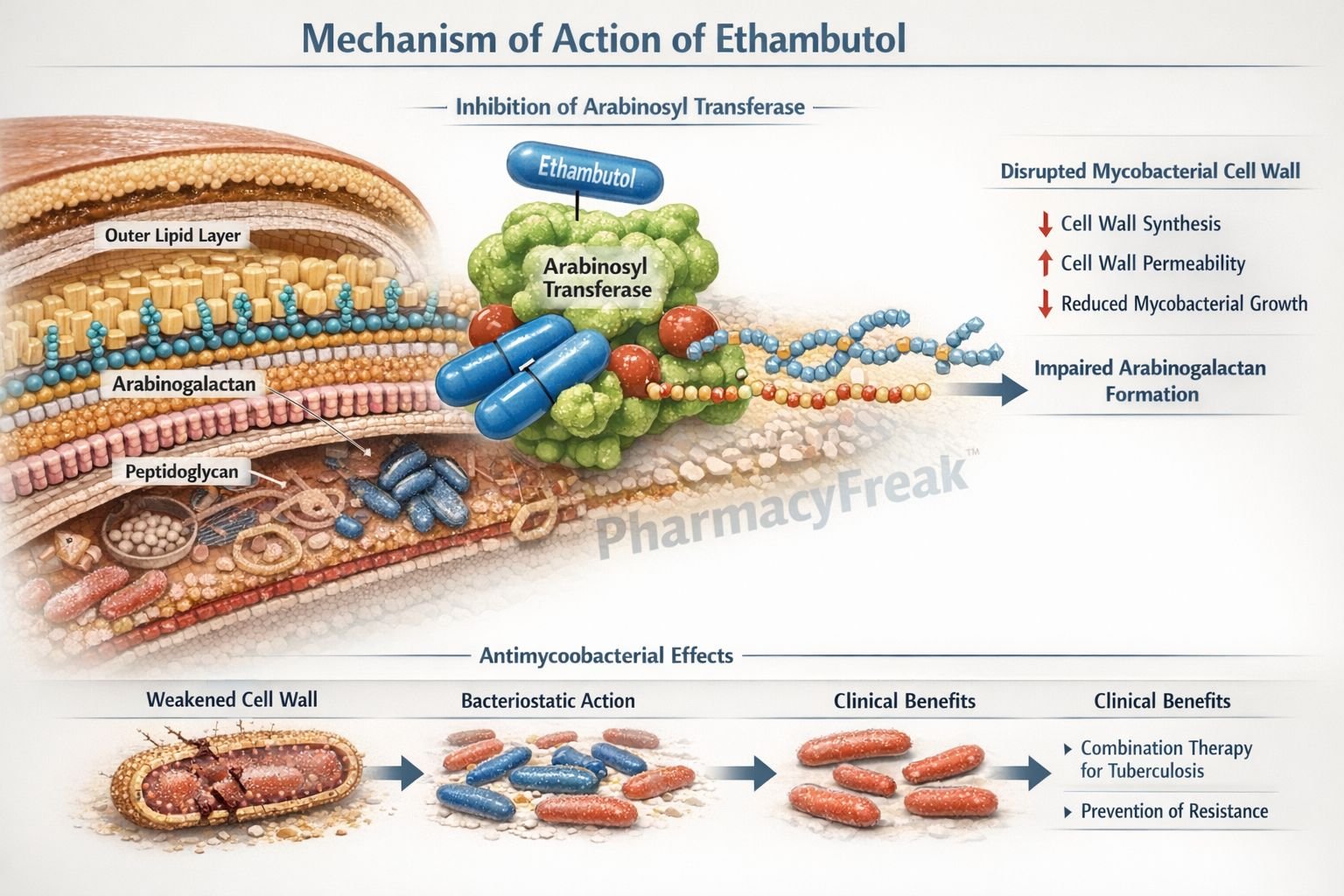
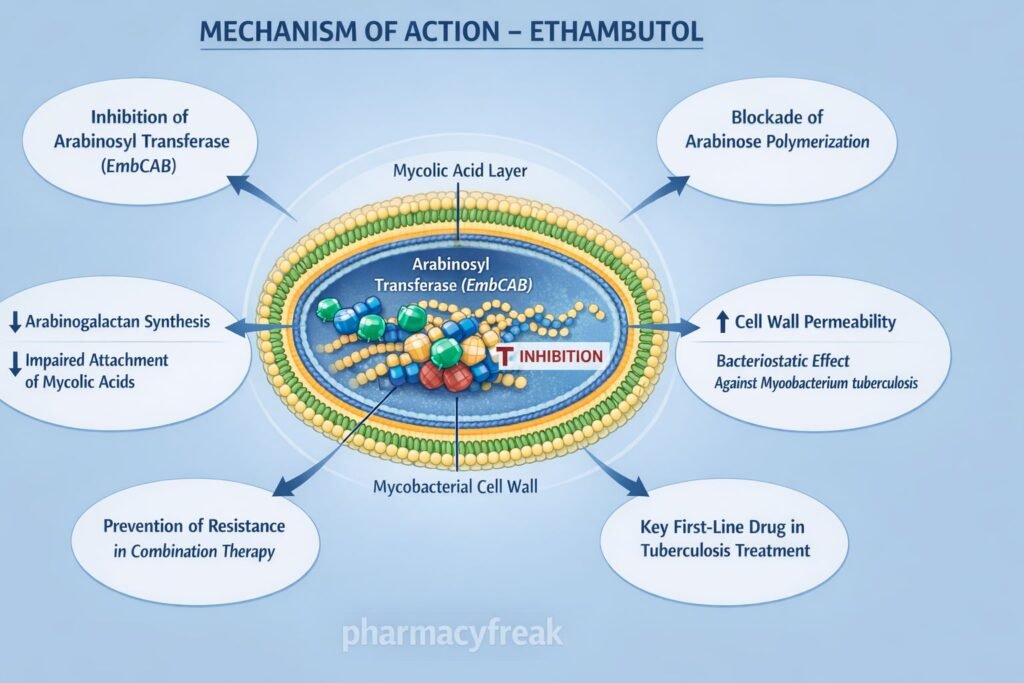
Ethambutol inhibits mycobacterial cell wall synthesis by interfering with arabinan formation.
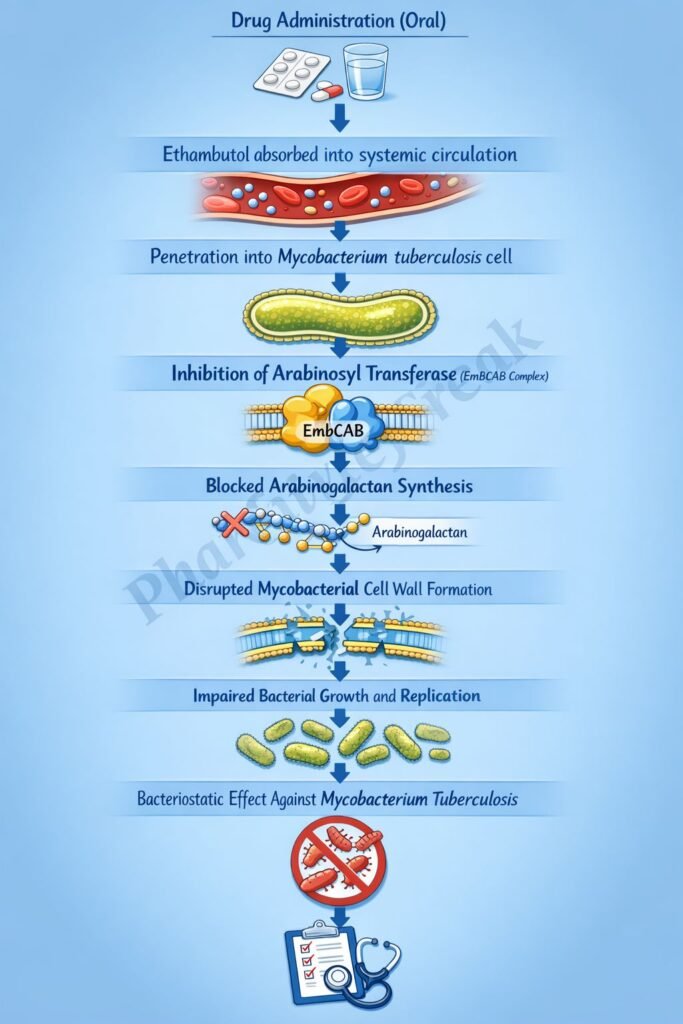
Step 1: Entry into Mycobacterium tuberculosis
Ethambutol penetrates the mycobacterial cell and reaches the cell wall synthesis machinery.
Step 2: Inhibition of arabinosyl transferase
It specifically inhibits arabinosyl transferase (EmbCAB complex), an enzyme essential for cell wall assembly.
Step 3: Impaired arabinogalactan synthesis
Inhibition of arabinosyl transferase prevents polymerization of arabinose into arabinogalactan, a key structural component of the mycobacterial cell wall.
Step 4: Disruption of cell wall integrity
Defective arabinogalactan weakens the mycobacterial cell wall and increases permeability.
Step 5: Bacteriostatic effect
Impaired cell wall synthesis inhibits bacterial growth and replication, making ethambutol bacteriostatic.
Pharmacokinetics
- Route of administration: Oral
- Absorption: Well absorbed from the gastrointestinal tract
- Distribution: Widely distributed; penetrates lung tissue and erythrocytes
- CNS penetration: Poor (improves in meningeal inflammation)
- Metabolism: Partial hepatic metabolism
- Half-life: 3–4 hours
- Excretion: Mainly renal (dose adjustment required in renal impairment)
Clinical Uses
- Pulmonary tuberculosis (part of first-line regimen)
- Extrapulmonary tuberculosis
- Drug-resistant tuberculosis (as per susceptibility testing)
Ethambutol is never used as monotherapy and is primarily included to prevent resistance to other antitubercular drugs.
Adverse Effects
Ocular (most important):
- Optic neuritis
- Decreased visual acuity
- Red–green color blindness (dose-related and reversible on early withdrawal)
Neurological:
- Peripheral neuropathy (rare)
- Headache
Others:
- Hyperuricemia
- Gastrointestinal upset
Exam pearl:
Regular visual acuity and color vision testing is mandatory during therapy.
Comparative Analysis
Ethambutol vs Isoniazid vs Pyrazinamide
| Feature | Ethambutol | Isoniazid | Pyrazinamide |
|---|---|---|---|
| Primary action | Cell wall synthesis | Mycolic acid synthesis | Cell membrane disruption |
| Bacteriostatic/cidal | Bacteriostatic | Bactericidal | Bactericidal |
| Major toxicity | Optic neuritis | Hepatotoxicity, neuropathy | Hepatotoxicity |
| Resistance prevention | Yes | Moderate | Moderate |
| Use in combination | Always | Always | Always |
Explanation:
Ethambutol is primarily included in anti-TB regimens to reduce resistance development. Unlike isoniazid and pyrazinamide, its defining toxicity is optic neuritis, making regular ophthalmic monitoring essential.
MCQs
- Ethambutol inhibits mycobacterial growth by blocking:
a) Mycolic acid synthesis
b) Protein synthesis
c) Arabinosyl transferase
d) DNA gyrase
Answer: c) Arabinosyl transferase
- Ethambutol interferes with synthesis of:
a) Peptidoglycan
b) Arabinogalactan
c) Mycolic acid
d) Lipopolysaccharide
Answer: b) Arabinogalactan
- Nature of antimicrobial action of ethambutol is:
a) Bactericidal
b) Bacteriostatic
c) Fungicidal
d) Virucidal
Answer: b) Bacteriostatic
- Most characteristic adverse effect of ethambutol is:
a) Hepatitis
b) Nephrotoxicity
c) Optic neuritis
d) Ototoxicity
Answer: c) Optic neuritis
- Color vision defect caused by ethambutol commonly affects:
a) Blue–yellow vision
b) Red–green vision
c) Black–white vision
d) Peripheral vision
Answer: b) Red–green vision
- Ethambutol is primarily excreted by the:
a) Liver
b) Lungs
c) Kidney
d) Intestine
Answer: c) Kidney
- Dose adjustment of ethambutol is required in:
a) Liver disease
b) Heart failure
c) Renal impairment
d) Diabetes
Answer: c) Renal impairment
- Ethambutol resistance occurs due to mutation in:
a) KatG gene
b) rpoB gene
c) embB gene
d) gyrA gene
Answer: c) embB gene
- Ethambutol is contraindicated in:
a) Diabetes mellitus
b) Hypertension
c) Optic neuritis
d) Peptic ulcer disease
Answer: c) Optic neuritis
- Ethambutol is included in TB regimens mainly to:
a) Reduce treatment duration
b) Prevent resistance
c) Increase bactericidal activity
d) Improve compliance
Answer: b) Prevent resistance
FAQs
1. Why is ethambutol bacteriostatic?
It inhibits cell wall synthesis without directly killing mycobacteria.
2. Why is vision monitoring required during therapy?
Because ethambutol can cause optic neuritis.
3. Is ethambutol safe in renal disease?
Dose adjustment is required due to renal excretion.
4. Can ethambutol be used alone?
No, it must always be used in combination therapy.
5. Is ethambutol toxicity reversible?
Yes, if detected early and the drug is discontinued promptly.
References
- Goodman & Gilman’s The Pharmacological Basis of Therapeutics
https://accesspharmacy.mhmedical.com - Katzung BG. Basic and Clinical Pharmacology
https://accessmedicine.mhmedical.com - Tripathi KD. Essentials of Medical Pharmacology
- Harrison’s Principles of Internal Medicine
https://accessmedicine.mhmedical.com