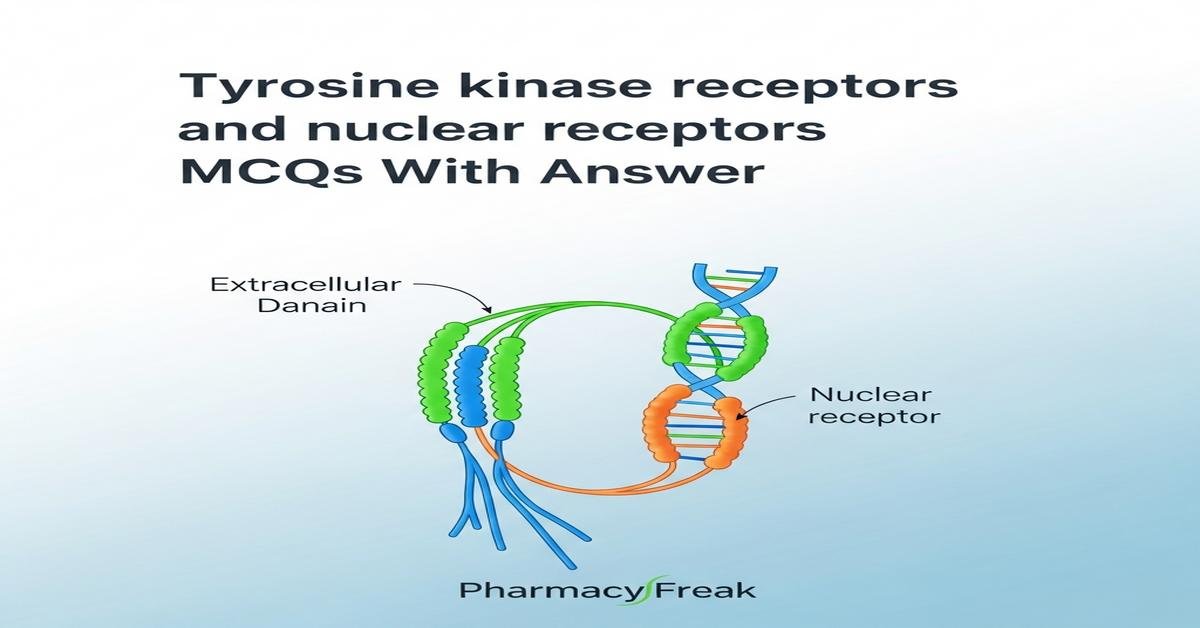
Tyrosine kinase receptors and nuclear receptors MCQs With Answer
This quiz collection is designed for M.Pharm students to reinforce and deepen understanding of receptor pharmacology focusing on receptor tyrosine kinases (RTKs) and nuclear receptors. Questions emphasize molecular structure, activation mechanisms, downstream signalling cascades, receptor regulation, pharmacological modulation and clinically relevant inhibitors/ligands. The problems range from core concepts (dimerization, autophosphorylation, DNA response elements) to applied topics (drug mechanisms, receptor cross-talk, receptor trafficking and cofactor dynamics). Explanatory-style options help students practice critical thinking needed for advanced coursework and research. Use these MCQs for revision, self-assessment, or group discussion to prepare for exams and practical pharmacology applications.
Q1. Which structural feature is characteristic of receptor tyrosine kinases (RTKs)?
- A single transmembrane helix, an extracellular ligand-binding domain and an intracellular tyrosine kinase domain
- Seven transmembrane helices coupled to G proteins
- Intracellular ligand-binding domain and DNA-binding zinc fingers
- A cytosolic JAK kinase associated non-covalently with the receptor
Correct Answer: A single transmembrane helix, an extracellular ligand-binding domain and an intracellular tyrosine kinase domain
Q2. What is the primary molecular event that activates most RTKs after ligand binding?
- Ligand-induced receptor dimerization leading to trans-autophosphorylation of tyrosine residues
- Immediate cleavage of the receptor release domain that translocates to nucleus
- Binding of GTP to an intrinsic GTPase domain in the receptor
- Recruitment of nuclear corepressors to the receptor complex
Correct Answer: Ligand-induced receptor dimerization leading to trans-autophosphorylation of tyrosine residues
Q3. Which downstream signalling pathways are commonly activated by RTKs?
- RAS/RAF/MEK/ERK (MAPK), PI3K/Akt and PLCγ pathways
- cAMP/PKA and direct GPCR-mediated arrestin signalling only
- Canonical Wnt/β-catenin exclusively
- Intrinsic mitochondrial apoptosis pathway only
Correct Answer: RAS/RAF/MEK/ERK (MAPK), PI3K/Akt and PLCγ pathways
Q4. How do small-molecule inhibitors like gefitinib and erlotinib inhibit EGFR activity?
- By competing with ATP for binding at the receptor tyrosine kinase catalytic site
- By blocking ligand binding to the extracellular domain
- By irreversibly alkylating cysteine residues in the DNA-binding domain
- By promoting proteasomal degradation of EGFR mRNA
Correct Answer: By competing with ATP for binding at the receptor tyrosine kinase catalytic site
Q5. What is a distinguishing feature of the insulin receptor compared with many other RTKs?
- It exists as a preformed disulfide-linked α2β2 dimer that undergoes conformational changes on ligand binding
- It signals exclusively through G-proteins after ligand binding
- It has seven transmembrane domains characteristic of GPCRs
- It directly translocates to the nucleus to act as a transcription factor
Correct Answer: It exists as a preformed disulfide-linked α2β2 dimer that undergoes conformational changes on ligand binding
Q6. Which statement best describes multi-kinase RTK inhibitors such as sunitinib?
- They target multiple receptor tyrosine kinases (e.g., VEGFR, PDGFR) to inhibit angiogenesis and tumour growth
- They activate RTKs to promote receptor recycling and cell survival
- They are monoclonal antibodies that block ligand binding to a single receptor subtype
- They specifically inhibit nuclear receptor DNA binding
Correct Answer: They target multiple receptor tyrosine kinases (e.g., VEGFR, PDGFR) to inhibit angiogenesis and tumour growth
Q7. Which domain arrangement correctly describes classical nuclear receptor architecture?
- N-terminal A/B domain with AF-1, central DNA-binding domain (C) with zinc fingers, hinge D domain, ligand-binding domain (E) containing AF-2
- Single transmembrane helix, intracellular SH2 domain and extracellular ligand-binding zinc finger
- Multiple transmembrane helices with intracellular kinase domain and extracellular zinc-finger DNA-binding motif
- RNA-binding domain, transmembrane domain and GTPase domain
Correct Answer: N-terminal A/B domain with AF-1, central DNA-binding domain (C) with zinc fingers, hinge D domain, ligand-binding domain (E) containing AF-2
Q8. How do Type I and Type II nuclear receptors generally differ in DNA-binding and localization?
- Type I (steroid receptors) are cytosolic and often form homodimers on palindromic response elements; Type II (thyroid, retinoid receptors) are nuclear and form heterodimers with RXR on direct repeats
- Type I receptors exclusively bind RNA; Type II receptors are membrane-bound enzymes
- Type I receptors are permanently nuclear heterodimers with RXR; Type II receptors are cytosolic monomers
- There is no difference; both types are identical in localization and dimerization
Correct Answer: Type I (steroid receptors) are cytosolic and often form homodimers on palindromic response elements; Type II (thyroid, retinoid receptors) are nuclear and form heterodimers with RXR on direct repeats
Q9. Tamoxifen’s pharmacological action best exemplifies which concept?
- Selective estrogen receptor modulation: antagonist in breast tissue but partial agonist in uterus and bone
- Irreversible inhibition of estrogen receptor kinase activity
- Complete systemic blockade of estrogen synthesis
- Activation of estrogen receptor dimerization leading to global coactivator recruitment in all tissues
Correct Answer: Selective estrogen receptor modulation: antagonist in breast tissue but partial agonist in uterus and bone
Q10. In the absence of ligand, thyroid hormone receptors often repress transcription because they:
- Bind DNA as RXR heterodimers and recruit corepressors (e.g., NCoR/SMRT) and histone deacetylases
- Are sequestered in the mitochondria and cannot access nuclear DNA
- Constitute constitutive activators of transcription even without ligand
- Undergo ubiquitin-mediated degradation preventing DNA binding
Correct Answer: Bind DNA as RXR heterodimers and recruit corepressors (e.g., NCoR/SMRT) and histone deacetylases
Q11. What defines an “orphan” nuclear receptor?
- A receptor identified by sequence homology whose endogenous ligand was unknown at discovery
- A nuclear receptor that permanently resides in mitochondria and never binds ligand
- A receptor that is only activated by synthetic drugs and never by endogenous compounds
- A receptor lacking a DNA-binding domain and unable to regulate transcription
Correct Answer: A receptor identified by sequence homology whose endogenous ligand was unknown at discovery
Q12. What role do heat shock proteins (e.g., Hsp90) play in steroid receptor signalling?
- They chaperone unliganded steroid receptors in the cytoplasm maintaining an inactive conformation until ligand binding
- They methylate histones to promote transcriptional activation by receptors
- They serve as DNA-binding cofactors that directly recognize response elements
- They ubiquitinate receptors to promote immediate degradation upon ligand binding
Correct Answer: They chaperone unliganded steroid receptors in the cytoplasm maintaining an inactive conformation until ligand binding
Q13. The consensus estrogen response element (ERE) is best described as:
- A palindromic inverted repeat of the sequence GGTCAnnnTGACC (two half-sites separated by 3 bp)
- A single direct repeat separated by five nucleotides only recognized by RXR homodimers
- An AT-rich TATA box located 30 bp upstream of the transcription start site
- A stem-loop RNA structure that binds ligand-activated receptors
Correct Answer: A palindromic inverted repeat of the sequence GGTCAnnnTGACC (two half-sites separated by 3 bp)
Q14. Mifepristone (RU-486) primarily acts as:
- A competitive antagonist of progesterone receptor and antagonist/partial agonist at glucocorticoid receptor
- An irreversible covalent activator of progesterone receptor transcriptional activity
- A selective estrogen receptor degrader (SERD)
- A tyrosine kinase inhibitor that blocks nuclear receptor phosphorylation
Correct Answer: A competitive antagonist of progesterone receptor and antagonist/partial agonist at glucocorticoid receptor
Q15. Which mechanism commonly targets activated RTKs for downregulation after ligand stimulation?
- Ubiquitination by E3 ligases such as Cbl followed by clathrin-mediated endocytosis and lysosomal degradation
- Direct dephosphorylation by nuclear phosphatases resulting in immediate transcriptional activation
- Export to mitochondria for proteolytic processing enhancing signalling
- Conversion into G-protein-coupled receptors by proteolytic cleavage
Correct Answer: Ubiquitination by E3 ligases such as Cbl followed by clathrin-mediated endocytosis and lysosomal degradation
Q16. How do receptor tyrosine kinases differ from receptor serine/threonine kinases?
- They phosphorylate tyrosine residues on substrates, whereas receptor serine/threonine kinases phosphorylate serine or threonine residues and often have distinct downstream SMAD signalling
- RTKs are exclusively nuclear while serine/threonine receptors are membrane-bound GPCRs
- RTKs are activated by cyclic nucleotides whereas serine/threonine kinases are activated by calcium
- There is no biochemical distinction; both phosphorylate the same residues interchangeably
Correct Answer: They phosphorylate tyrosine residues on substrates, whereas receptor serine/threonine kinases phosphorylate serine or threonine residues and often have distinct downstream SMAD signalling
Q17. Peroxisome proliferator-activated receptors (PPARs) regulate metabolic genes primarily by:
- Forming heterodimers with RXR and binding PPAR response elements to modulate transcription of lipid metabolism genes
- Directly phosphorylating enzyme targets in the cytosol independent of DNA binding
- Acting as ion channels across the inner mitochondrial membrane
- Sequestering insulin receptors at the plasma membrane to inhibit glucose uptake
Correct Answer: Forming heterodimers with RXR and binding PPAR response elements to modulate transcription of lipid metabolism genes
Q18. The tissue-selective actions of selective nuclear receptor modulators (e.g., SERMs) are largely due to:
- Differential recruitment of coactivators or corepressors by the receptor-ligand complex in different cell types
- Complete blockade of receptor nuclear localization in all tissues equally
- Irreversible receptor degradation in target tissues only
- Universal enhancement of receptor DNA-binding affinity in all tissues
Correct Answer: Differential recruitment of coactivators or corepressors by the receptor-ligand complex in different cell types
Q19. Bcr-Abl fusion protein, a target of imatinib, is best classified as which type of kinase?
- A constitutively active non-receptor (cytosolic) tyrosine kinase resulting from chromosomal translocation
- A receptor tyrosine kinase localized at the plasma membrane activated by growth factors
- A receptor serine/threonine kinase involved in TGF-β signalling
- An ion channel-associated kinase that phosphorylates tyrosines extracellularly
Correct Answer: A constitutively active non-receptor (cytosolic) tyrosine kinase resulting from chromosomal translocation
Q20. Ligand binding to the nuclear receptor ligand-binding domain commonly triggers which structural change important for coactivator binding?
- Repositioning of helix 12 (AF-2) to create a surface that recruits LXXLL-motif-containing coactivators
- Cleavage of the DNA-binding zinc fingers leading to receptor export from the nucleus
- Assembly of a seven-transmembrane helical bundle that activates heterotrimeric G-proteins
- Immediate proteasomal degradation preventing any gene regulation
Correct Answer: Repositioning of helix 12 (AF-2) to create a surface that recruits LXXLL-motif-containing coactivators

