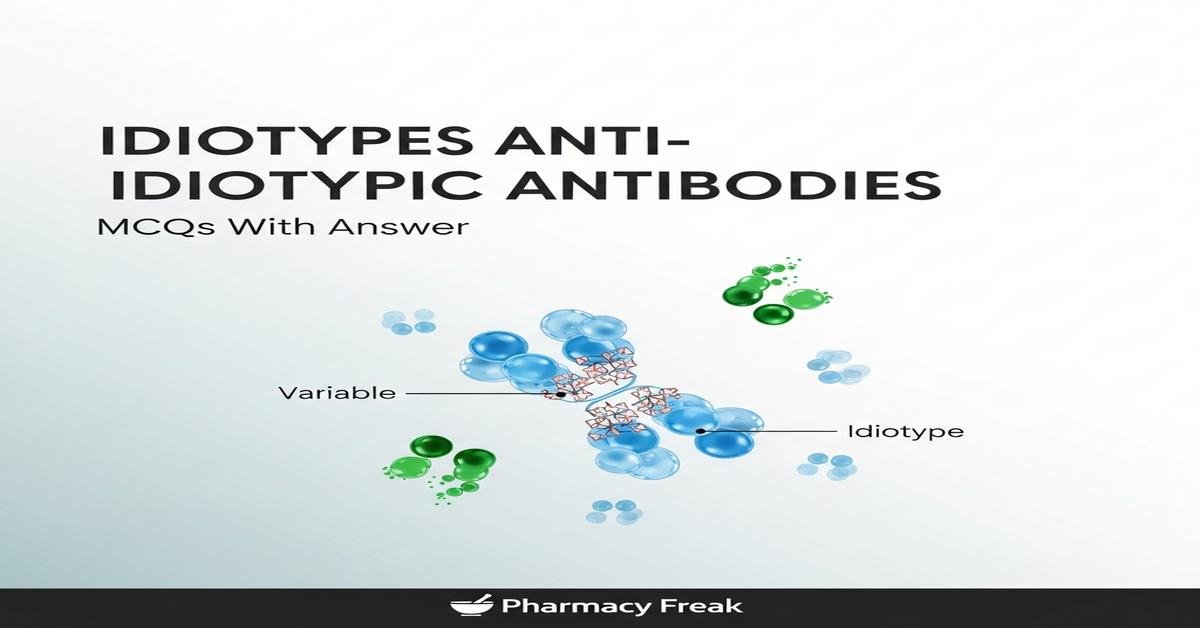
Introduction: Idiotypes and anti-idiotypic antibodies MCQs With Answer is a focused question set designed for M.Pharm students studying Immunotechnology. This collection explores the molecular basis of idiotypes—unique antigenic determinants on antibody variable regions—and the generation, classification and function of anti-idiotypic antibodies. Questions probe mechanisms such as the internal-image concept, Ab1/Ab2/Ab3 relationships, laboratory techniques for detection and mapping, therapeutic and vaccine applications, and analytical uses in drug development. The MCQs emphasize conceptual depth and practical implications for biologics, immunogenicity assessment and assay standardization, helping students consolidate advanced knowledge required for research and clinical translation in antibody-based technologies.
Q1. What is an idiotype in immunology?
- Set of antigenic determinants located on the constant region of an antibody
- Set of unique antigenic determinants (idiotopes) present on the variable region of an antibody
- All epitopes on a protein antigen that an antibody can bind
- The antigen-binding site shape only determined by antigen structure
Correct Answer: Set of unique antigenic determinants (idiotopes) present on the variable region of an antibody
Q2. Which statement best distinguishes an idiotope from a paratope?
- An idiotope is the antigen; a paratope is the antibody
- An idiotope is any epitope on an antigen; a paratope is any epitope on an antibody
- An idiotope is an antigenic determinant on the antibody’s variable region; a paratope is the antigen-binding site of the antibody
- An idiotope is the constant-region determinant; a paratope is the hinge region
Correct Answer: An idiotope is an antigenic determinant on the antibody’s variable region; a paratope is the antigen-binding site of the antibody
Q3. Which class of anti-idiotypic antibodies is described as possessing an “internal image” that can mimic the original antigen?
- Ab2α
- Ab2β
- Ab2γ
- Ab3
Correct Answer: Ab2β
Q4. Which laboratory technique is most commonly used to quantify anti-idiotypic antibodies as surrogate standards in bioanalytical assays?
- Competitive ELISA using anti-idiotype as competitor
- Western blot using denatured antigen
- Mass spectrometry-based proteomics
- Immunoprecipitation without labeled reagents
Correct Answer: Competitive ELISA using anti-idiotype as competitor
Q5. In vaccine design, how can an anti-idiotypic antibody serve as a vaccine antigen?
- By acting as an adjuvant to increase innate immunity
- By providing a scaffold to present T-cell epitopes only
- By mimicking the original antigen (internal image) and inducing antibodies that recognize the antigen
- By neutralizing host antibodies to lower autoimmunity
Correct Answer: By mimicking the original antigen (internal image) and inducing antibodies that recognize the antigen
Q6. What is the standard method for generating monoclonal anti-idiotypic antibodies in the laboratory?
- Phage display from human serum without selection
- Hybridoma technology: immunize an animal with Ab1, fuse splenocytes with myeloma cells and screen clones
- Direct chemical synthesis of variable regions
- Passive transfer of polyclonal serum
Correct Answer: Hybridoma technology: immunize an animal with Ab1, fuse splenocytes with myeloma cells and screen clones
Q7. Which technique is most appropriate to demonstrate idiotype expression on malignant B cells for tumor-specific targeting?
- Flow cytometry using anti-idiotype monoclonal antibodies
- Chromatography of serum immunoglobulins
- RT-PCR for constant region transcripts only
- Standard bacterial culture and sensitivity
Correct Answer: Flow cytometry using anti-idiotype monoclonal antibodies
Q8. Who proposed the idiotype network theory that posits regulatory networks of antibodies and anti-antibodies?
- Paul Ehrlich
- Niels Jerne
- Emil von Behring
- Gerald Edelman
Correct Answer: Niels Jerne
Q9. In the Ab1–Ab2–Ab3 cascade, which antibody is produced after immunization with an anti-idiotypic antibody and may resemble the original Ab1?
- Ab0
- Ab2
- Ab3
- Ab4
Correct Answer: Ab3
Q10. If an anti-idiotypic antibody binds directly to the antigen-binding (paratope) site of Ab1 and acts as a structural mimic of the original antigen, it is classified as:
- An Ab2α, non-inhibitory anti-idiotype
- An Ab2β, internal-image anti-idiotype
- An Ab2γ, steric-hindrance anti-idiotype
- Ab3, anti-anti-idiotype
Correct Answer: An Ab2β, internal-image anti-idiotype
Q11. Which practical application best describes the use of anti-idiotypic antibodies in bioanalytical assay development for monoclonal therapeutics?
- They are used as general protein stains for SDS-PAGE
- They serve as surrogate antigens or calibrators to quantify therapeutic antibody concentration and to evaluate assay specificity
- They replace the Fc receptor in cell-based assays
- They are used only for complement activation studies
Correct Answer: They serve as surrogate antigens or calibrators to quantify therapeutic antibody concentration and to evaluate assay specificity
Q12. Idiotopes are typically formed by which structural components of the antibody?
- Only the CH2 and CH3 constant domains
- Complementarity-determining regions (CDRs) and adjacent framework residues within the variable domains
- The carbohydrate moieties on Fc region
- The transmembrane region of B-cell receptors exclusively
Correct Answer: Complementarity-determining regions (CDRs) and adjacent framework residues within the variable domains
Q13. Why are anti-idiotypic antibodies valuable in pharmacokinetic (PK) assays of therapeutic monoclonal antibodies?
- They increase half-life of the therapeutic antibody in vivo
- They allow specific quantification of the therapeutic antibody even in the presence of circulating antigen and complex formation
- They eliminate all interfering immunoglobulins in serum
- They are used to denature the therapeutic antibody for measurement
Correct Answer: They allow specific quantification of the therapeutic antibody even in the presence of circulating antigen and complex formation
Q14. Which characteristic best describes an Ab2γ anti-idiotypic antibody?
- Non-inhibitory and binds away from the paratope
- Internal-image mimic that structurally imitates antigen epitope
- Inhibitory by steric hindrance without mimicking the antigen structure
- Identical to the original Ab1 in sequence
Correct Answer: Inhibitory by steric hindrance without mimicking the antigen structure
Q15. When anti-idiotypic antibodies are used as vaccines, the desirable immune response is to induce:
- A cellular immune response that targets Fc receptors exclusively
- Production of Ab3 antibodies that recognize the original antigen and confer protective immunity
- Only innate immune activation without adaptive response
- Tolerance to the original antigen via regulatory T cells only
Correct Answer: Production of Ab3 antibodies that recognize the original antigen and confer protective immunity
Q16. Idiotype vaccines for B-cell lymphomas typically use which antigenic material?
- Generic pooled human IgG constant regions
- Patient-specific tumor immunoglobulin variable region (idiotype) as a tumor-specific antigen
- Lipid antigens from tumor membranes
- Common bacterial antigens to stimulate cross-reactivity
Correct Answer: Patient-specific tumor immunoglobulin variable region (idiotype) as a tumor-specific antigen
Q17. For neutralizing antibody assays against therapeutic monoclonal antibodies, how are anti-idiotypic monoclonal antibodies commonly used?
- As a universal negative control that never binds
- As a positive control or surrogate neutralizer because they can block the therapeutic antibody–antigen interaction
- Only to precipitate complement components
- To degrade the therapeutic antibody enzymatically
Correct Answer: As a positive control or surrogate neutralizer because they can block the therapeutic antibody–antigen interaction
Q18. Which approach is most appropriate to map critical conformational idiotopes involved in antigen mimicry?
- Linear peptide ELISA using short overlapping peptides exclusively
- Alanine-scanning mutagenesis and X-ray crystallography of the Ab–anti-idiotype complex
- Southern blotting of antibody genes
- Basic light microscopy of antibody solutions
Correct Answer: Alanine-scanning mutagenesis and X-ray crystallography of the Ab–anti-idiotype complex
Q19. What is a primary safety concern related to induction of anti-idiotypic responses against therapeutic antibodies?
- They always improve drug efficacy without risks
- They can generate anti-drug antibodies that neutralize the therapeutic and cause hypersensitivity or reduced efficacy
- They convert the therapeutic into an antigen-presenting cell
- They universally eliminate endogenous immunoglobulins
Correct Answer: They can generate anti-drug antibodies that neutralize the therapeutic and cause hypersensitivity or reduced efficacy
Q20. From a regulatory and assay-validation perspective, what is essential when using anti-idiotypic reagents as standards or controls?
- That they are generated in human donors without documentation
- That they are poorly characterized to mimic variability
- That they are well-characterized regarding specificity, affinity, purity and traceability with documented performance
- That they are only used once and discarded without data
Correct Answer: That they are well-characterized regarding specificity, affinity, purity and traceability with documented performance

