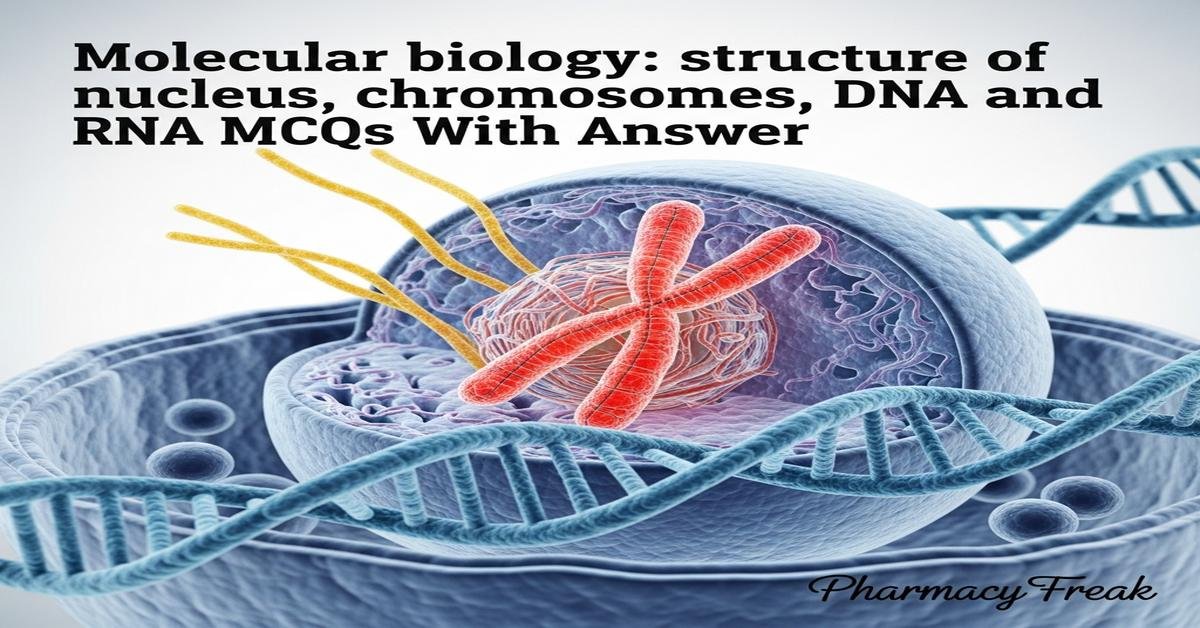
Molecular biology: structure of nucleus, chromosomes, DNA and RNA MCQs With Answer
This quiz collection is designed for M.Pharm students preparing for Microbial and Cellular Biology (MPB102T). It focuses on detailed, examinable aspects of nuclear structure, chromatin and chromosome organization, and the chemistry and biology of DNA and RNA. Questions cover nucleolar function, nucleosome composition, chromosomal elements (centromeres, telomeres, satellite DNA), DNA replication and topology, mitochondrial genomes, and RNA types and processing. Each MCQ includes four focused options and a clear correct answer to help you assess conceptual understanding and apply molecular principles to pharmaceutical contexts such as gene expression regulation, drug targets (e.g., topoisomerases), and genetic stability.
Q1. Which statement best describes the nuclear envelope?
- Single membrane with pores continuous with the rough endoplasmic reticulum
- Double membrane with perinuclear space and nuclear pore complexes
- Triple-layered membrane containing nuclear lamins embedded in the lumen
- Membrane-less compartment bounded by nucleoporins only
Correct Answer: Double membrane with perinuclear space and nuclear pore complexes
Q2. What is the primary function of the nucleolus?
- Replication of chromosomal DNA
- Synthesis of lipids and sterols
- rRNA transcription and ribosomal subunit assembly
- Packaging of heterochromatin at the nuclear periphery
Correct Answer: rRNA transcription and ribosomal subunit assembly
Q3. How is euchromatin best characterized compared to heterochromatin?
- More condensed, transcriptionally silent, late-replicating
- Less condensed, transcriptionally active, early-replicating
- Composed exclusively of repetitive satellite DNA
- Found only in prokaryotic genomes
Correct Answer: Less condensed, transcriptionally active, early-replicating
Q4. What is the nucleosome core particle composition?
- DNA wrapped around a histone tetramer H1-H2A only
- Approximately 147 bp of DNA wrapped around a histone octamer (two each of H2A, H2B, H3, H4)
- Single-stranded DNA bound to RNA polymerase complexes
- Protein scaffold of lamins with non-histone chromosomal proteins
Correct Answer: Approximately 147 bp of DNA wrapped around a histone octamer (two each of H2A, H2B, H3, H4)
Q5. Which role is specifically attributed to histone H1?
- Core histone forming the octamer around which DNA wraps
- Linker histone that binds linker DNA and promotes higher-order chromatin folding
- Enzyme that acetylates histone tails to activate transcription
- DNA methyltransferase that silences gene expression
Correct Answer: Linker histone that binds linker DNA and promotes higher-order chromatin folding
Q6. What is the principal function of the centromere?
- Initiation site for DNA replication
- Assembly site for the kinetochore and ensuring accurate chromosome segregation
- Region where telomerase binds to extend chromosome ends
- Main locus for rRNA gene clusters
Correct Answer: Assembly site for the kinetochore and ensuring accurate chromosome segregation
Q7. Which statement best describes telomeres?
- Protein complexes that initiate transcription at promoters
- Terminal tandem repeats (e.g., TTAGGG in humans) that protect chromosome ends
- Unique single-copy sequences located adjacent to centromeres
- Sites of active homologous recombination during meiosis only
Correct Answer: Terminal tandem repeats (e.g., TTAGGG in humans) that protect chromosome ends
Q8. What is satellite DNA?
- Highly repetitive tandem arrays often found in centromeric heterochromatin
- Protein-coding unique sequence distributed across exons
- Mitochondrial genome sequences integrated into the nucleus
- Short single-copy regulatory elements upstream of genes
Correct Answer: Highly repetitive tandem arrays often found in centromeric heterochromatin
Q9. What is the diploid chromosome number in normal human somatic cells?
- 23 chromosomes (haploid)
- 46 chromosomes (23 pairs)
- 92 chromosomes (tetraploid)
- 44 autosomes only, sex chromosomes vary
Correct Answer: 46 chromosomes (23 pairs)
Q10. Which description best fits the canonical B-form DNA?
- Left-handed helix with three bases per turn and no major groove
- Right-handed double helix with antiparallel strands and a sugar-phosphate backbone
- Single-stranded linear polymer without base pairing
- Z-form helix with wide major groove and narrow minor groove
Correct Answer: Right-handed double helix with antiparallel strands and a sugar-phosphate backbone
Q11. According to Chargaff’s rules, which hydrogen-bonding pattern is correct?
- Adenine pairs with cytosine via three hydrogen bonds
- Adenine pairs with thymine via two hydrogen bonds; guanine pairs with cytosine via three hydrogen bonds
- Guanine pairs with thymine via two hydrogen bonds
- All base pairs form identical numbers of hydrogen bonds
Correct Answer: Adenine pairs with thymine via two hydrogen bonds; guanine pairs with cytosine via three hydrogen bonds
Q12. In which direction do DNA polymerases synthesize new DNA strands?
- 3′ to 5′ direction using a 5′-OH
- 5′ to 3′ direction by adding nucleotides to the 3′-OH
- Bidirectional polymerization without strand polarity
- Synthesis only from RNA templates
Correct Answer: 5′ to 3′ direction by adding nucleotides to the 3′-OH
Q13. What are Okazaki fragments?
- Continuous stretches of DNA synthesized on the leading strand
- Short DNA fragments synthesized discontinuously on the lagging strand
- RNA primers removed during replication termination only
- Telomeric repeats added by telomerase
Correct Answer: Short DNA fragments synthesized discontinuously on the lagging strand
Q14. How do topoisomerase I and II differ mechanistically?
- Topoisomerase I introduces double-strand breaks; Topoisomerase II nicks a single strand only
- Topoisomerase I makes transient single-strand nicks; Topoisomerase II creates transient double-strand breaks and requires ATP
- Both enzymes only relax supercoils without breaking DNA
- Topoisomerase II functions exclusively in mitochondria while I is nuclear
Correct Answer: Topoisomerase I makes transient single-strand nicks; Topoisomerase II creates transient double-strand breaks and requires ATP
Q15. Which statement distinguishes eukaryotic chromatin packaging from prokaryotic DNA organization?
- Eukaryotes lack histones and package DNA with nucleoid-associated proteins only
- Eukaryotic DNA is wrapped around histones forming nucleosomes; prokaryotes generally lack nucleosomes
- Prokaryotic DNA is linear and organized into chromatin domains identical to eukaryotes
- Eukaryotic genomes are always circular while prokaryotic are linear
Correct Answer: Eukaryotic DNA is wrapped around histones forming nucleosomes; prokaryotes generally lack nucleosomes
Q16. Which feature is characteristic of mitochondrial DNA (mtDNA) in humans?
- Large linear chromosomes packaged with histones
- Circular genome, maternally inherited, encoding rRNAs, tRNAs and some proteins
- Equally inherited from both parents and integrated into nuclear chromosomes
- Contains intron-rich gene clusters similar to nuclear genes
Correct Answer: Circular genome, maternally inherited, encoding rRNAs, tRNAs and some proteins
Q17. Which RNA class is a core component of the spliceosome and mediates pre-mRNA splicing?
- rRNA (ribosomal RNA)
- tRNA (transfer RNA)
- snRNA (small nuclear RNA)
- miRNA (microRNA)
Correct Answer: snRNA (small nuclear RNA)
Q18. What is a defining structural feature of tRNA molecules?
- Linear single-stranded RNA without secondary structure
- Cloverleaf secondary structure with an anticodon loop and a 3′ CCA acceptor sequence
- Long polyadenylated tail critical for amino acid attachment
- Double-stranded RNA helix identical to rRNA
Correct Answer: Cloverleaf secondary structure with an anticodon loop and a 3′ CCA acceptor sequence
Q19. Which processing events are typical for eukaryotic pre-mRNA maturation?
- Only 3′ polyadenylation with no splicing or capping
- 5′ cap addition, 3′ polyadenylation, and intron removal by splicing
- Direct export to cytoplasm without modification
- Reverse transcription into DNA before translation
Correct Answer: 5′ cap addition, 3′ polyadenylation, and intron removal by splicing
Q20. Which RNA polymerase in eukaryotes is primarily responsible for synthesizing pre-mRNA (the precursor to mRNA)?
- RNA polymerase I
- RNA polymerase II
- RNA polymerase III
- RNA-dependent RNA polymerase
Correct Answer: RNA polymerase II

