
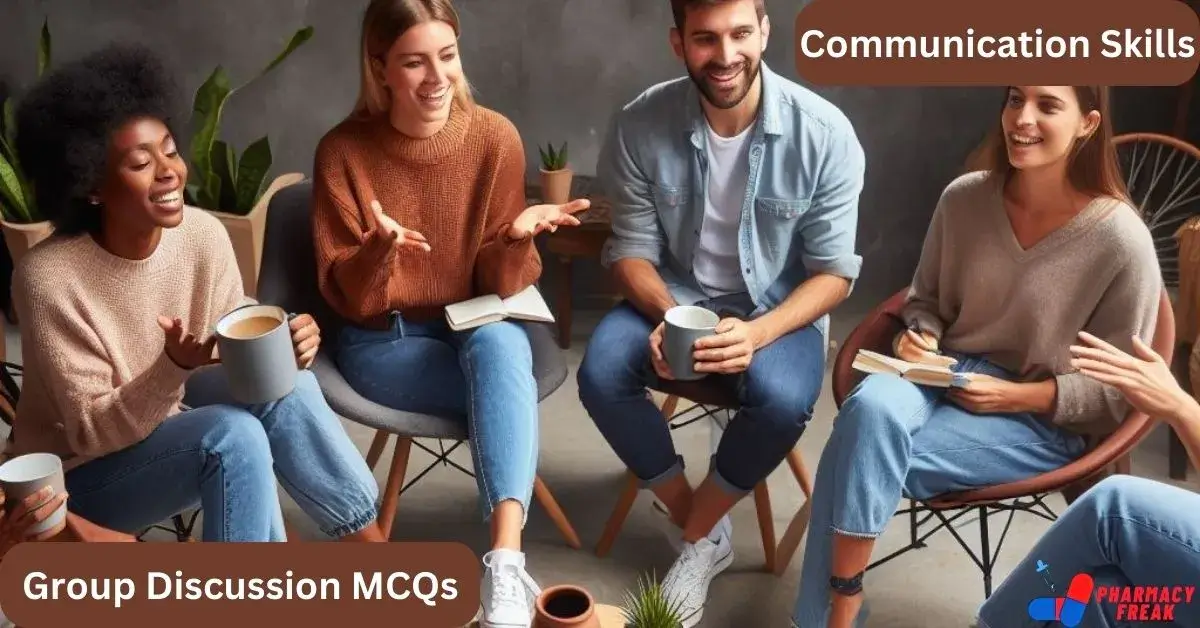
We have provided 30 MCQs on Group Discussion, Unit-5, 1st semester, COMMUNICATION SKILLS, B. Pharm.
We have covered following topics.
Group Discussion: Introduction, Communication skills in group discussion, Do’s and Dont’s of group discussion.
Table of Contents
MCQ on Group Discussion
1. What is a group discussion?
- A. A formal meeting in which a group of people discuss a topic.
- B. An informal conversation between a group of people.
- C. A debate between two or more people.
- D. A presentation by a group of people to a larger audience.
Answer: A
2. What are the benefits of participating in group discussions?
- A. Improve your communication and teamwork skills.
- B. Learn new things and broaden your perspective.
- C. Develop critical thinking and problem-solving skills.
Answer: D
3. What are some important communication skills for group discussion?
- A. Listening attentively and responding thoughtfully.
- B. Being able to articulate your ideas clearly and concisely.
- C. Being respectful of others’ opinions and perspectives.
Answer: D
4. How can you improve your listening skills in a group discussion?
- A. Make eye contact with the speaker and give them your full attention.
- B. Avoid interrupting the speaker or talking over them.
- C. Ask clarifying questions and summarize what you have heard.
Answer: D
5. What are some things you should do in a group discussion?
- A. Be prepared and have something to say.
- B. Be respectful of others’ opinions and perspectives.
- C. Be willing to listen attentively and respond thoughtfully.
Answer: D
6. What are some things you should not do in a group discussion?
- A. Dominate the conversation or talk over others.
- B. Be disrespectful or dismissive of others’ opinions.
- C. Go off on tangents or introduce irrelevant information.
Answer: D
7. What are some tips for handling difficult people in a group discussion?
- A. Remain calm and collected.
- B. Try to understand their perspective and why they are behaving that way.
- C. Be assertive and communicate your boundaries.
Answer: D
8. What is the best way to end a group discussion?
- A. Summarize the main points of the discussion and restate the group’s consensus (if there is one).
- B. Thank everyone for their participation and remind them of any next steps.
Answer: C
9. What are the different types of group discussions?
- A. Structured and unstructured group discussions.
- B. Formal and informal group discussions.
- C. Topic-based and skill-based group discussions.
Answer: D
10. What are the different roles that people play in a group discussion?
- A. Initiator, contributor, summarizer, and observer.
- B. Leader, follower, and moderator.
- C. Problem solver, decision maker, and communicator.
Answer: A
11. How can you improve your speaking skills in a group discussion?
- A. Practice speaking clearly and confidently.
- B. Use body language and gestures effectively.
- C. Be mindful of your tone of voice.
Answer: D
12. What are some common mistakes to avoid when speaking in a group discussion?
- A. Mumbling or speaking too softly.
- B. Speaking too quickly or without pausing.
- C. Using filler words and phrases such as “um” and “like.”
Answer: D
13. What are some things you should do to show respect for others in a group discussion?
- A. Listen attentively and respond thoughtfully.
- B. Make eye contact and nod your head to show that you are listening.
- C. Avoid interrupting or talking over others.
Answer: D
14. What are some things you should not do to show disrespect for others in a group discussion?
- A. Dismissing or belittling others’ opinions.
- B. Attacking others personally.
- C. Using foul language or insults.
Answer: D
15. What is the best way to handle a situation where you disagree with someone in a group discussion?
- A. State your disagreement respectfully and explain your reasoning.
- B. Be open to hearing the other person’s perspective and considering changing your own.
- C. Be willing to compromise and find a solution that works for everyone.
Answer: D
16. What is the best way to summarize a group discussion?
- A. Identify the key points that were discussed.
- B. Restate the group’s consensus (if there is one).
- C. Suggest next steps for the group to take.
Answer: D
17. What is the difference between a structured and an unstructured group discussion?
- A. A structured group discussion follows a specific format and agenda, while an unstructured group discussion is more free-form.
Answer: A
18. What are some of the benefits of participating in structured group discussions?
- A. They help you to practice your communication and teamwork skills in a structured environment.
- B. They can give you feedback on your performance from a trained moderator.
- C. They can help you to learn about different perspectives and viewpoints on a topic.
Answer: D
19. How can you improve your body language and gestures in a group discussion?
- A. Be mindful of your posture and facial expressions.
- B. Make eye contact with the speaker and other members of the group.
- C. Use gestures to emphasize your points and make your presentation more engaging.
Answer: D
20. What are some common mistakes to avoid when using body language and gestures in a group discussion?
- A. Slouching or fidgeting.
- B. Crossing your arms or legs.
- C. Making aggressive or distracting gestures.
Answer: D
21. What are some things you should do to be a good contributor in a group discussion?
- A. Be prepared and have something to say.
- B. Listen attentively to others’ contributions.
- C. Be respectful of others’ opinions and perspectives.
Answer: D
22. What are some things you should not do in a group discussion?
- A. Dominate the conversation or talk over others.
- B. Be disruptive or disrespectful.
- C. Go off on tangents or introduce irrelevant information.
Answer: D
23. What is the best way to handle a situation where you are not familiar with the topic of the group discussion?
- A. Be honest and upfront about your lack of knowledge.
- B. Ask clarifying questions and listen attentively to others’ contributions.
- C. Try to contribute to the discussion in a meaningful way, even if you do not have expert knowledge on the topic.
Answer: D
24. What is the best way to end your participation in a group discussion?
- A. Summarize your main points and thank the group for their time.
- B. Be respectful of others’ time and allow them to finish their contributions.
- C. Be open to feedback and willing to learn from others.
Answer: D
25. What are some of the benefits of participating in unstructured group discussions?
- A. They can help you to develop your critical thinking and problem-solving skills.
- B. They can help you to learn about different perspectives and viewpoints on a topic.
- C. They can help you to improve your communication and teamwork skills.
Answer: D
26. How can you improve your body language and gestures in a group discussion?
- A. Be mindful of your posture and facial expressions.
- B. Make eye contact with the speaker and other members of the group.
- C. Use gestures to emphasize your points and make your presentation more engaging.
Answer: D
27. What are some common mistakes to avoid when using body language and gestures in a group discussion?
- A. Slouching or fidgeting.
- B. Crossing your arms or legs.
- C. Making aggressive or distracting gestures.
Answer: D
28. What is the best way to handle a situation where you are not familiar with the topic of the group discussion?
- A. Be honest and upfront about your lack of knowledge.
- B. Ask clarifying questions and listen attentively to others’ contributions.
- C. Try to contribute to the discussion in a meaningful way, even if you do not have expert knowledge on the topic.
Answer: D
29. What is the best way to end your participation in a group discussion?
- A. Summarize your main points and thank the group for their time.
- B. Be respectful of others’ time and allow them to finish their contributions.
- C. Be open to feedback and willing to learn from others.
Answer: D
30. What are some important qualities of a good leader in a group discussion?
- A. The ability to listen and communicate effectively.
- B. Being open to different perspectives and willing to make decisions.
- C. The capacity to motivate and guide the group.
Answer: D
31. What should a group discussion leader do to facilitate a productive discussion?
- A. Set clear objectives and an agenda for the discussion.
- B. Encourage active participation from all members of the group.
- C. Ensure that the discussion stays on track and within the allotted time.
Answer: D
32. How can a group discussion leader handle disagreements or conflicts within the group?
- A. Encourage respectful dialogue and provide a neutral perspective.
- B. Mediate conflicts and help the group reach a resolution.
- C. Empower group members to resolve their disagreements independently.
Answer: D
33. In a structured group discussion, what role does a moderator typically play?
- A. The moderator sets the discussion agenda and objectives.
- B. The moderator evaluates participants’ performance and provides feedback.
- C. The moderator guides the discussion, ensures it stays on track, and enforces time limits.
Answer: C
34. How can group members ensure that the discussion remains focused and on-topic?
- A. By adhering to the agenda and objectives set by the leader or moderator.
- B. By allowing tangential discussions to develop and exploring diverse topics.
- C. By imposing strict rules and regulations on what can be discussed.
Answer: A
35. What is the purpose of giving feedback to group members during or after a discussion?
- A. To criticize and point out flaws in their contributions.
- B. To motivate and encourage further participation and improvement.
- C. To discourage them from participating in future discussions.
Answer: B
36. How can group members actively encourage and involve quieter or less talkative participants in the discussion?
- A. By dominating the conversation to ensure everyone is heard.
- B. By making space for others to speak, asking for their opinions, and acknowledging their contributions.
- C. By interrupting and completing their sentences to help them express their thoughts.
Answer: B
37. In a group discussion, why is it essential to be aware of cultural differences and sensitivities?
- A. Cultural differences have no impact on group dynamics and discussions.
- B. To avoid unintentional misunderstandings and conflicts that may arise due to cultural disparities.
- C. Cultural sensitivity is irrelevant in a group setting.
Answer: B
38. How can technology, such as video conferencing or online platforms, impact the dynamics of a group discussion?
- A. Technology has no influence on group discussions.
- B. It can enhance remote collaboration and provide flexibility but may also lead to technical issues and distractions.
- C. Technology only hinders the effectiveness of group discussions.
Answer: B
39. What are some key considerations when choosing a physical or virtual location for a group discussion?
- A. Accessibility, comfort, and the availability of necessary resources and technology.
- B. Proximity to the group members’ homes.
- C. Aesthetic appeal of the location.
Answer: A
40. In a group discussion, what does the term “brainstorming” refer to?
- A. A method of setting strict rules for the discussion.
- B. A technique for generating creative ideas and solutions through free and open sharing of thoughts.
- C. A formal presentation delivered by a group member.
Answer: B
More MCQs
Communication Skills
- Unit-1
- Unit-2
- Unit-3
- Unit-4
- Unit-5


