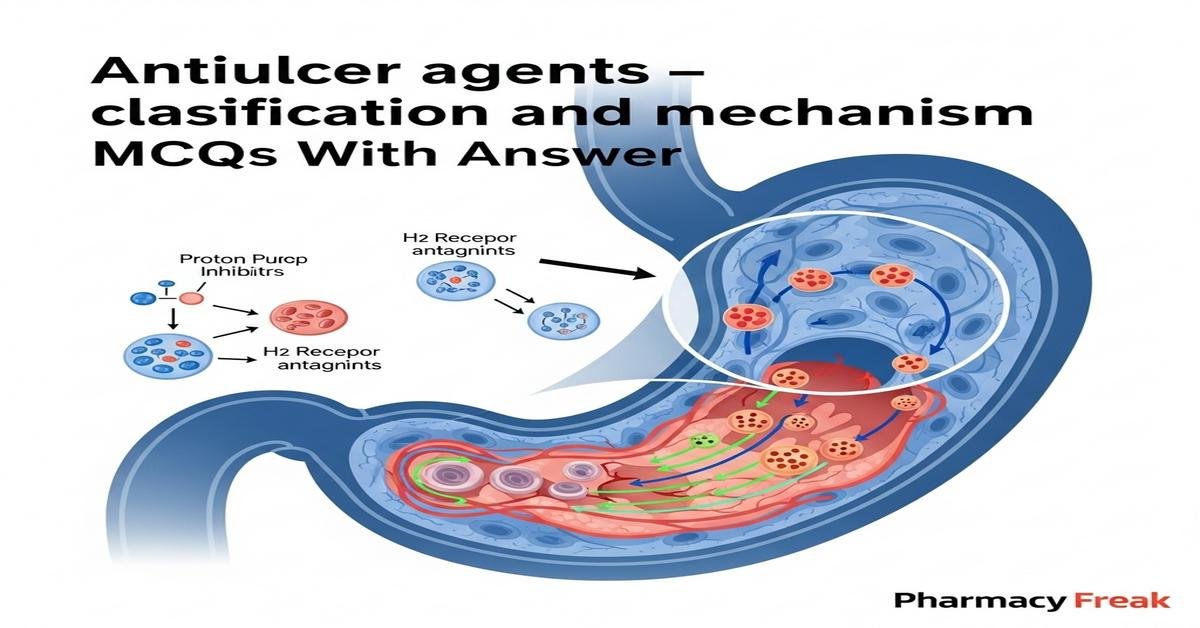
Antiulcer agents – classification and mechanism MCQs With Answer
This concise introduction reviews antiulcer agents for B. Pharm students, focusing on classification, cellular and molecular mechanisms, examples, pharmacokinetics, and clinically relevant adverse effects. Key topics include antacids, H2 receptor antagonists, proton pump inhibitors (PPIs), prostaglandin analogs, sucralfate, bismuth compounds, mucosal protectants, and Helicobacter pylori eradication regimens. Emphasis is placed on receptor signaling (H2–cAMP, M3–IP3/Ca2+), irreversible inhibition of H+/K+ ATPase by PPIs, and drug interactions such as CYP-mediated effects of cimetidine and PPIs. This targeted overview prepares you for applied questions on mechanism-based therapy, rational drug selection, and safety considerations. Now let’s test your knowledge with 30 MCQs on this topic.
Q1. Which class of antiulcer drug neutralizes gastric acid by direct chemical reaction?
- H2 receptor antagonists
- Proton pump inhibitors
- Antacids
- Prostaglandin analogs
Correct Answer: Antacids
Q2. Which enzyme is directly inhibited by proton pump inhibitors leading to reduced acid secretion?
- Gastric H+/K+ ATPase
- Pepsin
- Carbonic anhydrase
- Histidine decarboxylase
Correct Answer: Gastric H+/K+ ATPase
Q3. H2 receptor antagonists reduce acid secretion primarily by blocking which intracellular signaling pathway?
- Gs protein → increased cAMP
- Gi protein → decreased cAMP
- Gq protein → increased IP3/DAG
- Tyrosine kinase → MAPK activation
Correct Answer: Gs protein → increased cAMP
Q4. Which antiulcer agent is a prostaglandin E1 analog used to prevent NSAID-induced gastric ulcers?
- Misoprostol
- Sucralfate
- Omeprazole
- Ranitidine
Correct Answer: Misoprostol
Q5. Sucralfate exerts its protective action mainly by which mechanism?
- Neutralizing acid by chemical reaction
- Coating ulcer base and forming a viscous complex in acidic pH
- Inhibiting H2 receptors on parietal cells
- Blocking proton pump irreversibly
Correct Answer: Coating ulcer base and forming a viscous complex in acidic pH
Q6. Which antacid is most commonly associated with constipation as an adverse effect?
- Magnesium hydroxide
- Aluminium hydroxide
- Calcium carbonate
- Sodium bicarbonate
Correct Answer: Aluminium hydroxide
Q7. A major safety concern with long-term proton pump inhibitor therapy includes all EXCEPT:
- Hypomagnesemia
- Vitamin B12 deficiency
- Increased risk of gastric carcinoid tumors in humans (common finding)
- Increased risk of bone fractures
Correct Answer: Increased risk of gastric carcinoid tumors in humans (common finding)
Q8. Which H2 receptor antagonist is well known for CYP450 inhibition and antiandrogenic side effects?
- Famotidine
- Nizatidine
- Cimetidine
- Ranitidine
Correct Answer: Cimetidine
Q9. Which of the following antacids can cause milk-alkali syndrome when overused?
- Magnesium hydroxide
- Aluminium hydroxide
- Calcium carbonate
- Sodium bicarbonate
Correct Answer: Calcium carbonate
Q10. Proton pump inhibitors are prodrugs that require activation in which environment?
- Neutral pH of intestinal lumen
- Acidic secretory canaliculi of parietal cells
- Basic pH of blood plasma
- Alkaline duodenum
Correct Answer: Acidic secretory canaliculi of parietal cells
Q11. Which antiulcer agent directly stimulates mucus and bicarbonate secretion and enhances mucosal blood flow?
- Misoprostol
- Sucralfate
- Bismuth subsalicylate
- Omeprazole
Correct Answer: Misoprostol
Q12. Bismuth compounds used in H. pylori therapy act by which primary mechanism?
- Competitive inhibition of H2 receptors
- Coating ulcers and exerting topical antimicrobial effects
- Irreversible inhibition of proton pump
- Neutralizing gastric acid
Correct Answer: Coating ulcers and exerting topical antimicrobial effects
Q13. Which drug interaction is clinically significant with omeprazole?
- Enhances activation of clopidogrel via CYP2C19
- Inhibits CYP2C19 and can reduce clopidogrel activation
- Induces CYP3A4 increasing warfarin clearance
- Chelates with tetracyclines in stomach
Correct Answer: Inhibits CYP2C19 and can reduce clopidogrel activation
Q14. The most appropriate first-line pharmacotherapy for Zollinger–Ellison syndrome is:
- Antacids as needed
- H2 receptor antagonists only
- High-dose proton pump inhibitors
- Sucralfate monotherapy
Correct Answer: High-dose proton pump inhibitors
Q15. Which statement about H2 antagonists is true?
- They irreversibly inactivate the H+/K+ ATPase
- They competitively block histamine H2 receptors on parietal cells
- They require acid activation to be effective
- They increase gastrin secretion more than PPIs
Correct Answer: They competitively block histamine H2 receptors on parietal cells
Q16. Antacids containing magnesium are most likely to cause which adverse effect?
- Constipation
- Diarrhea
- Gynecomastia
- Hypercalcemia
Correct Answer: Diarrhea
Q17. Which antiulcer medication forms a viscous gel that selectively binds to ulcers and erosions, protecting them from acid and pepsin?
- Sucralfate
- Famotidine
- Magnesium hydroxide
- Omeprazole
Correct Answer: Sucralfate
Q18. Which receptor subtype on parietal cells mediates ACh-induced acid secretion via IP3/Ca2+ signaling?
- M1 muscarinic receptor
- M2 muscarinic receptor
- M3 muscarinic receptor
- Nicotinic receptor
Correct Answer: M3 muscarinic receptor
Q19. Which antiulcer agent is contraindicated in pregnancy due to uterine stimulant effects?
- Misoprostol
- Famotidine
- Sucralfate
- Omeprazole
Correct Answer: Misoprostol
Q20. Which of the following reduces the effectiveness of sucralfate when coadministered?
- Giving sucralfate before meals
- Concurrent high-dose antacid therapy that raises gastric pH
- Administration with acidic juices
- Separation from other drugs by 2 hours
Correct Answer: Concurrent high-dose antacid therapy that raises gastric pH
Q21. Which H2 blocker is considered most potent and has minimal CYP interactions among the listed options?
- Cimetidine
- Famotidine
- Ranitidine
- Nizatidine
Correct Answer: Famotidine
Q22. The major mechanism by which Helicobacter pylori contributes to peptic ulcer disease is:
- Direct stimulation of parietal cell proton pumps
- Disruption of mucous layer and induction of inflammation via urease activity and toxins
- Competitive inhibition of prostaglandin receptors
- Promoting systemic hyperacidity through gastrin release
Correct Answer: Disruption of mucous layer and induction of inflammation via urease activity and toxins
Q23. Which antiulcer drug can interfere with absorption of tetracyclines and fluoroquinolones by chelation?
- Proton pump inhibitors
- H2 receptor antagonists
- Antacids containing polyvalent cations (e.g., aluminium, magnesium, calcium)
- Misoprostol
Correct Answer: Antacids containing polyvalent cations (e.g., aluminium, magnesium, calcium)
Q24. Which is the most appropriate timing for administration of an oral proton pump inhibitor for optimal efficacy?
- At bedtime
- Immediately after a heavy meal
- 30–60 minutes before the first major meal of the day
- Any time; timing is irrelevant
Correct Answer: 30–60 minutes before the first major meal of the day
Q25. Which of the following is a common regimen component for H. pylori eradication along with a PPI?
- Single H2 blocker
- Bismuth subsalicylate and two antibiotics (bismuth quadruple) or two antibiotics without bismuth (triple therapy)
- Sucralfate monotherapy
- Antacid and prostaglandin analog
Correct Answer: Bismuth subsalicylate and two antibiotics (bismuth quadruple) or two antibiotics without bismuth (triple therapy)
Q26. Rebound acid hypersecretion after stopping therapy is most commonly associated with which drug class?
- Antacids
- H2 receptor antagonists
- Proton pump inhibitors
- Sucralfate
Correct Answer: Proton pump inhibitors
Q27. Which antiulcer agent’s systemic metabolism is significantly influenced by CYP2C19 polymorphism?
- Ranitidine
- Omeprazole (a proton pump inhibitor)
- Sucralfate
- Magnesium hydroxide
Correct Answer: Omeprazole (a proton pump inhibitor)
Q28. Which acid-suppressing drug class reduces pepsin activity indirectly by raising gastric pH?
- Antacids and proton pump inhibitors
- H2 receptor antagonists only
- Sucralfate only
- Bismuth compounds only
Correct Answer: Antacids and proton pump inhibitors
Q29. Long-term use of which agent is most associated with risk of Clostridioides difficile infection due to profound acid suppression?
- Antacids
- H2 receptor antagonists
- Proton pump inhibitors
- Sucralfate
Correct Answer: Proton pump inhibitors
Q30. Which statement best explains why PPIs must be activated in acidic canaliculi to inhibit the proton pump?
- Acid catalyzes conversion of prodrug to active sulfenamide that covalently binds H+/K+ ATPase
- Acid neutralizes the prodrug enabling systemic absorption
- Acid degrades the drug into inactive metabolites
- Acid prevents the drug from reaching parietal cells
Correct Answer: Acid catalyzes conversion of prodrug to active sulfenamide that covalently binds H+/K+ ATPase


