
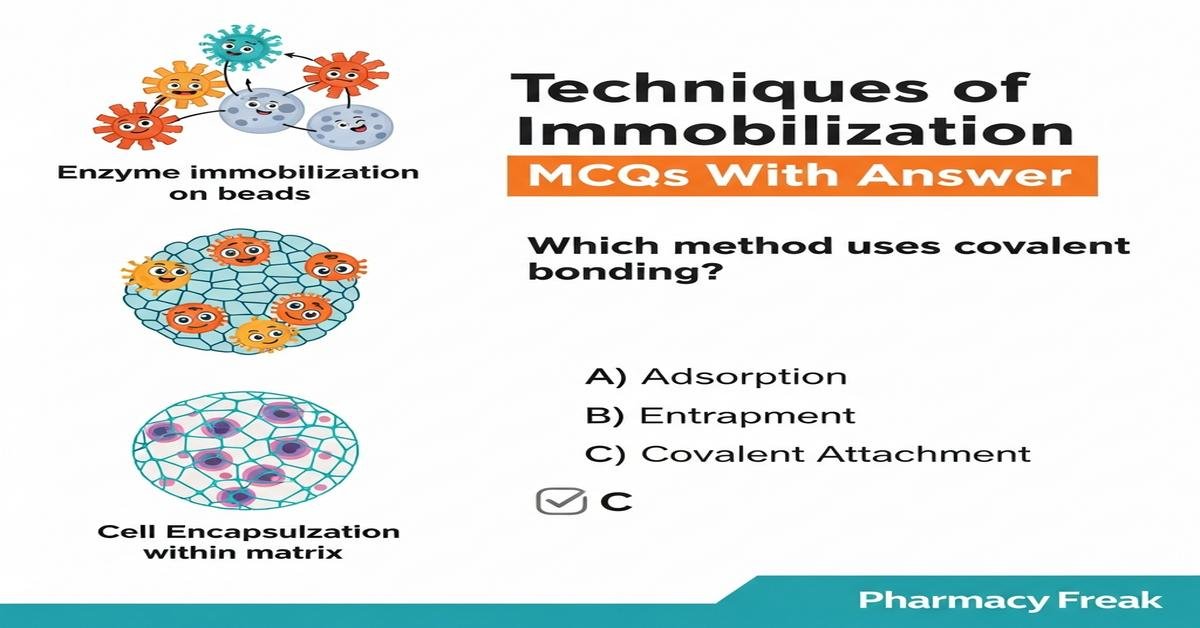
Techniques of Immobilization MCQs With Answer
This quiz collection is designed for M.Pharm students studying Bioprocess Engineering and Technology, focusing on enzyme and cell immobilization methods. It covers core techniques — adsorption, covalent binding, entrapment, cross-linking, encapsulation, and carrier-free approaches — and explores materials, reaction conditions, mass transfer limitations, stability, and reactor configurations. Questions emphasize mechanistic understanding, selection criteria, advantages and drawbacks, and practical considerations for pharmaceutical bioprocess design and scale-up. Each MCQ tests conceptual depth, analytical thinking, and application to real-world formulation and biocatalysis problems, helping students prepare for exams and research tasks involving immobilized biocatalysts and immobilized-cell reactors.
Q1. Which immobilization technique primarily relies on weak physical interactions such as van der Waals forces, hydrogen bonding and ionic interactions between enzyme and support?
- Entrapment within a polymer matrix
- Covalent binding to activated support
- Physical adsorption onto carrier surface
- Cross-linking of enzyme molecules
Correct Answer: Physical adsorption onto carrier surface
Q2. Which support property most directly reduces internal mass transfer limitations for immobilized enzymes?
- High surface hydrophobicity
- Small pore size below enzyme dimensions
- High macroporosity and interconnected pore network
- Strong ionic charge density
Correct Answer: High macroporosity and interconnected pore network
Q3. Which cross-linking reagent is most commonly used to create covalent bonds between lysine residues of enzymes and amino-functionalized supports?
- Calcium chloride
- Glutaraldehyde
- EDC/NHS carbodiimide chemistry
- Sodium alginate
Correct Answer: Glutaraldehyde
Q4. Carrier-free immobilized enzyme particles produced by precipitation and cross-linking are known as:
- Affinity supports
- Cross-linked enzyme aggregates (CLEAs)
- Alginate beads
- Polymeric microcapsules
Correct Answer: Cross-linked enzyme aggregates (CLEAs)
Q5. Which immobilization method typically provides the strongest covalent attachment and minimal enzyme leaching but risks multipoint attachment that can reduce activity?
- Physical adsorption
- Entrapment in agarose
- Covalent immobilization on functionalized silica
- Encapsulation in liposomes
Correct Answer: Covalent immobilization on functionalized silica
Q6. In alginate bead entrapment, what is the primary role of calcium ions (Ca2+)?
- To chemically cross-link enzyme active sites
- To gel the alginate by ionic cross-linking forming a bead matrix
- To act as a cofactor enhancing enzyme activity
- To increase bead hydrophobicity
Correct Answer: To gel the alginate by ionic cross-linking forming a bead matrix
Q7. Which immobilization technique is most suitable when reversible release and recovery of the enzyme without denaturation is required?
- Strong covalent linkage via epoxy groups
- Physical adsorption on weakly interacting support
- Cross-linking with glutaraldehyde
- Entrapment in chemically cured polyacrylamide
Correct Answer: Physical adsorption on weakly interacting support
Q8. What is a major disadvantage of entrapment methods in dense polymer matrices for small-molecule biotransformations?
- Excessive enzyme–support covalent bonding
- Severe external mass transfer limitations only
- Diffusional resistance causing decreased apparent reaction rates
- Complete prevention of enzyme denaturation
Correct Answer: Diffusional resistance causing decreased apparent reaction rates
Q9. Which technique is particularly effective for orienting enzymes to expose active sites while immobilized, using a specific ligand on the support?
- Random covalent attachment via glutaraldehyde
- Affinity immobilization using a specific ligand
- Physical entrapment in non-porous beads
- Cross-linking to form CLEAs
Correct Answer: Affinity immobilization using a specific ligand
Q10. For immobilized whole-cell biocatalysts used in continuous reactors, which reactor type minimizes pressure drop while allowing high cell density beads?
- Packed-bed reactor
- Stirred-tank reactor with free cells
- Membrane bioreactor with suspended cells
- Fluidized-bed reactor
Correct Answer: Fluidized-bed reactor
Q11. Which analytical method is most appropriate to determine the amount of enzyme covalently bound to a support after immobilization?
- Scanning electron microscopy imaging of beads
- SDS-PAGE of supernatant only
- Mass balance by measuring protein in washings and subtracting from initial load
- pH titration of immobilized preparation
Correct Answer: Mass balance by measuring protein in washings and subtracting from initial load
Q12. Multipoint covalent attachment of an enzyme to a rigid support typically leads to:
- Increased conformational flexibility and higher activity
- Enhanced thermal and operational stability but possible activity loss
- Immediate enzyme desorption under mild conditions
- Complete protection from substrate inhibition
Correct Answer: Enhanced thermal and operational stability but possible activity loss
Q13. Which support material is favored for immobilization in pharmaceutical biocatalysis due to its biocompatibility, tunable porosity, and gentle gelation conditions?
- Polystyrene latex beads
- Sodium alginate
- Sulfonated polystyrene resins
- Metallic nanoparticles
Correct Answer: Sodium alginate
Q14. When designing an immobilized enzyme process, which parameter best quantifies the fraction of enzyme activity retained after immobilization compared to the soluble form?
- Operational stability index
- Specific surface area
- Activity recovery (percent retained activity)
- Protein leaching rate
Correct Answer: Activity recovery (percent retained activity)
Q15. EDC/NHS chemistry is commonly used to couple carboxyl groups of supports to which functional group on proteins?
- Hydroxyl groups
- Amino groups (–NH2)
- Thiols (–SH)
- Guanidinium groups
Correct Answer: Amino groups (–NH2)
Q16. Which immobilization outcome is most likely if an enzyme is immobilized on a highly hydrophobic support without prior surface modification?
- Increased enzyme desorption due to hydrophilicity
- Strong irreversible adsorption possibly causing denaturation
- Selective covalent bond formation via hydrophobic residues
- Complete pore blockage with no substrate access
Correct Answer: Strong irreversible adsorption possibly causing denaturation
Q17. In a packed-bed reactor with immobilized enzymes, which factor most commonly causes a decline in conversion over repeated cycles?
- Increase of substrate concentration over time
- Enzyme leaching, denaturation, or fouling of support
- Conversion to a more active isoenzyme
- Improved mass transfer due to channeling
Correct Answer: Enzyme leaching, denaturation, or fouling of support
Q18. Co-immobilization of sequential pathway enzymes on the same support primarily aims to:
- Increase individual enzyme stability at the expense of pathway flux
- Enhance intermediate channeling and overall reaction efficiency
- Reduce substrate specificity of enzymes
- Prevent multi-enzyme complex formation
Correct Answer: Enhance intermediate channeling and overall reaction efficiency
Q19. Which kinetic effect is commonly observed for immobilized enzymes compared with their free counterparts due to mass transfer limitations?
- Apparent increase in Vmax with unchanged Km
- No change in apparent kinetic parameters
- Apparent increase in Km (lower apparent affinity) and decreased apparent Vmax
- Complete loss of Michaelis–Menten behavior
Correct Answer: Apparent increase in Km (lower apparent affinity) and decreased apparent Vmax
Q20. For large-scale pharmaceutical processes, which immobilization consideration is most critical to ensure regulatory compliance and product purity?
- Use of supports with unknown leachable impurities
- Thorough characterization of support chemistry, low leachables, and reproducible immobilization
- Maximizing enzyme load without characterization
- Choosing cheapest available materials regardless of trace contaminants
Correct Answer: Thorough characterization of support chemistry, low leachables, and reproducible immobilization

