
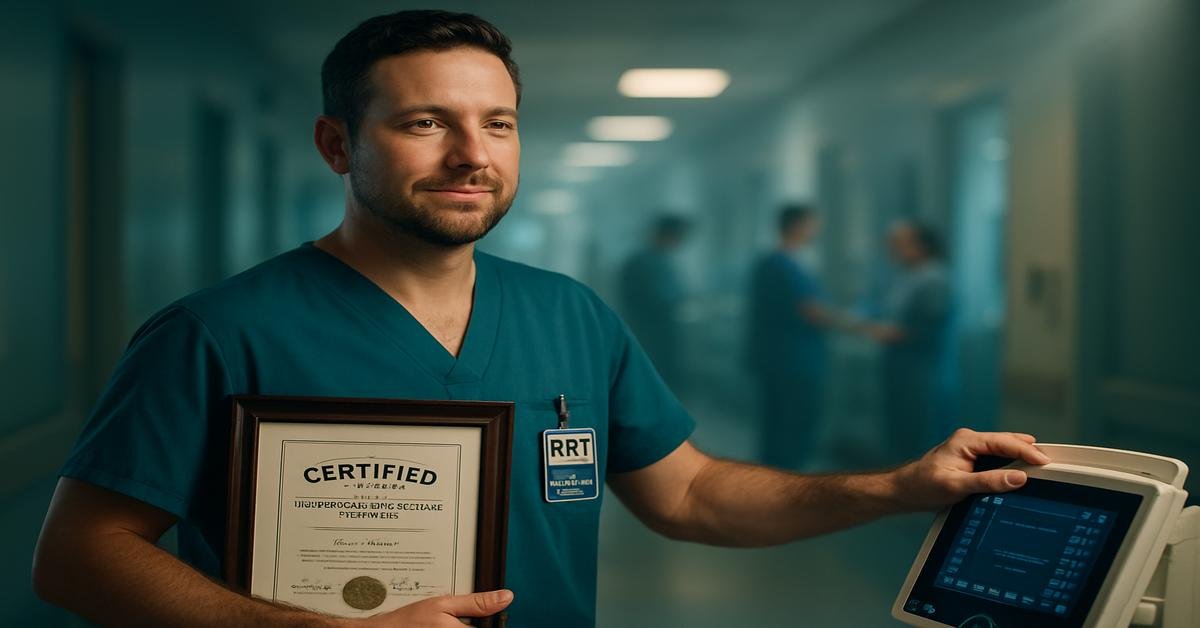
A career in respiratory care can last decades, but only if it keeps moving forward. For Registered Respiratory Therapists, staying certified is not just a box to check. It is one of the clearest ways to protect job options, income, credibility, and patient trust over the long term. Healthcare changes fast. Treatment standards shift. Equipment improves. Employer expectations rise. In that kind of environment, certification is not simply a starting point. It is part of how an RRT stays relevant, employable, and effective year after year.
Certification supports long-term career stability
Respiratory therapy is a profession built on skill, judgment, and current clinical knowledge. Employers need proof that those things are still in place. That is where certification matters. It tells hospitals, clinics, sleep centers, transport teams, and other employers that an RRT has maintained the standards expected in the field.
That matters more over time, not less. Early in a career, a candidate may be hired based on education, clinical rotations, and entry-level readiness. Ten or fifteen years later, employers look for evidence that the therapist has kept up with changes in care. A current credential helps answer that question quickly.
It also protects against career disruption. Healthcare systems merge. Staffing models change. New managers bring new expectations. A therapist who has stayed certified is in a stronger position when roles are restructured or when applying for a new job after years in the same department. Certification works like professional continuity. It shows steady commitment, even if the workplace around the therapist changes.
Patient care depends on current knowledge, not old training
Respiratory care is not a static field. Ventilator strategies evolve. Noninvasive support changes. Best practices in airway management, oxygen delivery, neonatal care, pulmonary rehabilitation, and critical care are updated as evidence grows. A therapist cannot rely on what was learned in school alone.
Staying certified helps push continued learning. That is important because outdated habits in respiratory care can affect real patient outcomes. A small gap in knowledge can lead to poor ventilator adjustments, missed warning signs, ineffective patient education, or incorrect responses during emergencies.
The value of certification is not the document itself. The value is what it represents: ongoing professional development. An RRT who stays current is more likely to understand why a newer protocol exists, when an old approach no longer fits, and how to adapt treatment safely.
For example, consider a therapist who trained before newer lung-protective ventilation practices became standard in many settings. If that therapist never keeps up with the field, they may continue using habits that do not reflect current evidence. Certification maintenance helps reduce that risk by keeping learning active.
Employers often treat certification as a baseline requirement
In many settings, current certification is not seen as optional. It is part of the minimum professional standard. Employers may tie it directly to hiring, onboarding, annual review, promotion, and continued employment.
This happens for practical reasons:
-
Risk management: Healthcare organizations need qualified staff who meet professional standards.
-
Accreditation and compliance: Facilities often need properly credentialed staff to meet internal and external requirements.
-
Quality of care: Employers want therapists who are current in clinical practice.
-
Public trust: Credentials help patients and families feel confident in the care team.
Even when a job does not strictly require an active RRT credential at every stage, it often affects who gets chosen for the better opportunities. A manager comparing two candidates may see one therapist with current credentials and recent continuing education, and another with a weaker record of maintenance. The first candidate usually looks more dependable.
That pattern shows up in promotions too. Charge roles, educator roles, leadership paths, specialty assignments, and critical care opportunities often go to people who show consistency in professional upkeep.
Staying certified helps protect earning potential
Long-term success is not only about staying employed. It is also about avoiding income plateaus. Current certification can support stronger earning power because it keeps more jobs open and helps therapists compete for advanced roles.
A therapist who lets certification lapse may still have experience, but experience alone does not always convert into higher pay if the credential status creates limits. Some employers will not consider that person for premium shifts, specialty teams, or leadership tracks. Others may require re-entry steps that cost time and money.
By contrast, therapists who maintain certification consistently are often better positioned to:
-
Apply for higher-paying hospital systems
-
Move into ICU, NICU, PICU, transport, or pulmonary diagnostics roles
-
Pursue educator, supervisor, or department lead positions
-
Negotiate pay based on continued professional development
-
Remain competitive in travel or contract work, where credential review is often strict
Income growth usually comes from flexibility and access. Certification helps preserve both.
Career mobility depends on keeping doors open
Many respiratory therapists do not stay in one role forever. Some move from bedside care into education, case management, sales, home care, sleep medicine, pulmonary function testing, or leadership. Others relocate to a different state or switch from adult care to pediatrics or neonatal work. These shifts are easier when certification has been maintained without interruption.
Gaps in certification can create friction. A therapist may need extra paperwork, additional proof of competency, or even retraining depending on the role and location. That does not mean recovery is impossible. It means the process becomes harder than it needed to be.
Career mobility matters because long careers are rarely linear. Personal circumstances change. Family needs change. Physical demands change. A therapist who no longer wants a heavy bedside schedule may need to move into another type of role. Current credentials make that transition smoother.
This is especially important in a physically and emotionally demanding profession. Not every RRT wants to work nights, critical care, or emergency response forever. Staying certified helps preserve choices later, when those choices matter most.
Certification strengthens professional credibility
Credibility is easy to overlook because it is hard to measure, but it affects daily work. A current RRT credential sends a simple message to peers, physicians, nurses, administrators, and patients: this therapist takes professional standards seriously.
That message matters in team-based care. Respiratory therapists are often expected to make recommendations, respond during crises, educate patients, and contribute to treatment planning. Those responsibilities depend partly on trust. When a therapist maintains certification and continues learning, that trust is easier to build.
Credibility also matters outside direct patient care. If an RRT wants to teach, precept students, join committees, speak at staff education sessions, or move into policy or quality improvement work, certification supports their authority. People are more likely to listen when they see current professional standing backed by continued competence.
This is not about status. It is about confidence. Credentials do not replace judgment or experience, but they support both by showing that the therapist remains engaged with the profession.
The field changes, and certified therapists adapt faster
Healthcare technology does not stand still. Respiratory therapists work with devices, monitoring systems, and treatment methods that continue to evolve. Someone who stays certified is more likely to stay mentally prepared for those changes because continuing education builds the habit of adaptation.
That habit becomes valuable when new equipment is introduced or protocols are revised. Therapists who have kept learning tend to ask better questions, understand the reasons behind change, and adopt safer practices more quickly. They are often the staff members who help others adjust.
For example, when a department rolls out a new ventilator platform or changes a high-flow oxygen protocol, therapists with recent education are often more comfortable connecting the new process to existing physiology and patient care goals. That reduces confusion and improves consistency on the unit.
Over a long career, adaptability is one of the biggest predictors of staying effective. Certification maintenance supports that adaptability in a structured way.
Letting certification lapse can create avoidable setbacks
Many professionals do not plan to let credentials lapse. Life happens. Work gets busy. Family responsibilities grow. Deadlines are missed. But even a temporary lapse can create bigger problems than expected.
Possible setbacks include:
-
Delayed job applications
-
Loss of eligibility for internal promotions
-
Extra fees or reinstatement steps
-
Questions from employers about professional reliability
-
Reduced confidence during interviews or evaluations
There is also a psychological cost. When therapists fall behind on certification, they may start to feel disconnected from the profession. That can affect motivation, career planning, and willingness to pursue better roles. Staying current helps prevent that drift.
In other words, certification maintenance is easier than career repair.
Long careers require intentional professional identity
People who last in healthcare usually have more than technical skill. They have a strong sense of professional identity. They see themselves not just as employees, but as members of a clinical discipline with standards, responsibilities, and long-term growth.
Staying certified reinforces that identity. It creates a regular point of reflection: What has changed in the field? What do I need to update? Where do I want my career to go next? Those questions are useful because they keep a therapist from becoming passive.
Passive careers often stall. Intentional careers tend to grow.
For an RRT, that might mean using certification maintenance as a reason to deepen a specialty interest, improve clinical teaching skills, prepare for leadership, or strengthen knowledge in an area that has become more important at work. The process can be practical, not abstract. It can shape the next stage of a career.
How to make certification maintenance manageable
One reason some professionals fall behind is that they treat renewal as a once-in-a-while event instead of an ongoing routine. That approach creates stress and makes it easier to miss deadlines. A better method is to spread the work across the year.
Useful habits include:
-
Track deadlines early: Put renewal dates and required steps in a calendar with reminders months in advance.
-
Break continuing education into small pieces: A little each month is easier than a rush at the end.
-
Choose education tied to real work: Focus on topics that improve current practice or support future goals.
-
Keep records organized: Save completion documents in one place so renewal is simpler.
-
Review career direction yearly: Use certification periods as a checkpoint for professional planning.
This kind of system reduces stress and turns maintenance into part of normal career management. It also makes the learning more useful, because it is chosen with purpose rather than completed at the last minute.
Why staying certified matters more as the years go on
At the start of a respiratory therapy career, certification proves readiness to enter the field. Later, it proves something different: durability. It shows that the therapist has not stood still while medicine, technology, and patient needs have changed.
That is why staying certified becomes more valuable over time. It supports employability, income, mobility, adaptability, and professional trust. It protects against avoidable setbacks and helps therapists stay connected to the standards of their profession. Most of all, it benefits patient care by encouraging current, informed practice.
For Registered Respiratory Therapists who want long-term success, certification should not be viewed as an administrative burden. It is a practical career tool. It keeps doors open. It protects hard-earned experience. And in a field where being current can directly affect patient outcomes, it remains one of the clearest signs that a therapist is ready for the next stage of a long and meaningful career.

