Table of Contents
Introduction
Monoamine oxidase inhibitors (MAO inhibitors) are a class of antidepressant drugs used in the treatment of major depressive disorder, atypical depression, and certain anxiety disorders. They increase the availability of key neurotransmitters such as serotonin, norepinephrine, and dopamine by inhibiting their enzymatic breakdown. Although effective, their use is limited due to dietary restrictions and significant drug interactions.
Mechanism of Action (Step-wise)
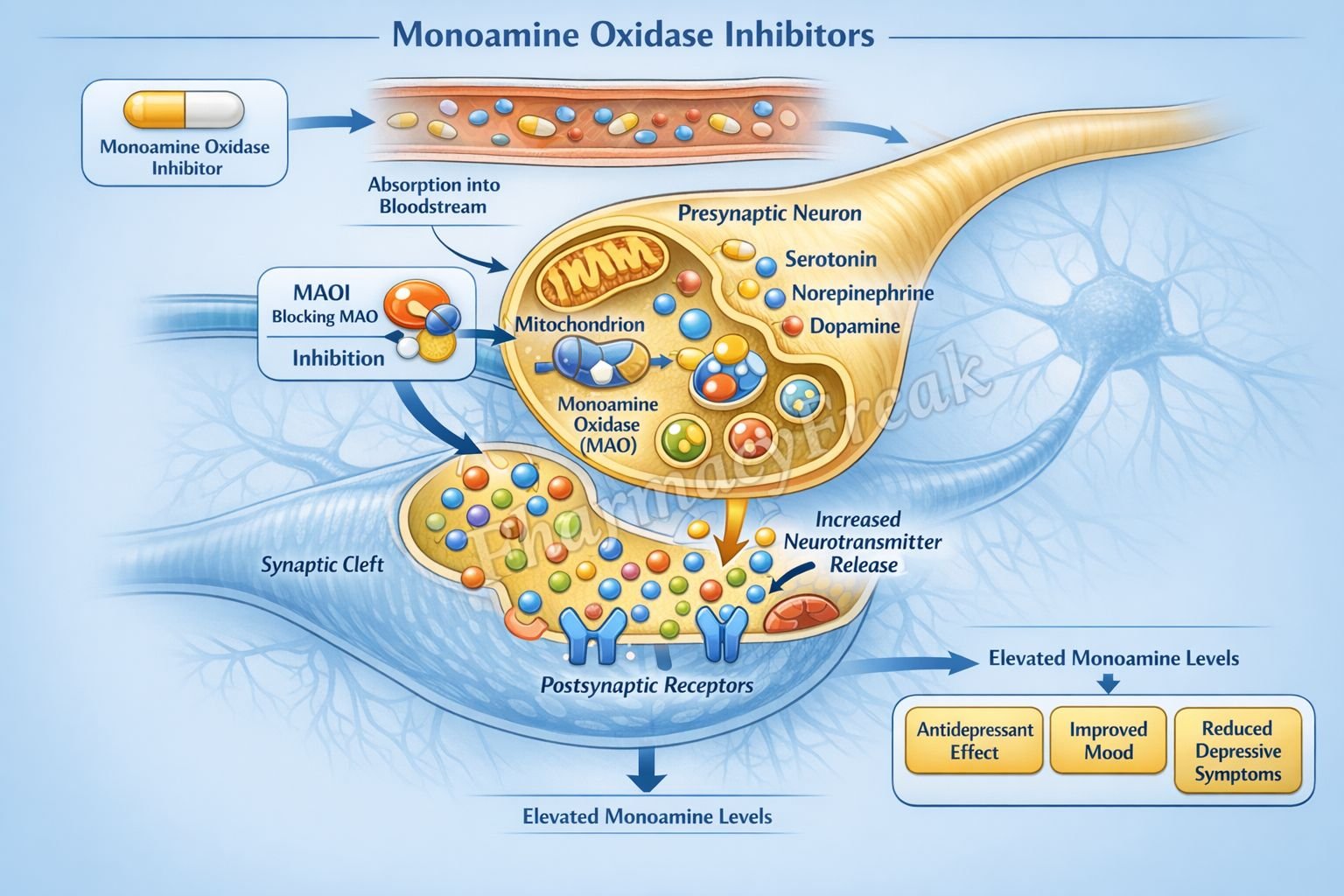
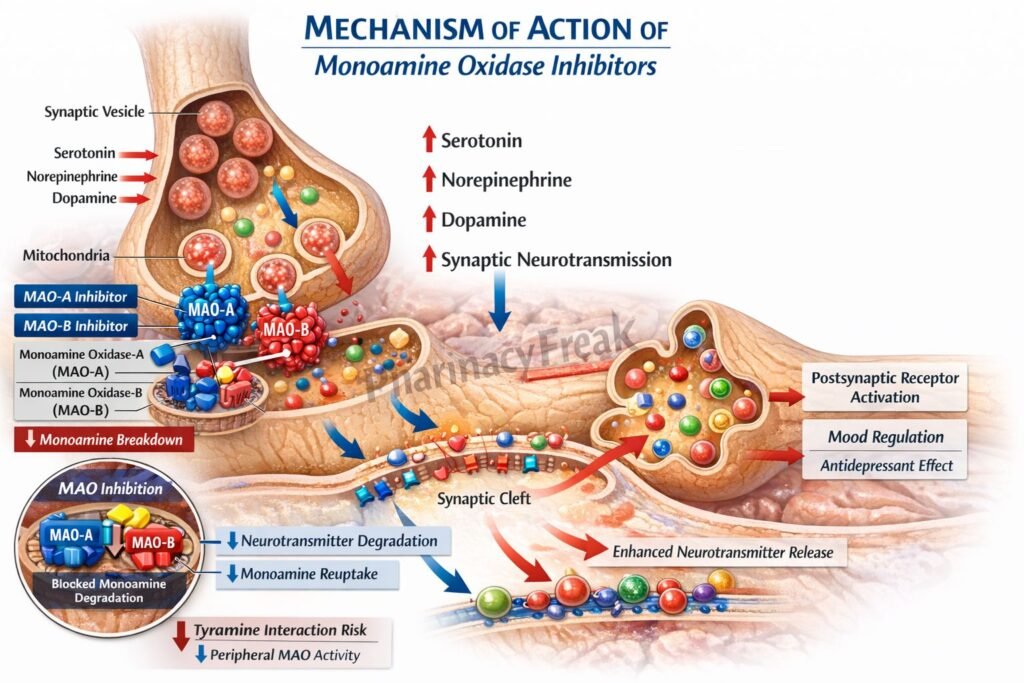
- Monoamine oxidase (MAO) is an enzyme located in the outer mitochondrial membrane of neurons.
- It exists in two isoforms: MAO-A and MAO-B.
- MAO-A metabolizes serotonin, norepinephrine, and tyramine.
- MAO-B metabolizes dopamine and phenylethylamine.
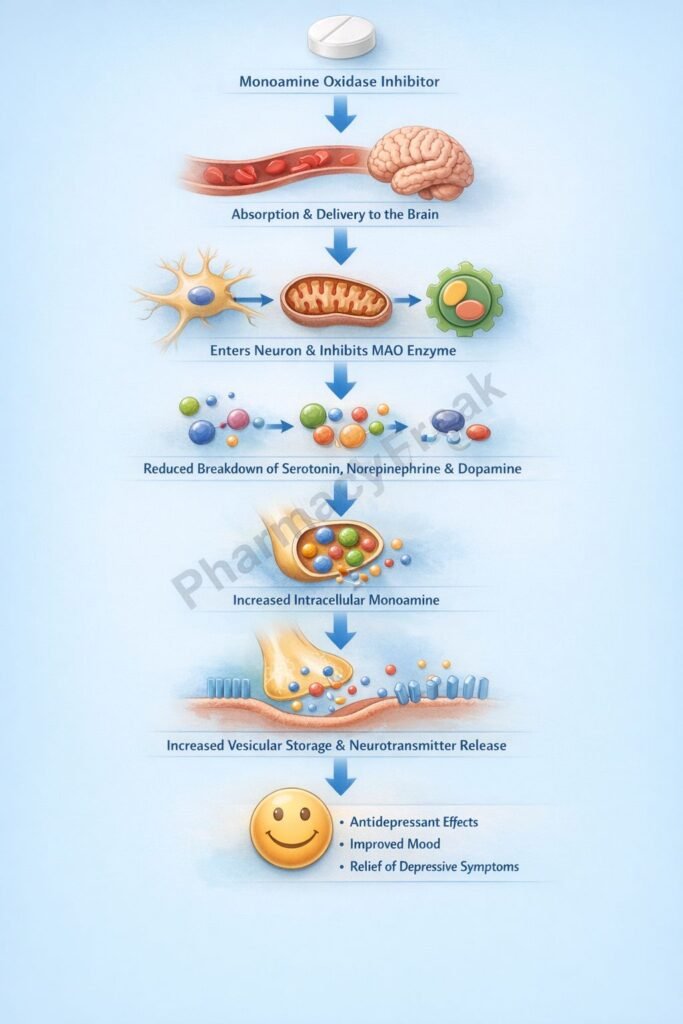
- MAO inhibitors bind to and inhibit these enzymes (reversibly or irreversibly).
- Inhibition prevents degradation of monoamine neurotransmitters.
- This leads to increased intracellular levels of serotonin, norepinephrine, and dopamine.
- More neurotransmitters are stored in synaptic vesicles.
- Upon release, higher concentrations are available in the synaptic cleft.
- This enhances neurotransmission and improves mood.
A key exam point is that MAO inhibitors increase monoamine levels by preventing their breakdown.
Pharmacokinetics
MAO inhibitors are administered orally and are well absorbed. Many classical MAO inhibitors (e.g., phenelzine, tranylcypromine) irreversibly inhibit MAO, meaning enzyme activity returns only after new enzyme synthesis. Their pharmacological effects persist longer than their plasma half-life. They are metabolized in the liver and excreted via urine. Some newer agents selectively inhibit MAO-B and may be reversible.
Clinical Uses
MAO inhibitors are used in treatment-resistant depression and atypical depression. They are also useful in certain anxiety disorders such as social anxiety disorder. Selective MAO-B inhibitors such as selegiline are used in Parkinson disease to increase dopamine levels. Due to safety concerns, MAO inhibitors are typically reserved for patients who do not respond to first-line antidepressants.
Adverse Effects
Common adverse effects include orthostatic hypotension, weight gain, insomnia, and sexual dysfunction. A major concern is the “cheese reaction,” caused by ingestion of tyramine-rich foods, leading to hypertensive crisis. MAO inhibitors can also cause serotonin syndrome when combined with other serotonergic drugs such as SSRIs. These interactions are critical exam points.
Comparative Analysis
| Feature | MAO Inhibitors | SSRIs | TCAs |
|---|---|---|---|
| Mechanism | Inhibit monoamine breakdown | Inhibit serotonin reuptake | Inhibit NE and serotonin reuptake |
| Neurotransmitters | Serotonin, NE, dopamine | Mainly serotonin | Serotonin and NE |
| Dietary restrictions | Required | Not required | Not required |
| Risk of hypertensive crisis | High | Low | Low |
| Risk of serotonin syndrome | High | Moderate | Moderate |
| Use | Resistant depression | First-line depression | Alternative |
MAO inhibitors differ from SSRIs and TCAs in that they increase neurotransmitter levels by preventing degradation rather than inhibiting reuptake. Their clinical use is limited by dietary and drug interaction risks.
MCQs
- MAO inhibitors act by:
a) Blocking receptors
b) Inhibiting monoamine oxidase
c) Increasing reuptake
d) Blocking calcium channels
Answer: b) Inhibiting monoamine oxidase
- MAO-A primarily metabolizes:
a) Dopamine
b) Serotonin and norepinephrine
c) Acetylcholine
d) GABA
Answer: b) Serotonin and norepinephrine
- MAO-B primarily metabolizes:
a) Serotonin
b) Dopamine
c) Histamine
d) Acetylcholine
Answer: b) Dopamine
- Inhibition of MAO leads to increased:
a) Sodium
b) Monoamines
c) Calcium
d) Chloride
Answer: b) Monoamines
- The cheese reaction is due to:
a) Lactose
b) Tyramine
c) Dopamine
d) Serotonin
Answer: b) Tyramine
- MAO inhibitors are used in:
a) Hypertension
b) Depression
c) Asthma
d) Diabetes
Answer: b) Depression
- Which condition uses MAO-B inhibitors?
a) Parkinson disease
b) Asthma
c) Kidney disease
d) Hyperthyroidism
Answer: a) Parkinson disease
- A serious interaction leads to:
a) Hypoglycemia
b) Serotonin syndrome
c) Hypercalcemia
d) Hypokalemia
Answer: b) Serotonin syndrome
- MAO inhibitors increase neurotransmitters by:
a) Increasing synthesis
b) Blocking degradation
c) Blocking receptors
d) Increasing excretion
Answer: b) Blocking degradation
- MAO inhibitors are usually used for:
a) First-line therapy
b) Resistant cases
c) Pediatric cases only
d) Emergency use
Answer: b) Resistant cases
- Orthostatic hypotension is:
a) Rare
b) Common
c) Not associated
d) Severe only
Answer: b) Common
- Combining MAO inhibitors with SSRIs can cause:
a) Hypertension only
b) Serotonin syndrome
c) Hypotension
d) Renal failure
Answer: b) Serotonin syndrome
FAQs
What is the mechanism of action of MAO inhibitors?
They inhibit monoamine oxidase, preventing breakdown of serotonin, norepinephrine, and dopamine.
What is the difference between MAO-A and MAO-B?
MAO-A metabolizes serotonin and norepinephrine, while MAO-B metabolizes dopamine.
Why are MAO inhibitors not first-line drugs?
Due to dietary restrictions and risk of serious interactions.
What causes the cheese reaction?
Tyramine accumulation leading to hypertensive crisis.
What is serotonin syndrome?
A life-threatening condition caused by excessive serotonergic activity.
Which drugs are MAO-B selective?
Selegiline and rasagiline.
References
Goodman & Gilman’s The Pharmacological Basis of Therapeutics – Antidepressants
https://accessmedicine.mhmedical.com/book.aspx?bookid=3191
Katzung: Basic and Clinical Pharmacology – Antidepressants
https://accessmedicine.mhmedical.com/content.aspx?bookid=3382
Tripathi: Essentials of Medical Pharmacology – Antidepressants
https://www.jaypeedigital.com
Harrison’s Principles of Internal Medicine – Depression
https://accessmedicine.mhmedical.com