Table of Contents
Introduction
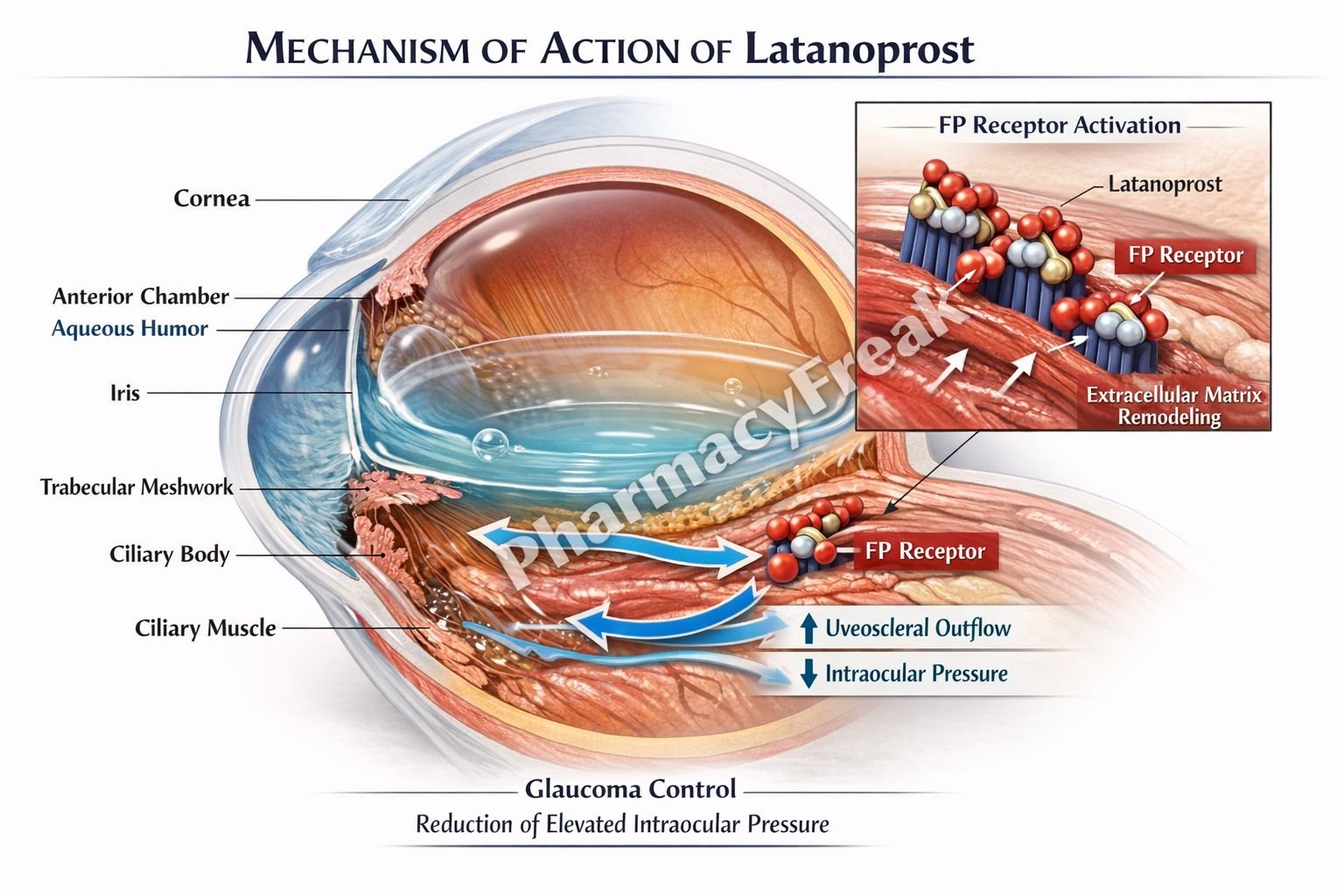
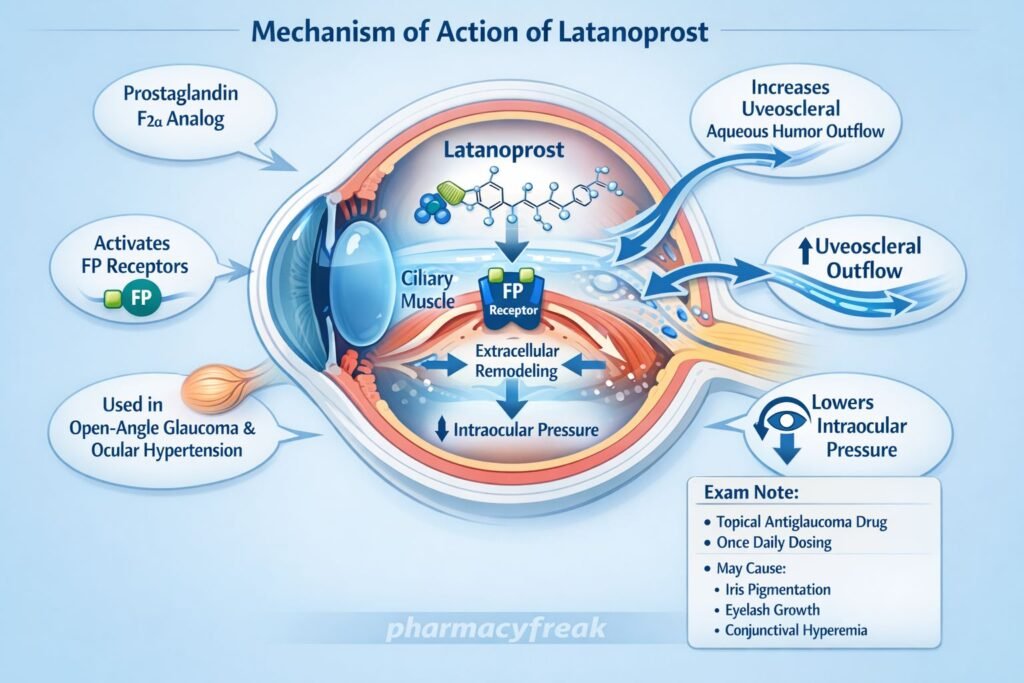
Latanoprost is a prostaglandin F2α (PGF2α) analog used as a first-line agent in the management of open-angle glaucoma and ocular hypertension. It effectively lowers intraocular pressure (IOP) by increasing aqueous humor outflow, thereby preventing optic nerve damage and vision loss.
Mechanism of Action (Step-wise)
- Prodrug Activation
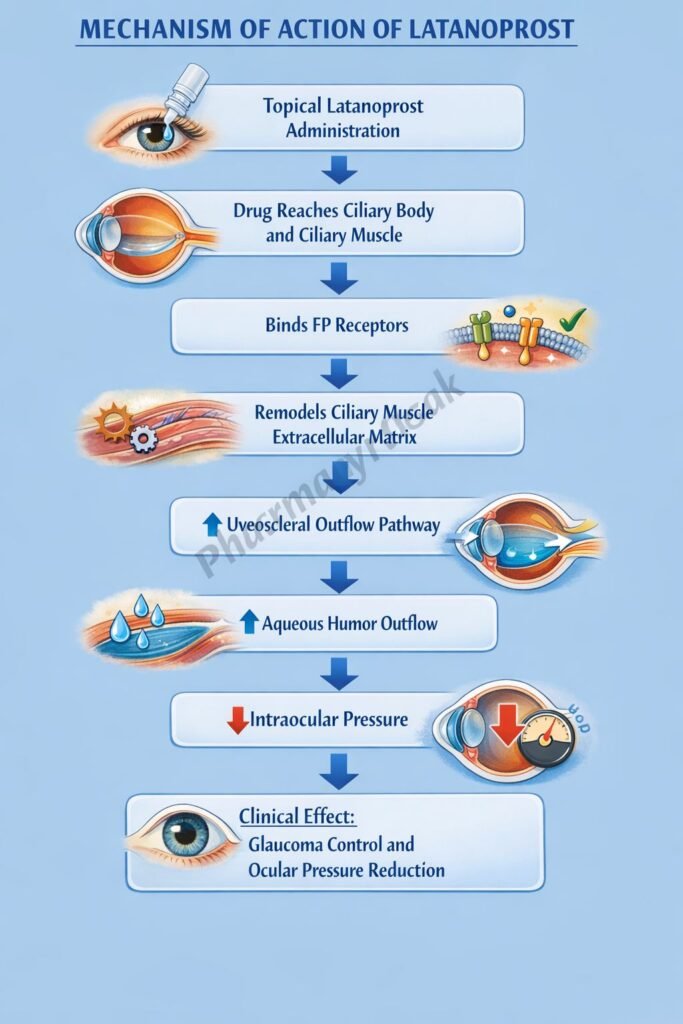
Latanoprost is administered as an isopropyl ester prodrug and is hydrolyzed in the cornea to its active form (latanoprost acid). - Activation of FP Prostaglandin Receptors
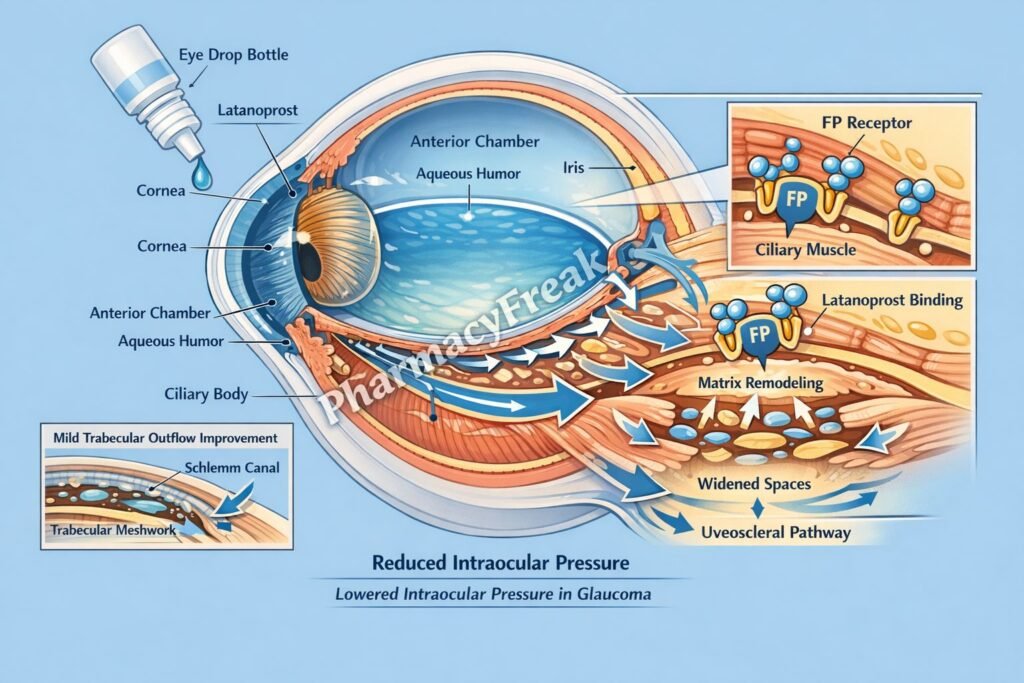
The active drug binds to FP receptors located in the ciliary muscle. - Remodeling of Extracellular Matrix
Activation of FP receptors induces changes in matrix metalloproteinases (MMPs), leading to remodeling of the extracellular matrix. - Increased Uveoscleral Outflow
Structural changes in the ciliary muscle enhance the uveoscleral pathway for aqueous humor drainage. - Reduction in Intraocular Pressure (IOP)
Increased outflow of aqueous humor leads to a sustained decrease in intraocular pressure. - Minimal Effect on Aqueous Humor Production
Latanoprost primarily affects outflow rather than reducing aqueous humor formation.
Pharmacokinetics
- Administration: Topical (eye drops)
- Absorption: Rapid corneal absorption
- Activation: Hydrolysis in cornea
- Peak effect: 8–12 hours
- Duration: ~24 hours
- Metabolism: Hepatic
- Excretion: Renal
Clinical Uses
- Primary open-angle glaucoma
- Ocular hypertension
- First-line therapy for lowering intraocular pressure
Adverse Effects
- Increased iris pigmentation (irreversible)
- Eyelash growth (hypertrichosis)
- Conjunctival hyperemia
- Eye irritation
- Rare systemic effects
Comparative Analysis
| Feature | Latanoprost | Timolol | Acetazolamide |
|---|---|---|---|
| Class | Prostaglandin analog | β-blocker | Carbonic anhydrase inhibitor |
| Mechanism | ↑ Uveoscleral outflow | ↓ Aqueous production | ↓ Aqueous production |
| Dosing | Once daily | Twice daily | Oral/topical |
| IOP reduction | High | Moderate | Moderate |
| Systemic effects | Minimal | Significant | Moderate |
Latanoprost is preferred as first-line therapy due to its strong efficacy, once-daily dosing, and minimal systemic side effects compared to β-blockers like timolol and systemic agents like acetazolamide.
MCQs
- Latanoprost is an analog of:
a) Prostaglandin E2
b) Prostaglandin F2α
c) Leukotriene
d) Thromboxane
Answer: b) Prostaglandin F2α - Primary mechanism:
a) Decreases aqueous production
b) Increases aqueous outflow
c) Blocks β receptors
d) Inhibits carbonic anhydrase
Answer: b) Increases aqueous outflow - Site of action:
a) Retina
b) Cornea
c) Ciliary muscle
d) Lens
Answer: c) Ciliary muscle - Type of drug:
a) β-blocker
b) Diuretic
c) Prostaglandin analog
d) Antibiotic
Answer: c) Prostaglandin analog - Main pathway increased:
a) Trabecular
b) Uveoscleral
c) Renal
d) Hepatic
Answer: b) Uveoscleral - Frequency of dosing:
a) Once daily
b) Twice daily
c) Thrice daily
d) Weekly
Answer: a) Once daily - Common side effect:
a) Cataract
b) Iris pigmentation
c) Blindness
d) Retinal detachment
Answer: b) Iris pigmentation - Latanoprost is a:
a) Active drug
b) Prodrug
c) Antibiotic
d) Steroid
Answer: b) Prodrug - Effect on aqueous humor production:
a) Decreases significantly
b) No effect
c) Increases
d) Blocks completely
Answer: b) No effect - Preferred use:
a) Cataract
b) Glaucoma
c) Retinopathy
d) Macular degeneration
Answer: b) Glaucoma
FAQs
- What is the mechanism of action of latanoprost?
It increases uveoscleral outflow of aqueous humor, reducing intraocular pressure. - Why is latanoprost used once daily?
Because it has a long duration of action (~24 hours). - Does latanoprost reduce aqueous humor production?
No, it mainly increases outflow. - Why does latanoprost change eye color?
It increases melanin production in the iris. - Is latanoprost a first-line drug for glaucoma?
Yes, due to its efficacy and safety profile. - What is its major advantage?
Minimal systemic side effects.