Table of Contents
Introduction
Exenatide is an incretin-based antidiabetic drug classified as a glucagon-like peptide-1 (GLP-1) receptor agonist. It is used in the management of type 2 diabetes mellitus to improve glycemic control, particularly in patients with inadequate response to oral antidiabetic agents. Exenatide is exam-relevant because it mimics endogenous GLP-1, enhances glucose-dependent insulin secretion, promotes weight loss, and has a low risk of hypoglycemia.
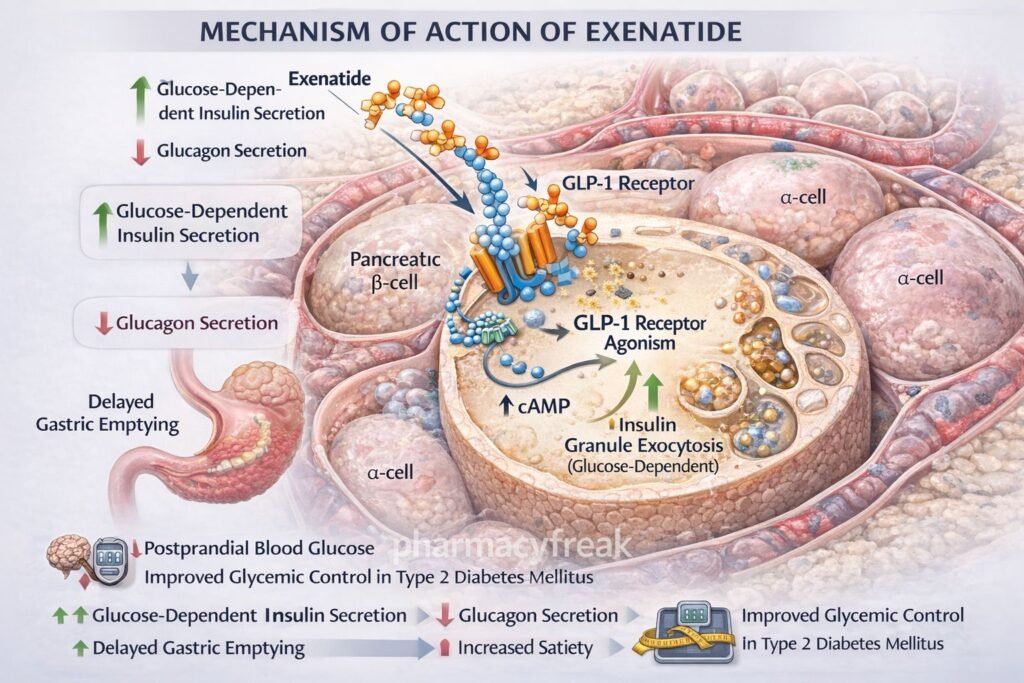
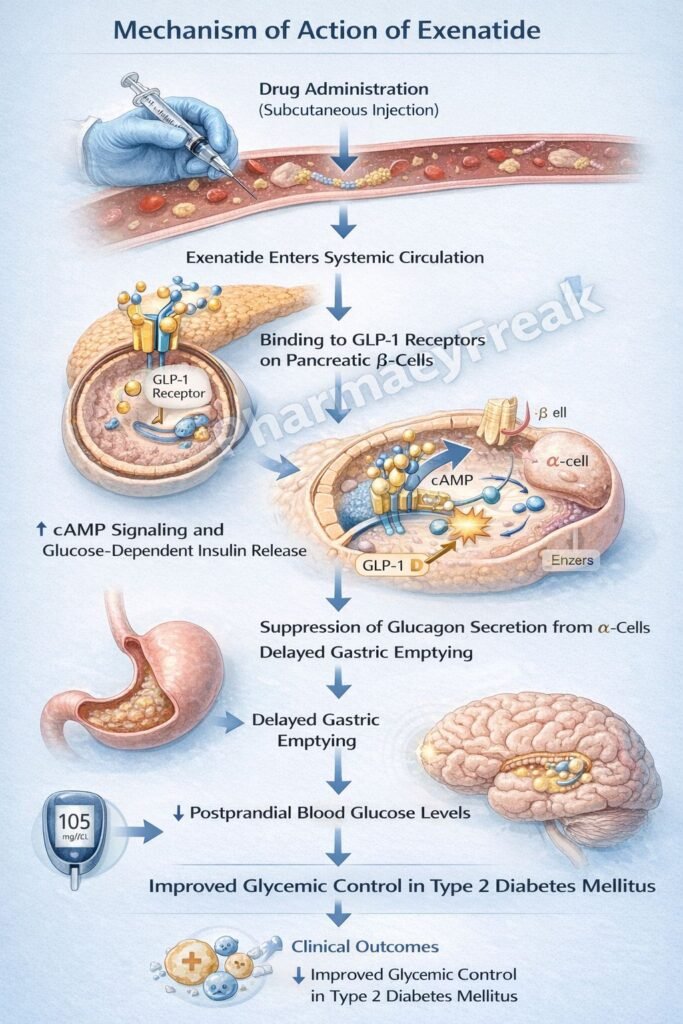
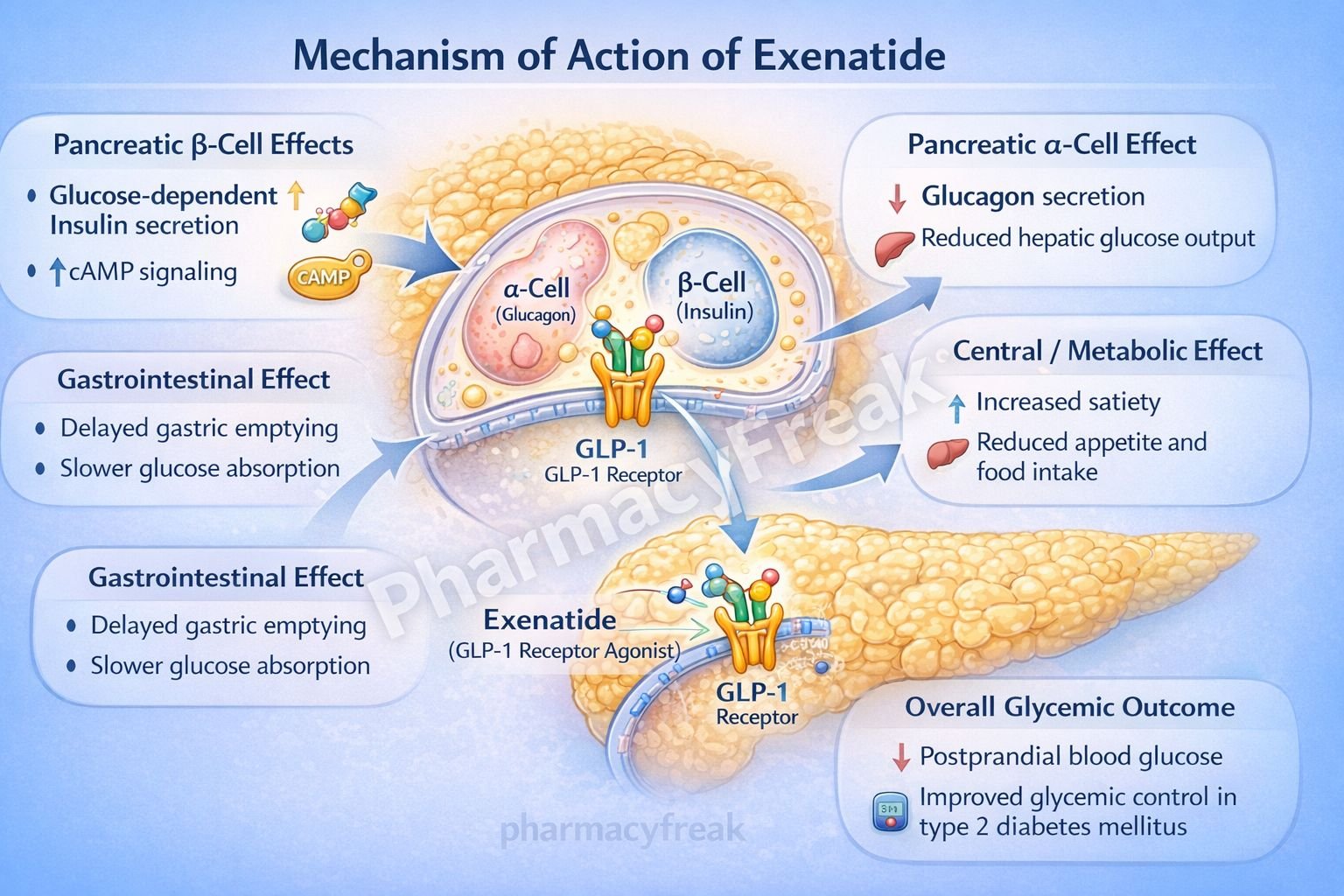
Mechanism of Action (Step-wise)
Exenatide lowers blood glucose by mimicking the physiological actions of GLP-1.
Step 1: Binding to GLP-1 receptors
Exenatide binds to GLP-1 receptors located on pancreatic β-cells, α-cells, gastrointestinal tract, and central nervous system.
Step 2: Glucose-dependent insulin secretion
Activation of GLP-1 receptors increases intracellular cAMP in β-cells, enhancing insulin release only in the presence of elevated blood glucose.
Step 3: Suppression of glucagon secretion
Exenatide inhibits glucagon release from pancreatic α-cells, reducing hepatic glucose output.
Step 4: Delayed gastric emptying
It slows gastric emptying, leading to reduced postprandial glucose absorption.
Step 5: Appetite suppression and weight loss
Central GLP-1 receptor activation increases satiety and reduces appetite, contributing to weight reduction.
Exam pearl:
Exenatide does not stimulate insulin secretion during hypoglycemia.
Pharmacokinetics
- Route of administration: Subcutaneous injection
- Bioavailability: High after SC administration
- Protein binding: Minimal
- Onset of action: Rapid
- Half-life: ~2–4 hours
- Metabolism: Proteolytic degradation
- Excretion: Renal
- Dosing: Twice daily (short-acting); once weekly (extended-release formulation)
Clinical Uses
- Type 2 diabetes mellitus (monotherapy or add-on therapy)
- Patients with obesity and T2DM (favorable weight effect)
- Inadequate control with metformin or sulfonylureas
Exenatide is ineffective in type 1 diabetes mellitus.
Adverse Effects
Gastrointestinal (most common):
- Nausea
- Vomiting
- Diarrhea
Metabolic:
- Hypoglycemia (rare; increased with sulfonylureas)
Pancreatic:
- Acute pancreatitis (rare but serious)
Others:
- Injection site reactions
- Antibody formation (may reduce efficacy)
Comparative Analysis
Exenatide vs Sitagliptin vs Insulin
| Feature | Exenatide | Sitagliptin | Insulin |
|---|---|---|---|
| Drug class | GLP-1 agonist | DPP-4 inhibitor | Hormone |
| Insulin release | Glucose-dependent | Glucose-dependent | Glucose-independent |
| Effect on weight | Weight loss | Neutral | Weight gain |
| Route | SC injection | Oral | SC/IV |
| Hypoglycemia risk | Low | Very low | High |
Explanation:
Exenatide directly activates GLP-1 receptors, whereas sitagliptin prolongs endogenous GLP-1 action. Insulin lacks glucose dependency, explaining its higher hypoglycemia risk.
MCQs
- Exenatide is an analog of:
a) Insulin
b) Amylin
c) GLP-1
d) GIP
Answer: c) GLP-1
- Insulin secretion with exenatide occurs only when:
a) Insulin levels are low
b) Blood glucose is elevated
c) Glucagon is present
d) Food intake is absent
Answer: b) Blood glucose is elevated
- Exenatide reduces postprandial glucose mainly by:
a) Increasing insulin resistance
b) Delaying gastric emptying
c) Increasing hepatic glucose output
d) Stimulating glycogenolysis
Answer: b) Delaying gastric emptying
- Major site of action of exenatide is the:
a) Liver
b) Muscle
c) Pancreatic β-cells
d) Kidney
Answer: c) Pancreatic β-cells
- Hypoglycemia risk with exenatide alone is low because it:
a) Suppresses insulin synthesis
b) Is rapidly metabolized
c) Acts glucose-dependently
d) Blocks insulin receptors
Answer: c) Acts glucose-dependently
- Exenatide causes weight loss primarily by:
a) Increasing metabolism
b) Reducing appetite
c) Increasing insulin resistance
d) Promoting glucosuria
Answer: b) Reducing appetite
- Route of administration of exenatide is:
a) Oral
b) Intravenous
c) Subcutaneous
d) Intramuscular
Answer: c) Subcutaneous
- Exenatide is contraindicated in:
a) Type 2 diabetes
b) Obesity
c) Type 1 diabetes
d) Metabolic syndrome
Answer: c) Type 1 diabetes
- Rare but serious adverse effect of exenatide is:
a) Hepatitis
b) Pancreatitis
c) Nephrolithiasis
d) Retinopathy
Answer: b) Pancreatitis
- Extended-release exenatide is administered:
a) Daily
b) Twice daily
c) Weekly
d) Monthly
Answer: c) Weekly
FAQs
1. Why does exenatide not cause hypoglycemia alone?
Because insulin release is glucose-dependent.
2. Does exenatide promote weight loss?
Yes, by delaying gastric emptying and reducing appetite.
3. Can exenatide be used in type 1 diabetes?
No, it requires functioning β-cells.
4. What is the major safety concern with exenatide?
Risk of pancreatitis.
5. Why is exenatide injectable?
Because it is a peptide and would be degraded orally.
References
- Goodman & Gilman’s The Pharmacological Basis of Therapeutics
https://accesspharmacy.mhmedical.com - Katzung BG. Basic and Clinical Pharmacology
https://accessmedicine.mhmedical.com - Tripathi KD. Essentials of Medical Pharmacology
- Harrison’s Principles of Internal Medicine
https://accessmedicine.mhmedical.com