Table of Contents
Introduction
Docusate is a stool softener (emollient laxative) commonly used for the prevention and treatment of constipation, particularly in patients who should avoid straining during defecation. It is widely prescribed in postoperative care, cardiovascular disease, pregnancy, and chronic constipation. Docusate is a high-yield drug in pharmacology and clinical examinations because of its surfactant-based mechanism, which distinguishes it from stimulant and osmotic laxatives.

Mechanism of Action (Step-wise)
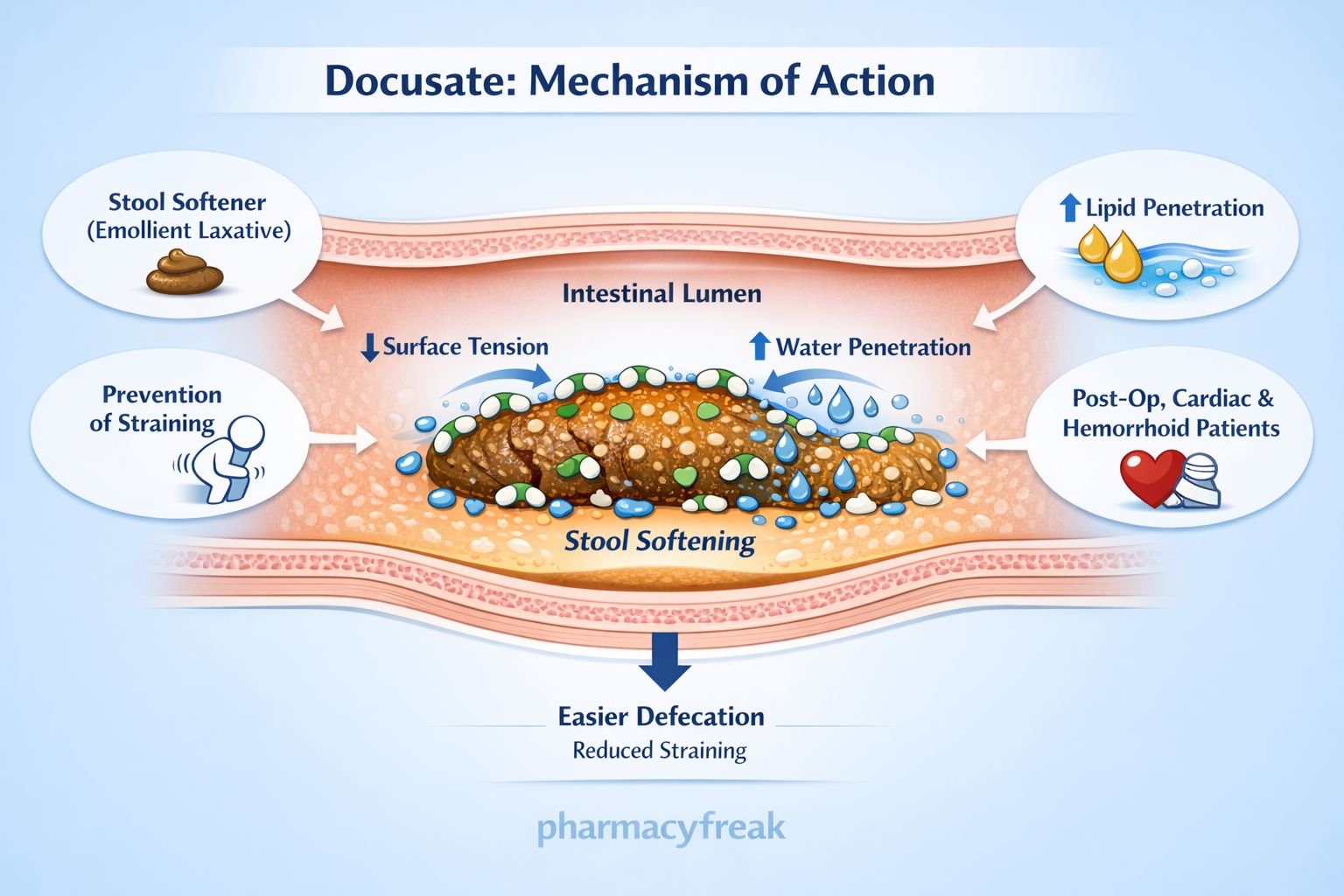
Docusate facilitates bowel movement by softening stool through alteration of surface tension.
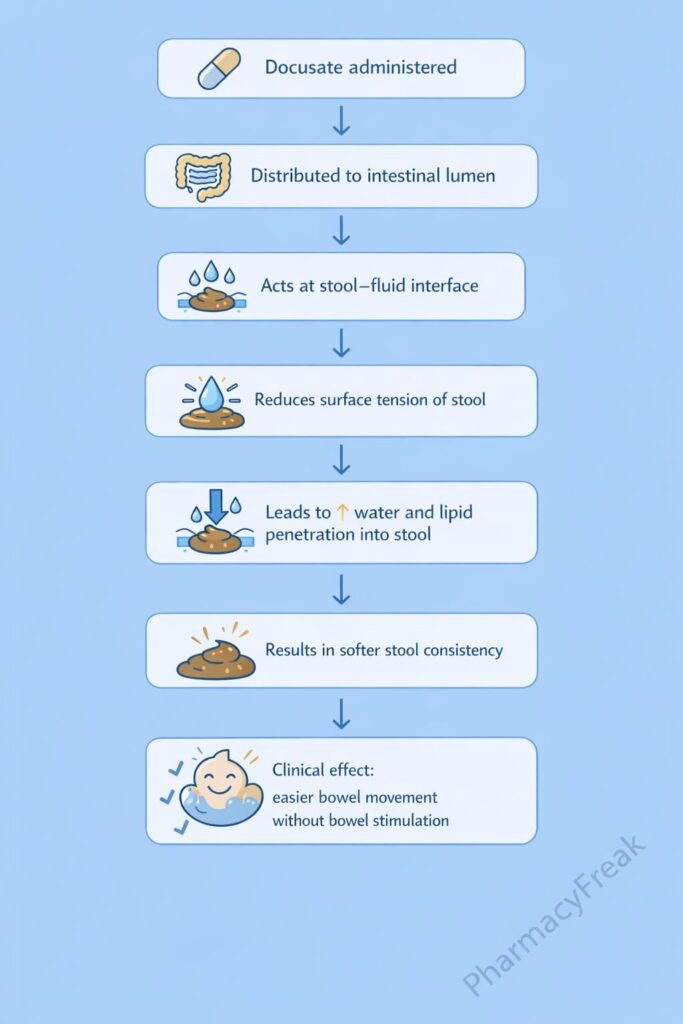
Step-wise mechanism:
- Surfactant (Detergent) Properties
Docusate acts as an anionic surfactant within the gastrointestinal tract. - Reduction of Stool Surface Tension
It lowers the surface tension at the oil–water interface of stool. - Increased Water Penetration into Stool
Reduced surface tension allows water and lipids to penetrate and mix with fecal material. - Softening of Fecal Mass
Increased water content makes the stool softer and more pliable. - Facilitated Stool Passage
Softer stool passes more easily through the colon with minimal straining. - No Direct Effect on Intestinal Motility
Docusate does not stimulate peristalsis or bowel contractions. - Gentle Laxative Effect
Bowel movement occurs naturally once stool consistency is improved.
Pharmacokinetics
- Absorption: Minimal systemic absorption
- Onset of action: 12–72 hours
- Distribution: Acts locally in the intestinal lumen
- Metabolism: Partial intestinal metabolism
- Elimination: Fecal excretion
- Special feature: Safe for long-term prophylactic use
Clinical Uses
Docusate is primarily used to prevent hard stools and straining:
- Functional constipation
- Postoperative constipation
- Constipation in pregnancy
- Constipation in elderly patients
- Patients with hemorrhoids or anal fissures
- After myocardial infarction (to avoid straining)
- Adjunct with opioid therapy
It is not effective for acute severe constipation.
Adverse Effects
Docusate is generally well tolerated:
- Mild abdominal cramps
- Diarrhea (rare)
- Throat irritation (liquid formulations)
- Nausea (uncommon)
Important caution:
Chronic use with mineral oil increases systemic absorption of mineral oil and should be avoided.
Comparative Analysis (must include a table + explanation)
Comparison of Laxative Classes
| Feature | Docusate | Senna | Lactulose |
|---|---|---|---|
| Laxative type | Stool softener | Stimulant | Osmotic |
| Mechanism | ↓ Surface tension | ↑ Peristalsis | Osmotic water retention |
| Onset | Slow (12–72 h) | 6–12 h | 6–8 h |
| Cramping | Minimal | Common | Moderate |
| Use for straining avoidance | Yes | No | No |
Explanation:
Docusate differs fundamentally from stimulant and osmotic laxatives because it does not induce bowel contractions or osmotic shifts. This makes it ideal for patients where straining must be avoided, though it is ineffective in severe constipation.
MCQs (10–15)
- Docusate is classified as a:
a) Stimulant laxative
b) Osmotic laxative
c) Stool softener
d) Bulk-forming laxative
Answer: c) Stool softener
- Docusate softens stool by:
a) Increasing peristalsis
b) Retaining water osmotically
c) Reducing stool surface tension
d) Blocking sodium absorption
Answer: c) Reducing stool surface tension
- Docusate allows penetration of which substances into stool?
a) Electrolytes only
b) Enzymes
c) Water and lipids
d) Bacteria
Answer: c) Water and lipids
- Docusate does NOT:
a) Soften stool
b) Reduce straining
c) Stimulate peristalsis
d) Improve stool consistency
Answer: c) Stimulate peristalsis
- Docusate is most useful in patients with:
a) Acute intestinal obstruction
b) Diarrhea
c) Hemorrhoids
d) Bowel ischemia
Answer: c) Hemorrhoids
- Onset of action of docusate is usually:
a) Immediate
b) 1–2 hours
c) 12–72 hours
d) 5–10 days
Answer: c) 12–72 hours
- Docusate should not be used with:
a) Senna
b) Lactulose
c) Mineral oil
d) Polyethylene glycol
Answer: c) Mineral oil
- Docusate has which effect on intestinal motility?
a) Increases
b) Decreases
c) No effect
d) Biphasic
Answer: c) No effect
- Docusate is safest for long-term use because it:
a) Causes dependency
b) Is non-absorbed
c) Stimulates colon strongly
d) Is bactericidal
Answer: b) Is non-absorbed
- Docusate is contraindicated in:
a) Pregnancy
b) Elderly patients
c) Intestinal obstruction
d) Post-MI patients
Answer: c) Intestinal obstruction
FAQs (minimum 5)
- What is the primary mechanism of docusate?
Reduction of stool surface tension allowing water penetration. - Does docusate stimulate bowel movement?
No, it only softens stool. - Why is docusate preferred after surgery or MI?
Because it prevents straining during defecation. - Is docusate effective in severe constipation?
No, it is best for mild or preventive use. - Can docusate be used long term?
Yes, it is considered safe for prolonged use. - Why should docusate not be combined with mineral oil?
It increases systemic absorption of mineral oil.
References
- Goodman & Gilman’s The Pharmacological Basis of Therapeutics
https://accessmedicine.mhmedical.com - Katzung BG. Basic and Clinical Pharmacology
https://accessmedicine.mhmedical.com - Tripathi KD. Essentials of Medical Pharmacology
https://www.jaypeebrothers.com - Harrison’s Principles of Internal Medicine
https://accessmedicine.mhmedical.com