Table of Contents
Introduction
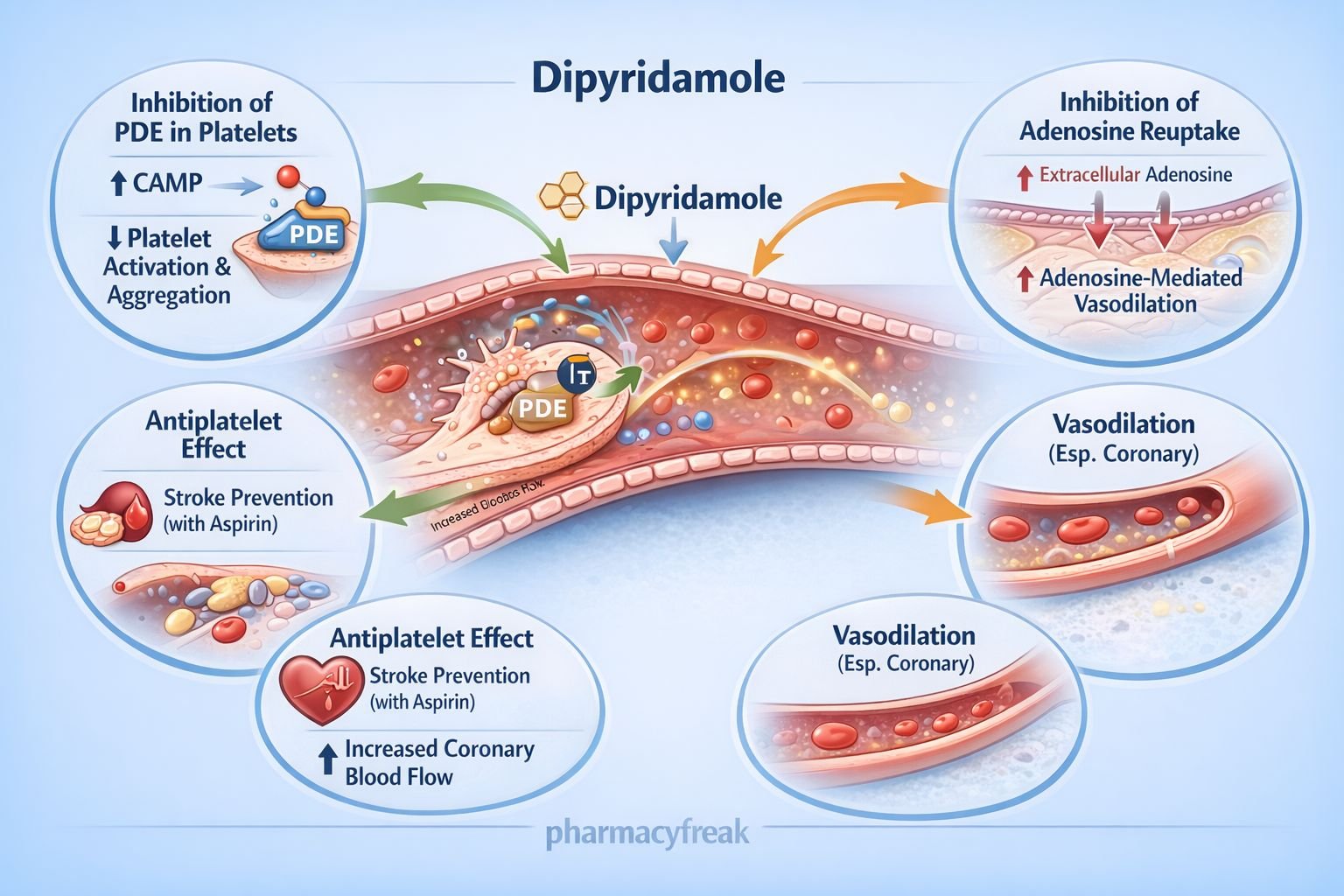
Dipyridamole is an antiplatelet and vasodilator drug primarily used in the prevention of thromboembolic events, especially in combination with aspirin for secondary stroke prevention. It also has an important diagnostic role in pharmacologic stress testing for coronary artery disease. Dipyridamole is a high-yield drug in pharmacology, cardiology, and neurology examinations due to its phosphodiesterase inhibition and adenosine-mediated effects.

Mechanism of Action (Step-wise)
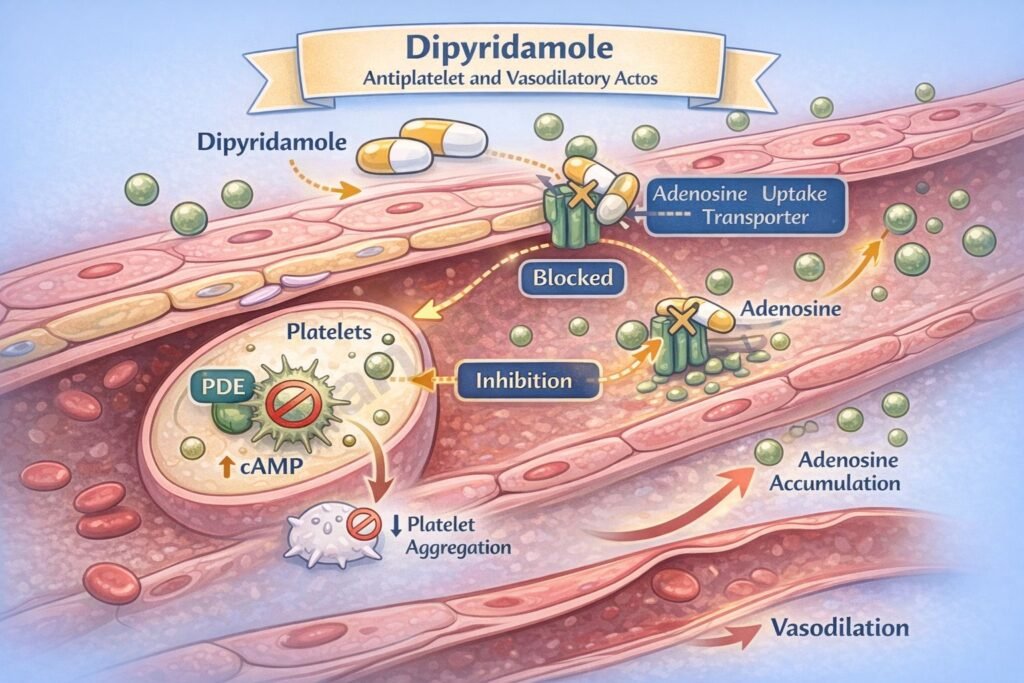
Dipyridamole inhibits platelet aggregation and causes vasodilation by increasing intracellular cyclic nucleotides and adenosine levels.
Step-wise mechanism:
- Inhibition of Phosphodiesterase (PDE)
Dipyridamole inhibits phosphodiesterase enzymes in platelets and vascular smooth muscle. - Reduced Breakdown of cAMP
PDE inhibition prevents degradation of cyclic adenosine monophosphate (cAMP). - Increase in Intracellular cAMP (Platelets)
Elevated cAMP levels inhibit platelet activation and aggregation. - Inhibition of Adenosine Uptake
Dipyridamole blocks cellular uptake of adenosine by endothelial cells and erythrocytes. - Increased Extracellular Adenosine Levels
Accumulated adenosine activates A₂ receptors on vascular smooth muscle and platelets. - Vasodilation via Adenosine A₂ Receptors
Adenosine-induced activation of A₂ receptors increases cAMP, leading to smooth muscle relaxation. - Antiplatelet Effect
Combined increase in cAMP and adenosine suppresses platelet aggregation. - Overall Effect
- Reduced thrombus formation
- Coronary and cerebral vasodilation
Pharmacokinetics
- Absorption: Variable oral absorption
- Bioavailability: Moderate
- Distribution: Highly protein bound
- Metabolism: Hepatic metabolism
- Elimination: Biliary excretion
- Half-life: Approximately 10–12 hours
- Special note: Effect enhanced when combined with aspirin
Clinical Uses
Dipyridamole is used in antiplatelet therapy and diagnostic cardiology:
- Secondary prevention of ischemic stroke (with aspirin)
- Prevention of thromboembolism in prosthetic heart valves (adjunct)
- Pharmacologic stress testing for coronary artery disease
- Peripheral vascular disease (limited use)
Adverse Effects
Adverse effects are mainly related to vasodilation:
- Headache (most common)
- Dizziness
- Flushing
- Hypotension
- Gastrointestinal discomfort
Important caution:
Dipyridamole may worsen angina due to coronary steal phenomenon.
Comparative Analysis (must include a table + explanation)
Comparison of Antiplatelet Drugs
| Feature | Dipyridamole | Aspirin | Clopidogrel |
|---|---|---|---|
| Primary mechanism | ↑ cAMP, ↑ adenosine | COX-1 inhibition | P2Y₁₂ receptor blockade |
| Antiplatelet potency | Moderate | Moderate | High |
| Use alone | Rare | Yes | Yes |
| Combination use | With aspirin | With dipyridamole | With aspirin |
| Role in stress testing | Yes | No | No |
Explanation:
Dipyridamole is weaker as a standalone antiplatelet agent but provides additive benefit with aspirin. Unlike aspirin and clopidogrel, it also produces coronary vasodilation, which is exploited in cardiac stress testing.
MCQs (10–15)
- Dipyridamole inhibits platelet aggregation primarily by increasing:
a) Calcium
b) cAMP
c) cGMP only
d) Thromboxane A₂
Answer: b) cAMP
- Dipyridamole inhibits which enzyme?
a) Cyclooxygenase
b) Adenylate cyclase
c) Phosphodiesterase
d) Protein kinase C
Answer: c) Phosphodiesterase
- Dipyridamole increases extracellular levels of:
a) Dopamine
b) Serotonin
c) Adenosine
d) Nitric oxide
Answer: c) Adenosine
- Dipyridamole prevents platelet aggregation by:
a) Blocking P2Y₁₂ receptors
b) Reducing thromboxane synthesis
c) Increasing intracellular cAMP
d) Chelating calcium
Answer: c) Increasing intracellular cAMP
- Dipyridamole is commonly combined with:
a) Heparin
b) Warfarin
c) Aspirin
d) Clopidogrel
Answer: c) Aspirin
- Dipyridamole causes vasodilation mainly through:
a) Nitric oxide release
b) Adenosine receptor activation
c) Alpha blockade
d) Beta stimulation
Answer: b) Adenosine receptor activation
- A common adverse effect of dipyridamole is:
a) Bleeding
b) Headache
c) Nephrotoxicity
d) Bradycardia
Answer: b) Headache
- Dipyridamole is used in cardiac stress testing because it:
a) Increases heart rate
b) Causes coronary vasodilation
c) Blocks beta receptors
d) Inhibits calcium channels
Answer: b) Causes coronary vasodilation
- Dipyridamole may worsen angina due to:
a) Reflex tachycardia
b) Myocardial depression
c) Coronary steal phenomenon
d) Platelet activation
Answer: c) Coronary steal phenomenon
- Dipyridamole is eliminated mainly via:
a) Renal excretion
b) Pulmonary excretion
c) Biliary excretion
d) Sweat glands
Answer: c) Biliary excretion
FAQs (minimum 5)
- What is the primary mechanism of dipyridamole?
Inhibition of phosphodiesterase and adenosine uptake, increasing cAMP levels. - Why is dipyridamole combined with aspirin?
To enhance antiplatelet efficacy through complementary mechanisms. - How does dipyridamole cause vasodilation?
By increasing extracellular adenosine and activating A₂ receptors. - Why can dipyridamole worsen angina?
Due to coronary steal, diverting blood from ischemic areas. - Is dipyridamole a strong antiplatelet drug?
No, it is moderate and mainly used in combination therapy. - Does dipyridamole increase bleeding risk?
Yes, especially when combined with other antiplatelet agents.
References
- Goodman & Gilman’s The Pharmacological Basis of Therapeutics
https://accessmedicine.mhmedical.com - Katzung BG. Basic and Clinical Pharmacology
https://accessmedicine.mhmedical.com - Tripathi KD. Essentials of Medical Pharmacology
https://www.jaypeebrothers.com - Harrison’s Principles of Internal Medicine
https://accessmedicine.mhmedical.com