Table of Contents
Introduction
Dicyclomine (dicycloverine) is an anticholinergic antispasmodic agent primarily used in the management of irritable bowel syndrome (IBS) and other functional gastrointestinal disorders. It relieves abdominal pain and cramping by reducing smooth muscle spasm in the gastrointestinal tract. Dicyclomine is a high-yield drug in pharmacology and gastroenterology examinations because of its muscarinic receptor antagonism and characteristic anticholinergic adverse effects.
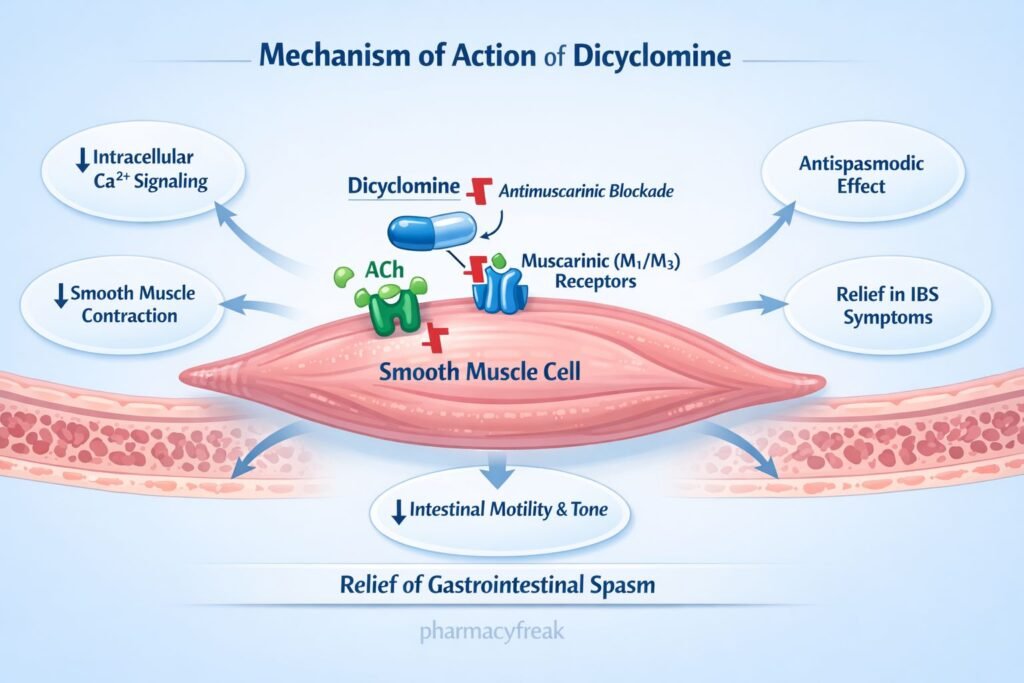
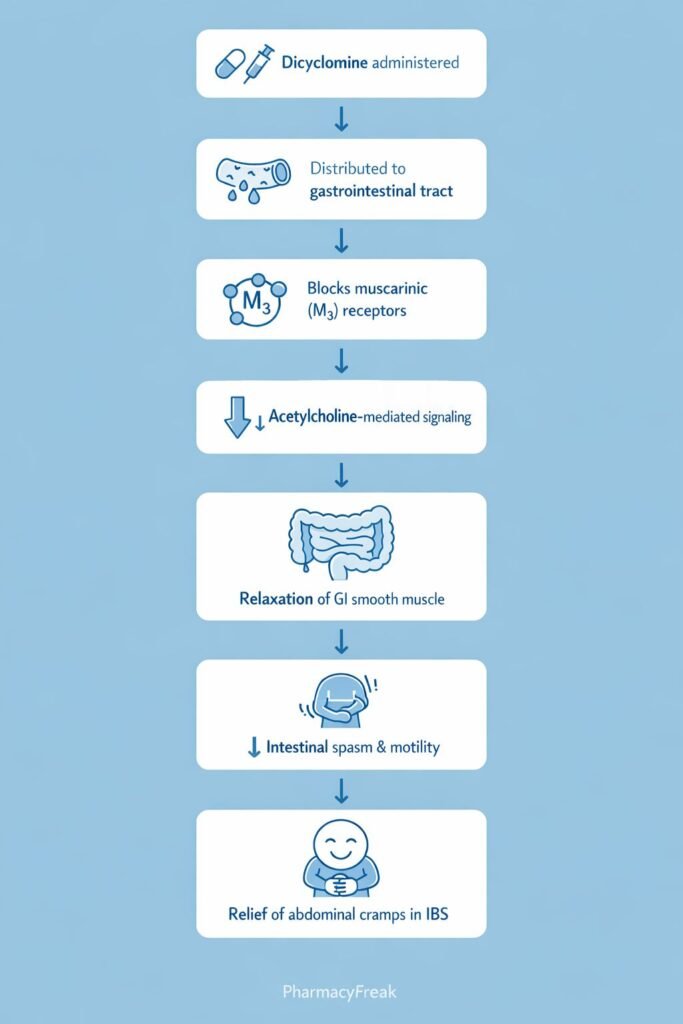
Mechanism of Action (Step-wise)
Dicyclomine reduces gastrointestinal smooth muscle spasm by blocking muscarinic receptors.
Step-wise mechanism:
- Parasympathetic Control of GI Motility
Gastrointestinal smooth muscle contraction is mediated by acetylcholine acting on muscarinic (M₃) receptors. - Muscarinic Receptor Antagonism
Dicyclomine competitively antagonizes muscarinic receptors on GI smooth muscle. - Inhibition of Acetylcholine Action
Blocking muscarinic receptors prevents acetylcholine-induced smooth muscle contraction. - Reduced Intracellular Calcium
Muscarinic blockade decreases calcium influx into smooth muscle cells. - Relaxation of GI Smooth Muscle
Decreased calcium availability leads to reduced tone and spasm of intestinal smooth muscle. - Reduction in GI Motility and Spasm
Intestinal hypermotility and spasmodic contractions are suppressed. - Relief of Abdominal Pain
Decreased spasm results in symptomatic relief of cramping and abdominal discomfort.
Pharmacokinetics
- Absorption: Well absorbed orally
- Distribution: Widely distributed; crosses blood–brain barrier
- Metabolism: Hepatic metabolism
- Elimination: Renal excretion
- Half-life: Approximately 1.8 hours
- Onset of action: Rapid (within 1–2 hours)
Clinical Uses
Dicyclomine is primarily used in functional gastrointestinal disorders:
- Irritable bowel syndrome (IBS)
- Intestinal colic
- Functional bowel spasm
- Abdominal cramping due to hypermotility
It is not effective in inflammatory bowel disease or mechanical obstruction.
Adverse Effects
Adverse effects are related to anticholinergic activity:
- Central nervous system:
- Dizziness
- Drowsiness
- Confusion (elderly)
- Peripheral anticholinergic effects:
- Dry mouth
- Blurred vision
- Constipation
- Urinary retention
- Tachycardia
Dicyclomine should be used cautiously in elderly patients and those with glaucoma or prostatic hypertrophy.
Comparative Analysis (must include a table + explanation)
Comparison of Antispasmodic Agents
| Feature | Dicyclomine | Hyoscine (Scopolamine) | Peppermint Oil |
|---|---|---|---|
| Mechanism | Muscarinic blockade | Muscarinic blockade | Calcium channel modulation |
| CNS penetration | Moderate | High | None |
| Use in IBS | Yes | Yes | Yes |
| Anticholinergic effects | Moderate | High | Minimal |
| Sedation | Mild | Moderate | None |
Explanation:
Dicyclomine provides effective relief of GI spasm with fewer CNS effects than hyoscine. Peppermint oil offers a non-anticholinergic alternative but may be less potent in severe symptoms.
MCQs (10–15)
- Dicyclomine relieves abdominal pain by:
a) Increasing GI motility
b) Blocking opioid receptors
c) Blocking muscarinic receptors
d) Inhibiting prostaglandin synthesis
Answer: c) Blocking muscarinic receptors
- The primary site of action of dicyclomine is:
a) Central nervous system
b) Neuromuscular junction
c) GI smooth muscle
d) Enteric neurons only
Answer: c) GI smooth muscle
- Dicyclomine decreases intestinal spasm by reducing:
a) Sodium influx
b) Potassium efflux
c) Calcium influx
d) Chloride secretion
Answer: c) Calcium influx
- Dicyclomine is most commonly used in:
a) Peptic ulcer disease
b) Irritable bowel syndrome
c) Ulcerative colitis
d) Crohn disease
Answer: b) Irritable bowel syndrome
- Dicyclomine belongs to which drug class?
a) Opioid analgesic
b) Antispasmodic anticholinergic
c) Prokinetic agent
d) H₂ receptor blocker
Answer: b) Antispasmodic anticholinergic
- A common adverse effect of dicyclomine is:
a) Diarrhea
b) Bradycardia
c) Dry mouth
d) Hypotension
Answer: c) Dry mouth
- Dicyclomine reduces GI motility by inhibiting:
a) Sympathetic activity
b) Parasympathetic activity
c) Enteroendocrine hormones
d) Nitric oxide synthesis
Answer: b) Parasympathetic activity
- Dicyclomine should be avoided in patients with:
a) IBS
b) Glaucoma
c) Mild diarrhea
d) Dyspepsia
Answer: b) Glaucoma
- Which receptor subtype is mainly blocked by dicyclomine?
a) M₁
b) M₂
c) M₃
d) Nicotinic
Answer: c) M₃
- Dicyclomine differs from peppermint oil because it:
a) Has no effect on smooth muscle
b) Is anticholinergic
c) Is prokinetic
d) Causes diarrhea
Answer: b) Is anticholinergic
FAQs (minimum 5)
- What is the primary mechanism of dicyclomine?
Competitive antagonism of muscarinic receptors in GI smooth muscle. - Why is dicyclomine effective in IBS?
It reduces intestinal smooth muscle spasm and abdominal pain. - Does dicyclomine affect GI secretion?
Yes, it may reduce secretions due to anticholinergic action. - Can dicyclomine cause CNS effects?
Yes, especially dizziness and confusion in elderly patients. - Is dicyclomine useful in inflammatory bowel disease?
No, it is mainly used in functional bowel disorders. - Why should dicyclomine be used cautiously in glaucoma?
Because anticholinergic effects can increase intraocular pressure.
References
- Goodman & Gilman’s The Pharmacological Basis of Therapeutics
https://accessmedicine.mhmedical.com - Katzung BG. Basic and Clinical Pharmacology
https://accessmedicine.mhmedical.com - Tripathi KD. Essentials of Medical Pharmacology
https://www.jaypeebrothers.com - Harrison’s Principles of Internal Medicine
https://accessmedicine.mhmedical.com