Table of Contents
Introduction
Diamox is the brand name for acetazolamide, a carbonic anhydrase inhibitor primarily used as a diuretic, antiglaucoma agent, antiepileptic adjunct, and for the prevention and treatment of acute mountain sickness. Unlike conventional diuretics, Diamox alters acid–base balance and fluid dynamics by inhibiting carbonic anhydrase in multiple tissues. Its distinctive mechanism makes it a high-yield drug in pharmacology, ophthalmology, nephrology, neurology, and clinical entrance examinations.


Mechanism of Action (Step-wise)
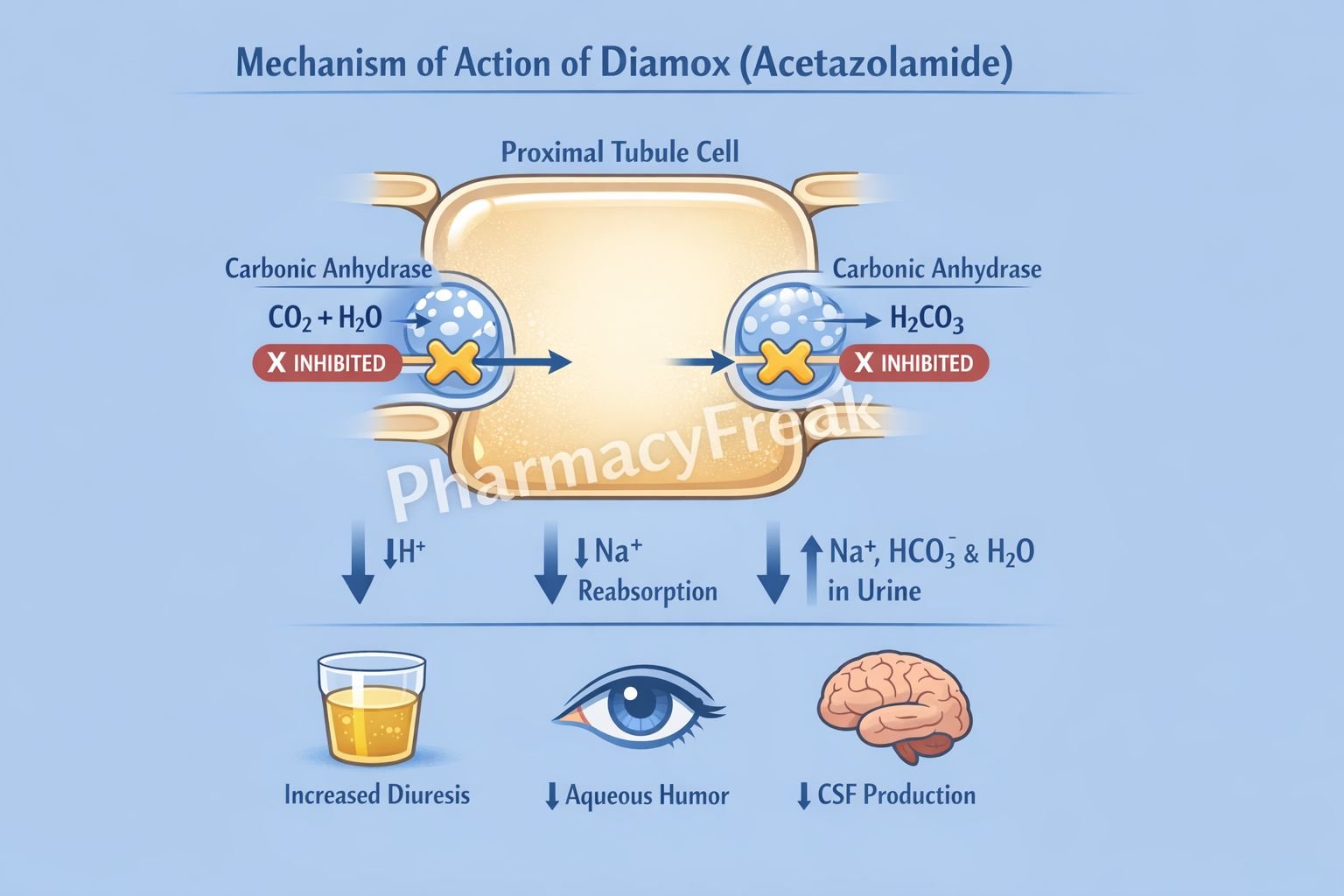
Diamox (acetazolamide) acts by inhibiting the enzyme carbonic anhydrase, leading to altered bicarbonate handling and pH changes.
Step-wise mechanism:
- Carbonic Anhydrase Inhibition
Diamox inhibits carbonic anhydrase (CA), an enzyme that catalyzes the reversible conversion of carbon dioxide and water to carbonic acid. - Renal Proximal Tubule Action
In the proximal convoluted tubule, carbonic anhydrase is essential for bicarbonate (HCO₃⁻) reabsorption. - Reduced Hydrogen Ion Secretion
Inhibition of CA decreases intracellular hydrogen ion (H⁺) formation, reducing H⁺ secretion into the tubular lumen. - Decreased Bicarbonate Reabsorption
Reduced H⁺ availability prevents sodium–hydrogen exchange, leading to decreased reabsorption of sodium bicarbonate. - Increased Bicarbonate Excretion
Excess bicarbonate is excreted in urine, causing alkaline urine and mild diuresis. - Metabolic Acidosis Development
Loss of bicarbonate results in systemic metabolic acidosis. - Reduced Aqueous Humor Formation
In the eye, CA inhibition decreases bicarbonate-dependent fluid secretion, lowering intraocular pressure. - Reduced Cerebrospinal Fluid (CSF) Production
Inhibition of CA in the choroid plexus decreases CSF formation. - Ventilatory Stimulation in Altitude Sickness
Metabolic acidosis stimulates respiration, improving oxygenation at high altitude.
Pharmacokinetics
- Absorption: Well absorbed orally
- Distribution: Widely distributed; penetrates eye and CNS
- Protein binding: High
- Metabolism: Minimal hepatic metabolism
- Elimination: Renal excretion (unchanged drug)
- Half-life: Approximately 10–15 hours
- Special note: Contraindicated in severe renal disease
Clinical Uses
Diamox is used in diverse clinical settings due to its multisystem effects:
- Glaucoma (open-angle and acute angle-closure adjunct)
- Acute mountain sickness (prophylaxis and treatment)
- Idiopathic intracranial hypertension (pseudotumor cerebri)
- Metabolic alkalosis
- Adjunct therapy in epilepsy
- Periodic paralysis (hypokalemic type)
It is not commonly used as a primary diuretic due to weak natriuretic effect.
Adverse Effects
Adverse effects are mainly related to electrolyte imbalance and acidosis:
- Metabolic acidosis
- Hypokalemia
- Paresthesias (tingling of fingers and toes)
- Renal stone formation (calcium phosphate stones)
- Fatigue and drowsiness
- Sulfonamide hypersensitivity reactions
Diamox should be avoided in patients with cirrhosis due to risk of hepatic encephalopathy.
Comparative Analysis (must include a table + explanation)
Comparison of Diuretic Classes
| Feature | Diamox (Acetazolamide) | Loop Diuretics | Thiazides |
|---|---|---|---|
| Primary site | Proximal tubule | Loop of Henle | Distal tubule |
| Mechanism | CA inhibition | Na⁺–K⁺–2Cl⁻ inhibition | Na⁺–Cl⁻ inhibition |
| Effect on pH | Metabolic acidosis | Metabolic alkalosis | Metabolic alkalosis |
| Diuretic potency | Weak | Strong | Moderate |
| Use in glaucoma | Yes | No | No |
Explanation:
Diamox differs from loop and thiazide diuretics by producing metabolic acidosis rather than alkalosis. Its weak diuretic action limits routine use for edema, but its effects on CSF, aqueous humor, and ventilation make it clinically unique.
MCQs (10–15)
- Diamox inhibits which enzyme?
a) Cyclooxygenase
b) Carbonic anhydrase
c) Aldosterone synthase
d) Na⁺/K⁺-ATPase
Answer: b) Carbonic anhydrase
- The primary renal site of action of Diamox is the:
a) Collecting duct
b) Loop of Henle
c) Distal tubule
d) Proximal tubule
Answer: d) Proximal tubule
- Diamox causes which acid–base disturbance?
a) Metabolic alkalosis
b) Respiratory alkalosis
c) Metabolic acidosis
d) Respiratory acidosis
Answer: c) Metabolic acidosis
- Diamox is useful in glaucoma because it:
a) Increases aqueous humor drainage
b) Reduces aqueous humor production
c) Dilates pupil
d) Relaxes ciliary muscle
Answer: b) Reduces aqueous humor production
- Diamox is commonly used in altitude sickness to:
a) Increase hemoglobin
b) Reduce pulmonary edema
c) Stimulate ventilation
d) Cause diuresis
Answer: c) Stimulate ventilation
- A characteristic adverse effect of Diamox is:
a) Hyperkalemia
b) Hypokalemia
c) Hypernatremia
d) Hypercalcemia
Answer: b) Hypokalemia
- Diamox alkalinizes which fluid?
a) Blood
b) CSF
c) Urine
d) Intracellular fluid
Answer: c) Urine
- Renal stone formation with Diamox is due to:
a) Uric acid precipitation
b) Calcium phosphate stones
c) Oxalate stones
d) Cystine stones
Answer: b) Calcium phosphate stones
- Diamox should be avoided in patients with:
a) Glaucoma
b) Altitude sickness
c) Liver cirrhosis
d) Pseudotumor cerebri
Answer: c) Liver cirrhosis
- Diamox is classified as a:
a) Loop diuretic
b) Thiazide diuretic
c) Carbonic anhydrase inhibitor
d) Potassium-sparing diuretic
Answer: c) Carbonic anhydrase inhibitor
FAQs (minimum 5)
- What is the primary mechanism of Diamox?
Inhibition of carbonic anhydrase leading to bicarbonate loss and metabolic acidosis. - Why is Diamox effective in altitude sickness?
It induces metabolic acidosis that stimulates ventilation. - Does Diamox lower intraocular pressure?
Yes, by reducing aqueous humor formation. - Why does Diamox cause kidney stones?
Due to alkaline urine and calcium phosphate precipitation. - Is Diamox a strong diuretic?
No, it is a weak diuretic. - Can Diamox cause electrolyte imbalance?
Yes, especially hypokalemia and metabolic acidosis.
References
- Goodman & Gilman’s The Pharmacological Basis of Therapeutics
https://accessmedicine.mhmedical.com - Katzung BG. Basic and Clinical Pharmacology
https://accessmedicine.mhmedical.com - Tripathi KD. Essentials of Medical Pharmacology
https://www.jaypeebrothers.com - Harrison’s Principles of Internal Medicine
https://accessmedicine.mhmedical.com