Table of Contents
Introduction
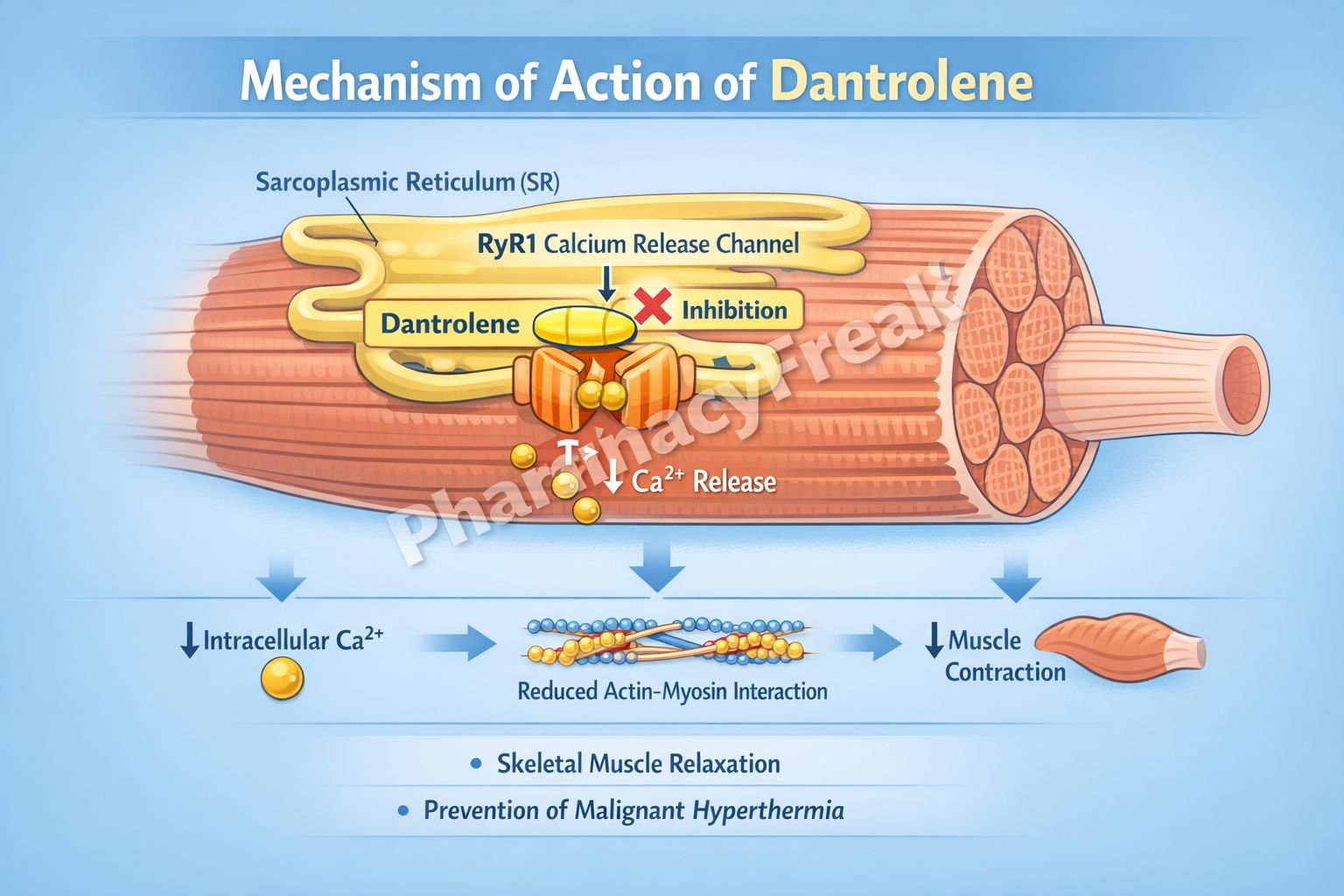
Dantrolene is a direct-acting skeletal muscle relaxant uniquely used in the management of malignant hyperthermia, neuroleptic malignant syndrome, and selected cases of chronic spasticity. Unlike centrally acting muscle relaxants, dantrolene acts peripherally at the level of skeletal muscle fibers, making its mechanism of action distinct and high-yield for pharmacology, anesthesia, emergency medicine, and critical care examinations.
Mechanism of Action (Step-wise)
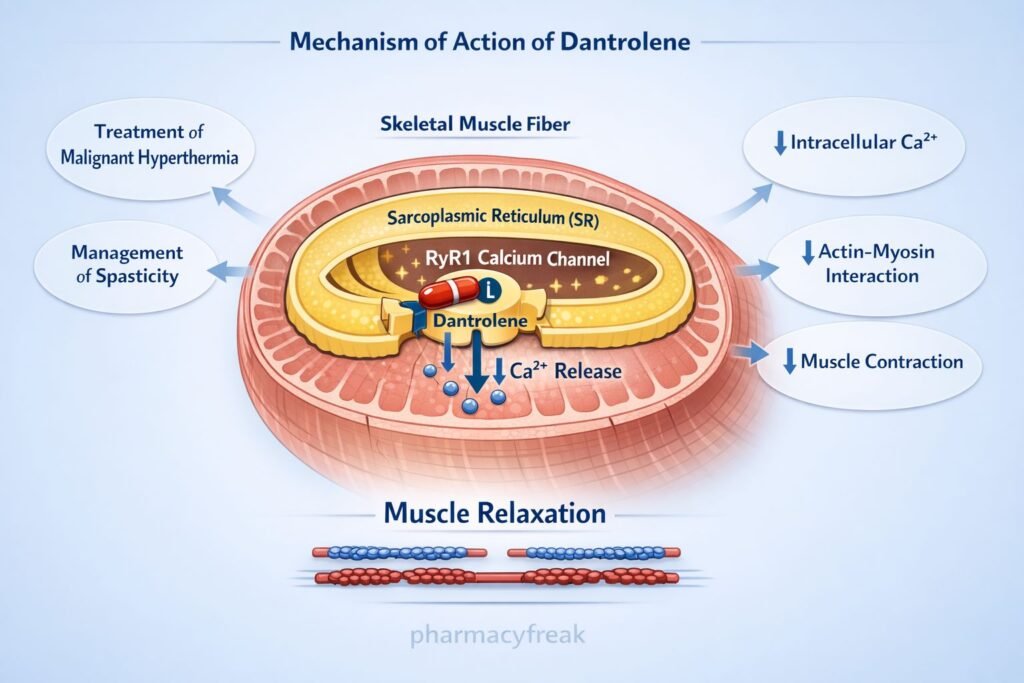
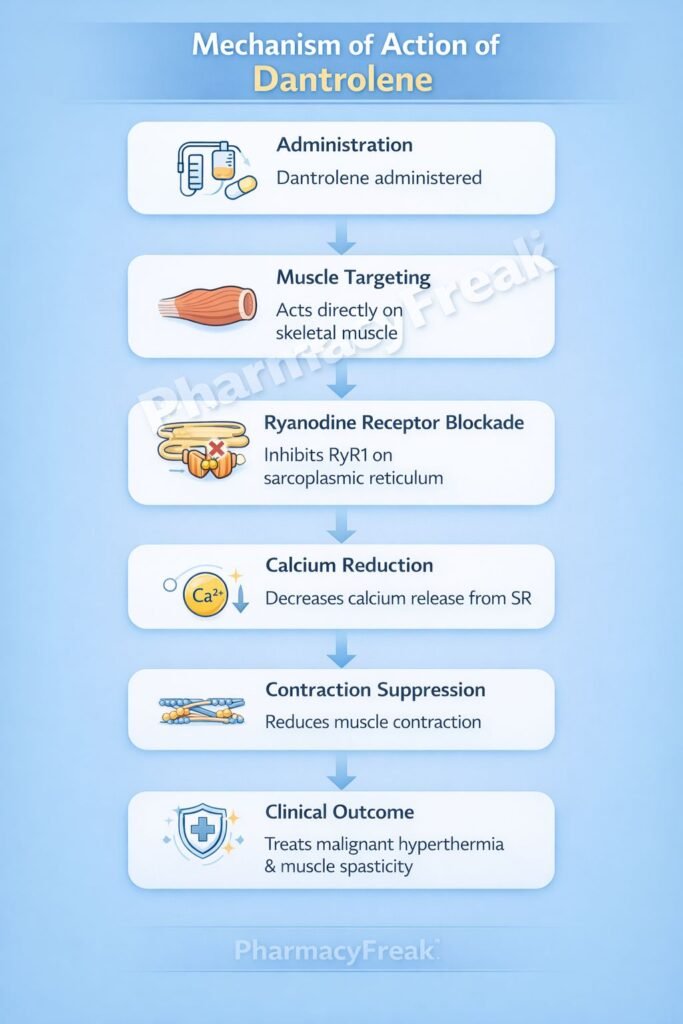
Dantrolene reduces skeletal muscle contraction by inhibiting calcium release from the sarcoplasmic reticulum.
Step-wise mechanism:
- Excitation–Contraction Coupling in Skeletal Muscle
Muscle contraction depends on calcium release from the sarcoplasmic reticulum via ryanodine receptor type 1 (RyR1). - Role of Ryanodine Receptor (RyR1)
Depolarization of the muscle membrane activates dihydropyridine receptors, which in turn trigger RyR1-mediated calcium release. - Binding of Dantrolene to RyR1
Dantrolene binds directly to the RyR1 calcium release channel on the sarcoplasmic reticulum. - Inhibition of Calcium Release
Binding reduces the amount of calcium released into the cytoplasm during muscle excitation. - Reduced Actin–Myosin Interaction
Lower intracellular calcium levels decrease activation of troponin, reducing actin–myosin cross-bridge formation. - Decreased Muscle Contraction
Skeletal muscle contraction is weakened without affecting neuromuscular transmission or central nervous system activity. - Reversal of Hypermetabolic State
In malignant hyperthermia, reduced calcium release reverses muscle rigidity, hyperthermia, and excessive ATP consumption.
Pharmacokinetics
- Absorption: Moderate oral absorption
- Administration: Oral (chronic use), IV (emergency use)
- Distribution: Widely distributed to skeletal muscle
- Metabolism: Hepatic metabolism
- Elimination: Renal excretion of metabolites
- Half-life: Approximately 8–9 hours
- Special note: IV dantrolene acts rapidly in malignant hyperthermia
Clinical Uses
Dantrolene is indicated in conditions involving excessive skeletal muscle calcium release:
- Malignant hyperthermia (drug of choice)
- Neuroleptic malignant syndrome
- Chronic spasticity due to:
- Cerebral palsy
- Multiple sclerosis
- Spinal cord injury
- Prevention of recurrent malignant hyperthermia
It is not useful for muscle spasm of musculoskeletal origin.
Adverse Effects
Adverse effects are primarily related to muscle weakness and hepatic toxicity:
- Musculoskeletal:
- Muscle weakness
- Fatigue
- Central nervous system:
- Drowsiness
- Dizziness
- Gastrointestinal:
- Nausea
- Diarrhea
- Hepatic:
- Hepatotoxicity (dose- and duration-dependent)
Liver function monitoring is essential during long-term therapy.
Comparative Analysis (must include a table + explanation)
Comparison of Muscle Relaxants
| Feature | Dantrolene | Baclofen | Diazepam |
|---|---|---|---|
| Site of action | Skeletal muscle | Spinal cord | CNS |
| Mechanism | Inhibits Ca²⁺ release | GABA-B agonist | GABA-A agonist |
| Use in malignant hyperthermia | Yes | No | No |
| Sedation | Minimal | Moderate | High |
| Hepatotoxicity | Yes | No | No |
Explanation:
Dantrolene is the only muscle relaxant that acts directly on skeletal muscle by inhibiting calcium release. This unique peripheral mechanism makes it lifesaving in malignant hyperthermia, whereas baclofen and benzodiazepines act centrally and are ineffective in this condition.
MCQs (10–15)
- Dantrolene acts by inhibiting calcium release from the:
a) Mitochondria
b) Endoplasmic reticulum
c) Sarcoplasmic reticulum
d) T-tubules
Answer: c) Sarcoplasmic reticulum
- The molecular target of dantrolene is:
a) Dihydropyridine receptor
b) Ryanodine receptor
c) Sodium channel
d) Acetylcholine receptor
Answer: b) Ryanodine receptor
- Dantrolene is the drug of choice for:
a) Tetanus
b) Neuroleptic malignant syndrome
c) Malignant hyperthermia
d) Acute dystonia
Answer: c) Malignant hyperthermia
- Dantrolene reduces muscle contraction by decreasing:
a) Sodium influx
b) Potassium efflux
c) Intracellular calcium
d) Acetylcholine release
Answer: c) Intracellular calcium
- Dantrolene acts primarily at the level of:
a) Central nervous system
b) Neuromuscular junction
c) Skeletal muscle fiber
d) Peripheral nerve
Answer: c) Skeletal muscle fiber
- Which adverse effect is most characteristic of dantrolene?
a) Agranulocytosis
b) Hepatotoxicity
c) QT prolongation
d) Nephrotoxicity
Answer: b) Hepatotoxicity
- Dantrolene does NOT affect:
a) Actin–myosin interaction
b) Calcium release
c) Acetylcholine receptors
d) Muscle contraction
Answer: c) Acetylcholine receptors
- In malignant hyperthermia, dantrolene reverses:
a) Bradycardia
b) Muscle rigidity
c) Hypoglycemia
d) Hypotension
Answer: b) Muscle rigidity
- Which anesthetic agent is associated with malignant hyperthermia?
a) Nitrous oxide
b) Halothane
c) Propofol
d) Midazolam
Answer: b) Halothane
- Long-term dantrolene therapy requires monitoring of:
a) Renal function
b) Cardiac enzymes
c) Liver function
d) Electrolytes
Answer: c) Liver function
FAQs (minimum 5)
- What is the primary mechanism of dantrolene?
Inhibition of calcium release from the sarcoplasmic reticulum via ryanodine receptor blockade. - Why is dantrolene effective in malignant hyperthermia?
It reduces excessive skeletal muscle calcium release responsible for hypermetabolism. - Does dantrolene act on the CNS?
No, it acts directly on skeletal muscle. - Can dantrolene cause muscle weakness?
Yes, due to reduced excitation–contraction coupling. - Is dantrolene useful for acute muscle spasm?
No, it is used for spasticity and malignant hyperthermia. - Why is liver monitoring necessary with dantrolene?
Because of the risk of hepatotoxicity with prolonged use.
References
- Goodman & Gilman’s The Pharmacological Basis of Therapeutics
https://accessmedicine.mhmedical.com - Katzung BG. Basic and Clinical Pharmacology
https://accessmedicine.mhmedical.com - Tripathi KD. Essentials of Medical Pharmacology
https://www.jaypeebrothers.com - Harrison’s Principles of Internal Medicine
https://accessmedicine.mhmedical.com