Table of Contents
Introduction
Clotrimazole is a broad-spectrum imidazole antifungal agent commonly used for the treatment of superficial fungal infections involving the skin, oral cavity, and genital tract. It is effective against dermatophytes, Candida species, and certain dimorphic fungi. Due to its widespread topical use and classic mechanism involving ergosterol synthesis inhibition, clotrimazole is a frequently tested drug in pharmacology, microbiology, and clinical entrance examinations.


Mechanism of Action (Step-wise)
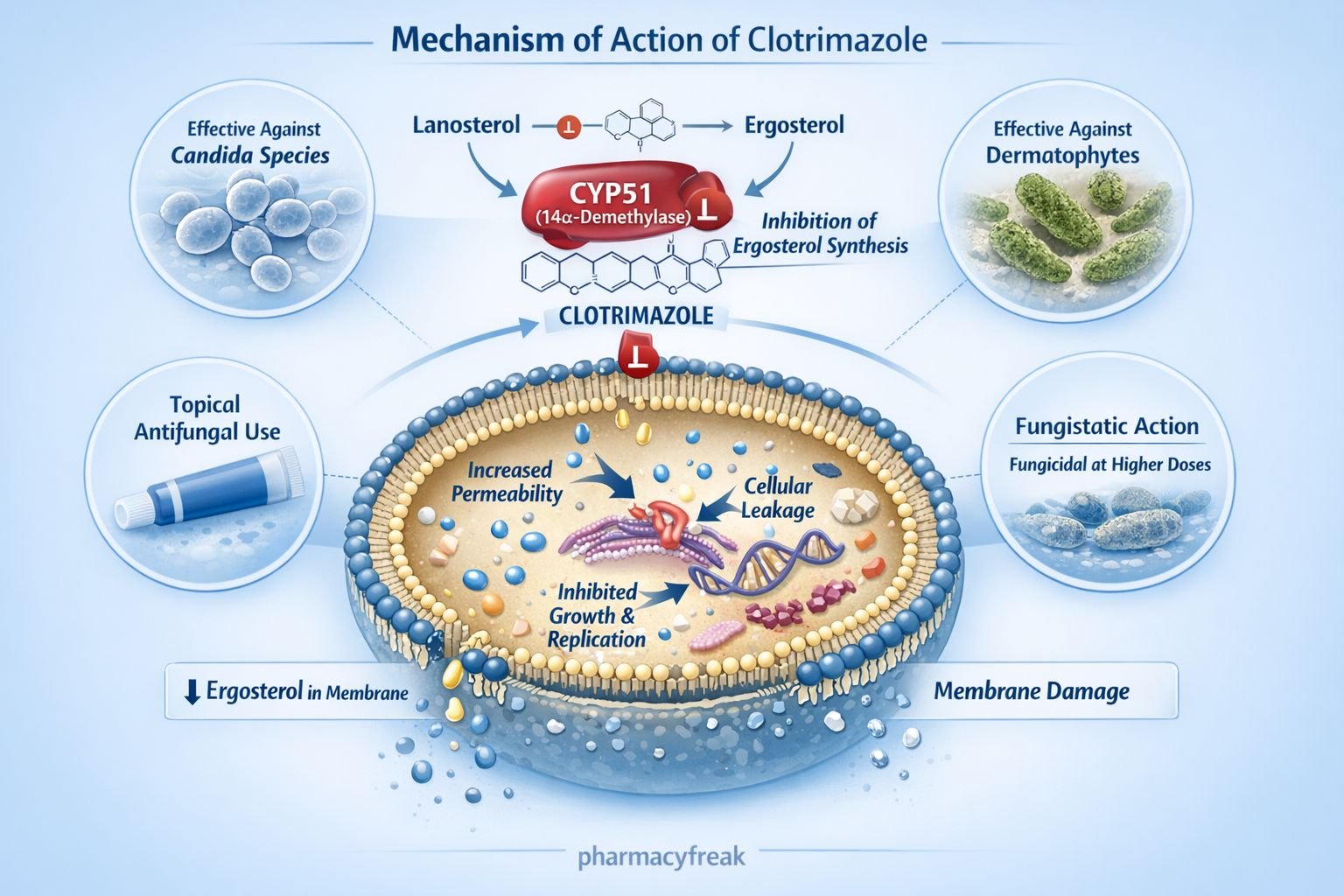
Clotrimazole exerts its antifungal activity by inhibiting ergosterol synthesis, an essential component of fungal cell membranes.
Step-wise mechanism:
- Fungal Cell Membrane Composition
Fungal cell membranes contain ergosterol, which is analogous to cholesterol in human cell membranes and is critical for membrane integrity and function. - Target Enzyme: 14-α-Demethylase
Ergosterol synthesis requires the cytochrome P450–dependent enzyme lanosterol 14-α-demethylase. - Enzyme Inhibition by Clotrimazole
Clotrimazole inhibits 14-α-demethylase by binding to the fungal cytochrome P450 system. - Decreased Ergosterol Synthesis
Inhibition of this enzyme leads to reduced conversion of lanosterol to ergosterol. - Accumulation of Toxic Sterols
Abnormal methylated sterols accumulate within the fungal cell membrane. - Membrane Instability and Dysfunction
Altered membrane permeability results in leakage of intracellular contents. - Growth Inhibition and Cell Death
The net effect is inhibition of fungal growth (fungistatic) and, at higher concentrations, fungal cell death (fungicidal).
Pharmacokinetics
- Absorption: Minimal systemic absorption after topical or vaginal administration
- Distribution: Localized to site of application
- Metabolism: Hepatic metabolism if systemically absorbed (negligible)
- Elimination: Biliary and fecal routes (trace systemic absorption)
- Half-life: Not clinically significant due to topical use
- Special feature: High local concentration with minimal systemic exposure
Clotrimazole’s safety profile is largely due to its poor systemic absorption.
Clinical Uses
Clotrimazole is primarily used for superficial fungal infections:
- Cutaneous candidiasis
- Vulvovaginal candidiasis
- Oral thrush (topical lozenges)
- Tinea infections (tinea pedis, cruris, corporis)
- Pityriasis versicolor
- Fungal diaper rash
It is available in creams, lotions, powders, vaginal tablets, and oral troches.
Adverse Effects
Clotrimazole is generally well tolerated. Adverse effects are usually mild and localized:
- Burning or stinging sensation at application site
- Skin irritation or erythema
- Pruritus
- Peeling or blistering (rare)
- Gastrointestinal upset (with oral troches)
Systemic adverse effects are extremely rare due to minimal absorption.
Comparative Analysis (must include a table + explanation)
Comparison of Antifungal Drug Classes
| Feature | Clotrimazole | Polyenes (Amphotericin B) | Echinocandins |
|---|---|---|---|
| Drug class | Azole (Imidazole) | Polyene | Lipopeptide |
| Target | Ergosterol synthesis | Ergosterol binding | β-glucan synthesis |
| Route | Topical / Vaginal | IV | IV |
| Systemic toxicity | Minimal | High | Low |
| Common use | Superficial mycoses | Severe systemic mycoses | Invasive candidiasis |
Explanation:
Clotrimazole is ideal for superficial fungal infections due to targeted inhibition of ergosterol synthesis and minimal systemic toxicity. Polyenes and echinocandins are reserved for severe systemic infections but carry higher costs and require parenteral administration.
MCQs (10–15)
- Clotrimazole inhibits fungal growth by blocking synthesis of:
a) Chitin
b) Peptidoglycan
c) Ergosterol
d) Glucan
Answer: c) Ergosterol
- The enzyme inhibited by clotrimazole is:
a) DNA gyrase
b) β-glucan synthase
c) Squalene epoxidase
d) 14-α-demethylase
Answer: d) 14-α-demethylase
- Clotrimazole belongs to which antifungal class?
a) Triazole
b) Polyene
c) Imidazole
d) Echinocandin
Answer: c) Imidazole
- The primary effect of clotrimazole is:
a) Cell wall lysis
b) Membrane permeability alteration
c) DNA damage
d) Protein synthesis inhibition
Answer: b) Membrane permeability alteration
- Clotrimazole is most commonly used for:
a) Systemic aspergillosis
b) Cryptococcal meningitis
c) Superficial fungal infections
d) Invasive candidemia
Answer: c) Superficial fungal infections
- Clotrimazole is primarily:
a) Fungicidal only
b) Fungistatic at low doses
c) Antibacterial
d) Antiviral
Answer: b) Fungistatic at low doses
- Systemic toxicity of clotrimazole is low because:
a) Rapid renal clearance
b) Minimal absorption
c) High protein binding
d) Short half-life
Answer: b) Minimal absorption
- Which organism is commonly treated with clotrimazole?
a) Pseudomonas aeruginosa
b) Candida albicans
c) Mycobacterium tuberculosis
d) Plasmodium falciparum
Answer: b) Candida albicans
- Accumulation of toxic sterols results in:
a) Cell wall thickening
b) Ribosomal inhibition
c) Membrane dysfunction
d) DNA fragmentation
Answer: c) Membrane dysfunction
- Clotrimazole vaginal tablets are used for:
a) Bacterial vaginosis
b) Trichomoniasis
c) Vulvovaginal candidiasis
d) Chlamydial infection
Answer: c) Vulvovaginal candidiasis
FAQs (minimum 5)
- What is the primary mechanism of clotrimazole?
Inhibition of ergosterol synthesis by blocking 14-α-demethylase. - Is clotrimazole fungicidal or fungistatic?
It is primarily fungistatic but may be fungicidal at higher concentrations. - Why is clotrimazole safe for topical use?
Because systemic absorption is minimal. - Does clotrimazole affect human cholesterol synthesis?
No, it selectively targets fungal cytochrome P450 enzymes. - Can clotrimazole be used orally?
Yes, in the form of oral troches for oropharyngeal candidiasis. - Is clotrimazole effective against bacteria?
No, it has antifungal activity only.
References
- Goodman & Gilman’s The Pharmacological Basis of Therapeutics
https://accessmedicine.mhmedical.com - Katzung BG. Basic and Clinical Pharmacology
https://accessmedicine.mhmedical.com - Tripathi KD. Essentials of Medical Pharmacology
https://www.jaypeebrothers.com - Harrison’s Principles of Internal Medicine
https://accessmedicine.mhmedical.com