Table of Contents
Introduction
Cinacalcet is an oral calcimimetic agent primarily used in the management of disorders associated with excessive parathyroid hormone (PTH) secretion. It plays a crucial role in treating secondary hyperparathyroidism in patients with chronic kidney disease (CKD on dialysis), parathyroid carcinoma, and severe primary hyperparathyroidism when surgery is not an option. Cinacalcet is frequently tested in pharmacology and clinical medicine examinations due to its unique mechanism of action on calcium-sensing receptors.


Mechanism of Action (Step-wise)
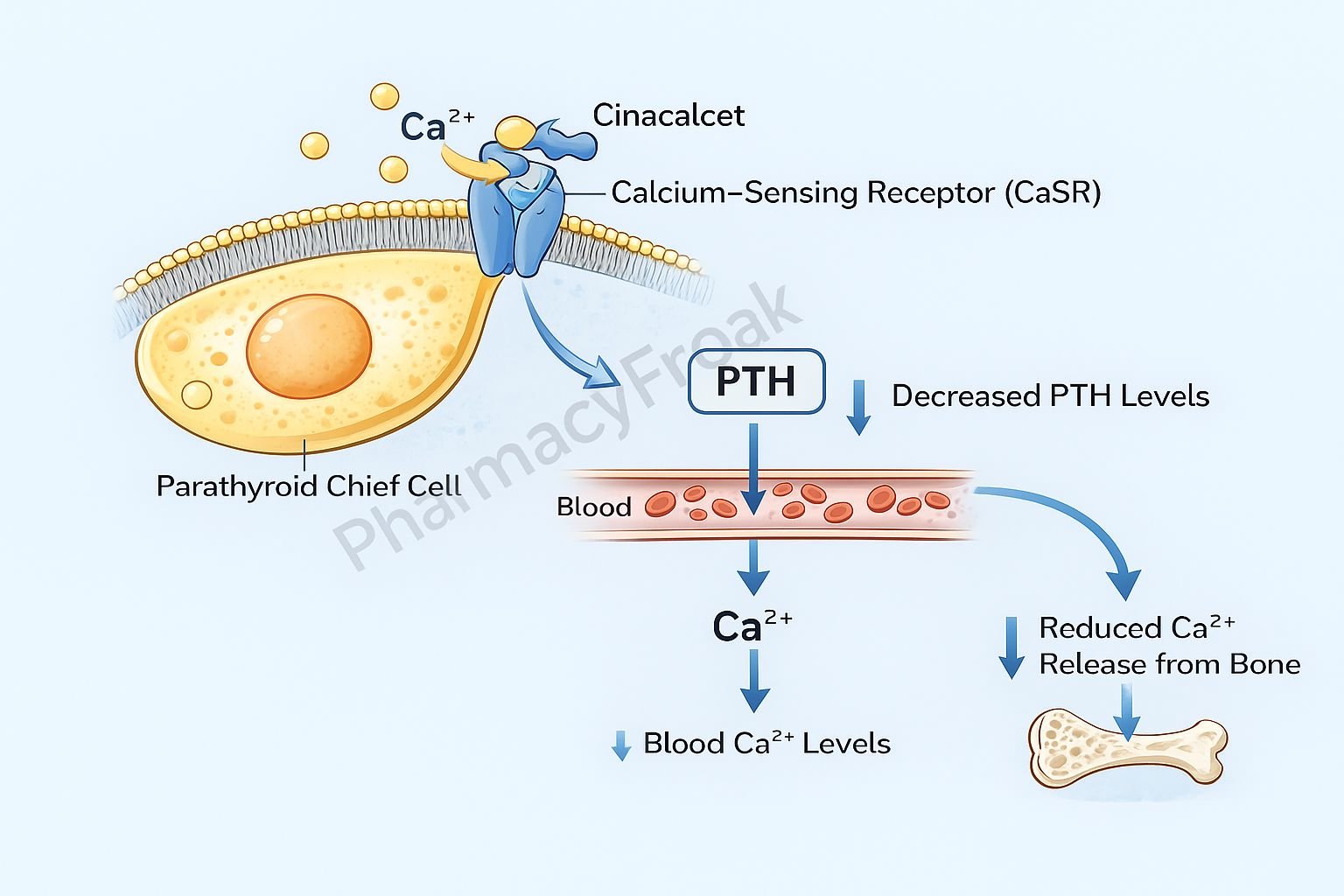
Cinacalcet acts by increasing the sensitivity of the calcium-sensing receptor (CaSR) on parathyroid cells to extracellular calcium.
Step-wise mechanism:
- Presence of Calcium-Sensing Receptors (CaSR)
Calcium-sensing receptors are G protein–coupled receptors located on the surface of parathyroid chief cells. - Normal Physiology
Under normal conditions, elevated extracellular calcium activates CaSR, suppressing PTH synthesis and release. - Allosteric Binding of Cinacalcet
Cinacalcet binds allosterically to the CaSR at a site distinct from calcium. - Increased Receptor Sensitivity
This binding increases the sensitivity of CaSR to extracellular calcium, making the receptor respond as if calcium levels are higher than they actually are. - Suppression of Parathyroid Hormone (PTH)
Enhanced CaSR activation inhibits PTH secretion and reduces PTH gene transcription. - Downstream Effects
Reduced PTH levels lead to:- Decreased bone resorption
- Reduced calcium and phosphate release from bone
- Lower serum calcium levels
Pharmacokinetics
- Absorption: Well absorbed orally; bioavailability increased with food
- Distribution: Highly protein bound (>90%)
- Metabolism: Extensive hepatic metabolism via CYP3A4, CYP2D6, and CYP1A2
- Elimination: Primarily via feces; minimal renal excretion
- Half-life: Approximately 30–40 hours
- Onset of action: PTH reduction within hours of dosing
Clinical Uses
Cinacalcet is indicated for conditions characterized by excess PTH secretion:
- Secondary hyperparathyroidism in CKD patients on dialysis
- Parathyroid carcinoma–associated hypercalcemia
- Severe primary hyperparathyroidism when parathyroidectomy is not feasible
- Control of hypercalcemia refractory to conventional therapy
Adverse Effects
Common and clinically relevant adverse effects include:
- Hypocalcemia (most important adverse effect)
- Nausea and vomiting
- Diarrhea
- Myalgia
- Paresthesias
- Seizures (secondary to hypocalcemia, rare but serious)
Regular monitoring of serum calcium is mandatory during therapy.
Comparative Analysis (must include a table + explanation)
Comparison of Drugs Affecting Parathyroid Hormone Regulation
| Feature | Cinacalcet | Vitamin D Analogues | Parathyroidectomy |
|---|---|---|---|
| Mechanism | CaSR sensitizer | Suppress PTH synthesis | Removes parathyroid tissue |
| Effect on calcium | Decreases | Increases | Decreases |
| Route | Oral | Oral / IV | Surgical |
| Use in CKD | Yes | Yes | Limited |
| Risk of hypocalcemia | High | Low | Moderate |
Explanation:
Cinacalcet uniquely lowers PTH while also reducing serum calcium, making it especially useful in hypercalcemic states. Vitamin D analogues suppress PTH but can worsen hypercalcemia, whereas surgery provides definitive treatment but is not always feasible.
MCQs (10–15)
- Cinacalcet primarily acts on which receptor?
a) Vitamin D receptor
b) Calcium-sensing receptor
c) PTH receptor
d) NMDA receptor
Answer: b) Calcium-sensing receptor
- Cinacalcet decreases PTH secretion by:
a) Blocking calcium channels
b) Increasing intracellular calcium
c) Sensitizing CaSR to calcium
d) Inhibiting osteoclasts directly
Answer: c) Sensitizing CaSR to calcium
- Cinacalcet is classified as a:
a) PTH analogue
b) Bisphosphonate
c) Calcimimetic
d) Calcilytic
Answer: c) Calcimimetic
- The most important adverse effect of cinacalcet is:
a) Hypercalcemia
b) Hypocalcemia
c) Hyperphosphatemia
d) Nephrotoxicity
Answer: b) Hypocalcemia
- Cinacalcet is most commonly used in:
a) Osteoporosis
b) Primary hyperparathyroidism (all cases)
c) Secondary hyperparathyroidism in CKD
d) Paget disease
Answer: c) Secondary hyperparathyroidism in CKD
- Cinacalcet reduces PTH by acting on which cells?
a) Osteoclasts
b) Renal tubular cells
c) Parathyroid chief cells
d) Osteoblasts
Answer: c) Parathyroid chief cells
- Which condition requires close calcium monitoring during cinacalcet therapy?
a) Hypertension
b) Diabetes mellitus
c) Seizure disorder
d) Chronic kidney disease
Answer: d) Chronic kidney disease
- Cinacalcet is primarily metabolized by:
a) Kidney
b) Plasma esterases
c) Liver CYP enzymes
d) Lungs
Answer: c) Liver CYP enzymes
- Cinacalcet mimics the action of:
a) PTH
b) Vitamin D
c) Calcium
d) Phosphate
Answer: c) Calcium
- Cinacalcet lowers serum calcium by:
a) Increasing intestinal absorption
b) Increasing renal reabsorption
c) Reducing PTH-mediated bone resorption
d) Activating vitamin D
Answer: c) Reducing PTH-mediated bone resorption
FAQs (minimum 5)
- What is the primary mechanism of cinacalcet?
Cinacalcet increases the sensitivity of calcium-sensing receptors to extracellular calcium. - Why does cinacalcet cause hypocalcemia?
By suppressing PTH, it reduces calcium release from bone and renal reabsorption. - Is cinacalcet used in primary hyperparathyroidism?
Yes, when surgery is contraindicated or not feasible. - Does cinacalcet increase vitamin D levels?
No, it acts independently of vitamin D pathways. - Which patients benefit most from cinacalcet?
Patients with CKD on dialysis and secondary hyperparathyroidism.
References
- Goodman & Gilman’s The Pharmacological Basis of Therapeutics
https://accessmedicine.mhmedical.com - Katzung BG. Basic and Clinical Pharmacology
https://accessmedicine.mhmedical.com - Tripathi KD. Essentials of Medical Pharmacology
https://www.jaypeebrothers.com - Harrison’s Principles of Internal Medicine
https://accessmedicine.mhmedical.com