
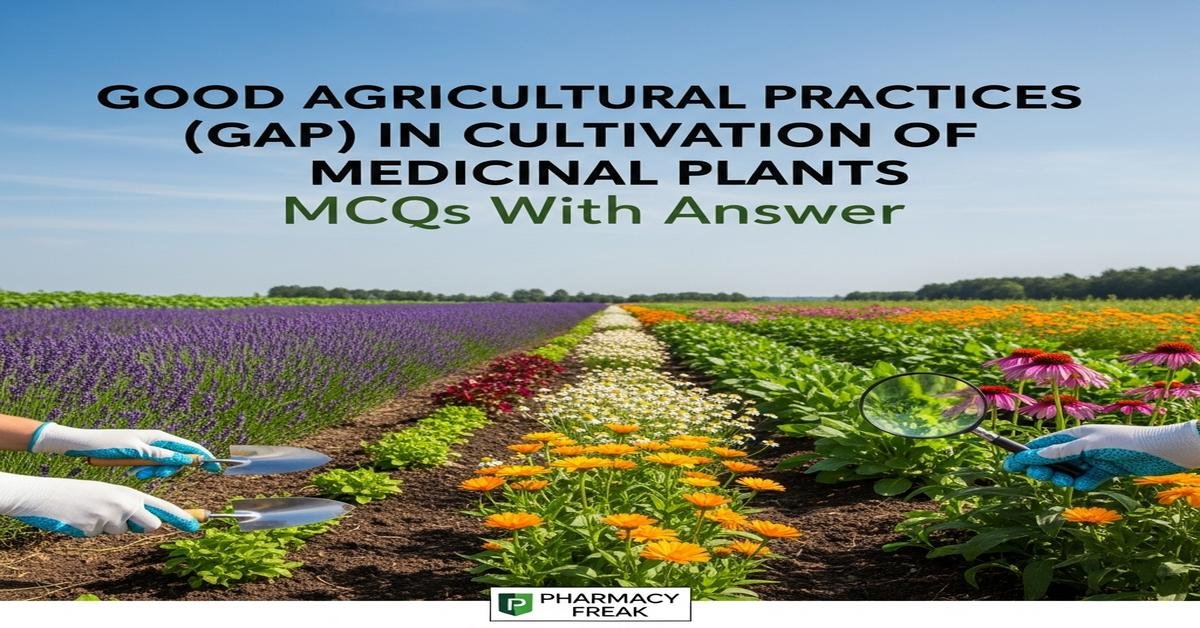
Introduction: Good Agricultural Practices (GAP) in cultivation of medicinal plants are a set of science-based principles and practical measures that ensure the safety, quality, and sustainability of herbal raw materials. For B.Pharm students, understanding GAP is essential for linking field cultivation to pharmaceutical quality, preserving active phytochemicals, preventing contamination, and ensuring traceability from seed to storage. GAP covers site selection, propagation, soil and nutrient management, integrated pest management, hygienic harvesting, post-harvest handling, documentation, and compliance with standards such as GACP and national regulations. Mastery of GAP helps pharmacists assess raw material integrity and supports safe, effective herbal products. Now let’s test your knowledge with 30 MCQs on this topic.
Q1. What is the primary objective of Good Agricultural Practices (GAP) for medicinal plants?
- Maximizing yield regardless of quality
- Ensuring consistent phytochemical quality and safety
- Replacing traditional practices with synthetic inputs
- Eliminating all microorganisms from fields
Correct Answer: Ensuring consistent phytochemical quality and safety
Q2. Which guideline specifically addresses medicinal plant collection and cultivation at an international level?
- WHO GACP (Good Agricultural and Collection Practices)
- ICH Q7 (Good Manufacturing Practice)
- FDA 21 CFR Part 11
- Codex Alimentarius for processed foods
Correct Answer: WHO GACP (Good Agricultural and Collection Practices)
Q3. Which practice is most important to maintain traceability in GAP?
- Random sampling of final product only
- Comprehensive record-keeping from seed to storage
- Marketing the crop under a brand name
- Using only certified organic fertilizers
Correct Answer: Comprehensive record-keeping from seed to storage
Q4. Soil testing in GAP primarily helps to determine:
- Best harvesting equipment
- Nutrient status and contamination risks
- Market demand for the herb
- Transport routes to processors
Correct Answer: Nutrient status and contamination risks
Q5. Which of the following is a GAP measure to minimize pesticide residues in medicinal plants?
- Applying the highest labeled dose to ensure pest kill
- Using integrated pest management and pre-harvest intervals
- Spraying pesticides immediately before harvest
- Mixing multiple pesticides together for broad-spectrum control
Correct Answer: Using integrated pest management and pre-harvest intervals
Q6. Why is correct identification of plant species important under GAP?
- To reduce the need for irrigation
- To prevent adulteration and ensure correct therapeutic properties
- To enable growth in any soil type
- To allow harvesting at random times
Correct Answer: To prevent adulteration and ensure correct therapeutic properties
Q7. Which propagation technique is preferred in GAP to maintain chemotype uniformity?
- Random seed collection from mixed populations
- Vegetative propagation from authenticated mother plants
- Intercropping with unrelated species
- Broadcast sowing without selection
Correct Answer: Vegetative propagation from authenticated mother plants
Q8. What is the role of buffer zones in GAP for medicinal plants?
- To maximize planting density
- To reduce drift and contamination from adjacent land uses
- To increase fertilizer usage near boundaries
- To provide extra space for livestock grazing
Correct Answer: To reduce drift and contamination from adjacent land uses
Q9. Which post-harvest practice directly protects phytochemical integrity?
- Immediate drying using controlled temperature and humidity
- Leaving material in the field overnight
- Storing wet biomass in sealed plastic without drying
- Stacking harvested material in dense piles
Correct Answer: Immediate drying using controlled temperature and humidity
Q10. In GAP, which of the following minimizes heavy metal contamination?
- Selecting cultivation sites away from industrial emissions and contaminated water
- Increasing phosphorus fertilizers
- Using untreated sewage water for irrigation
- Applying sludge as a fertilizer without testing
Correct Answer: Selecting cultivation sites away from industrial emissions and contaminated water
Q11. What does GAP recommend for irrigation water quality?
- Any available water source without testing
- Water tested and free from high microbial and chemical contaminants
- Only distilled water for field irrigation
- Using saline water to increase secondary metabolites
Correct Answer: Water tested and free from high microbial and chemical contaminants
Q12. Which documentation is critical under GAP for each cultivation batch?
- Only sales invoices
- Records of seed source, agrochemical use, irrigation and harvest dates
- Personal notes of the field worker kept informally
- Advertising materials for the herb
Correct Answer: Records of seed source, agrochemical use, irrigation and harvest dates
Q13. Integrated Pest Management (IPM) in GAP emphasizes:
- Exclusive reliance on synthetic insecticides
- Combining biological, cultural and chemical controls with monitoring
- Eliminating natural predators to control pests
- Frequent prophylactic spraying on schedule
Correct Answer: Combining biological, cultural and chemical controls with monitoring
Q14. Pre-harvest interval (PHI) refers to:
- Time between fertilizer application and flowering
- Minimum time between last pesticide application and harvest
- Duration of drying after harvest
- Time taken to transport crop to market
Correct Answer: Minimum time between last pesticide application and harvest
Q15. Which hazard is GAP principally designed to control for medicinal plant raw materials?
- Only genetic contamination
- Biological, chemical and physical contaminants
- Loss of trademark rights
- Market price fluctuations
Correct Answer: Biological, chemical and physical contaminants
Q16. Why is harvesting at the correct plant growth stage important in GAP?
- To maximize leaf area index only
- To ensure optimal concentration of desired phytochemicals
- To reduce labor requirements regardless of quality
- To allow immediate sale to consumers
Correct Answer: To ensure optimal concentration of desired phytochemicals
Q17. Which practice helps prevent microbial contamination during harvesting?
- Harvesting with soiled hands and unclean tools
- Using clean tools, hygienic handling and protective clothing
- Collecting harvested material in open, dirty containers
- Transporting wet material in sealed bags for several days
Correct Answer: Using clean tools, hygienic handling and protective clothing
Q18. GAP recommends drying medicinal plants to reduce moisture because:
- High moisture encourages microbial growth and metabolite degradation
- Drying increases pesticide residues
- Dry material is heavier and increases transport cost
- Moisture has no impact on shelf life
Correct Answer: High moisture encourages microbial growth and metabolite degradation
Q19. Which analytical test is commonly associated with GAP quality screening of raw herbs?
- DNA barcoding for species authentication
- Accelerated stability testing of finished tablets only
- Financial audit of farm income
- Colorimetric soil pH strip only
Correct Answer: DNA barcoding for species authentication
Q20. What is the significance of Good Agricultural and Collection Practices (GACP) for wild-collected medicinal plants?
- It forbids any collection from wild sources
- It provides guidance to ensure sustainable, quality and ethical collection
- It requires cultivation of wild species only in greenhouses
- It eliminates the need for post-harvest processing
Correct Answer: It provides guidance to ensure sustainable, quality and ethical collection
Q21. Which fertilizer practice aligns with GAP to prevent contamination?
- Using untreated human sewage sludge as fertilizer
- Applying well-characterized, tested organic amendments and following rates
- Applying unknown industrial by-products to improve growth
- Excessive use of micronutrients without testing
Correct Answer: Applying well-characterized, tested organic amendments and following rates
Q22. Which record is NOT typically required under GAP for medicinal plant cultivation?
- Seed lot and supplier details
- Agrochemical application records
- Personal medical records of farmworkers
- Harvest dates and storage conditions
Correct Answer: Personal medical records of farmworkers
Q23. How does crop rotation support GAP in medicinal plant farming?
- By increasing pest build-up in successive seasons
- By enhancing soil fertility and breaking pest and disease cycles
- By ensuring the same crop is planted every season
- By discouraging soil testing
Correct Answer: By enhancing soil fertility and breaking pest and disease cycles
Q24. Which statement about GAP and organic certification is correct?
- GAP and organic standards are identical and interchangeable
- GAP focuses on safety and quality; organic certification focuses on permitted inputs and practices
- Organic certification removes the need for documentation
- GAP prohibits any use of organic manures
Correct Answer: GAP focuses on safety and quality; organic certification focuses on permitted inputs and practices
Q25. Which contaminant is of special concern for medicinal plants used in pharmaceuticals?
- Heavy metals like lead and arsenic
- Only ultraviolet light exposure
- Excessive soil nitrogen alone
- Too much beneficial microbiota
Correct Answer: Heavy metals like lead and arsenic
Q26. What is the role of Good Agricultural Practices in supply chain risk management?
- To make supply chains opaque so competitors can’t copy them
- To reduce risks by ensuring quality, traceability and documented controls
- To remove the need for supplier audits
- To focus only on retail packaging
Correct Answer: To reduce risks by ensuring quality, traceability and documented controls
Q27. Which intervention improves worker hygiene during harvesting according to GAP?
- Prohibiting hand washing in the field
- Providing clean water, sanitizers and training on hygiene
- Allowing workers to handle harvest with bare, dirty hands to speed harvest
- Removing protective clothing requirements
Correct Answer: Providing clean water, sanitizers and training on hygiene
Q28. Which action supports genetic purity and quality of planting material under GAP?
- Using uncertified, mixed seed lots
- Sourcing certified seed or authenticated vegetative material from reliable suppliers
- Collecting seeds from roadside populations without testing
- Interchanging seed lots between unrelated species
Correct Answer: Sourcing certified seed or authenticated vegetative material from reliable suppliers
Q29. Final raw material acceptance in pharmaceutical use of herbs should consider:
- Only the color of the material
- Identity, purity, potency (phytochemical content) and contaminant limits
- Price paid to the farmer only
- Packaging design exclusively
Correct Answer: Identity, purity, potency (phytochemical content) and contaminant limits
Q30. Which audit or certification best demonstrates compliance with GAP principles for medicinal plants?
- Financial audit by a bank
- GACP/GAP certification and traceability audit by competent bodies
- ISO 9001 without agricultural focus only
- Advertising award for packaging
Correct Answer: GACP/GAP certification and traceability audit by competent bodies


