
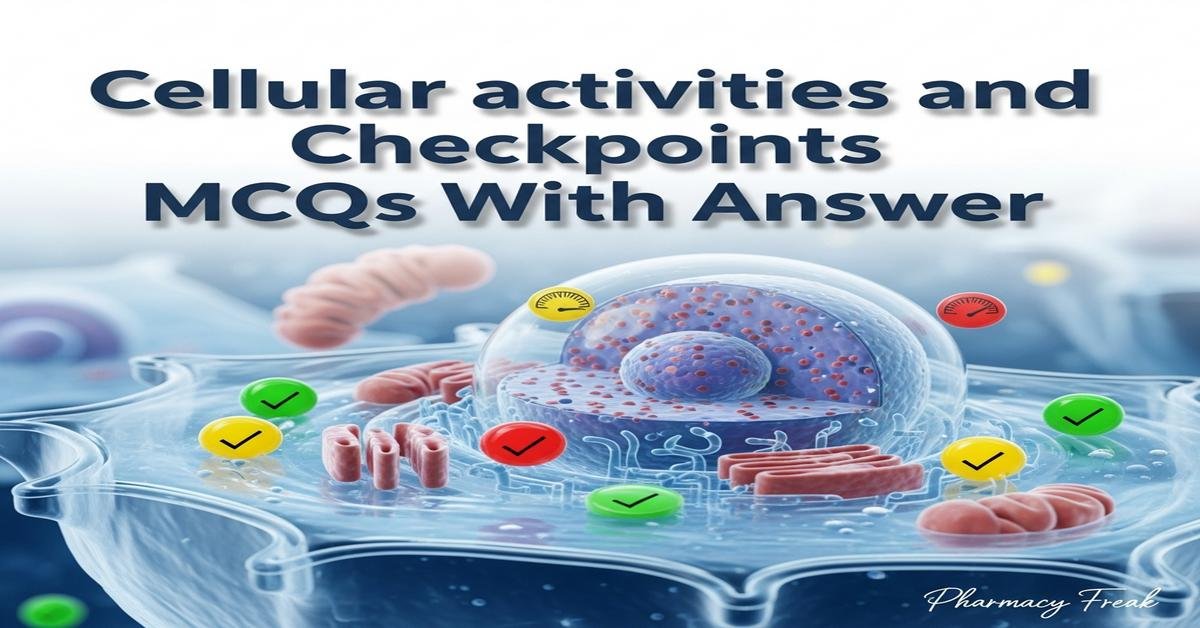
Understanding cellular activities and checkpoints is essential for B. Pharm students preparing for careers in pharmacology, toxicology, and drug development. This topic covers the cell cycle phases, cyclin–CDK regulation, DNA damage responses (ATM/ATR, CHK1/CHK2), key checkpoint proteins (p53, Rb, Cdc25, Wee1), and pathways of DNA repair, apoptosis, senescence and mitotic control. Knowledge of ubiquitin–proteasome systems, APC/C and SCF complexes, and therapeutic targets such as PARP, CHK inhibitors, and microtubule-targeting drugs links molecular mechanism to pharmacotherapy. Questions emphasize clinical relevance, experimental assays and drug mechanisms to prepare you for exams and research. Now let’s test your knowledge with 30 MCQs on this topic.
Q1. Which sequence lists the main phases of the eukaryotic cell cycle in correct order?
- G1, S, G2, M
- S, G1, M, G2
- M, G1, S, G2
- G2, S, G1, M
Correct Answer: G1, S, G2, M
Q2. Which cyclin–CDK complex primarily drives the G1 to S phase transition in mammalian cells?
- Cyclin D–CDK4/6
- Cyclin A–CDK2
- Cyclin B–CDK1
- Cyclin E–CDK1
Correct Answer: Cyclin D–CDK4/6
Q3. The retinoblastoma protein (Rb) controls S phase entry mainly by interacting with which transcription factor family?
- E2F
- MYC
- p53
- NF-κB
Correct Answer: E2F
Q4. Which kinase is primarily activated in response to DNA double-strand breaks (DSBs)?
- ATM
- ATR
- CHK1
- CHK2
Correct Answer: ATM
Q5. p53 mediates cell cycle arrest after DNA damage mainly by inducing which CDK inhibitor?
- p21 (CDKN1A)
- p16 (INK4A)
- p27 (Kip1)
- p57 (Kip2)
Correct Answer: p21 (CDKN1A)
Q6. CHK1 and CHK2 checkpoint kinases enforce arrest by phosphorylating and inhibiting which phosphatase?
- Cdc25
- PTEN
- PP2A
- Calcineurin
Correct Answer: Cdc25
Q7. The anaphase-promoting complex/cyclosome (APC/C) triggers anaphase by ubiquitinating which key substrates?
- Securin and cyclin B
- p53 and Rb
- Cdc25 and Wee1
- PCNA and MCM
Correct Answer: Securin and cyclin B
Q8. The spindle assembly checkpoint (SAC) prevents anaphase until kinetochores are properly attached by producing which inhibitory complex?
- Mitotic checkpoint complex (MCC)
- SCF ubiquitin ligase
- Proteasome complex
- DNA repair foci
Correct Answer: Mitotic checkpoint complex (MCC)
Q9. Separation of sister chromatids at anaphase requires activation of which protease after securin degradation?
- Separase
- Separin
- Caspase-8
- Calpain
Correct Answer: Separase
Q10. Homologous recombination (HR) repairs double-strand breaks using what template?
- The sister chromatid as a template
- The homologous chromosome always as template
- Random RNA template
- End-joining without template
Correct Answer: The sister chromatid as a template
Q11. PARP inhibitors are particularly effective in tumors with defects in which repair pathway due to synthetic lethality?
- Homologous recombination (HR)
- Nucleotide excision repair (NER)
- Base excision repair (BER)
- Mismatch repair (MMR)
Correct Answer: Homologous recombination (HR)
Q12. Which kinase phosphorylates and inhibits CDK1 to delay entry into mitosis during DNA damage or incomplete replication?
- Wee1
- Chk2
- Cdk7
- Mps1
Correct Answer: Wee1
Q13. Activation of CDK1–cyclin B at the G2/M boundary is promoted by which phosphatase?
- Cdc25
- PTEN
- CHK1
- SCF
Correct Answer: Cdc25
Q14. The SCF complex functions in cell cycle control mainly as which type of enzyme?
- E3 ubiquitin ligase targeting phosphorylated substrates for proteasomal degradation
- DNA helicase that unwinds replication forks
- Phosphatase that activates CDKs
- Transcription factor for cyclin genes
Correct Answer: E3 ubiquitin ligase targeting phosphorylated substrates for proteasomal degradation
Q15. Which anticancer drug stabilizes microtubules and prevents their depolymerization, arresting cells in mitosis?
- Paclitaxel
- Vincristine
- Doxorubicin
- Cisplatin
Correct Answer: Paclitaxel
Q16. Persistent activation of p21 can promote which long-term cellular outcome following damage?
- Cellular senescence
- Immediate necrosis
- Uncontrolled mitosis
- Enhanced telomerase activity
Correct Answer: Cellular senescence
Q17. Mitochondrial outer membrane permeabilization (MOMP) in intrinsic apoptosis is mediated by which pro-apoptotic proteins?
- Bax and Bak
- Bcl-2 and Bcl-xL
- XIAP and cIAP
- Survivin and Mcl-1
Correct Answer: Bax and Bak
Q18. In the intrinsic apoptotic pathway, which caspase is the main initiator activated in the apoptosome?
- Caspase-9
- Caspase-8
- Caspase-3
- Caspase-12
Correct Answer: Caspase-9
Q19. The SAC protein Mad2 inhibits progression to anaphase by binding and inactivating which APC/C activator?
- Cdc20
- Cdh1
- Skp2
- Geminin
Correct Answer: Cdc20
Q20. Pharmacologic inhibition of CHK1 in cancer therapy is intended to produce what effect in tumor cells?
- Abrogate S/G2 checkpoints and increase lethal DNA damage
- Enhance homologous recombination repair fidelity
- Stabilize replication forks to prevent collapse
- Directly inhibit microtubule polymerization
Correct Answer: Abrogate S/G2 checkpoints and increase lethal DNA damage
Q21. Geminin prevents DNA rereplication by inhibiting which licensing factor?
- Cdt1
- MCM2
- ORC1
- Cdc6
Correct Answer: Cdt1
Q22. Centrosome duplication normally occurs during which cell cycle phase?
- S phase
- M phase
- G2 phase
- G0 phase
Correct Answer: S phase
Q23. Which class of cancer-related genes typically requires loss-of-function of both alleles to contribute to tumorigenesis?
- Tumor suppressor genes
- Oncogenes
- Housekeeping genes
- Proto-oncogenes activated by one hit
Correct Answer: Tumor suppressor genes
Q24. Failure of the spindle assembly checkpoint most directly increases the risk of which cellular abnormality?
- Aneuploidy and chromosomal instability
- Point mutations in mitochondrial DNA
- Hyperactivation of telomerase
- Increased base excision repair
Correct Answer: Aneuploidy and chromosomal instability
Q25. Progressive telomere shortening in somatic cells primarily triggers which response preventing unlimited proliferation?
- Replicative senescence mediated by p53 and Rb
- Immediate apoptosis via caspase-8
- Enhanced homologous recombination
- Constitutive activation of CDK1
Correct Answer: Replicative senescence mediated by p53 and Rb
Q26. Deficiency in mismatch repair (MMR) proteins commonly leads to what genomic signature in tumors?
- Microsatellite instability (MSI)
- Large chromosomal translocations
- Increased mitochondrial mutations
- Polyploidy without instability
Correct Answer: Microsatellite instability (MSI)
Q27. In homologous recombination repair, RAD51 is essential for which step?
- Strand invasion and homology search
- Direct ligation of DNA ends
- Base excision and replacement
- Removal of RNA primers
Correct Answer: Strand invasion and homology search
Q28. Human papillomavirus (HPV) E7 protein contributes to malignant transformation by binding and inactivating which tumor suppressor?
- Rb
- p53
- BRCA1
- PTEN
Correct Answer: Rb
Q29. Single-stranded DNA at stalled replication forks primarily activates which sensor kinase?
- ATR
- ATM
- CHK2
- DNA-PKcs
Correct Answer: ATR
Q30. Mitotic catastrophe refers to cell death resulting from which situation?
- Failed mitosis due to irreparable DNA damage or checkpoint abrogation
- Chronic activation of telomerase leading to immortality
- Overactive base excision repair producing mutations
- Excessive autophagy protecting cells from death
Correct Answer: Failed mitosis due to irreparable DNA damage or checkpoint abrogation


