Trusted by 50K+ Pharmacy StudentsHigh Quality Notes, MCQs, Mock Tests & Study ResourcesGo Premium (Ads Free)
Pharmacy Freak

Differences between Indian and global pharmacovigilance systems MCQs With Answer
Differences between Indian and global pharmacovigilance systems MCQs With Answer

This concise guide helps B.Pharm students explore Differences between Indian and global pharmacovigilance systems MCQs With Answer. It explains key contrasts — Indian Pharmacovigilance Programme (PvPI), CDSCO roles, ADR reporting through ADR Monitoring Centres (AMCs) and national databases — versus global frameworks like FDA’s FAERS, EMA’s EudraVigilance, and WHO‑UMC’s VigiBase. Topics covered include causality assessment … Read more
Drugs & Cosmetics Act and Schedule Y for safety reporting MCQs With Answer

Drugs & Cosmetics Act and Schedule Y for safety reporting MCQs With Answer

Introduction: The Drugs & Cosmetics Act and Schedule Y form the backbone of clinical trial regulation and safety reporting in India. For B. Pharm students, understanding these laws is essential: they define “new drug,” outline protocol submission, investigator responsibilities, ethics committee review, and post‑marketing surveillance. Schedule Y specifically frames clinical trial phases, essential documents, bioavailability/bioequivalence … Read more

CDSCO regulations on pharmacovigilance in India MCQs With Answer

CDSCO regulations on pharmacovigilance in India MCQs With Answer

CDSCO regulations on pharmacovigilance in India set the legal and operational framework for detecting, assessing, and preventing adverse drug reactions (ADRs). For B.Pharm students, mastering terms like CDSCO, PvPI, Indian Pharmacopoeia Commission (IPC), ICSR, signal detection, PSUR, and MAH responsibilities is essential. These regulations connect clinical trial safety (Schedule Y), post-marketing surveillance, risk management plans … Read more

CIOMS ADR reporting form and structure MCQs With Answer

CIOMS ADR reporting form and structure MCQs With Answer

Introduction: The CIOMS ADR reporting form is a standardized pharmacovigilance tool used worldwide to document adverse drug reactions (ADRs), ensuring consistent case capture for signal detection, regulatory reporting, and safety assessment. B. Pharm students should understand CIOMS structure—patient details, reaction description, suspect drug information, reporter data, seriousness, expectedness, causality and supporting lab results—and related concepts … Read more

CIOMS working groups and their role MCQs With Answer

CIOMS working groups and their role MCQs With Answer

CIOMS working groups are expert panels convened by the Council for International Organizations of Medical Sciences to develop consensus guidelines, technical reports, and practical tools for drug safety and clinical research. For B.Pharm students, understanding CIOMS links pharmacovigilance theory with global regulatory practice: adverse drug reaction (ADR) reporting, causality assessment, signal detection, benefit–risk evaluation, pregnancy … Read more

Drug safety evaluation in geriatrics MCQs With Answer

Drug safety evaluation in geriatrics MCQs With Answer

Drug safety evaluation in geriatrics is an essential subject for B.Pharm students learning to reduce medication-related harm in older adults. Age-related changes in pharmacokinetics and pharmacodynamics, plus comorbidities and polypharmacy, increase risks of adverse drug reactions, drug–drug interactions, and prescribing cascades. Important keywords include drug safety evaluation, geriatrics, pharmacokinetics, pharmacodynamics, polypharmacy, adverse drug reactions, dose … Read more

Drug safety evaluation in pregnancy and lactation MCQs With Answer

Drug safety evaluation in pregnancy and lactation MCQs With Answer

Introduction: Drug safety evaluation in pregnancy and lactation is a critical subject for B. Pharm students focusing on teratogenicity, pharmacokinetics, placental transfer, and breastfeeding risk assessment. Understanding concepts like organogenesis timing, the Pregnancy and Lactation Labeling Rule (PLLR), milk-to-plasma ratio, relative infant dose (RID), and clinical counseling helps pharmacists optimize maternal and fetal outcomes. This … Read more

Drug safety evaluation in pediatric populations MCQs With Answer

Drug safety evaluation in pediatric populations MCQs With Answer

Drug safety evaluation in pediatric populations is essential for B.Pharm students to understand pediatric pharmacology, adverse drug reactions, dosing strategies, pharmacokinetics and pharmacodynamics in neonates, infants, children, and adolescents. This introduction covers age-related differences in drug absorption, distribution, metabolism, and excretion, key safety concerns like excipient toxicity, off-label use, therapeutic drug monitoring, pharmacovigilance, clinical trial … Read more

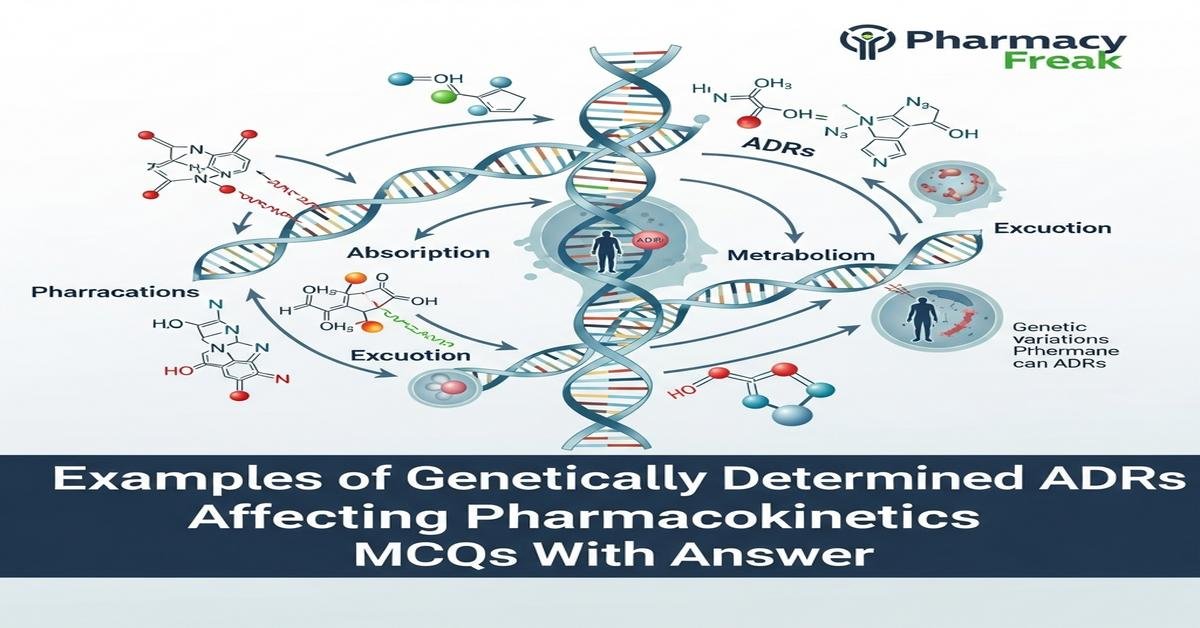
Examples of genetically determined ADRs affecting pharmacokinetics MCQs With Answer

Examples of genetically determined ADRs affecting pharmacokinetics MCQs With Answer

Genetically determined ADRs affecting pharmacokinetics occur when inherited variations in drug‑metabolizing enzymes, transporters or conjugating proteins alter absorption, distribution, metabolism or excretion, producing unexpected toxicity or therapeutic failure. Key pharmacogenetics keywords for B. Pharm students include CYP450 (CYP2D6, CYP2C9, CYP2C19, CYP3A5), TPMT, NAT2, UGT1A1, SLCO1B1 and DPYD. Clinical examples include codeine toxicity, warfarin bleeding, thiopurine … Read more

Pharmacogenomics and genetics of adverse drug reactions MCQs With Answer

Pharmacogenomics and genetics of adverse drug reactions MCQs With Answer

Pharmacogenomics and pharmacogenetics explore how genetic variation influences drug response and the risk of adverse drug reactions. For B.Pharm students, mastering concepts such as CYP450 polymorphisms, TPMT, NAT2, UGT1A1, HLA alleles, drug metabolism, pharmacokinetics, pharmacodynamics, genotype–phenotype correlations, and pharmacovigilance is essential for safe, personalized therapy. This focused, high-yield collection links molecular mechanisms to clinical consequences, … Read more

PRO
Ad-Free Access
$3.99 / month
  • ✓ No Interruptions
  • ✓ Faster Page Loads
  • ✓ Support Content Creators