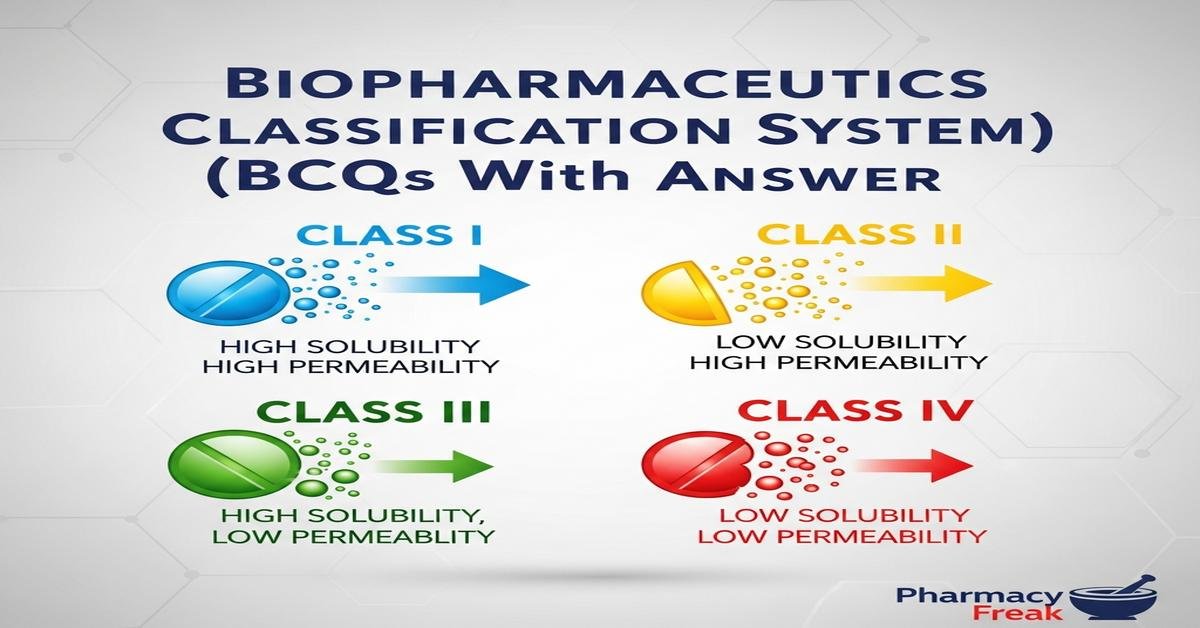
Introduction: This set of Biopharmaceutics Classification System (BCS) MCQs with answers is designed for M.Pharm students preparing for MIP 201T – Advanced Biopharmaceutics & Pharmacokinetics. The questions emphasize regulatory definitions, mechanistic understanding, and practical applications of BCS concepts — solubility and permeability criteria, dose number, classification of drugs into BCS classes I–IV, criteria for biowaivers, dissolution requirements, and differences with BDDCS. Items include in vitro and in vivo methods used to assess permeability and dissolution, the impact of pH and excipients on absorption, and the relevance of IVIVC. These MCQs aim to deepen conceptual clarity and prepare students for exams and research decisions.
Q1. What is the formal regulatory definition of a “high solubility” drug under the Biopharmaceutics Classification System?
- The drug is soluble in water at 25°C at any pH
- The highest single therapeutic dose is soluble in 250 mL or less of aqueous media across pH 1.0–6.8
- The drug has a solubility >1 mg/mL in buffer at pH 7.4
- The drug dissolves completely within 30 minutes in simulated gastric fluid
Correct Answer: The highest single therapeutic dose is soluble in 250 mL or less of aqueous media across pH 1.0–6.8
Q2. How is “high permeability” typically defined for regulatory BCS classification?
- Apparent permeability (Papp) in Caco-2 cells greater than 10 x10^-6 cm/s
- Extent of absorption in humans is ≥90% of the administered dose
- Passive membrane permeation observed in PAMPA assays
- Fraction metabolized in the liver greater than 80%
Correct Answer: Extent of absorption in humans is ≥90% of the administered dose
Q3. Which parameter (and its correct expression) defines the Dose Number (Do) used to assess solubility in BCS?
- Do = (Solubility × 250 mL) / Dose
- Do = Dose / (Solubility × 250 mL)
- Do = Dose × Solubility × 250 mL
- Do = Solubility / (Dose × 250 mL)
Correct Answer: Do = Dose / (Solubility × 250 mL)
Q4. Which of the following best describes BCS Class II compounds?
- High solubility, high permeability; absorption rate limited by gastric emptying
- Low solubility, high permeability; absorption is dissolution-rate limited
- High solubility, low permeability; absorption is permeation-rate limited
- Low solubility, low permeability; both dissolution and permeation limit absorption
Correct Answer: Low solubility, high permeability; absorption is dissolution-rate limited
Q5. Which BCS class is most amenable to regulatory biowaivers for immediate-release solid oral dosage forms under typical guidance?
- Class II
- Class III
- Class I
- Class IV
Correct Answer: Class I
Q6. Under common regulatory criteria, what dissolution performance is generally required across three media (pH 1.2, 4.5, 6.8) to support a biowaiver for Class I drugs?
- At least 85% dissolved in 30 minutes in all three media
- At least 50% dissolved in 60 minutes in all three media
- Complete dissolution within 120 minutes in any one medium
- At least 70% dissolved in 15 minutes in any two media
Correct Answer: At least 85% dissolved in 30 minutes in all three media
Q7. Which statement correctly describes Biopharmaceutics Drug Disposition Classification System (BDDCS) compared to BCS?
- BDDCS classifies drugs only by solubility and follows the same permeability thresholds as BCS
- BDDCS uses extent of metabolism instead of human permeability to predict transporter effects and clearance
- BDDCS replaces solubility with dissolution rate in its classification
- BDDCS applies only to parenteral drugs while BCS applies to oral drugs
Correct Answer: BDDCS uses extent of metabolism instead of human permeability to predict transporter effects and clearance
Q8. Which in vitro method provides a high-throughput estimate of passive permeability but cannot account for active transport?
- Human intestinal perfusion study
- Caco-2 cell monolayer assay
- PAMPA (Parallel Artificial Membrane Permeability Assay)
- In situ intestinal loop perfusion
Correct Answer: PAMPA (Parallel Artificial Membrane Permeability Assay)
Q9. When considering a biowaiver for a Class III drug, which additional condition is usually required compared to Class I?
- Evidence that the drug is >90% metabolized in the liver
- Similarity of excipients and rapid or very rapid dissolution of both test and reference
- Demonstration of identical crystal form only
- Requirement that the drug is a BCS Class II at lower doses
Correct Answer: Similarity of excipients and rapid or very rapid dissolution of both test and reference
Q10. Which factor most directly causes a Class II drug to have poor oral bioavailability despite high permeability?
- Extensive first-pass hepatic metabolism
- Low aqueous solubility resulting in slow dissolution
- High molecular weight restricting diffusion
- Efflux transporter activity in the kidney
Correct Answer: Low aqueous solubility resulting in slow dissolution
Q11. What is the practical definition of “sink conditions” in dissolution testing?
- The dissolution medium volume is equal to the tablet volume
- The drug concentration in medium never exceeds 10–30% of its saturation solubility
- The medium contains surfactant to ensure micelle formation
- pH of the medium is fixed at the isoelectric point of the drug
Correct Answer: The drug concentration in medium never exceeds 10–30% of its saturation solubility
Q12. Which of the following experimental findings would most likely reclassify a drug originally considered BCS Class I to Class III in practice?
- Human mass-balance studies show >95% urinary excretion of unchanged drug
- Caco-2 and in vivo studies reveal poor permeability with active uptake limited absorption
- Solubility increases markedly in presence of bile salts
- Drug shows rapid dissolution in all three regulatory media
Correct Answer: Caco-2 and in vivo studies reveal poor permeability with active uptake limited absorption
Q13. Which parameter from a Caco-2 assay is commonly used to indicate high cell monolayer permeability for screening purposes?
- Efflux ratio greater than 5
- Apparent permeability (Papp) > 1 × 10^-6 cm/s
- Transepithelial electrical resistance (TEER) below 50 Ω·cm^2
- Retention time on HPLC greater than 5 minutes
Correct Answer: Apparent permeability (Papp) > 1 × 10^-6 cm/s
Q14. How can pH-dependent solubility influence BCS classification and formulation strategy?
- If a basic drug is highly soluble only at low pH, formulation must ensure rapid gastric emptying
- If solubility is limited at intestinal pH, the drug may behave as BCS II despite intrinsic high permeability and require solubility-enhancing formulations
- pH-dependent solubility only affects parenteral formulations and is irrelevant to BCS
- Acidic drugs always have pH-independent solubility and thus are automatically Class I
Correct Answer: If solubility is limited at intestinal pH, the drug may behave as BCS II despite intrinsic high permeability and require solubility-enhancing formulations
Q15. Which of the following statements correctly links IVIVC and BCS concepts?
- Level A IVIVC is most likely to be established for BCS Class II drugs when dissolution is rate-limiting for absorption
- IVIVC is irrelevant for BCS because BCS only deals with solubility
- Level C IVIVC requires in vivo testing in at least 100 subjects
- BCS Class IV drugs always show perfect IVIVC due to dual limitations
Correct Answer: Level A IVIVC is most likely to be established for BCS Class II drugs when dissolution is rate-limiting for absorption
Q16. Which excipient effect is a particular concern for BCS Class III drugs when considering interchangeability and biowaiver eligibility?
- Excipient-induced enhancement of hepatic metabolism
- Excipient-mediated changes in intestinal permeability or GI transit that alter absorption
- Excipient effects on tablet color and appearance only
- Excipient-induced precipitation in blood plasma after absorption
Correct Answer: Excipient-mediated changes in intestinal permeability or GI transit that alter absorption
Q17. Which dissolution profile characteristic for a generic immediate-release product would most strongly support a waiver of in vivo bioequivalence for a BCS Class I compound?
- Profiles are superimposable by visual inspection only
- Similarity factor f2 > 50 in three media and rapid dissolution (≥85% in 30 min)
- At least one medium shows 50% dissolution at 60 minutes
- Generic dissolves slower but has the same excipient list
Correct Answer: Similarity factor f2 > 50 in three media and rapid dissolution (≥85% in 30 min)
Q18. Why might a highly permeable drug still show food effects on oral exposure?
- Food can alter gastric pH, bile salt secretion, and gastric emptying, affecting dissolution and solubilization
- Food always increases first-pass elimination and thus reduces exposure
- Highly permeable drugs are impermeable in fed state due to transporter induction
- Food causes binding of the drug in plasma leading to reduced absorption
Correct Answer: Food can alter gastric pH, bile salt secretion, and gastric emptying, affecting dissolution and solubilization
Q19. Which statement is true about the applicability of BCS-based biowaivers?
- Biowaivers based on BCS are applicable to all dosage forms including suspensions and transdermal patches
- BCS biowaivers are generally limited to immediate-release solid oral dosage forms with specific dissolution and excipient criteria
- Biowaivers remove the need for any in vitro dissolution testing
- BCS biowaivers require demonstration of bioequivalence in at least one clinical study
Correct Answer: BCS biowaivers are generally limited to immediate-release solid oral dosage forms with specific dissolution and excipient criteria
Q20. Which dissolution apparatus and condition consideration is most relevant when designing discriminating tests for BCS-related assessment?
- Choosing an apparatus that gives very rapid dissolution for all formulations to simplify comparison
- Selecting an apparatus and agitation speed that can detect formulation differences under non-sink or physiologically relevant conditions
- Using only deionized water at 25°C to avoid buffer complications
- Relying on visual observation rather than quantitative sampling to judge dissolution
Correct Answer: Selecting an apparatus and agitation speed that can detect formulation differences under non-sink or physiologically relevant conditions

