Table of Contents
Introduction
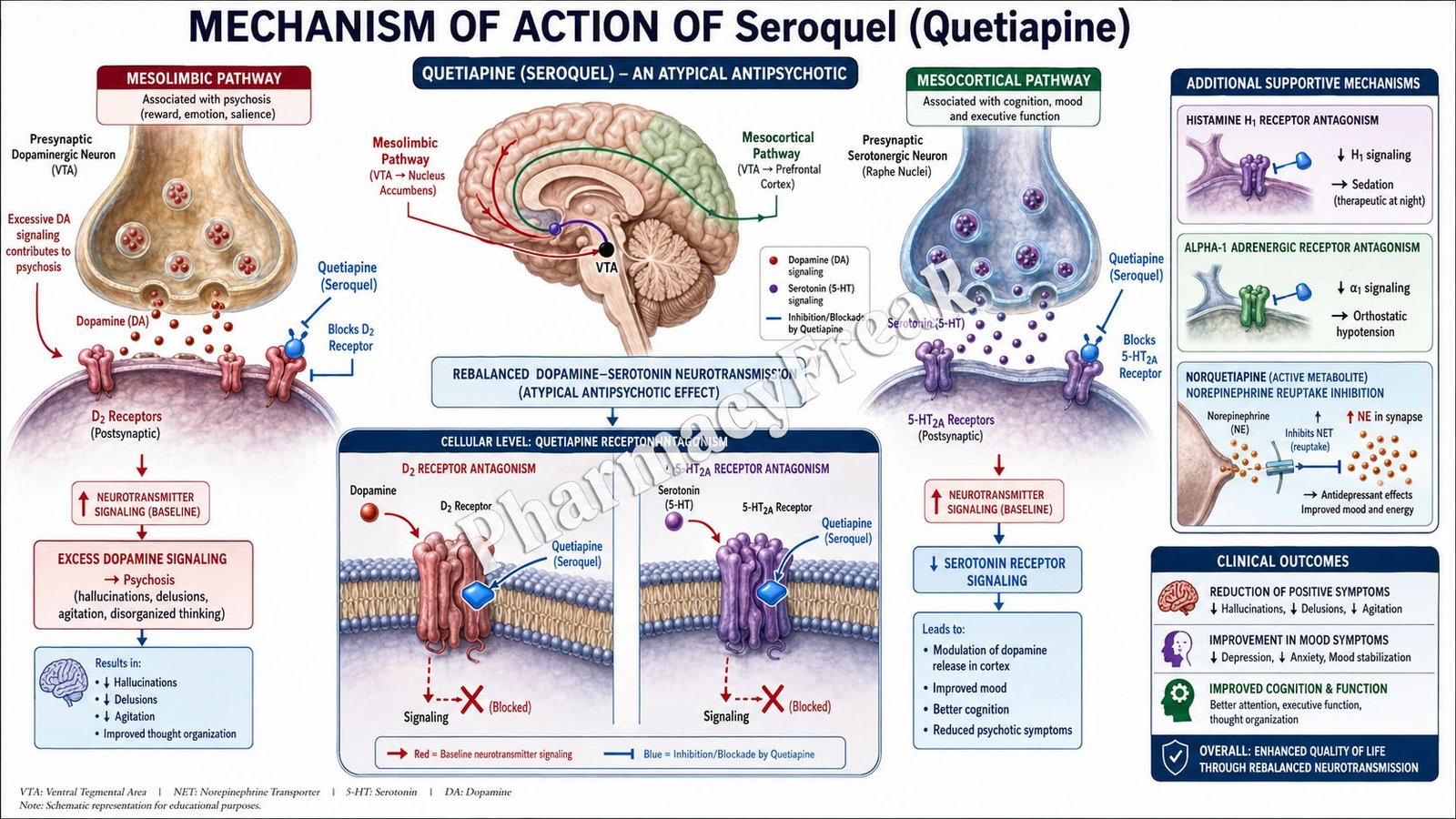
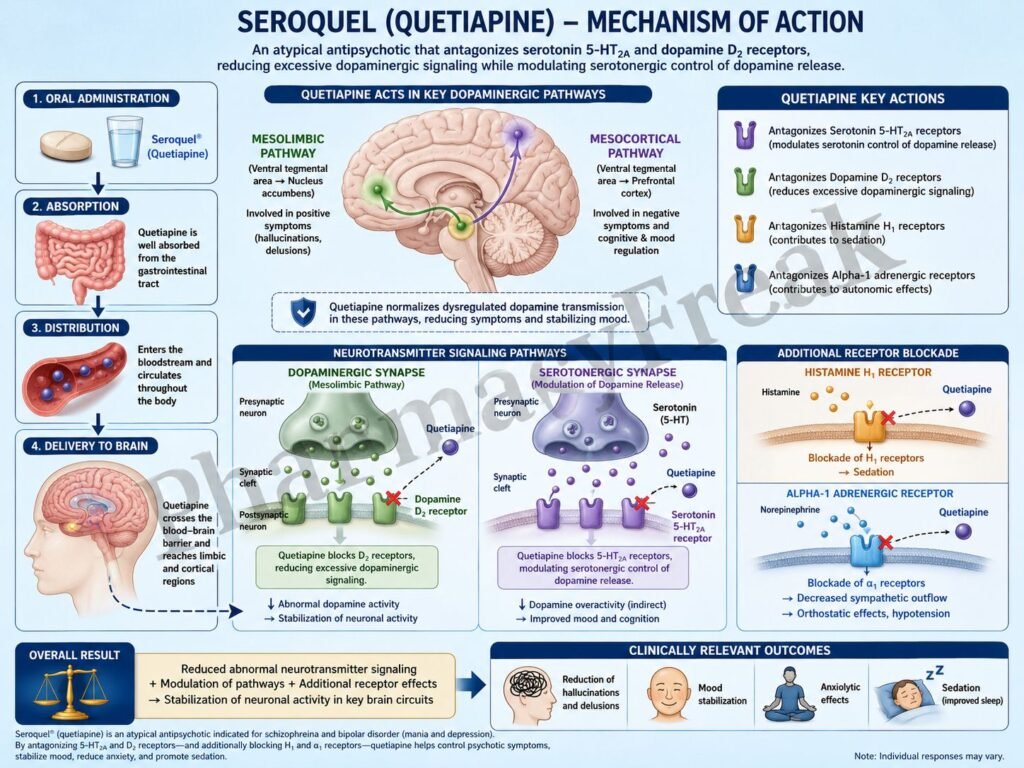
Seroquel is the brand name for quetiapine, an atypical antipsychotic medication used in schizophrenia, bipolar disorder, and major depressive disorder. It acts on multiple neurotransmitter receptors in the central nervous system, particularly dopamine and serotonin receptors. Its balanced serotonin-dopamine antagonism helps reduce psychotic symptoms while lowering the risk of extrapyramidal side effects compared with typical antipsychotics.
Mechanism of Action (Step-wise)
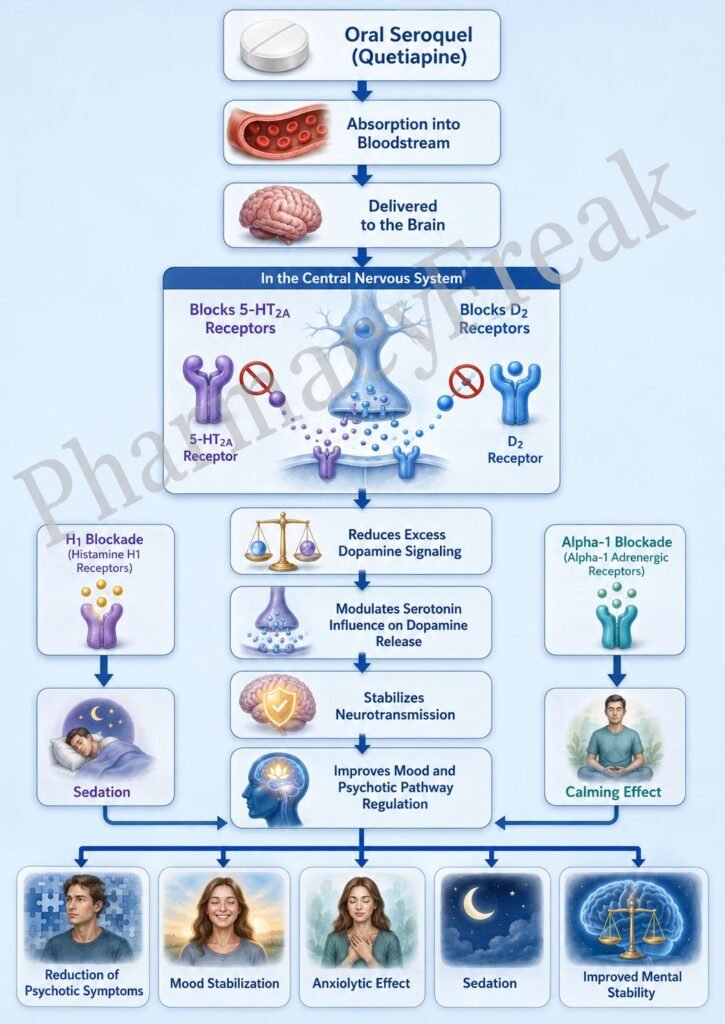
- Quetiapine acts primarily as an antagonist at dopamine D2 receptors and serotonin 5-HT2A receptors.
- Dopamine D2 receptor blockade decreases excessive dopaminergic activity in mesolimbic pathways.
- Reduced mesolimbic dopamine activity improves positive symptoms such as hallucinations and delusions.
- Serotonin 5-HT2A receptor antagonism increases dopamine release in nigrostriatal pathways.
- Increased dopamine in nigrostriatal pathways lowers risk of extrapyramidal side effects.
- Quetiapine also blocks histamine H1 receptors.
- H1 receptor blockade contributes to sedation and weight gain.
- α1-adrenergic receptor antagonism causes vasodilation and orthostatic hypotension.
- The active metabolite, norquetiapine, inhibits norepinephrine reuptake.
- Norepinephrine reuptake inhibition contributes to antidepressant activity.
- The overall effect is improvement of psychotic symptoms, mood stabilization, and reduction of depressive symptoms.
A key exam point is that quetiapine blocks dopamine D2 and serotonin 5-HT2A receptors with relatively low extrapyramidal toxicity.
Pharmacokinetics
Quetiapine is administered orally and is available in immediate-release and extended-release formulations. It undergoes hepatic metabolism mainly through CYP3A4. The active metabolite norquetiapine contributes to therapeutic effects. Elimination occurs mainly through urine and feces.
Clinical Uses
Quetiapine is used in schizophrenia, bipolar mania, bipolar depression, and major depressive disorder as adjunct therapy. It is also used off-label for anxiety disorders and insomnia in selected patients.
Adverse Effects
Common adverse effects include sedation, dizziness, orthostatic hypotension, dry mouth, weight gain, and metabolic syndrome. Hyperglycemia and dyslipidemia may occur. Compared with typical antipsychotics, extrapyramidal symptoms are less common.
Comparative Analysis
| Feature | Quetiapine (Seroquel) | Haloperidol | Risperidone |
|---|---|---|---|
| Drug class | Atypical antipsychotic | Typical antipsychotic | Atypical antipsychotic |
| Main receptors blocked | D2 + 5-HT2A | D2 | D2 + 5-HT2A |
| Sedation | High | Mild | Moderate |
| EPS risk | Low | High | Moderate |
| Weight gain | Moderate | Low | Moderate |
| Antidepressant effect | Present | Minimal | Mild |
Quetiapine differs from haloperidol because it combines serotonin and dopamine antagonism with lower extrapyramidal toxicity. Compared with risperidone, quetiapine generally causes more sedation but less hyperprolactinemia.
MCQs
- Seroquel is the brand name for:
a) Risperidone
b) Quetiapine
c) Olanzapine
d) Clozapine
Answer: b) Quetiapine
- Quetiapine belongs to which drug class?
a) Typical antipsychotics
b) Atypical antipsychotics
c) Benzodiazepines
d) Mood stabilizers only
Answer: b) Atypical antipsychotics
- Quetiapine blocks which dopamine receptor?
a) D1
b) D2
c) D3
d) D4
Answer: b) D2
- Quetiapine also blocks which serotonin receptor?
a) 5-HT1A
b) 5-HT2A
c) 5-HT3
d) 5-HT4
Answer: b) 5-HT2A
- D2 blockade in mesolimbic pathways improves:
a) Positive psychotic symptoms
b) Hyperglycemia
c) Hypercalcemia
d) Renal failure
Answer: a) Positive psychotic symptoms
- H1 receptor blockade contributes mainly to:
a) Bronchodilation
b) Sedation
c) Hypertension
d) Tachycardia
Answer: b) Sedation
- α1 receptor blockade may cause:
a) Orthostatic hypotension
b) Hypernatremia
c) Hyperglycemia
d) Bronchospasm
Answer: a) Orthostatic hypotension
- The active metabolite of quetiapine is:
a) Paliperidone
b) Norquetiapine
c) Haloperidol
d) Risperidone
Answer: b) Norquetiapine
- Norquetiapine contributes to:
a) Antidepressant effects
b) Calcium loss
c) Histamine release
d) Sodium retention
Answer: a) Antidepressant effects
- A common adverse effect of quetiapine is:
a) Weight gain
b) Severe hypoglycemia
c) Cataracts
d) Hypercalcemia
Answer: a) Weight gain
- Compared with haloperidol, quetiapine has:
a) Higher EPS risk
b) Lower EPS risk
c) No dopamine blockade
d) No sedation
Answer: b) Lower EPS risk
- Quetiapine is metabolized mainly by:
a) CYP2D6
b) CYP3A4
c) MAO
d) Acetylcholinesterase
Answer: b) CYP3A4
FAQs
What is the mechanism of action of Seroquel?
Seroquel (quetiapine) blocks dopamine D2 and serotonin 5-HT2A receptors in the CNS.
Why does quetiapine cause fewer extrapyramidal side effects?
Because serotonin 5-HT2A antagonism increases dopamine release in nigrostriatal pathways.
What are common side effects of quetiapine?
Sedation, dizziness, orthostatic hypotension, and weight gain.
What psychiatric disorders are treated with quetiapine?
Schizophrenia, bipolar disorder, and major depressive disorder.
How does quetiapine differ from risperidone?
Quetiapine generally causes more sedation but less hyperprolactinemia.
What enzyme mainly metabolizes quetiapine?
CYP3A4.
References
Goodman & Gilman’s The Pharmacological Basis of Therapeutics – Antipsychotic Agents
https://accessmedicine.mhmedical.com/book.aspx?bookid=3191
Katzung: Basic and Clinical Pharmacology – Antipsychotic Drugs
https://accessmedicine.mhmedical.com/content.aspx?bookid=3382
Tripathi: Essentials of Medical Pharmacology – Antipsychotic Drugs
https://www.jaypeedigital.com
Harrison’s Principles of Internal Medicine – Schizophrenia and Bipolar Disorders
https://accessmedicine.mhmedical.com