Table of Contents
Introduction
Pantoprazole is a proton pump inhibitor (PPI) used in the treatment of acid-related disorders such as gastroesophageal reflux disease (GERD), peptic ulcer disease, and Zollinger–Ellison syndrome. It reduces gastric acid secretion by irreversibly inhibiting the proton pump in gastric parietal cells. Pantoprazole is highly effective in reducing both basal and stimulated acid secretion.
Mechanism of Action (Step-wise)
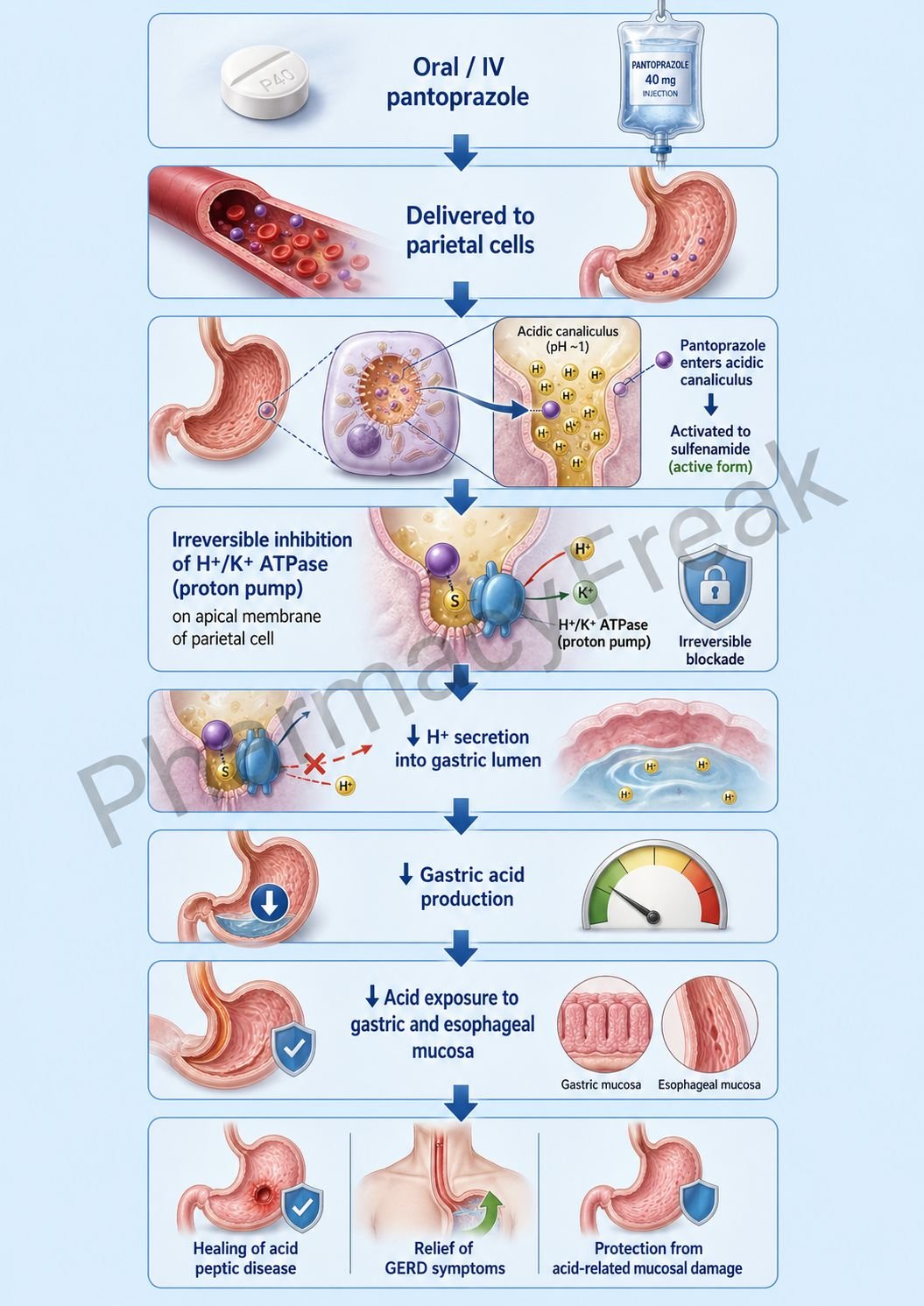
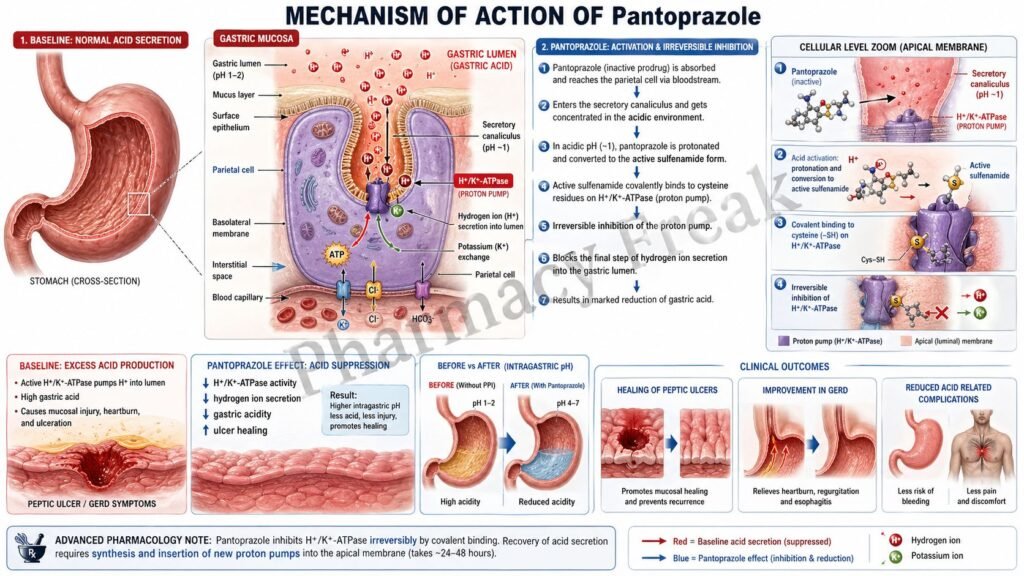
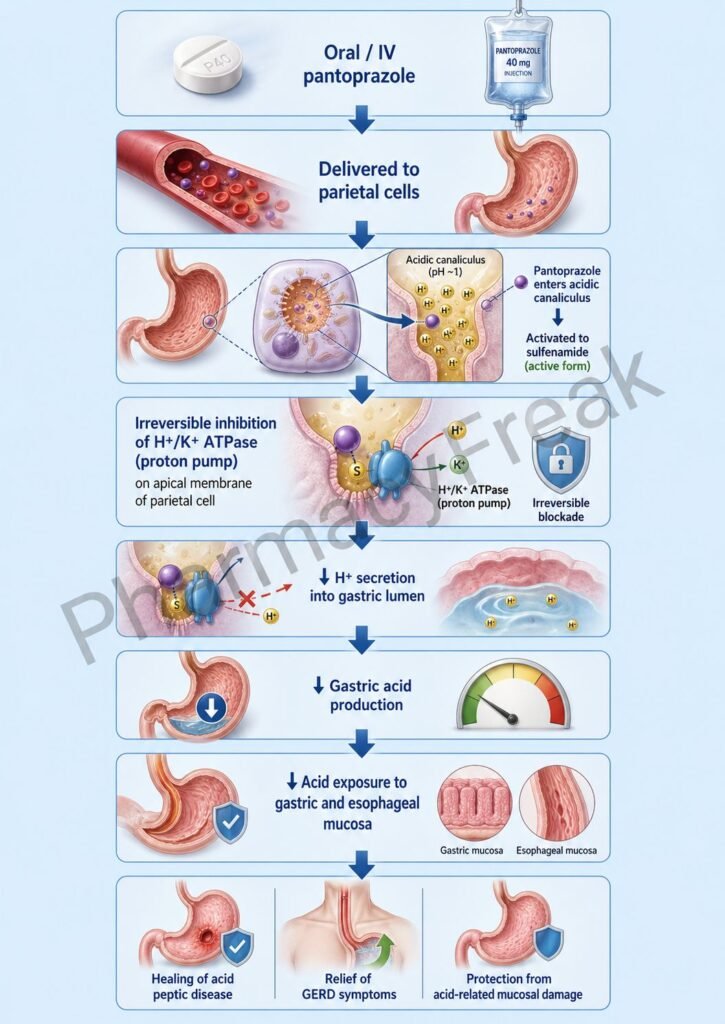
- Pantoprazole is a prodrug that is activated in the acidic environment of the parietal cell canaliculi.
- It diffuses into gastric parietal cells and accumulates in secretory canaliculi.
- In the acidic environment, it is converted to an active sulfenamide form.
- The active form covalently binds to the H⁺/K⁺-ATPase (proton pump).
- This enzyme is responsible for the final step of gastric acid secretion.
- Binding leads to irreversible inhibition of the proton pump.
- As a result, hydrogen ion (H⁺) secretion into the gastric lumen is blocked.
- This suppresses both basal and stimulated acid secretion.
- Acid secretion remains inhibited until new proton pumps are synthesized.
- The overall effect is a marked reduction in gastric acidity.
A key exam point is that pantoprazole irreversibly inhibits the H⁺/K⁺-ATPase proton pump.
Pharmacokinetics
Pantoprazole is administered orally or intravenously. It is absorbed in the small intestine and is acid-labile, so it is given in enteric-coated form. It undergoes hepatic metabolism mainly via CYP2C19 and CYP3A4. It has a short plasma half-life but a long duration of action due to irreversible enzyme inhibition. It is excreted via urine and bile.
Clinical Uses
Pantoprazole is used in GERD, peptic ulcer disease, and Zollinger–Ellison syndrome. It is also used in Helicobacter pylori eradication regimens in combination with antibiotics. It is effective in preventing stress ulcers and managing NSAID-induced gastric injury.
Adverse Effects
Pantoprazole is generally well tolerated. Common adverse effects include headache, nausea, diarrhea, and abdominal pain. Long-term use may lead to vitamin B12 deficiency, hypomagnesemia, and increased risk of infections such as Clostridioides difficile. Prolonged acid suppression may also affect calcium absorption.
Comparative Analysis
| Feature | Pantoprazole | Omeprazole | Ranitidine |
|---|---|---|---|
| Class | Proton pump inhibitor | Proton pump inhibitor | H2 receptor blocker |
| Mechanism | Irreversible H⁺/K⁺-ATPase inhibition | Same | H2 receptor blockade |
| Acid suppression | Very strong | Very strong | Moderate |
| Duration | Long | Long | Shorter |
| Use | GERD, ulcers | GERD, ulcers | GERD, ulcers |
| Tolerance | No | No | Yes |
Pantoprazole differs from ranitidine by acting on the final step of acid secretion, resulting in stronger acid suppression. Compared to omeprazole, it has similar efficacy but may have fewer drug interactions.
MCQs
- Pantoprazole belongs to which class?
a) Antacids
b) Proton pump inhibitors
c) H2 blockers
d) Antibiotics
Answer: b) Proton pump inhibitors
- Pantoprazole inhibits:
a) Sodium pump
b) Calcium pump
c) H⁺/K⁺-ATPase
d) Na⁺/K⁺-ATPase
Answer: c) H⁺/K⁺-ATPase
- Pantoprazole is activated in:
a) Blood
b) Liver
c) Acidic canaliculi
d) Kidney
Answer: c) Acidic canaliculi
- Pantoprazole inhibition is:
a) Reversible
b) Irreversible
c) Competitive
d) Non-specific
Answer: b) Irreversible
- Pantoprazole reduces:
a) Insulin
b) Gastric acid
c) Calcium
d) Sodium
Answer: b) Gastric acid
- Pantoprazole is used in:
a) Asthma
b) GERD
c) Diabetes
d) Anemia
Answer: b) GERD
- A common adverse effect is:
a) Bradycardia
b) Headache
c) Hypoglycemia
d) Hypercalcemia
Answer: b) Headache
- Pantoprazole is metabolized in the:
a) Kidney
b) Liver
c) Lung
d) Brain
Answer: b) Liver
- Pantoprazole has long duration due to:
a) Long half-life
b) Irreversible inhibition
c) High dose
d) Slow metabolism
Answer: b) Irreversible inhibition
- Compared to H2 blockers, pantoprazole:
a) Less effective
b) More effective
c) Same effect
d) No effect
Answer: b) More effective
- Long-term use may cause:
a) Hypercalcemia
b) Vitamin B12 deficiency
c) Hypoglycemia
d) Bradycardia
Answer: b) Vitamin B12 deficiency
- Pantoprazole acts on:
a) Early step
b) Final step of acid secretion
c) Middle step
d) No specific step
Answer: b) Final step of acid secretion
FAQs
What is the mechanism of action of pantoprazole?
It irreversibly inhibits the H⁺/K⁺-ATPase proton pump in gastric parietal cells.
Why is pantoprazole long-acting?
Because it irreversibly blocks proton pumps.
What is its main use?
GERD and peptic ulcer disease.
Does pantoprazole affect acid secretion completely?
It significantly suppresses both basal and stimulated acid secretion.
What is a long-term risk?
Vitamin B12 deficiency.
How is pantoprazole activated?
In the acidic environment of parietal cell canaliculi.
References
Goodman & Gilman’s The Pharmacological Basis of Therapeutics – Acid-Suppressing Drugs
https://accessmedicine.mhmedical.com/book.aspx?bookid=3191
Katzung: Basic and Clinical Pharmacology – Drugs for Acid-Peptic Disease
https://accessmedicine.mhmedical.com/content.aspx?bookid=3382
Tripathi: Essentials of Medical Pharmacology – Gastrointestinal Drugs
https://www.jaypeedigital.com
Harrison’s Principles of Internal Medicine – Gastroesophageal Reflux Disease
https://accessmedicine.mhmedical.com