Table of Contents
Introduction
Oxycodone is a semi-synthetic opioid analgesic used for the management of moderate to severe pain. It is commonly prescribed in both acute and chronic pain settings, including postoperative and cancer-related pain. Oxycodone acts primarily on opioid receptors in the central nervous system to produce analgesia, sedation, and euphoria.
Mechanism of Action (Step-wise)
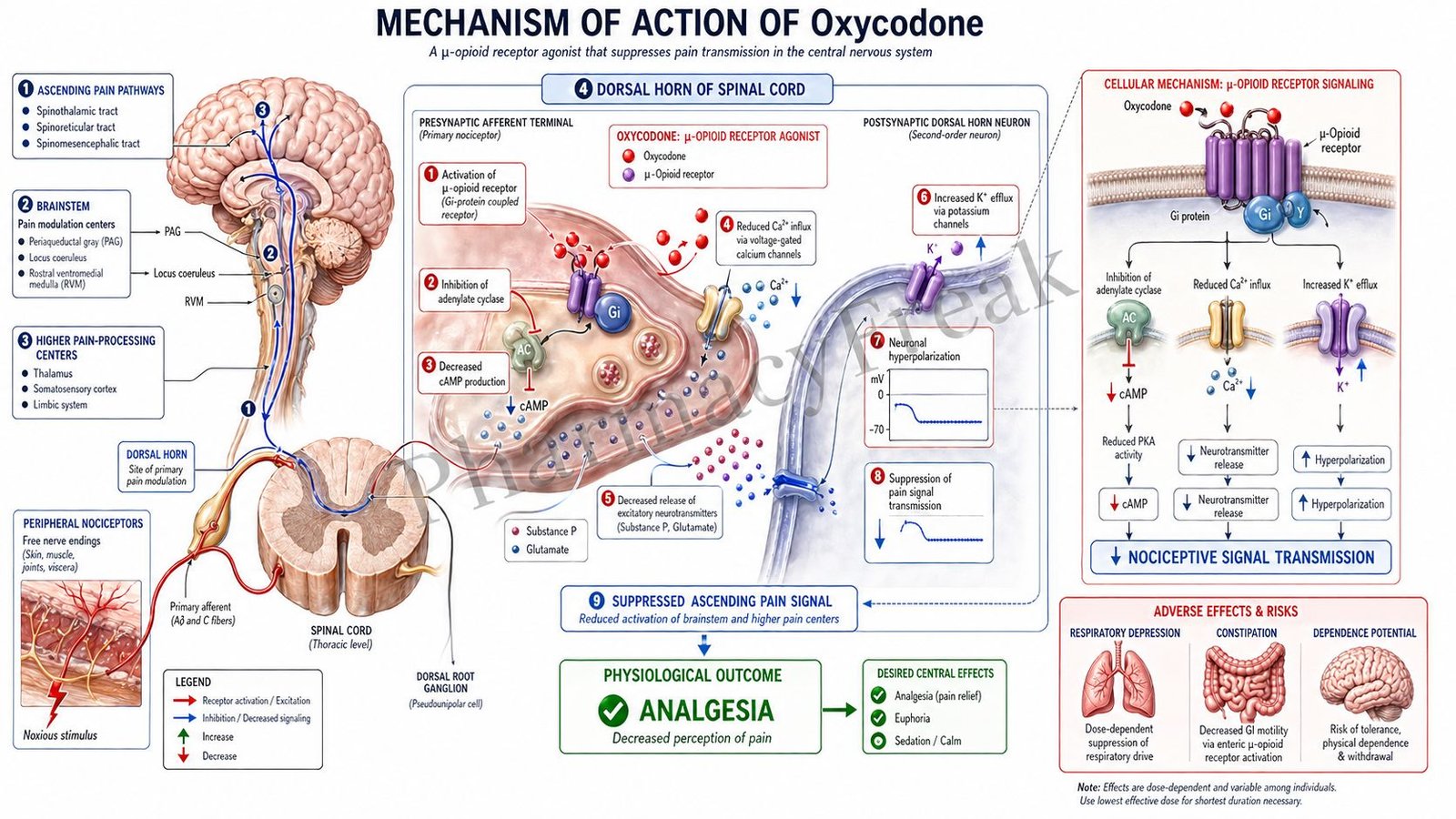
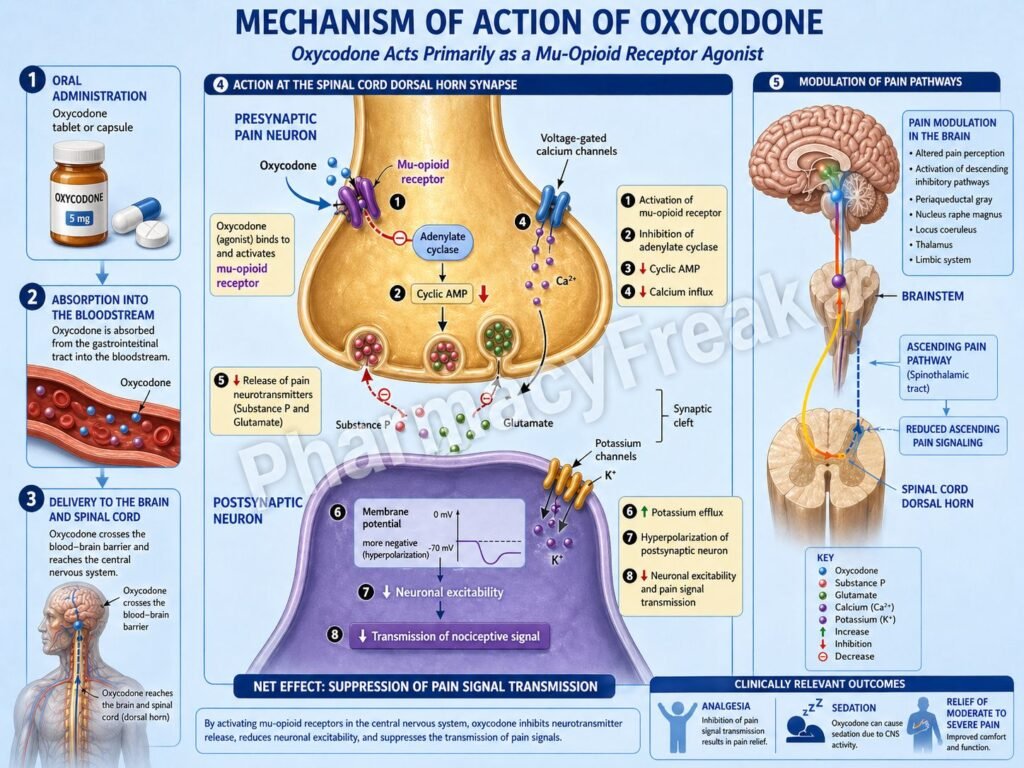
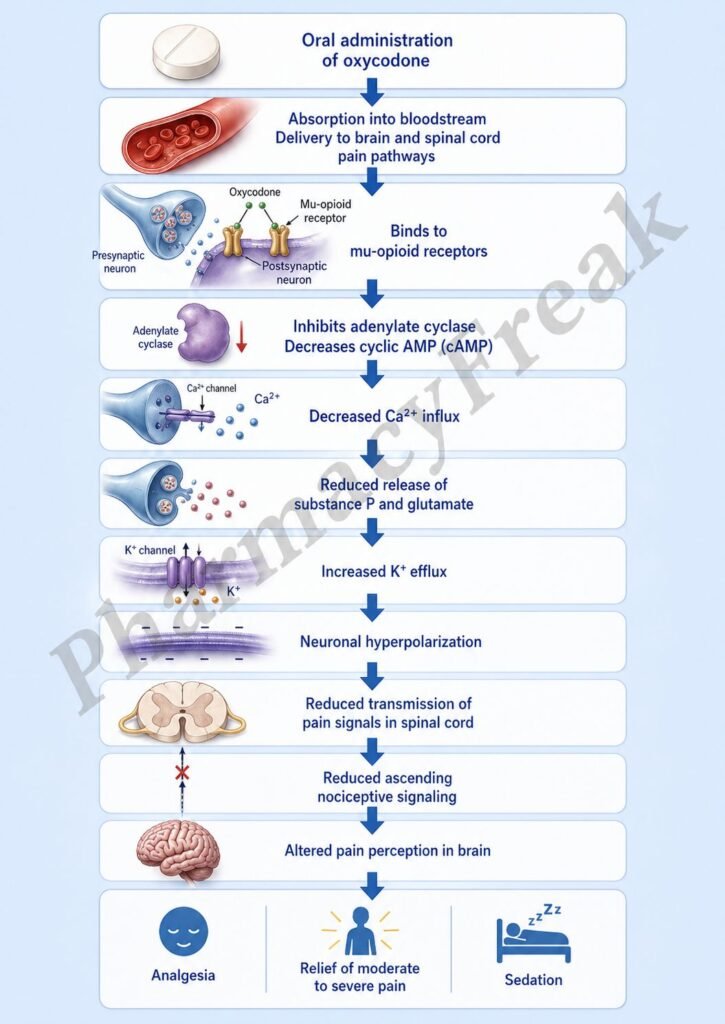
- Oxycodone binds primarily to μ-opioid receptors (MOR) in the central nervous system.
- These receptors are G-protein coupled receptors (Gi/o type).
- Activation inhibits adenylate cyclase activity.
- This reduces intracellular cyclic AMP (cAMP) levels.
- Oxycodone opens potassium channels, causing K⁺ efflux.
- This leads to hyperpolarization of neurons.
- It also inhibits voltage-gated calcium channels (↓ Ca²⁺ influx).
- Reduced calcium entry decreases release of excitatory neurotransmitters such as substance P, glutamate, and CGRP.
- These effects inhibit transmission of pain signals in the spinal cord.
- Oxycodone enhances descending inhibitory pain pathways from the brainstem.
- The net effect is decreased perception and transmission of pain (analgesia).
A key exam point is that oxycodone is a μ-opioid receptor agonist that reduces neuronal excitability and neurotransmitter release.
Pharmacokinetics
Oxycodone is administered orally and has good bioavailability compared to morphine. It is metabolized in the liver primarily by CYP3A4 and CYP2D6 to active and inactive metabolites. It has both immediate-release and extended-release formulations. It is excreted mainly via the kidneys. Its relatively high oral bioavailability makes it suitable for outpatient pain management.
Clinical Uses
Oxycodone is used for moderate to severe pain, including postoperative pain, cancer pain, and chronic pain conditions. It is often used when non-opioid analgesics are insufficient. Combination formulations with acetaminophen are also commonly prescribed.
Adverse Effects
Common adverse effects include respiratory depression, sedation, constipation, nausea, vomiting, and miosis. Tolerance and physical dependence may develop with prolonged use. Overdose can result in respiratory arrest. Other effects include pruritus and hypotension.
Comparative Analysis
| Feature | Oxycodone | Morphine | Fentanyl |
|---|---|---|---|
| Receptor activity | μ-opioid agonist | μ-opioid agonist | μ-opioid agonist |
| Oral bioavailability | High | Moderate | Low |
| Potency | Moderate–high | Moderate | Very high |
| Duration | Moderate | Moderate | Short |
| Use | Acute and chronic pain | Severe pain | Severe pain, anesthesia |
| Formulations | Oral IR/ER | Multiple routes | IV, transdermal |
Oxycodone differs from morphine by having higher oral bioavailability. Compared to fentanyl, it is less potent but more suitable for oral use in chronic pain management.
MCQs
- Oxycodone primarily acts on which receptor?
a) Dopamine receptor
b) μ-opioid receptor
c) Serotonin receptor
d) Histamine receptor
Answer: b) μ-opioid receptor
- Oxycodone inhibits adenylate cyclase leading to:
a) Increased cAMP
b) Decreased cAMP
c) Increased ATP
d) No change
Answer: b) Decreased cAMP
- Oxycodone causes hyperpolarization by:
a) Sodium influx
b) Potassium efflux
c) Calcium influx
d) Chloride influx
Answer: b) Potassium efflux
- Oxycodone reduces neurotransmitter release by decreasing:
a) Sodium
b) Calcium
c) Potassium
d) Chloride
Answer: b) Calcium
- Oxycodone inhibits release of:
a) Insulin
b) Substance P
c) Thyroxine
d) Cortisol
Answer: b) Substance P
- Oxycodone is used for:
a) Mild pain
b) Moderate to severe pain
c) Diabetes
d) Asthma
Answer: b) Moderate to severe pain
- A major adverse effect is:
a) Hypertension
b) Respiratory depression
c) Hypercalcemia
d) Hypoglycemia
Answer: b) Respiratory depression
- Oxycodone causes:
a) Mydriasis
b) Miosis
c) No pupil effect
d) Diplopia
Answer: b) Miosis
- Oxycodone is metabolized by:
a) CYP1A2
b) CYP3A4 and CYP2D6
c) CYP2C9
d) CYP2C19
Answer: b) CYP3A4 and CYP2D6
- Oxycodone is excreted via:
a) Liver
b) Kidney
c) Lung
d) Skin
Answer: b) Kidney
- Compared to morphine, oxycodone has:
a) Lower bioavailability
b) Higher bioavailability
c) Same effect
d) No effect
Answer: b) Higher bioavailability
- Oxycodone may lead to:
a) Dependence
b) Hyperglycemia
c) Hypercalcemia
d) Bradycardia
Answer: a) Dependence
FAQs
What is the mechanism of action of oxycodone?
It activates μ-opioid receptors, reducing neuronal excitability and neurotransmitter release.
Why is oxycodone effective orally?
Because of its higher oral bioavailability compared to morphine.
Does oxycodone cause respiratory depression?
Yes, especially at high doses.
What is a major adverse effect?
Constipation and respiratory depression.
Can oxycodone cause dependence?
Yes, with prolonged use.
What type of pain is oxycodone used for?
Moderate to severe pain.
References
Goodman & Gilman’s The Pharmacological Basis of Therapeutics – Opioids
https://accessmedicine.mhmedical.com/book.aspx?bookid=3191
Katzung: Basic and Clinical Pharmacology – Opioid Analgesics
https://accessmedicine.mhmedical.com/content.aspx?bookid=3382
Tripathi: Essentials of Medical Pharmacology – Opioids
https://www.jaypeedigital.com
Harrison’s Principles of Internal Medicine – Pain Management
https://accessmedicine.mhmedical.com