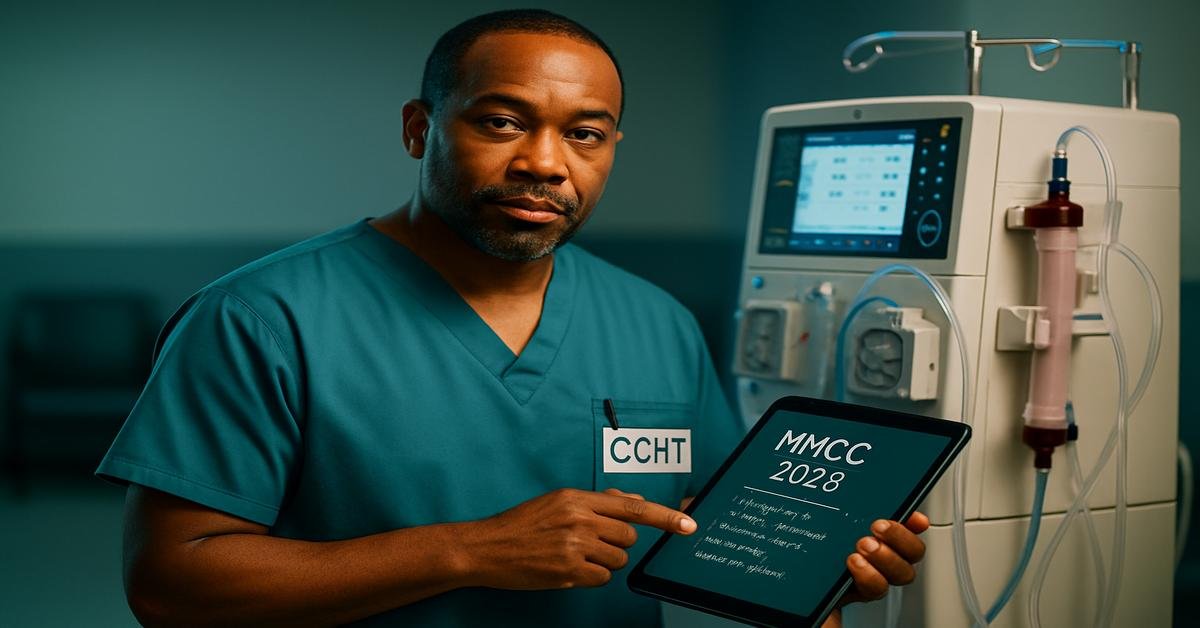
If you want to become a Certified Clinical Hemodialysis Technician, or CCHT, you need more than good test-taking skills. You need to understand what happens in a dialysis clinic, why each step matters, and how the NNCC exam checks that knowledge. The 2026 CCHT exam is not just about memorizing terms. It measures whether you can work safely with patients, machines, infection control rules, and treatment procedures. This guide breaks down what the certification means, what to expect on the exam, and how to study in a way that actually helps you pass.
What the CCHT certification means
The CCHT credential is awarded by the Nephrology Nursing Certification Commission, usually called the NNCC. It is designed for patient care dialysis technicians who work in hemodialysis settings.
This certification matters for a simple reason: hemodialysis is high-risk care. A technician handles bloodlines, monitors treatment, checks access sites, responds to alarms, and helps protect patients from serious harm. Errors can lead to infection, blood loss, air embolism, clotting, fluid imbalance, or dangerous blood pressure changes. The exam exists to confirm that a technician understands safe practice, not just clinic routines.
For many employers, certification also matters because it supports compliance, improves hiring prospects, and shows commitment to the field. In some settings, it can strengthen your job application or help with advancement. Even when certification is required after hire rather than before, passing early can give you an edge.
Who should take the exam in 2026
The CCHT exam is intended for technicians who provide direct patient care in hemodialysis. In practice, most candidates fall into one of these groups:
New dialysis technicians who have completed training and need certification.
Working technicians approaching an employer or regulatory deadline.
Technicians who want a nationally recognized credential to support career growth.
Before you apply, confirm the current NNCC eligibility requirements for 2026. Requirements can change. In general, candidates are usually expected to meet standards related to education, training, and work experience or clinical practice. Do not rely on old advice from coworkers or social media posts. Always verify the latest details directly from the official exam materials before you submit an application.
This matters because avoidable application errors can delay your testing date. A missed signature, incomplete employment verification, or wrong training documentation can turn a good study timeline into a rushed one.
What is on the NNCC CCHT exam
The exact test blueprint can be updated, but the exam usually covers the core knowledge needed for safe hemodialysis care. That means your study plan should focus on the real work of a dialysis technician.
Common content areas include:
Patient care before, during, and after treatment
Dialysis machine setup, monitoring, and shutdown
Water treatment and dialysate safety basics
Infection prevention and control
Vascular access care
Documentation, communication, and professionalism
Recognition of complications and appropriate response
The important point is this: the exam does not separate technical knowledge from patient safety. They are tied together. For example, a question about machine alarms is really a question about risk recognition. A question about taking pre-dialysis weight is really a question about fluid removal goals and preventing hypotension.
If you study each task as an isolated fact, the exam will feel harder. If you study the reason behind the task, the content starts to connect.
How the exam tends to think
Many candidates know the clinic routine but still miss exam questions. Usually, that happens because the test is asking for the best action, not just an action that could happen in real life.
On the exam, the correct answer is usually the one that is:
Safest for the patient
Most consistent with standard procedure
Within the technician’s role
Based on observation and proper reporting, not guessing
For example, if a patient becomes dizzy and hypotensive during treatment, the exam is not testing whether you have seen this before. It is testing whether you recognize the problem quickly and respond in the right order. That includes immediate patient safety steps, machine-related checks, and timely notification according to protocol.
Another example is infection control. In real clinics, people sometimes become casual when they are busy. The exam does not reward shortcuts. It rewards standard precautions, clean technique, and proper separation of contaminated and clean supplies. That is because small infection control failures in dialysis can lead to bloodstream infections, hospitalization, or worse.
The knowledge areas you must truly understand
Some topics come up again and again because they sit at the center of safe dialysis care. These are the areas worth deeper study.
1. Fluid balance and target weight
You need to understand why pre- and post-treatment weights matter. Dialysis removes excess fluid. If too much fluid is removed, the patient may cramp, become hypotensive, or lose consciousness. If too little is removed, fluid overload can continue and stress the heart and lungs. Questions may connect weight, blood pressure, symptoms, and ultrafiltration decisions.
2. Vascular access basics
Know the difference between an arteriovenous fistula, graft, and central venous catheter. Understand why access care is critical. A fistula is often preferred because it has lower infection risk and better long-term performance, but it must still be assessed carefully. You should know what to look for, such as bruit and thrill, signs of infection, poor blood flow, or complications at the site.
3. Infection control
This is one of the highest-value study areas because it affects almost every patient interaction. Understand hand hygiene, glove use, station disinfection, medication handling, and proper disposal of contaminated materials. Learn not just the rule, but the reason. Blood exposure risk is constant in hemodialysis, and cross-contamination can happen fast if technique slips.
4. Machine alarms and treatment monitoring
Do not memorize alarms as random labels. Learn what they mean physiologically or mechanically. An arterial pressure alarm, venous pressure issue, conductivity concern, or air detector alarm each points to a different type of risk. The exam may ask what problem is most likely or what action should come first.
5. Common complications during dialysis
Be ready to recognize hypotension, cramping, nausea, headache, clotting, blood leaks, disequilibrium symptoms, and signs of access problems. Focus on early recognition. In dialysis, timing matters. A delayed response can turn a manageable issue into an emergency.
6. Professional role and communication
The CCHT exam also reflects daily teamwork. Technicians collect and report patient data. They document clearly. They follow protocol. They communicate changes in patient condition. The exam often expects you to know when to act independently within your role and when to immediately report to the nurse.
How to build a study plan that works
A good study plan is not long for the sake of being long. It is structured, realistic, and tied to the exam content. Most people do better with steady weekly review than with last-minute cramming.
Here is a practical way to prepare over 8 to 12 weeks:
Week 1: Review exam eligibility, application timeline, and content outline.
Weeks 2 to 4: Study patient care, infection control, and vascular access.
Weeks 5 to 7: Study machine operation, alarms, water basics, and dialysate safety.
Weeks 8 to 9: Study complications, emergency response, and documentation.
Weeks 10 to 12: Take practice questions, review weak areas, and work on timing.
If you are already working full time, keep sessions short and repeat them often. Forty-five minutes of focused study four times a week is usually better than one exhausted four-hour session on the weekend.
Use this pattern for each topic:
Read the concept.
Explain it in your own words.
Connect it to a patient scenario.
Answer practice questions on that topic.
Review every wrong answer and ask why it was wrong.
That last step matters the most. Wrong answers show you where your thinking breaks down. Maybe you misread the question. Maybe you know the rule but not the reason. Maybe you jumped to a familiar clinic habit instead of the safest standard response.
Best ways to study for this kind of exam
The strongest CCHT preparation uses active recall, not passive reading. In plain terms, you need to pull the information out of your memory, not just look at it.
Useful methods include:
Flashcards for key terms and concepts, especially alarms, access care, infection control rules, and complications.
Scenario-based review, such as “Patient becomes nauseated and blood pressure drops. What do you assess first?”
Teach-back study, where you explain a concept aloud as if training a new technician.
Timed practice sets, so you get used to reading carefully under pressure.
A simple example: instead of rereading notes on fistulas, ask yourself, “What findings would make me report an access problem right away?” That kind of question prepares you for how the exam actually tests knowledge.
Common mistakes that cause people to fail
Most failures are not caused by lack of intelligence. They come from predictable problems in preparation.
Studying only from memory of clinic routine. Real-life habits are not always exam-standard practice.
Ignoring infection control. Some people treat it as basic review, but it is central to safe care.
Memorizing without understanding. If the question is worded differently, memorized facts may not help.
Skipping practice questions. You need to train yourself to spot what the question is really asking.
Not reviewing weak areas honestly. It feels better to keep studying what you already know, but that does not raise your score much.
Another common issue is role confusion. The exam expects technicians to know their scope of practice. If a question involves patient deterioration, unusual symptoms, or a problem outside routine technician actions, think about observation, immediate safety steps, and prompt reporting. Do not choose answers that go beyond the technician role unless the scenario clearly supports it.
How to handle exam day
By the time exam day arrives, your goal is not to learn new material. Your job is to stay calm and think clearly.
Get enough sleep the night before. Fatigue makes reading errors more likely.
Arrive early and bring the required identification and documents.
Read each question slowly. Watch for words that change the meaning, such as first, best, most appropriate, or immediate.
Eliminate clearly wrong answers first.
If stuck, ask what protects the patient most and what fits the technician role.
Do not spend too long on one question. Move on and come back if needed.
Test anxiety is real, but structure helps. A steady pace, careful reading, and basic elimination can recover points even when you feel unsure.
What to do if you do not pass the first time
Failing once does not mean you are not suited for dialysis work. It usually means your preparation did not match the exam well enough. Many strong technicians need a second attempt because they relied too much on experience and not enough on exam-style review.
If that happens, be specific in your response. Do not just “study harder.” Study smarter. Identify weak domains. Increase practice questions. Spend more time on scenarios. Ask experienced educators or supervisors to explain the why behind policies and procedures you only partly understand.
Certification is important, but so is the learning process behind it. The knowledge you build while preparing helps you protect real patients in real treatments.
Final thoughts on passing the CCHT exam in 2026
To pass the NNCC CCHT exam in 2026, focus on mastery, not memorization. Learn how dialysis works, why safety steps matter, how complications develop, and what a technician should do first when something changes. That approach does more than improve your score. It makes you a better dialysis technician.
The best preparation is practical and honest. Know the exam blueprint. Study the high-risk topics deeply. Practice with questions that force you to think. And keep asking the same question throughout your review: What is the safest, most appropriate action for this patient? When you can answer that consistently, you are not just getting ready to pass a test. You are getting ready to do the job well.

