Table of Contents
Introduction
Montelukast is a leukotriene receptor antagonist (LTRA) used in the management of asthma and allergic rhinitis. It is particularly effective in controlling chronic inflammation and preventing bronchoconstriction. Unlike bronchodilators, montelukast does not provide immediate relief but is used as a maintenance therapy to reduce airway inflammation and improve respiratory function.
Mechanism of Action (Step-wise)
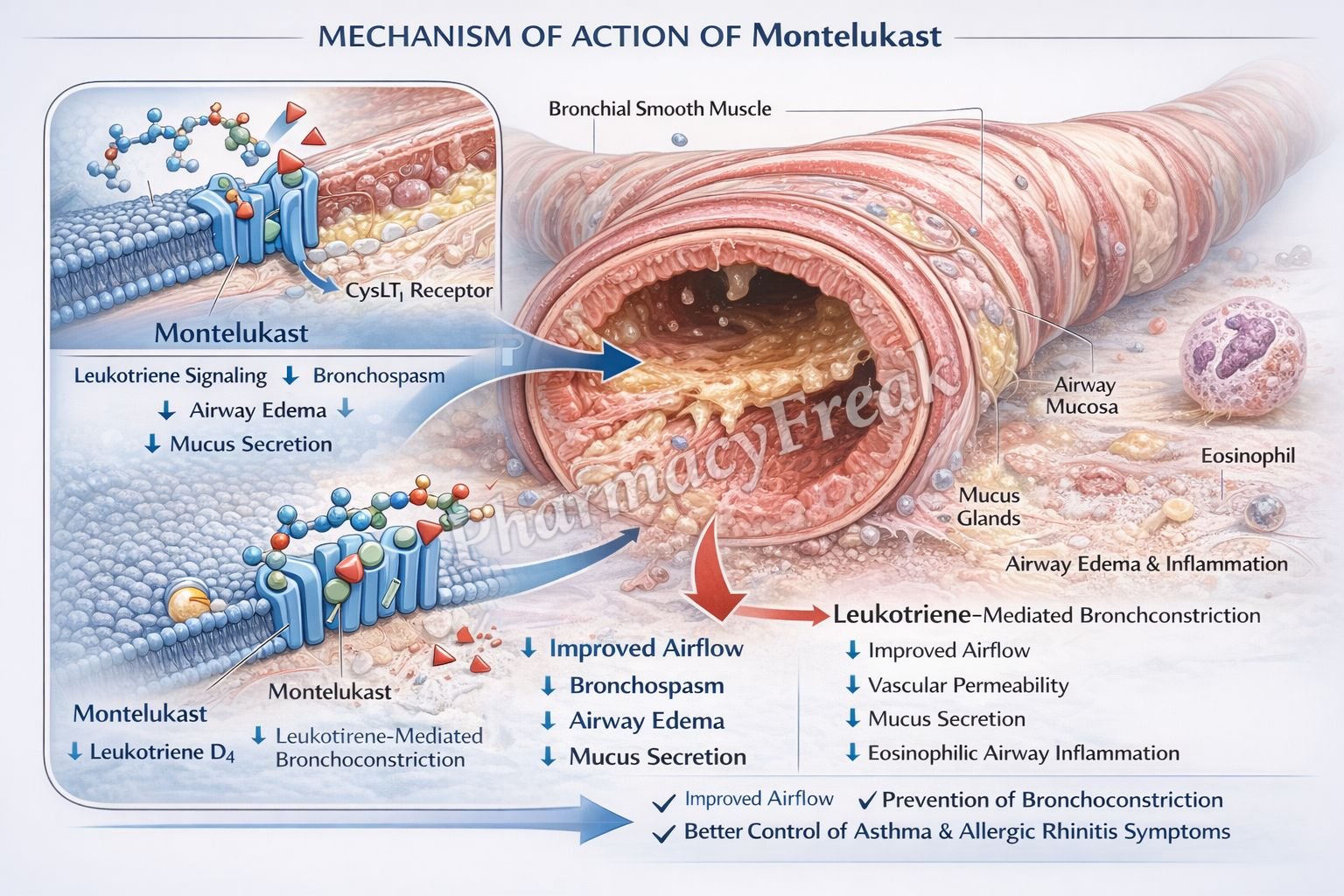
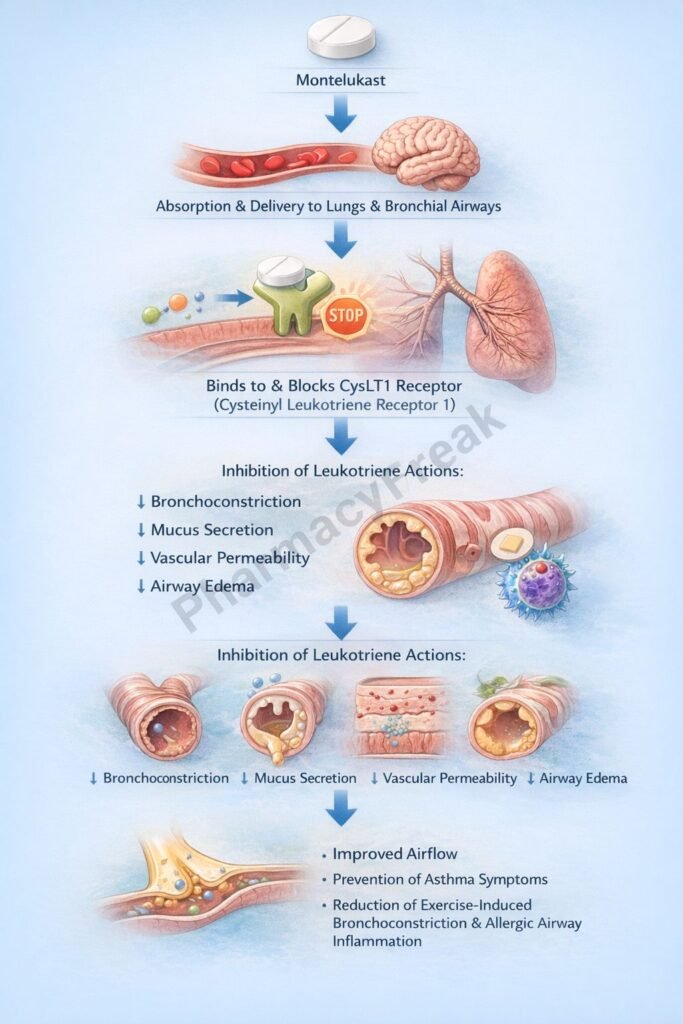
- Montelukast selectively blocks cysteinyl leukotriene type 1 (CysLT1) receptors.
- These receptors are present in airway smooth muscle, eosinophils, and other inflammatory cells.
- Leukotrienes (especially LTC4, LTD4, and LTE4) normally bind to CysLT1 receptors.
- Binding of leukotrienes causes bronchoconstriction, increased mucus secretion, and airway edema.
- Montelukast competitively inhibits leukotriene binding to CysLT1 receptors.
- This prevents bronchoconstriction and reduces airway inflammation.
- It decreases mucus production and vascular permeability.
- It reduces eosinophil recruitment and inflammatory response.
- The overall effect is improved airway patency and reduced asthma symptoms.
A key exam point is that montelukast blocks leukotriene receptors (CysLT1), preventing bronchoconstriction and inflammation.

Pharmacokinetics
Montelukast is administered orally and is well absorbed. It has high protein binding and is metabolized extensively in the liver via cytochrome P450 enzymes (CYP3A4, CYP2C9). It has a relatively long duration of action, allowing once-daily dosing. It is excreted mainly in bile. Because it does not require inhalation, it is convenient for long-term therapy.
Clinical Uses
Montelukast is used in the prophylaxis and chronic treatment of asthma, particularly in patients with mild persistent asthma. It is also effective in exercise-induced bronchospasm and allergic rhinitis. It is often used as an alternative or add-on therapy to inhaled corticosteroids. It is not used for acute asthma attacks.
Adverse Effects
Montelukast is generally well tolerated. Common adverse effects include headache, abdominal pain, and upper respiratory symptoms. Rare but important adverse effects include neuropsychiatric symptoms such as agitation, anxiety, depression, and suicidal ideation. These effects require careful monitoring.
Comparative Analysis
| Feature | Montelukast | Zileuton | β2 Agonists |
|---|---|---|---|
| Mechanism | CysLT1 receptor antagonist | 5-lipoxygenase inhibitor | β2 receptor agonist |
| Effect | Prevents leukotriene action | Prevents leukotriene synthesis | Bronchodilation |
| Use | Maintenance therapy | Maintenance therapy | Acute relief |
| Route | Oral | Oral | Inhaled |
| Onset | Slow | Slow | Rapid |
| Role in acute attack | No | No | Yes |
Montelukast differs from zileuton by blocking leukotriene receptors rather than inhibiting their synthesis. Compared to β2 agonists, it has a slower onset and is used for long-term control rather than acute relief.
MCQs
- Montelukast belongs to which class?
a) Beta blockers
b) Leukotriene receptor antagonists
c) Corticosteroids
d) Antihistamines
Answer: b) Leukotriene receptor antagonists
- Montelukast blocks which receptor?
a) H1 receptor
b) β2 receptor
c) CysLT1 receptor
d) Dopamine receptor
Answer: c) CysLT1 receptor
- Leukotrienes cause:
a) Bronchodilation
b) Bronchoconstriction
c) Vasodilation only
d) Muscle relaxation
Answer: b) Bronchoconstriction
- Montelukast is used in:
a) Acute asthma attack
b) Chronic asthma
c) Hypertension
d) Diabetes
Answer: b) Chronic asthma
- Montelukast reduces:
a) Insulin
b) Airway inflammation
c) Blood glucose
d) Calcium levels
Answer: b) Airway inflammation
- Montelukast is administered:
a) Intravenously
b) Inhaled
c) Orally
d) Intramuscularly
Answer: c) Orally
- Montelukast is useful in:
a) Exercise-induced bronchospasm
b) Arrhythmia
c) Kidney disease
d) Thyroid disease
Answer: a) Exercise-induced bronchospasm
- A common adverse effect is:
a) Hypoglycemia
b) Headache
c) Hypercalcemia
d) Bradycardia
Answer: b) Headache
- A serious adverse effect includes:
a) Hyperglycemia
b) Neuropsychiatric symptoms
c) Renal failure
d) Liver failure
Answer: b) Neuropsychiatric symptoms
- Montelukast is metabolized in the:
a) Kidney
b) Liver
c) Lung
d) Brain
Answer: b) Liver
- Montelukast blocks effects of:
a) Histamine
b) Leukotrienes
c) Dopamine
d) Serotonin
Answer: b) Leukotrienes
- Montelukast is NOT used for:
a) Asthma prevention
b) Allergic rhinitis
c) Acute asthma attack
d) Exercise-induced asthma
Answer: c) Acute asthma attack
FAQs
What is the mechanism of action of montelukast?
It blocks CysLT1 leukotriene receptors, preventing bronchoconstriction and inflammation.
Is montelukast used for acute asthma attacks?
No, it is used for long-term prevention.
How does montelukast help in allergic rhinitis?
By reducing leukotriene-mediated inflammation.
What is a serious adverse effect of montelukast?
Neuropsychiatric symptoms.
How often is montelukast taken?
Usually once daily.
What makes montelukast different from β2 agonists?
It prevents inflammation rather than providing rapid bronchodilation.
References
Goodman & Gilman’s The Pharmacological Basis of Therapeutics – Respiratory Drugs
https://accessmedicine.mhmedical.com/book.aspx?bookid=3191
Katzung: Basic and Clinical Pharmacology – Asthma Drugs
https://accessmedicine.mhmedical.com/content.aspx?bookid=3382
Tripathi: Essentials of Medical Pharmacology – Respiratory Pharmacology
https://www.jaypeedigital.com
Harrison’s Principles of Internal Medicine – Asthma and Allergy
https://accessmedicine.mhmedical.com