Table of Contents
Introduction
Mifepristone is a synthetic steroidal drug primarily used as an abortifacient and in the management of conditions such as Cushing syndrome. It acts as a progesterone receptor antagonist, disrupting the hormonal support required for pregnancy. Its ability to block glucocorticoid receptors also contributes to its use in hypercortisolism.
Mechanism of Action (Step-wise)
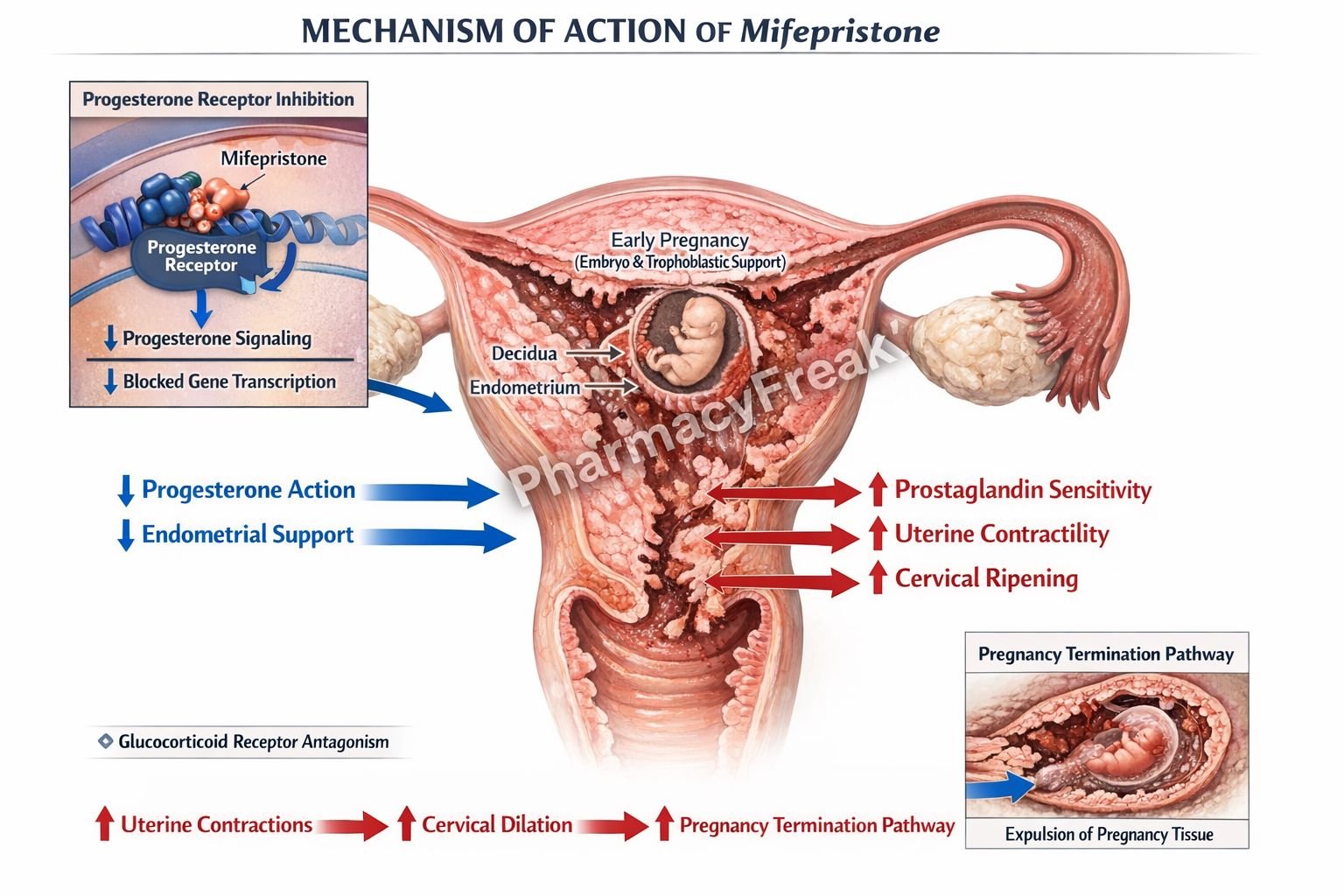
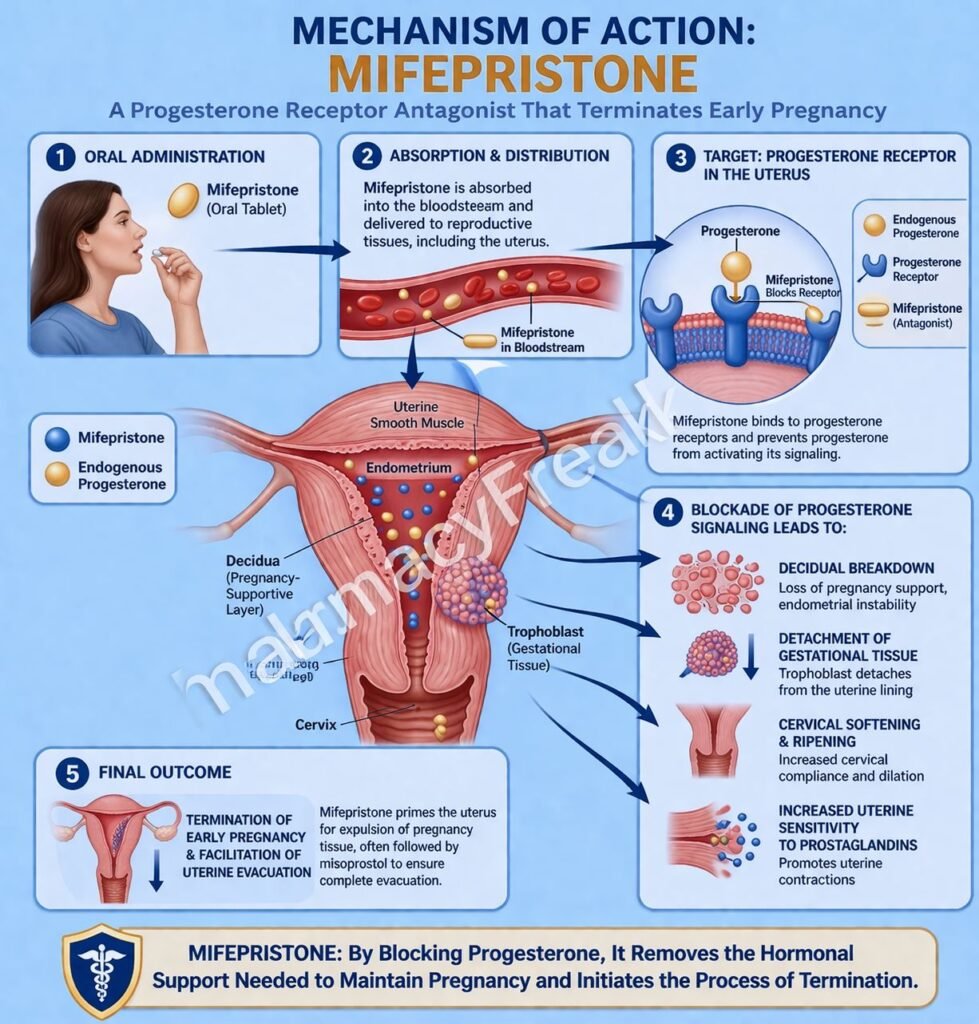
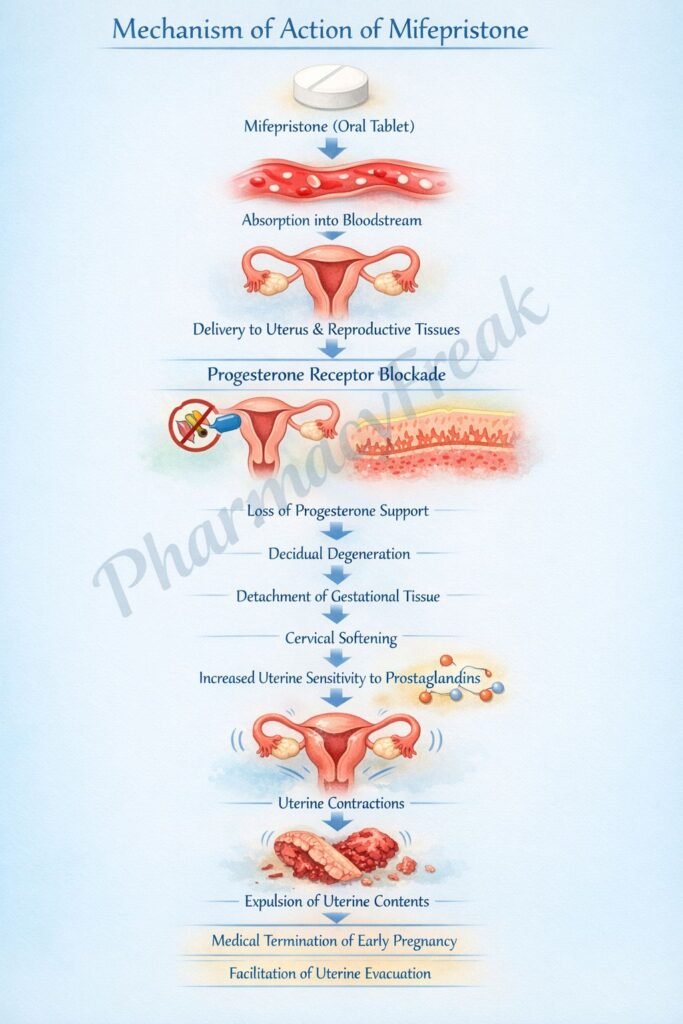
- Mifepristone competitively binds to progesterone receptors with high affinity.
- It acts as a progesterone receptor antagonist.
- Progesterone is essential for maintaining the endometrium and pregnancy.
- Blocking progesterone receptors leads to breakdown of the endometrial lining.
- This causes detachment of the implanted embryo.
- Mifepristone also increases uterine sensitivity to prostaglandins.
- This enhances uterine contractions.
- It promotes cervical softening and dilation.
- The combined effects lead to expulsion of uterine contents.
- Additionally, mifepristone antagonizes glucocorticoid receptors.
- This reduces the effects of cortisol in conditions like Cushing syndrome.
A key exam point is that mifepristone is a progesterone receptor antagonist that induces abortion and also blocks glucocorticoid receptors.
Pharmacokinetics
Mifepristone is administered orally and is well absorbed. It is highly protein-bound and has a long half-life, allowing sustained action. It is metabolized in the liver via cytochrome P450 enzymes, particularly CYP3A4. It is excreted mainly in feces. Its prolonged action supports its use in combination regimens for medical termination of pregnancy.
Clinical Uses
Mifepristone is primarily used for medical termination of early pregnancy, typically in combination with a prostaglandin analog such as misoprostol. It is also used in the management of Cushing syndrome due to its glucocorticoid receptor antagonism. In some cases, it may be used for emergency contraception.
Adverse Effects
Common adverse effects include abdominal pain, uterine cramping, nausea, vomiting, and vaginal bleeding. Heavy bleeding may occur in some patients. Because of its mechanism, it can cause endometrial changes. In patients treated for Cushing syndrome, it may lead to symptoms of adrenal insufficiency due to glucocorticoid blockade.
Comparative Analysis
| Feature | Mifepristone | Misoprostol | Levonorgestrel |
|---|---|---|---|
| Class | Progesterone antagonist | Prostaglandin analog | Progestin |
| Mechanism | Blocks progesterone receptors | Induces uterine contraction | Prevents ovulation |
| Use | Medical abortion | Abortion, ulcer prevention | Emergency contraception |
| Effect on uterus | Sensitizes to prostaglandins | Direct contraction | Minimal |
| Hormonal action | Anti-progesterone | None | Progesterone-like |
Mifepristone differs from misoprostol in that it prepares the uterus by blocking progesterone, while misoprostol induces contractions. Compared to levonorgestrel, which prevents ovulation, mifepristone acts after implantation to terminate pregnancy.
MCQs
- Mifepristone primarily blocks which receptor?
a) Estrogen receptor
b) Progesterone receptor
c) Androgen receptor
d) Dopamine receptor
Answer: b) Progesterone receptor
- Mifepristone is mainly used for:
a) Hypertension
b) Abortion
c) Diabetes
d) Asthma
Answer: b) Abortion
- Blocking progesterone leads to:
a) Increased implantation
b) Endometrial breakdown
c) Increased ovulation
d) Increased estrogen
Answer: b) Endometrial breakdown
- Mifepristone increases sensitivity to:
a) Insulin
b) Prostaglandins
c) Calcium
d) Sodium
Answer: b) Prostaglandins
- Mifepristone promotes:
a) Uterine relaxation
b) Uterine contraction
c) Vasodilation
d) Bronchodilation
Answer: b) Uterine contraction
- Mifepristone also blocks:
a) Dopamine receptors
b) Glucocorticoid receptors
c) Serotonin receptors
d) Histamine receptors
Answer: b) Glucocorticoid receptors
- Mifepristone is metabolized in the:
a) Kidney
b) Liver
c) Lung
d) Brain
Answer: b) Liver
- A common adverse effect is:
a) Hypoglycemia
b) Vaginal bleeding
c) Hypercalcemia
d) Bradycardia
Answer: b) Vaginal bleeding
- Mifepristone is used with:
a) Insulin
b) Misoprostol
c) Metformin
d) Atenolol
Answer: b) Misoprostol
- Mifepristone acts as:
a) Agonist
b) Antagonist
c) Partial agonist
d) Enzyme inhibitor
Answer: b) Antagonist
- In Cushing syndrome, mifepristone blocks:
a) Insulin
b) Cortisol action
c) Thyroxine
d) Aldosterone
Answer: b) Cortisol action
- Mifepristone has which half-life?
a) Short
b) Moderate
c) Long
d) Ultra-short
Answer: c) Long
FAQs
What is the mechanism of action of mifepristone?
It blocks progesterone receptors, leading to endometrial breakdown and termination of pregnancy.
Why is mifepristone combined with misoprostol?
Mifepristone prepares the uterus, and misoprostol induces contractions for expulsion.
How does mifepristone act in Cushing syndrome?
It blocks glucocorticoid receptors, reducing cortisol effects.
What is a major adverse effect?
Vaginal bleeding and uterine cramping.
Does mifepristone affect ovulation?
Its primary action is post-implantation, not ovulation.
Is mifepristone a hormone?
No, it is a hormone receptor antagonist.
References
Goodman & Gilman’s The Pharmacological Basis of Therapeutics – Endocrine Pharmacology
https://accessmedicine.mhmedical.com/book.aspx?bookid=3191
Katzung: Basic and Clinical Pharmacology – Reproductive Pharmacology
https://accessmedicine.mhmedical.com/content.aspx?bookid=3382
Tripathi: Essentials of Medical Pharmacology – Hormones and Antagonists
https://www.jaypeedigital.com
Harrison’s Principles of Internal Medicine – Endocrine Disorders
https://accessmedicine.mhmedical.com


amazing, excellent presentation of the topic everything covered in just a single flow chart… looking forward to learn more at pharmacy freak.com