Table of Contents
Introduction
Levetiracetam (brand name: Keppra) is a broad-spectrum antiepileptic drug used in the management of partial seizures, myoclonic seizures, and generalized tonic-clonic seizures. It is known for its unique mechanism of action, favorable safety profile, and minimal drug interactions, making it widely used in both adults and pediatric patients.
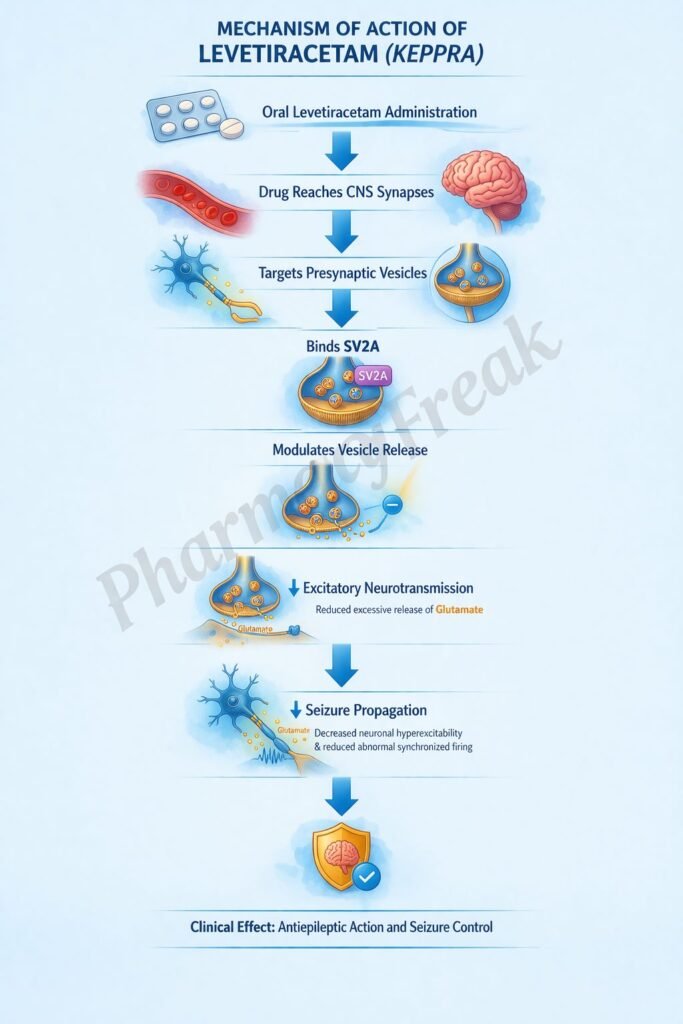
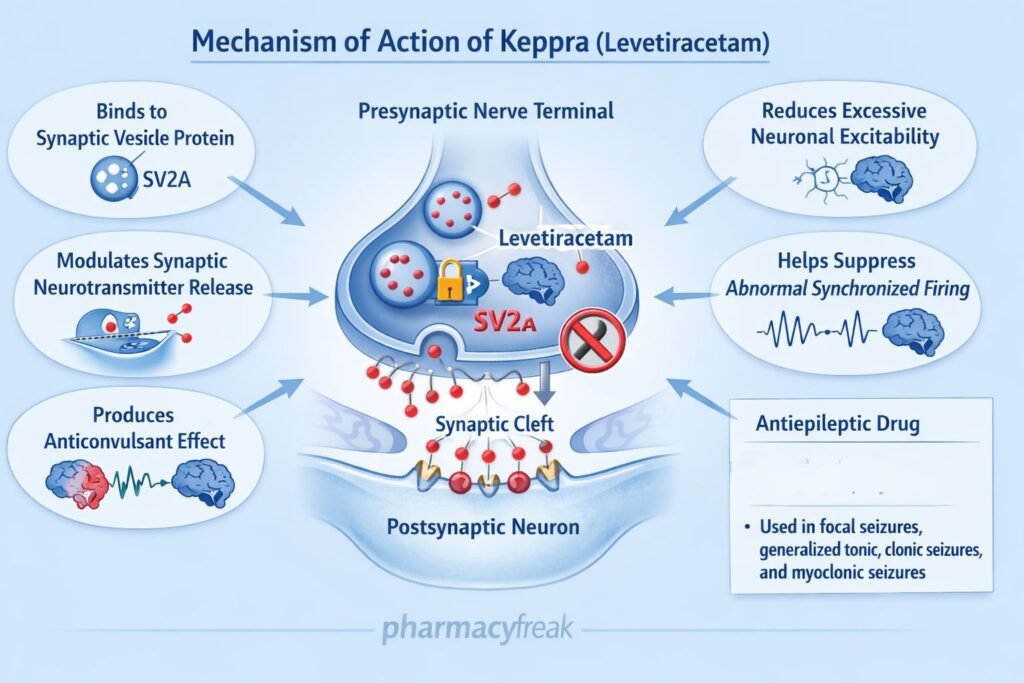
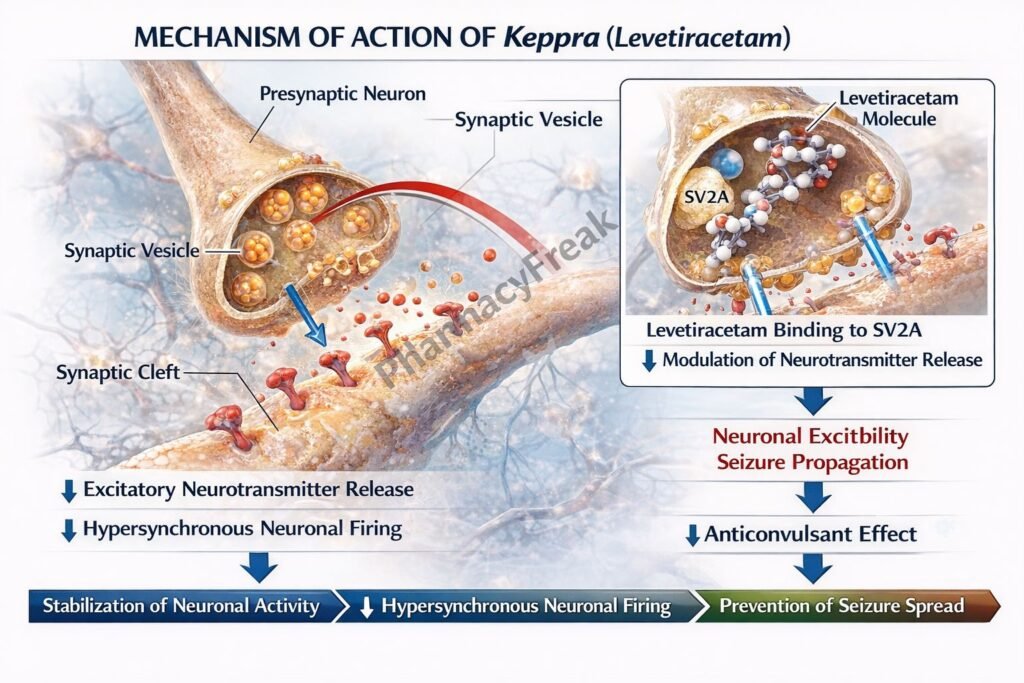
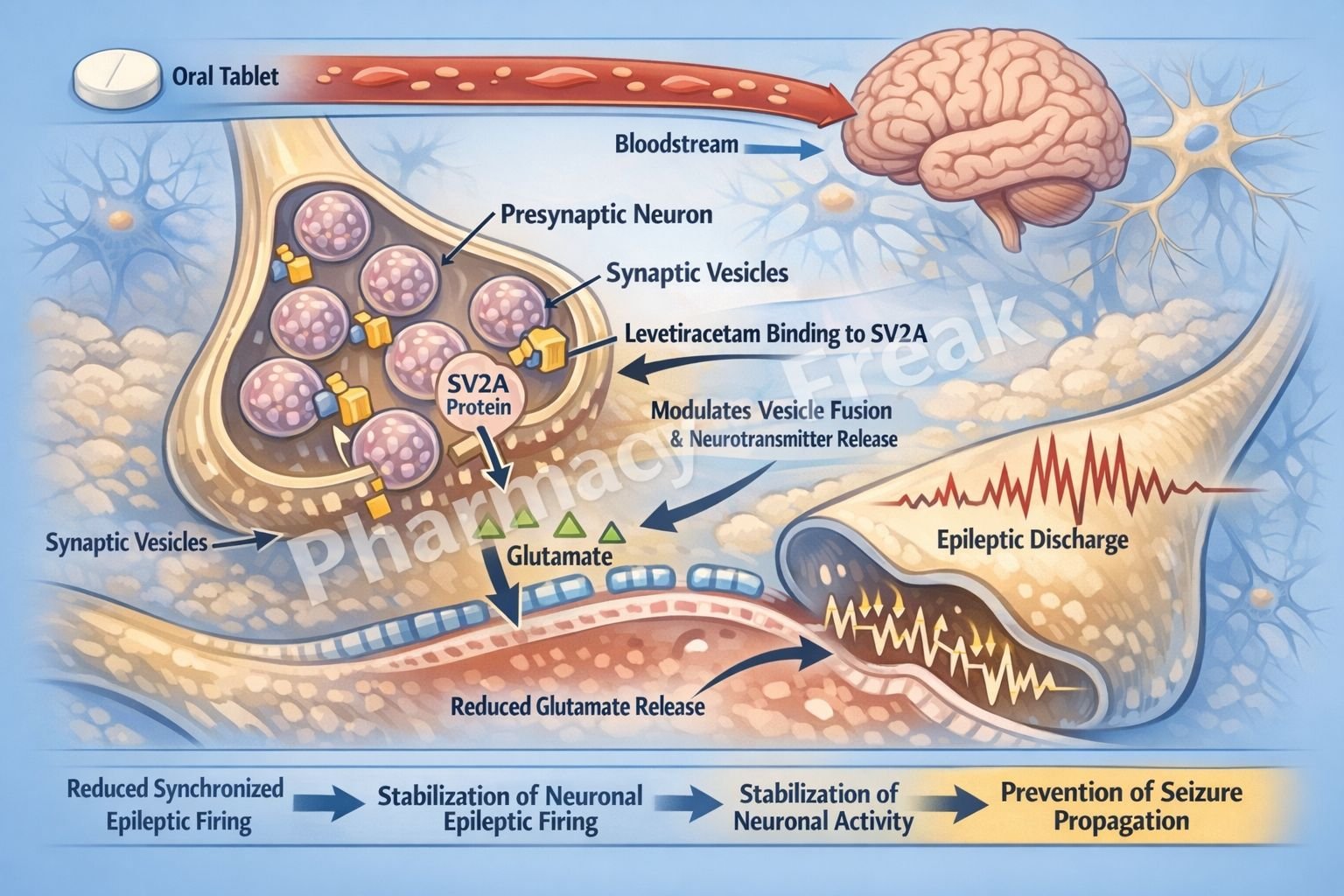
Mechanism of Action (Step-wise)
- Binding to Synaptic Vesicle Protein 2A (SV2A)
Levetiracetam selectively binds to SV2A, a protein located on presynaptic vesicles in neurons. - Modulation of Neurotransmitter Release
Binding to SV2A regulates vesicle exocytosis, reducing excessive neurotransmitter release. - Inhibition of Excitatory Neurotransmission
It decreases the release of excitatory neurotransmitters such as glutamate. - Stabilization of Neuronal Activity
By limiting excessive synaptic transmission, it stabilizes neuronal firing and prevents seizure propagation. - Reduction of Hypersynchronization
It inhibits abnormal neuronal synchronization that is characteristic of epileptic activity. - Minimal Effect on Normal Neurotransmission
Levetiracetam selectively targets pathological activity with minimal effect on normal neuronal signaling.
Pharmacokinetics
- Administration: Oral and intravenous
- Absorption: Rapid and almost complete
- Bioavailability: ~100%
- Protein Binding: Minimal
- Metabolism: Minimal hepatic metabolism
- Half-life: ~6–8 hours
- Excretion: Renal (primarily unchanged)
Clinical Uses
- Partial (focal) seizures
- Generalized tonic-clonic seizures
- Myoclonic seizures (especially in juvenile myoclonic epilepsy)
- Status epilepticus (off-label use)
Adverse Effects
- Somnolence
- Dizziness
- Fatigue
- Behavioral changes (irritability, aggression)
- Headache
Comparative Analysis
| Feature | Levetiracetam | Phenytoin | Valproate |
|---|---|---|---|
| Mechanism | SV2A binding | Na⁺ channel blockade | Multiple (Na⁺, GABA ↑) |
| Drug interactions | Minimal | Significant | Moderate |
| Sedation | Mild | Moderate | Moderate |
| Use | Broad-spectrum | Focal seizures | Broad-spectrum |
| Hepatic metabolism | Minimal | Extensive | Extensive |
Levetiracetam is preferred due to its unique SV2A-mediated mechanism, minimal drug interactions, and lack of significant hepatic metabolism. Compared to phenytoin and valproate, it has a better safety and tolerability profile.
MCQs
- Levetiracetam binds to which protein?
a) GABA receptor
b) Sodium channel
c) SV2A
d) NMDA receptor
Answer: c) SV2A - Main effect of levetiracetam:
a) Increase dopamine
b) Reduce glutamate release
c) Block calcium channels
d) Increase serotonin
Answer: b) Reduce glutamate release - Levetiracetam is used in:
a) Hypertension
b) Epilepsy
c) Diabetes
d) Asthma
Answer: b) Epilepsy - Bioavailability of levetiracetam:
a) 50%
b) 70%
c) 100%
d) 30%
Answer: c) 100% - Major route of excretion:
a) Hepatic
b) Renal
c) Pulmonary
d) Biliary
Answer: b) Renal - Levetiracetam has:
a) High protein binding
b) Minimal protein binding
c) No absorption
d) High metabolism
Answer: b) Minimal protein binding - Compared to phenytoin, levetiracetam:
a) Has more interactions
b) Has fewer interactions
c) Is less effective
d) Is more toxic
Answer: b) Has fewer interactions - Behavioral side effects include:
a) Hypotension
b) Aggression
c) Bradycardia
d) Constipation
Answer: b) Aggression - Mechanism involves:
a) Sodium channel block
b) SV2A modulation
c) Calcium channel activation
d) GABA breakdown
Answer: b) SV2A modulation - Levetiracetam is suitable for:
a) Only focal seizures
b) Only generalized seizures
c) Broad-spectrum seizure control
d) Pain management
Answer: c) Broad-spectrum seizure control
FAQs
- What is the mechanism of action of levetiracetam?
It binds to SV2A and modulates neurotransmitter release to prevent seizures. - Why is levetiracetam widely used?
Due to its safety, minimal interactions, and broad-spectrum activity. - Does levetiracetam affect liver enzymes?
No, it has minimal hepatic metabolism. - Can levetiracetam cause behavioral changes?
Yes, irritability and aggression may occur. - Is levetiracetam safe in polytherapy?
Yes, due to low drug interaction potential. - What type of seizures does it treat?
Both focal and generalized seizures.