Table of Contents
Introduction
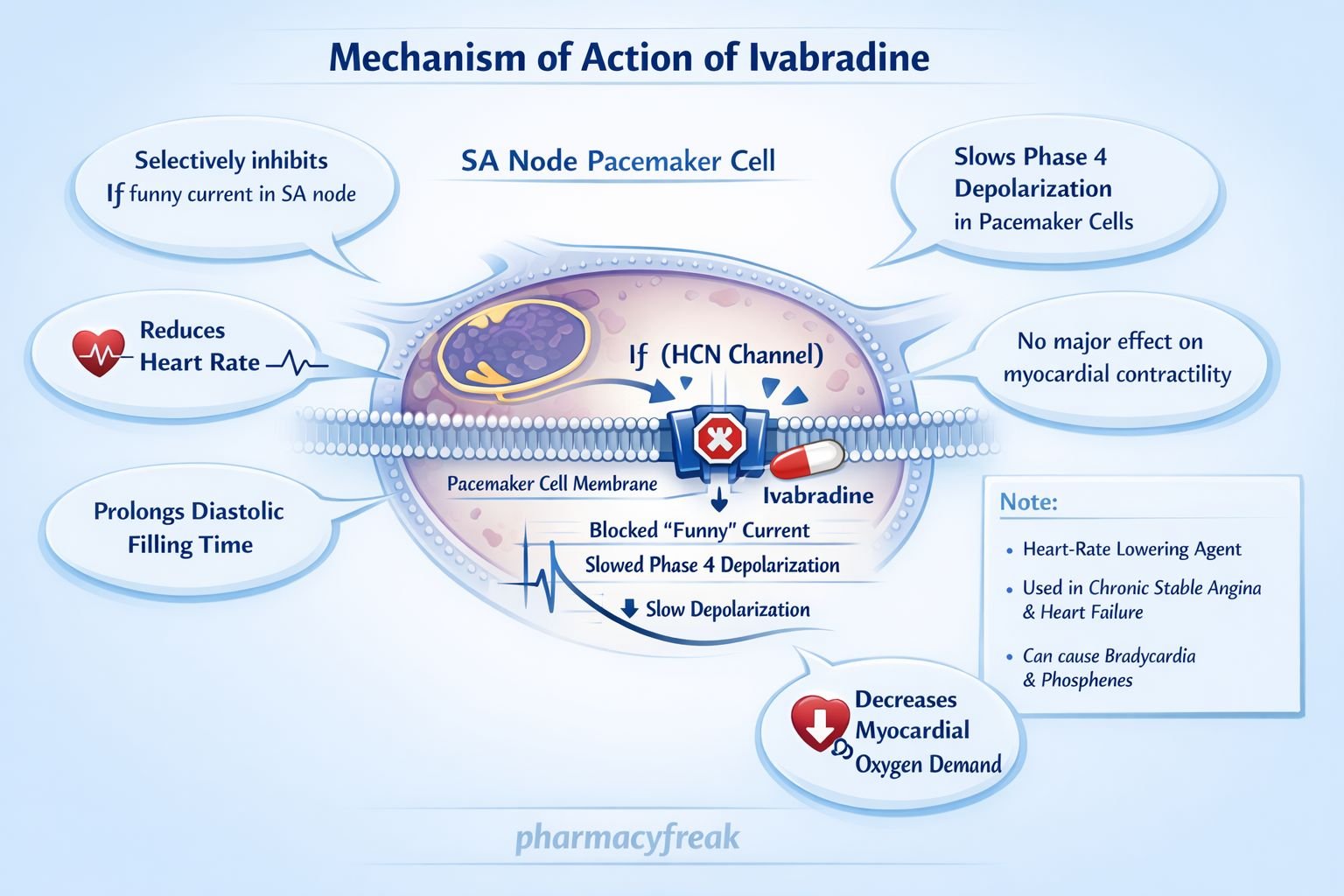
Ivabradine is a selective heart rate–reducing agent primarily used in the management of chronic stable angina and heart failure with reduced ejection fraction (HFrEF). Unlike beta-blockers, it reduces heart rate without affecting myocardial contractility or blood pressure significantly. Its action is highly specific to the sinoatrial (SA) node.
Mechanism of Action (Step-wise)
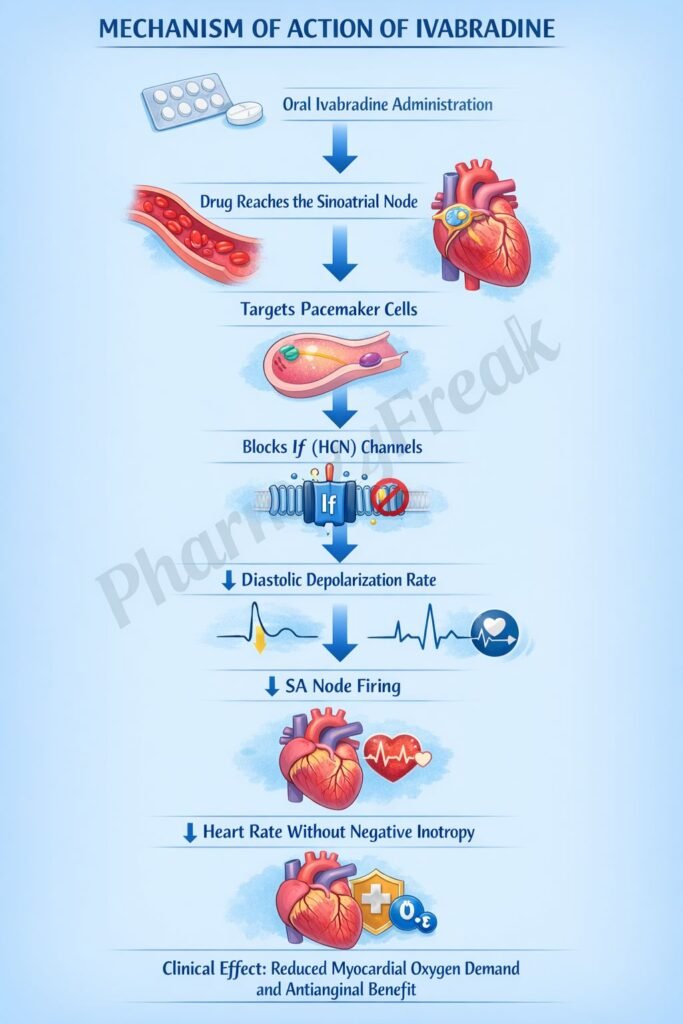
- Selective Inhibition of If (“Funny”) Current
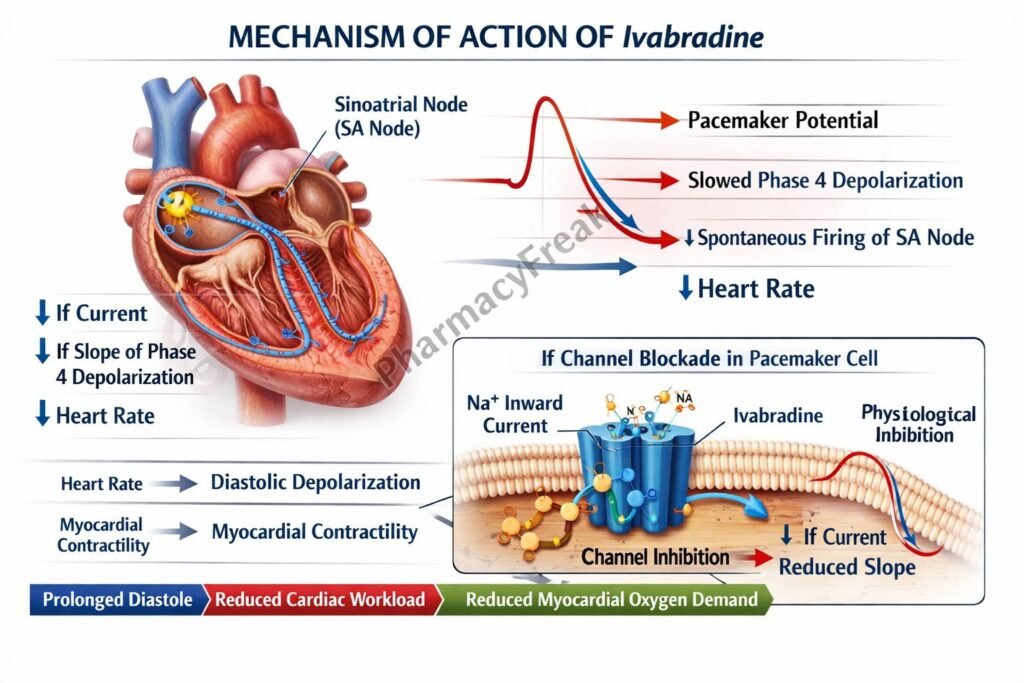
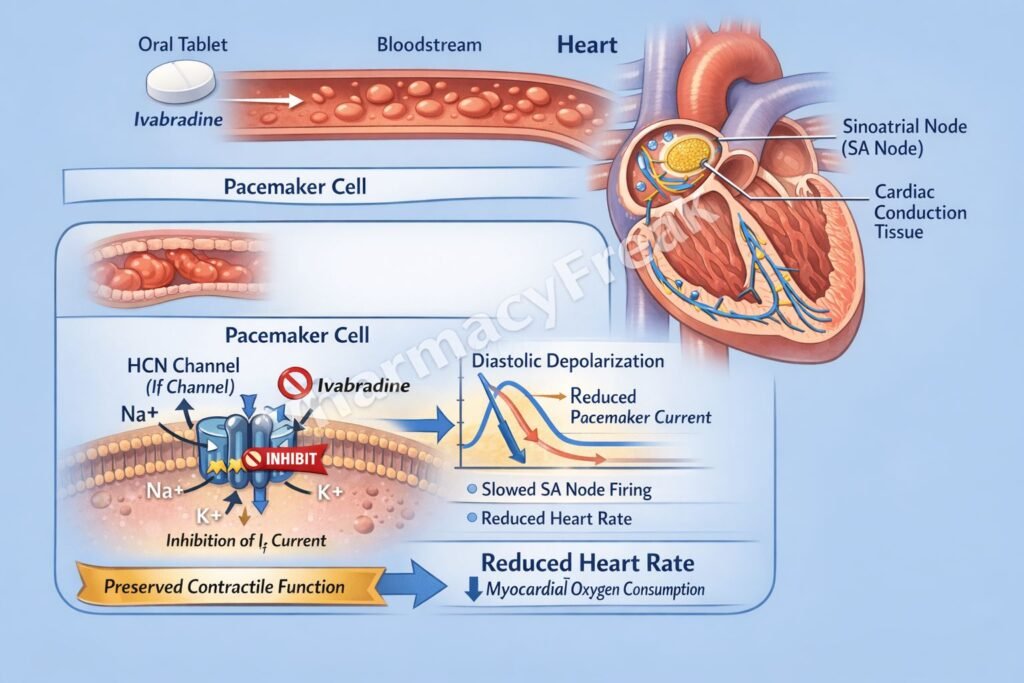
Ivabradine selectively inhibits the If current in the sinoatrial (SA) node. - Blockade of HCN Channels
The If current is mediated by hyperpolarization-activated cyclic nucleotide-gated (HCN) channels. Ivabradine blocks these channels. - Reduction in Pacemaker Activity
Inhibition of If current slows spontaneous diastolic depolarization in SA node cells. - Decrease in Heart Rate
Slower depolarization reduces the firing rate of the SA node, leading to decreased heart rate (negative chronotropic effect). - Prolongation of Diastole
Reduced heart rate increases diastolic duration, improving coronary perfusion. - No Effect on Contractility or Conduction
Ivabradine does not significantly affect myocardial contractility (inotropy) or atrioventricular conduction.
Pharmacokinetics
- Administration: Oral
- Absorption: Good oral absorption
- Bioavailability: ~40% (first-pass metabolism)
- Metabolism: Hepatic via CYP3A4
- Half-life: ~6 hours
- Excretion: Fecal and renal
Clinical Uses
- Chronic stable angina (in patients intolerant to beta-blockers)
- Heart failure with reduced ejection fraction (HFrEF)
- Heart rate control in sinus rhythm
Adverse Effects
- Bradycardia
- Luminous phenomena (phosphenes)
- Atrial fibrillation
- Headache
- Dizziness
Comparative Analysis
| Feature | Ivabradine | Propranolol | Diltiazem |
|---|---|---|---|
| Class | If channel inhibitor | β-blocker | Calcium channel blocker |
| Mechanism | Blocks SA node If current | β1 blockade | L-type Ca²⁺ channel blockade |
| Effect on HR | ↓↓ | ↓↓ | ↓ |
| Effect on contractility | No significant effect | Decreases | Decreases |
| Effect on BP | Minimal | Decreases | Decreases |
| Use | HF, angina | HTN, angina | HTN, arrhythmias |
Ivabradine provides a unique advantage by selectively reducing heart rate without affecting blood pressure or myocardial contractility. This makes it especially useful in patients who cannot tolerate beta-blockers.
MCQs
- Ivabradine inhibits which current?
a) Na⁺ current
b) Ca²⁺ current
c) If current
d) K⁺ current
Answer: c) If current - Site of action of ivabradine:
a) AV node
b) SA node
c) Ventricles
d) Purkinje fibers
Answer: b) SA node - Ivabradine acts on which channels?
a) Voltage-gated Na⁺ channels
b) HCN channels
c) L-type Ca²⁺ channels
d) K⁺ channels
Answer: b) HCN channels - Main clinical effect:
a) Increased BP
b) Reduced heart rate
c) Increased contractility
d) Vasoconstriction
Answer: b) Reduced heart rate - Ivabradine does NOT affect:
a) Heart rate
b) SA node activity
c) Contractility
d) Pacemaker activity
Answer: c) Contractility - Unique side effect:
a) Dry mouth
b) Phosphenes
c) Constipation
d) Rash
Answer: b) Phosphenes - Metabolism occurs via:
a) CYP2D6
b) CYP3A4
c) MAO
d) COMT
Answer: b) CYP3A4 - Used in:
a) Hypertension
b) Heart failure
c) Diabetes
d) Asthma
Answer: b) Heart failure - Ivabradine prolongs:
a) Systole
b) Diastole
c) QT interval
d) PR interval
Answer: b) Diastole - Compared to beta-blockers, ivabradine:
a) Decreases BP more
b) Has no cardiac effect
c) Does not affect contractility
d) Causes vasoconstriction
Answer: c) Does not affect contractility
FAQs
- What is the mechanism of action of ivabradine?
It selectively inhibits the If current in the SA node, reducing heart rate. - What makes ivabradine different from beta-blockers?
It lowers heart rate without affecting contractility or blood pressure. - What is the If current?
A pacemaker current responsible for spontaneous depolarization in SA node cells. - Why does ivabradine cause visual disturbances?
Due to effects on retinal HCN channels. - In which patients is ivabradine preferred?
Patients with heart failure who cannot tolerate beta-blockers. - Does ivabradine affect blood pressure?
No, it has minimal effect on blood pressure.