Table of Contents
Introduction
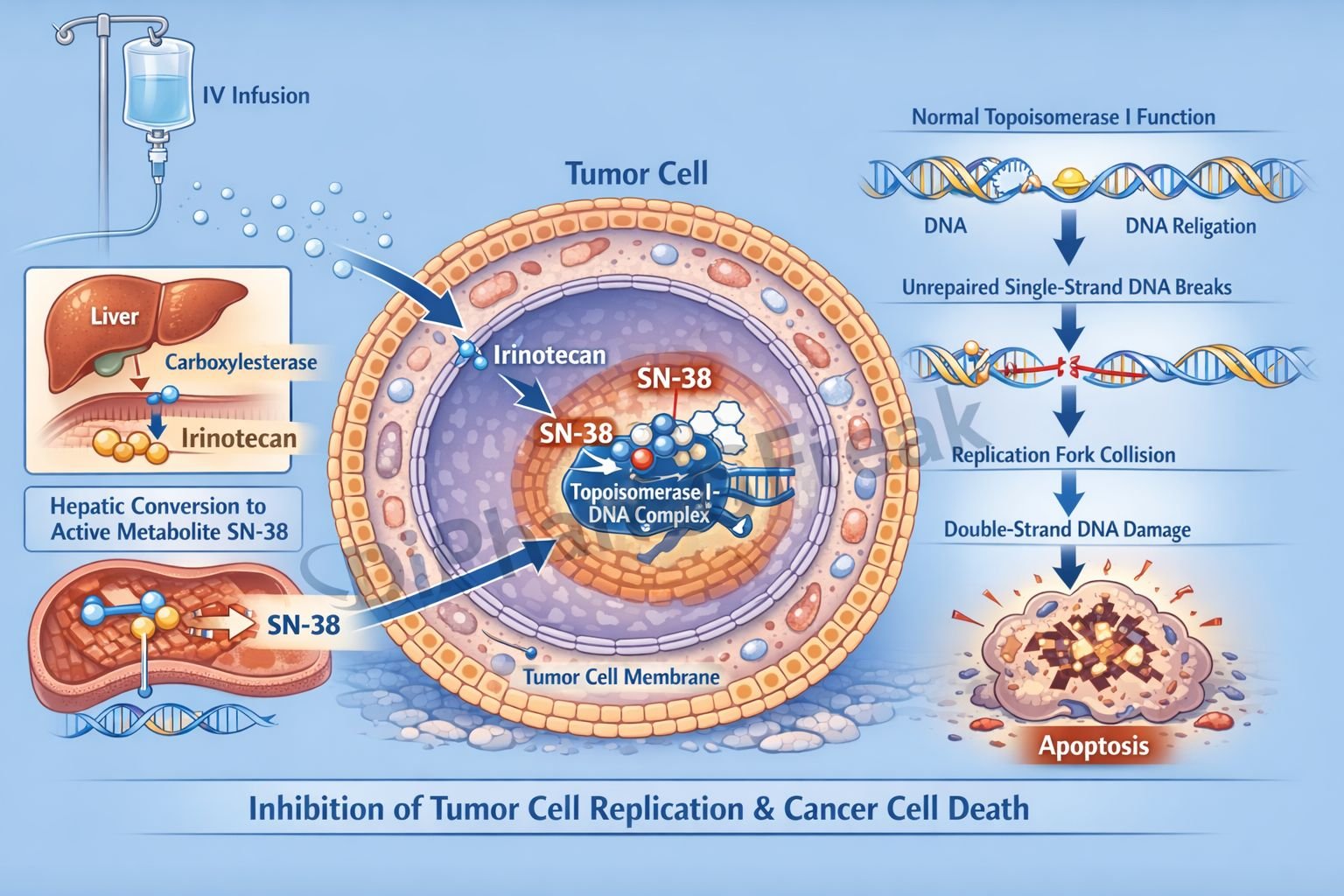
Irinotecan is a semi-synthetic camptothecin derivative used as an antineoplastic agent, primarily in the treatment of colorectal cancer and other solid tumors. It is a prodrug that requires metabolic activation to exert its cytotoxic effects. Irinotecan interferes with DNA replication in rapidly dividing cancer cells, leading to cell death.
Mechanism of Action (Step-wise)
- Prodrug Activation
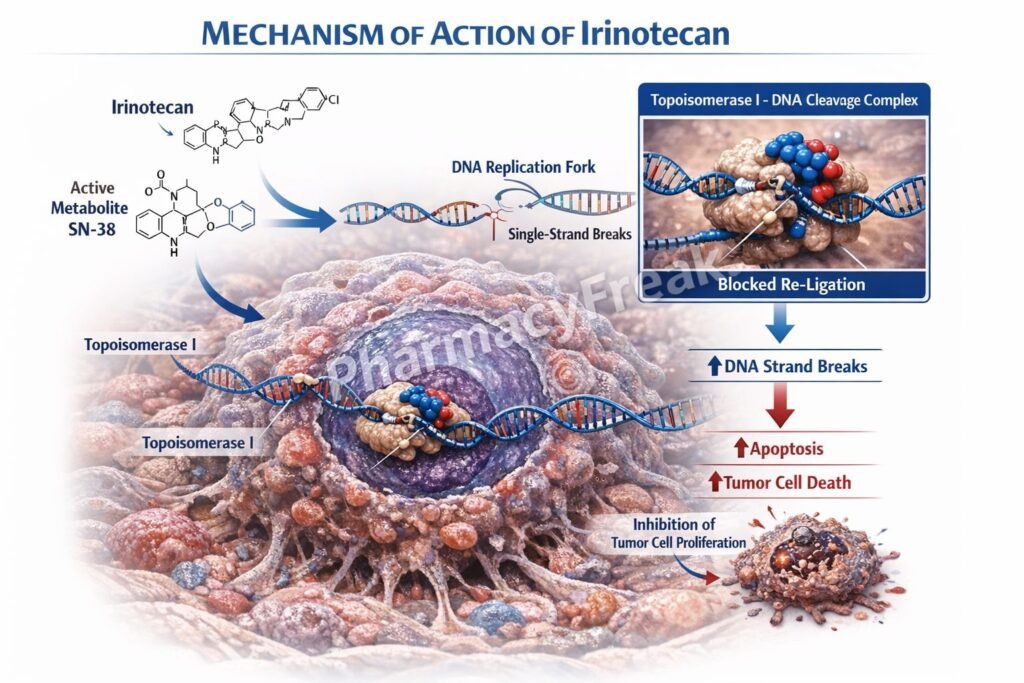
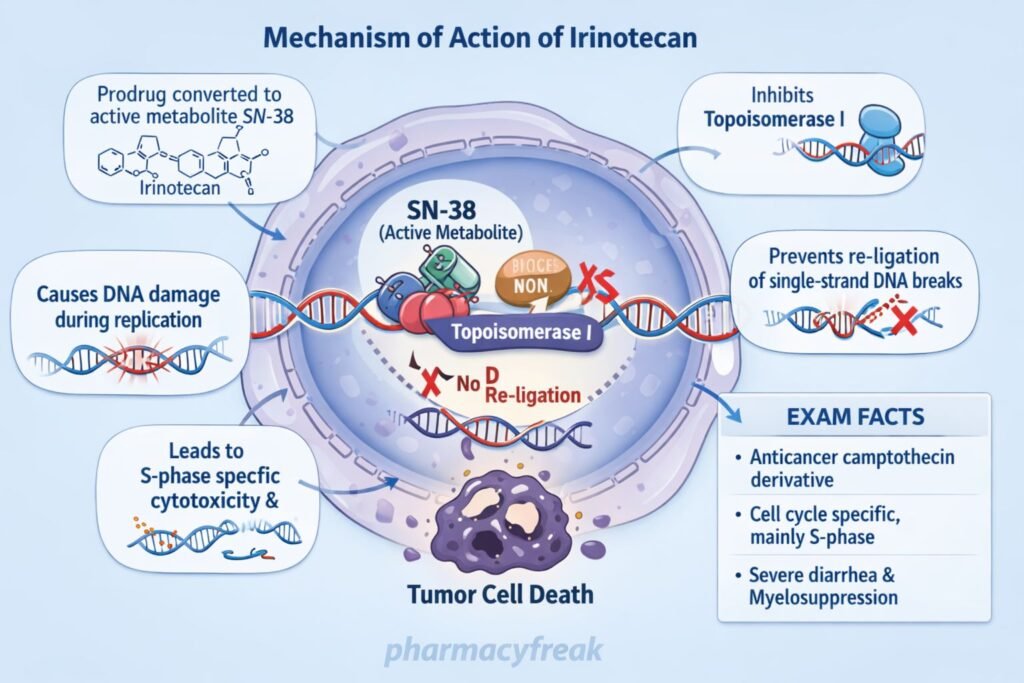
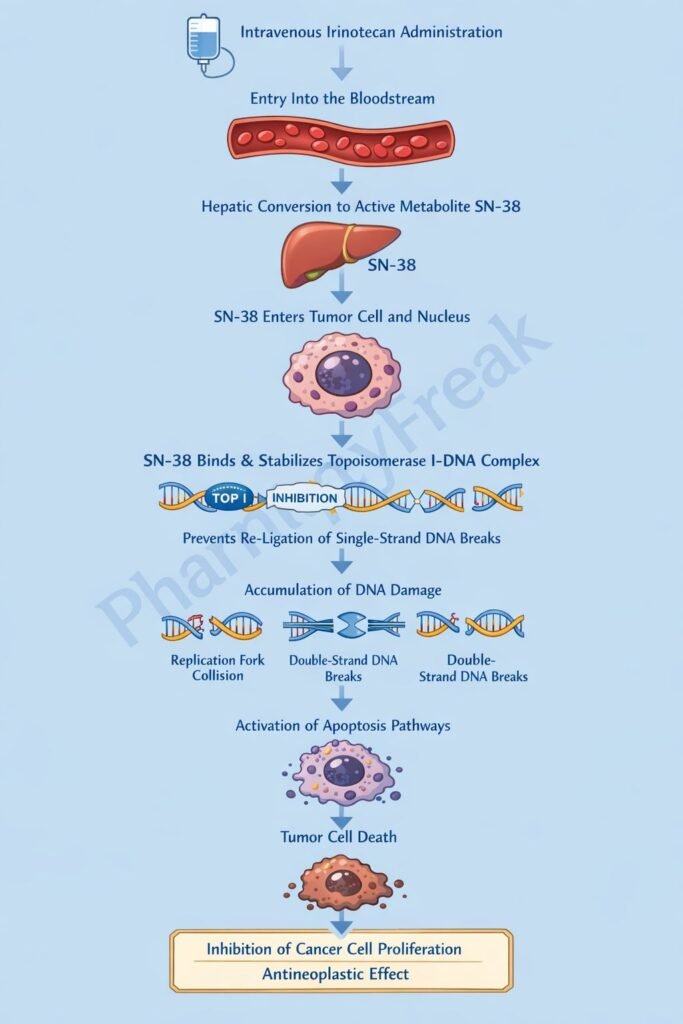
Irinotecan is converted in the liver by carboxylesterase enzymes into its active metabolite, SN-38. - Topoisomerase I Inhibition
SN-38 inhibits DNA topoisomerase I, an enzyme responsible for relieving torsional strain during DNA replication. - Stabilization of DNA-Enzyme Complex
It stabilizes the transient DNA-topoisomerase I complex, preventing re-ligation of single-strand breaks. - Accumulation of DNA Damage
During DNA replication, these single-strand breaks convert into double-strand breaks. - Cell Cycle-Specific Action
The cytotoxic effect is most pronounced during the S-phase of the cell cycle. - Induction of Apoptosis
Accumulated DNA damage triggers apoptosis in rapidly dividing tumor cells.
Pharmacokinetics
- Administration: Intravenous
- Activation: Hepatic conversion to SN-38
- Metabolism: SN-38 is inactivated by UGT1A1-mediated glucuronidation
- Half-life: Irinotecan ~6–12 hours; SN-38 longer
- Excretion: Biliary and fecal (major), renal (minor)
Clinical Uses
- Metastatic colorectal cancer
- Combination chemotherapy regimens (e.g., FOLFIRI)
- Other solid tumors (off-label uses)
Adverse Effects
- Severe diarrhea (early cholinergic and delayed secretory type)
- Myelosuppression (neutropenia)
- Nausea and vomiting
- Alopecia
- Fatigue
Comparative Analysis
| Feature | Irinotecan | Topotecan | Cisplatin |
|---|---|---|---|
| Class | Topoisomerase I inhibitor | Topoisomerase I inhibitor | Alkylating-like agent |
| Mechanism | Inhibits Topo I via SN-38 | Direct Topo I inhibition | DNA cross-linking |
| Cell cycle specificity | S-phase | S-phase | Non-specific |
| Main toxicity | Diarrhea, neutropenia | Myelosuppression | Nephrotoxicity |
| Use | Colorectal cancer | Ovarian, lung cancer | Multiple cancers |
Irinotecan differs from topotecan mainly in its prodrug nature and clinical indications. Compared to cisplatin, which causes DNA cross-linking, irinotecan specifically targets topoisomerase I and is cell cycle-specific.
MCQs
- Irinotecan is a prodrug converted into:
a) Cisplatin
b) SN-38
c) Methotrexate
d) Doxorubicin
Answer: b) SN-38 - Target enzyme of irinotecan:
a) DNA polymerase
b) Topoisomerase II
c) Topoisomerase I
d) RNA polymerase
Answer: c) Topoisomerase I - Phase of cell cycle affected:
a) G0
b) G1
c) S-phase
d) M-phase
Answer: c) S-phase - Mechanism involves:
a) DNA cross-linking
b) Inhibition of DNA repair
c) Stabilization of DNA breaks
d) RNA synthesis inhibition
Answer: c) Stabilization of DNA breaks - Major adverse effect:
a) Nephrotoxicity
b) Cardiotoxicity
c) Severe diarrhea
d) Ototoxicity
Answer: c) Severe diarrhea - Enzyme responsible for activation:
a) CYP3A4
b) Carboxylesterase
c) UGT1A1
d) MAO
Answer: b) Carboxylesterase - SN-38 is inactivated by:
a) Oxidation
b) Glucuronidation
c) Reduction
d) Hydrolysis
Answer: b) Glucuronidation - Used primarily in:
a) Breast cancer
b) Lung cancer
c) Colorectal cancer
d) Prostate cancer
Answer: c) Colorectal cancer - Type of DNA damage caused:
a) Cross-links
b) Single-strand breaks
c) Methylation
d) Deamination
Answer: b) Single-strand breaks - Delayed diarrhea is due to:
a) Infection
b) Secretory mechanisms
c) Bleeding
d) Hypersensitivity
Answer: b) Secretory mechanisms
FAQs
- What is the mechanism of action of irinotecan?
It inhibits topoisomerase I after conversion to SN-38, preventing DNA repair. - Why is irinotecan considered a prodrug?
Because it must be converted into its active metabolite SN-38. - What is the major toxicity of irinotecan?
Severe diarrhea and neutropenia. - What is the role of UGT1A1?
It inactivates SN-38 via glucuronidation. - Why is irinotecan S-phase specific?
It affects DNA replication processes occurring during S-phase. - What cancer is irinotecan commonly used for?
Metastatic colorectal cancer.