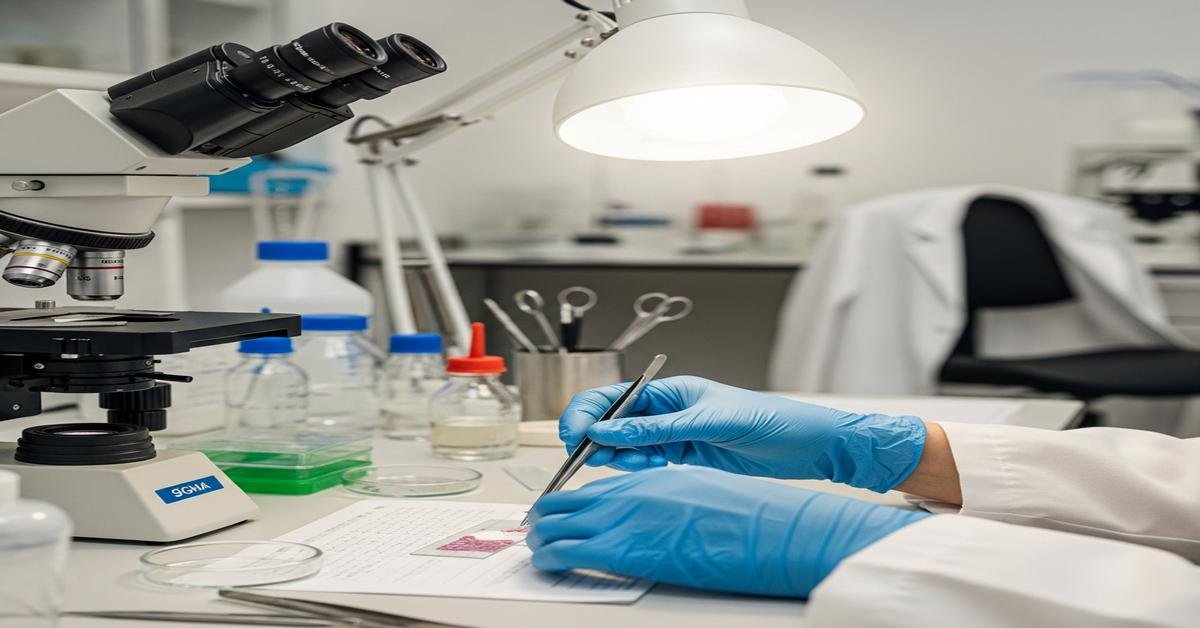
Histology turns tiny pieces of tissue into clear answers for doctors. The people who do that work are histotechnicians. They fix, process, embed, cut, and stain tissue so a pathologist can read it under the microscope. In 2026, certified histotechnicians (HT) are in short supply across hospitals, cancer centers, dermatology clinics, veterinary labs, research groups, and biotech. This article explains why the demand is high, what the HT credential proves, and exactly how to get certified this year.
What a Histotechnician Actually Does
Histotechnicians are the link between a biopsy jar and a diagnosis. The quality of their work shapes the pathologist’s interpretation. If tissue is under-fixed, over-processed, crushed, torn, or poorly stained, it can hide cancer cells or mimic disease. That is why certification matters: it signals you can get reproducible, diagnostic slides at pace.
Day to day, you will:
- Fix tissue correctly (formalin concentration, volume ratio, time) to preserve morphology and antigens.
- Process tissue with graded alcohols, xylene substitutes, and paraffin—balancing time, temperature, and vacuum so tissue is neither brittle nor mushy.
- Embed with proper orientation (epidermis down for skin, lumen open for GI, margins flat for resections).
- Cut microtomy at 2–5 µm without chatter, compression, or knife lines; float sections cleanly.
- Stain H&E consistently; perform special stains (e.g., PAS, trichrome, Gram, AFB) and immunohistochemistry (IHC) with controls and titers.
- Manage quality: track TAT, re-cut rates, stain runs, and instrument maintenance.
- Support intraoperative “frozen” sections so surgeons get answers while the patient is still on the table.
Every step has trade-offs. For example, decalcifying bone too fast with strong acid speeds turnaround but ruins nuclear detail and IHC. Histotechnicians learn where to draw the line, which is why trained, certified staff are valuable.
Why HT Certification Is in High Demand in 2026
- More biopsies, more cancer workups. Population aging and expanded screening programs drive steady biopsy volumes. Each sample becomes a set of blocks and slides. More volume needs more skilled prep.
- Precision oncology depends on good tissue. IHC and downstream molecular tests (e.g., NGS) need well-fixed, cleanly cut sections. Pre-analytical errors can invalidate expensive panels. Labs hire certified HTs to cut these risks.
- Retirements and staffing gaps. Many senior techs are leaving the workforce. Backfilling takes time because histology skills are learned on the bench.
- Digital and AI pathology rely on consistency. Scanners and algorithms need uniform thickness, sharp nuclear detail, and minimal artifacts. Certified HTs deliver that consistency.
- Regulatory pressure. CLIA, CAP, and state rules push labs to prove competency and quality. Hiring certified HTs is the simplest way to meet those standards.
- Dermatology and Mohs growth. Outpatient skin cancer clinics run high-volume same-day histology. They prize speed plus accuracy—skills tied closely to HT training.
Bottom line: pathology cannot automate away the need for excellent tissue handling. When the slide is bad, the diagnosis is uncertain. That risk keeps demand for certified HTs high.
Where the Jobs Are (and What They Pay)
You will find roles in:
- Hospitals and health systems: core histology labs, IHC labs, frozen section support.
- Dermatology/Mohs practices: rapid same-day processing, cryostat, margins.
- Reference labs and CROs: high-volume test menus, clinical trials, GLP work.
- Biotech and IVD companies: R&D, QC of reagents, field applications for instruments and antibodies.
- Veterinary pathology: similar workflows, often broader case mix.
Pay ranges (U.S., typical full-time):
- Entry-level HT: about $24–$32 per hour ($50k–$66k/year), higher with evenings/nights.
- Experienced/lead/IHC specialist: about $30–$42 per hour ($62k–$87k/year), more in high-cost markets.
- Travel contracts: weekly packages can exceed permanent roles, with variable stipends.
Why these numbers? Employers pay for repeatable quality and speed. IHC expertise, frozen competency, and low re-cut rates usually boost offers.
HT vs. HTL: Picking Your Ladder
HT (Histotechnician) certifies hands-on bench skills. It is the fastest entry into the field.
HTL (Histotechnologist) is the next rung. It typically requires a bachelor’s degree and covers deeper theory, complex IHC, validation, and leadership. Many leads, educators, and supervisors hold HTL.
If you want to move into lead roles, method validation, or IVD/biotech support, plan for HT first, then bridge to HTL while working.
Eligibility Paths for HT Certification in 2026
Certification is awarded by a major U.S. board of certification recognized across hospitals and labs. As of recent standards, you can qualify through several routes. Always verify current rules before you apply, because requirements can change.
Common HT eligibility routes (typical patterns):
- Route 1: Accredited HT program. Complete a NAACLS-accredited Histotechnician program (often 1–2 years). These programs include didactic courses plus clinical rotations and meet required biology/chemistry credits.
- Route 2: College credits + on-the-job experience. Earn at least 60 semester hours with specified biology and chemistry (commonly 12 credits each), then complete about one year of full-time histopathology lab experience within a set time frame.
- Route 3: Extended on-the-job experience. Some pathways accept a high school diploma or equivalent plus a longer duration of full-time histology experience (for example, two or more years) covering defined tasks like fixation, processing, embedding, microtomy, and staining.
Why multiple routes? Histology has a strong apprenticeship tradition. The routes balance formal education with competency proven at the bench.
Tip: If you are new to labs or want the most direct path, an accredited HT program is usually the fastest and cleanest route to an exam approval.
Step-by-Step: Your 2026 Certification Plan
Pick one of these plans based on your background.
Plan A: Accredited HT Program (fastest for newcomers)
- Now: Confirm prerequisites (high school algebra/chemistry, immunizations, background check). If you already hold an associate’s or higher, ask about credit transfer.
- Spring–Summer 2026: Apply to 2–3 NAACLS-accredited HT programs. Consider schedule (day/evening), clinical rotation partners, and IHC exposure.
- 2026–2027: Complete classroom and clinical. Keep a logbook of competencies (processing, microtomy, stain runs, frozen support) and QC artifacts you solved.
- Last term: Gather transcripts and program completion documents. Apply for the certification exam, then schedule your test window.
Plan B: College Credits + OJT (for those with prior science credits)
- Now: Verify you hold about 60 college credits with 12 biology and 12 chemistry credits. If you are short, enroll in missing courses.
- Next 12 months: Secure a full-time histology aide/trainee role. Work under a certified HT/HTL or pathologist. Get documented competency across fixation, processing, embedding, microtomy, H&E, special stains, and IHC basics.
- After 1 year (typical): Obtain signed experience verification from your lab. Apply for the exam and schedule.
Plan C: Extended OJT (for experienced uncredentialed staff)
- Now: Audit your task list. You will need to show comprehensive histology experience across core steps, not just one station.
- Before applying: Assemble HR job descriptions, competency checklists, and supervisor attestations covering the required time window.
- Apply: Submit documentation, then schedule your exam upon approval.
Application and scheduling basics
- Fees: Expect roughly $250–$300 for the exam, plus any verification or transcript costs.
- Processing: Application reviews often take several weeks. You will receive an eligibility window (commonly 90 days) to schedule with a testing center.
- Retakes: If you do not pass, there is a mandatory wait period before reapplying. Plan your study cycle accordingly.
What’s on the HT Exam
The exam measures whether you can produce diagnostic slides safely and consistently. Content typically includes:
- Fixation and processing: formalin chemistry, volume/time, microwave processing, decalcification choices and effects.
- Embedding and microtomy: orientation, sectioning artifacts, knife angles, flotation, cryostat technique for frozen sections.
- Staining: H&E theory, troubleshooting (weak nuclei, eosin overstain), special stains (e.g., PAS, GMS, trichrome, retic), IHC principles (antigen retrieval, controls, detection systems).
- Quality and safety: QC logs, lot-to-lot verification, CAP/CLIA concepts, OSHA/chemical hygiene, waste handling, ergonomics.
- Lab math and reagents: dilutions, molarity, buffer prep, pH effects on stains.
- Tissue types and artifacts: fat, bone, GI mucosa, skin margins; chatter, folds, floaters, incomplete dehydration.
Expect scenario questions: “A bone marrow section shows nuclear bubbling after antigen retrieval—what changed?” These test whether you understand cause and effect, not just memorized facts.
Smart Study Plan (8–12 Weeks)
Week 1–2: Map the test
- Print the content outline. Mark strong vs. weak areas honestly.
- Pick one primary histology text and one question bank. Do not juggle five sources.
Week 3–6: Core systems
- Fixation/processing: Make flashcards of time/temperature/solvent steps and what each error looks like on slides.
- Microtomy: Create an “artifact-to-cause” list (compression, chatter, washboarding, lift). Drill corrective actions.
- H&E and specials: For each stain, note the target, principle, key reagents, common pitfalls, and control tissue.
Week 7–9: IHC and QA
- Learn the logic of controls (positive, negative, reagent control) and why titers change with different platforms.
- Review CLIA/CAP basics, instrument maintenance logs, and document control.
Week 10–12: Practice and polish
- Full-length timed practice exams every 5–7 days. Review not just what you missed, but why your first instinct was off.
- Make a one-page “exam-day sheet” of conversions, stain targets, and artifact fixes.
Bench learners: If possible, ask to review real QC failures. Nothing cements knowledge like seeing a mushy biopsy after under-processing and linking it to dehydration times.
Clinical Skills Employers Want on Day One
- Orientation judgment: For skin excisions, get the entire epidermal margin flat in one plane. For GI, orient mucosa up to avoid shredding.
- Cutting discipline: Throw out the first few ribbons until the block steadies. Consistent 3–4 µm saves pathologists from focus fatigue.
- Controls and documentation: Never run a special stain or IHC without the right control. Log what you did and why.
- Frozen turnaround: Coordinate with OR. Aim for crisp sections within typical intraoperative windows.
- Troubleshooting mindset: State the hypothesis, test one variable, document the result. This reduces repeated failures.
State Licensure and Compliance
Some U.S. states and territories require a separate laboratory personnel license to practice histology (for example, Florida, New York, and others). Licensure often requires a combination of education, certification, and supervised experience. Why it matters: without the state license, an employer may not be able to put you on the bench, even if you hold the national certification.
Action items:
- Check your state’s laboratory licensure rules early—before you enroll or accept a job.
- Keep transcripts and course descriptions. Licensure boards often audit specific biology/chemistry credits.
- Save your competency and CE documents. They may be needed for renewals or inspections.
After You Pass: Keeping Your Credential Active
Most certified professionals maintain their credential through a three-year maintenance cycle with continuing education. A common requirement is 36 continuing education points every three years, including relevant histology topics and safety. Why continuing education? Methods evolve—new fixatives, detection chemistries, and digital workflows come quickly. CE keeps your practice current and defensible during inspections.
Simple CE plan:
- Earn 1–2 credits monthly from vendor webinars, lab in-services, or professional courses.
- Track credits in one place with certificates attached.
- Add one larger activity per year (e.g., method validation project or poster) to build your resume.
Common Pitfalls and How to Avoid Them
- Skipping documentation. If it is not written, it did not happen. Inspectors and supervisors need traceable records for QC and competency.
- Chasing speed over quality. Cutting fast but thick or uneven sections causes re-cuts and delays diagnoses. Consistency wins.
- Ignoring safety and ergonomics. Xylene substitutes, hot paraffin, cryostat nicks, repetitive strain—injuries sideline careers. Use PPE, rotate tasks, and sharpen blades safely.
- Studying only trivia. The exam favors scenario reasoning. Know why a stain fails and what variable to test first.
- Underestimating IHC. Even if your lab has autostainers, you must understand retrieval, primary/secondary systems, and control strategy to troubleshoot.
How to Stand Out in the Job Market
- Quantify your impact: list metrics (e.g., “Cut 120 blocks/day at 3 µm with re-cut rate < 3%”).
- Show problem-solving: describe one stain or processing issue you fixed and how you proved it stayed fixed.
- Highlight IHC: note antibodies you validated, control tissues used, and any titer/antigen-retrieval optimizations.
- Know your instruments: mention processors, stainers, coverslippers, and cryostats you have used.
- Be frozen-ready: if trained, state your intraoperative experience and typical turnaround time.
Sample 90-Day Countdown to the Exam
- Day 1–7: Application submitted. Start light review: fixation, processing flow, H&E.
- Day 8–30: Two study hours on weekdays, three on weekends. Build artifact-cause-action sheets.
- Day 31–60: Weekly full-length practice tests. Tighten weak areas (IHC controls, decalcification choices).
- Day 61–75: Memorize lab math/dilutions. Practice error analysis—explain the “why” of each miss.
- Day 76–90: Taper. Review one-page summaries. Sleep well in the final 72 hours.
Exam day: Arrive early with proper IDs. Use the tutorial to calm nerves. Mark hard questions, move on, return with fresh eyes.
Bridge from HT to HTL (If You Want Leadership)
Plan a bachelor’s degree while you work. Many HTs complete a BS in medical laboratory science, biology, or a related field online or part-time. Collect method validation and QC projects as you go; those count toward HTL-level competencies. The “why” here is simple: HTL expands your scope—oversight of IHC, validations, staff training, and often better pay.
A Realistic Look at the Work
Histology is satisfying, but it is physical and precise. Expect early mornings (processors finish overnight), repetitive hand skills, and the occasional rush for intraoperative consultations. You will also handle sharp blades, hot paraffin, and chemicals. People who thrive here like craftwork, patterns, and quiet concentration. If you enjoy solving small, repeatable problems with visible results, histology is a good fit.
Final Thoughts
HT certification is in demand in 2026 because the stakes are high and the supply of skilled techs is tight. The credential proves you can turn tissue into trustworthy slides—fast, safe, and reproducible. Choose your eligibility route, build real bench skills, study the “why” behind each step, and document everything. Do that, and you will enter a field with strong job security, clear career steps, and work that directly improves patient care.

