Table of Contents
Introduction
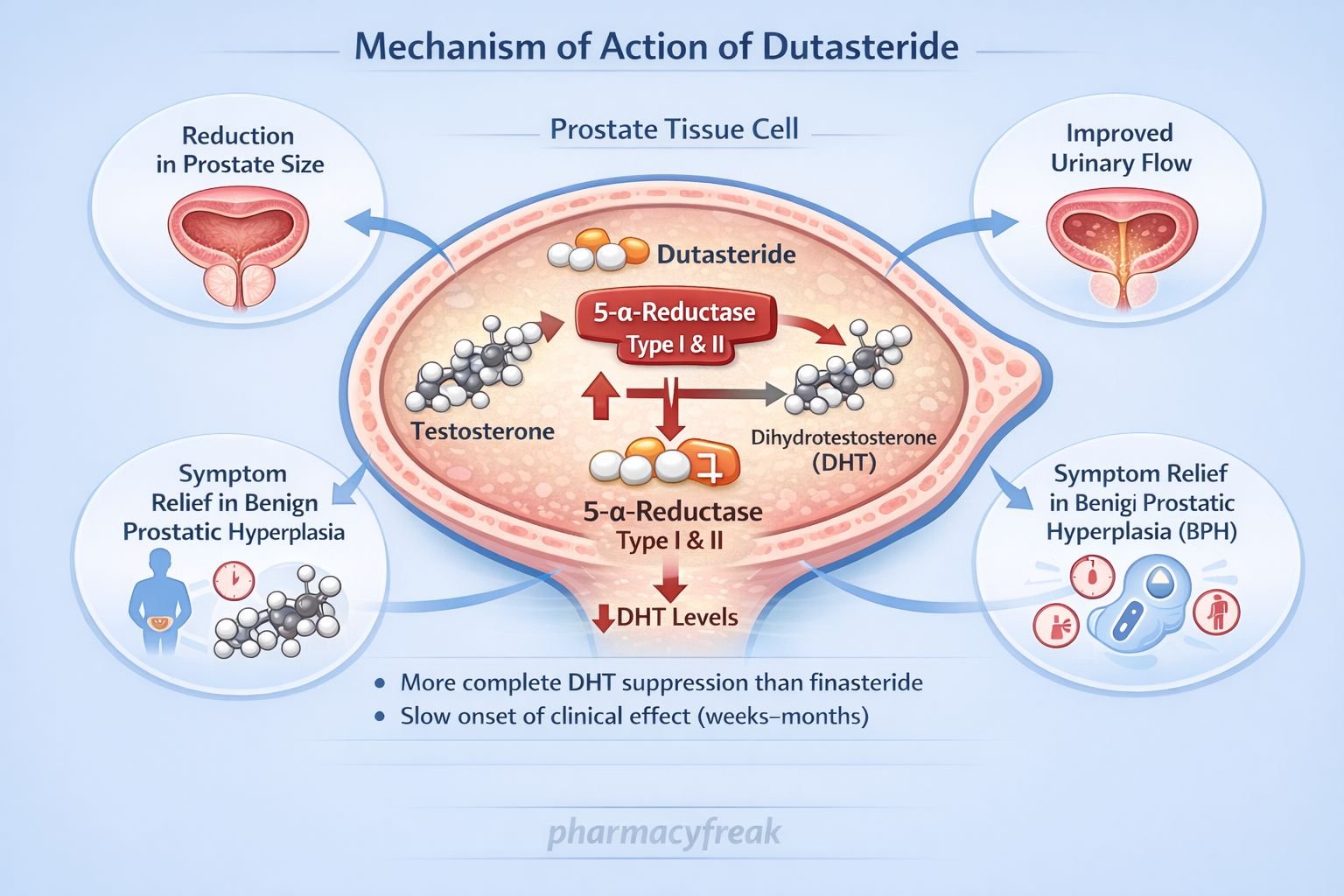
Dutasteride is a 5-alpha reductase inhibitor used primarily in the management of benign prostatic hyperplasia (BPH). It reduces prostate volume and improves lower urinary tract symptoms by profoundly suppressing dihydrotestosterone (DHT) synthesis. Dutasteride is a high-yield drug in pharmacology, urology, and endocrine examinations because it inhibits both isoforms of 5-alpha reductase, making it more potent than finasteride.
Mechanism of Action (Step-wise)
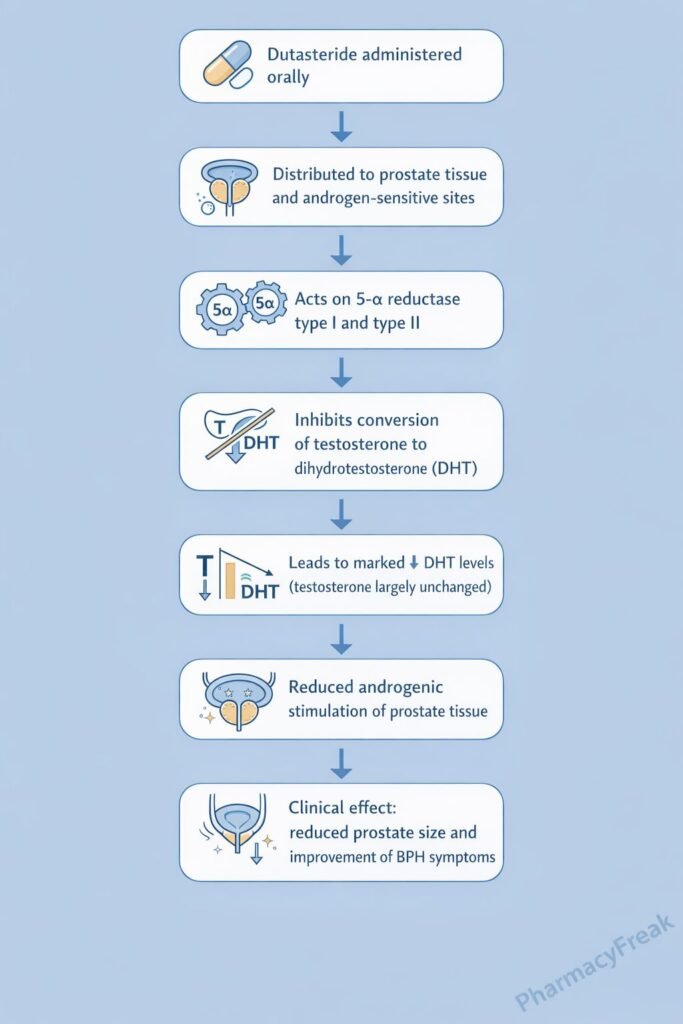
Dutasteride reduces androgen-mediated prostatic growth by inhibiting conversion of testosterone to dihydrotestosterone.
- Role of Androgens in Prostate Growth
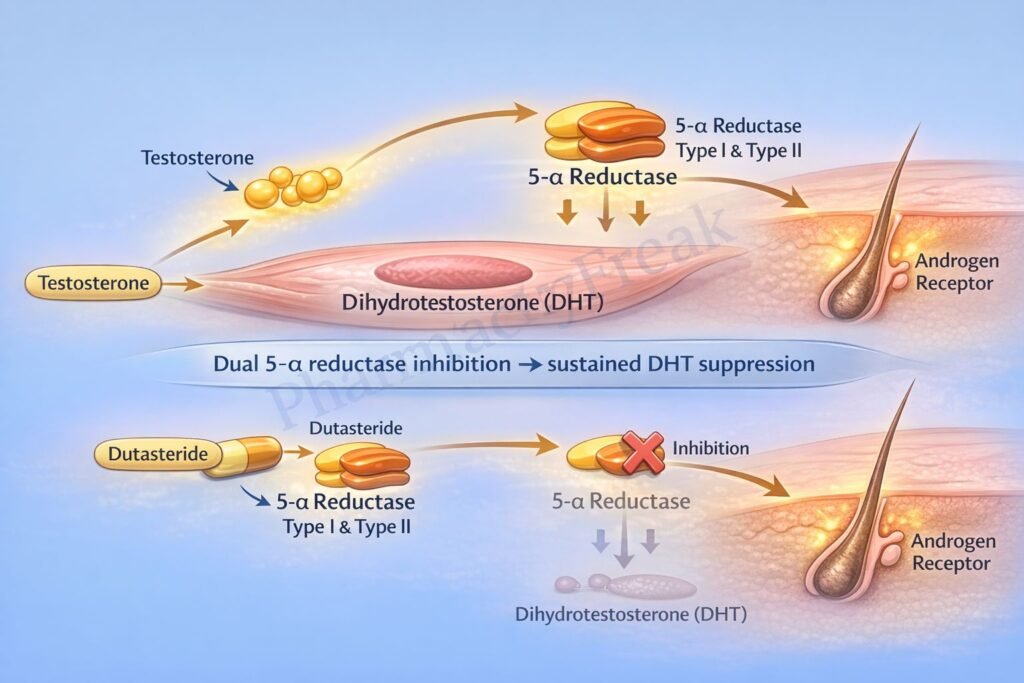
Prostate development and enlargement are driven primarily by dihydrotestosterone (DHT), a potent androgen. - Conversion of Testosterone to DHT
Testosterone is converted to DHT by the enzyme 5-alpha reductase. - Isoforms of 5-Alpha Reductase
- Type I: Present in liver, skin, and prostate
- Type II: Predominant in prostate and genital tissue
- Dual Enzyme Inhibition
Dutasteride competitively inhibits both type I and type II 5-alpha reductase enzymes. - Reduced DHT Synthesis
Inhibition leads to a marked decrease (>90%) in circulating and intraprostatic DHT levels. - Decreased Androgen Receptor Stimulation
Lower DHT results in reduced activation of androgen receptors in prostate tissue. - Prostate Volume Reduction
Suppression of androgenic stimulation causes gradual shrinkage of the prostate gland. - Improved Urinary Flow and Symptom Relief
Reduced prostate size relieves bladder outlet obstruction and improves lower urinary tract symptoms.
Pharmacokinetics
- Absorption: Well absorbed orally
- Bioavailability: Approximately 60%
- Distribution: Extensive tissue distribution; high protein binding
- Metabolism: Hepatic metabolism (CYP3A4, CYP3A5)
- Elimination: Fecal excretion
- Half-life: Very long (~5 weeks)
- Onset of clinical benefit: Several months
Clinical Uses
Dutasteride is used in androgen-dependent conditions:
- Benign prostatic hyperplasia (BPH)
- Moderate to severe lower urinary tract symptoms
- Prevention of acute urinary retention in BPH
- Reduction of need for BPH-related surgery
- Often combined with alpha-1 blockers (e.g., tamsulosin)
Adverse Effects
Adverse effects are related to androgen suppression:
- Sexual dysfunction:
- Decreased libido
- Erectile dysfunction
- Ejaculatory disorders
- Endocrine:
- Gynecomastia
- Breast tenderness
- Others:
- Depression (rare)
Important precautions:
- Contraindicated in pregnancy (teratogenic to male fetus)
- Capsules should not be handled by pregnant women
- PSA levels decrease (~50%), affecting prostate cancer screening
Comparative Analysis (must include a table + explanation)
Comparison of 5-Alpha Reductase Inhibitors
| Feature | Dutasteride | Finasteride |
|---|---|---|
| Enzyme inhibition | Type I + Type II | Type II only |
| DHT reduction | >90% | ~70% |
| Half-life | Very long (~5 weeks) | Short (~6–8 hours) |
| Potency | Higher | Lower |
| Use in BPH | Yes | Yes |
Explanation:
Dutasteride provides more complete DHT suppression by inhibiting both isoforms of 5-alpha reductase, resulting in greater prostate volume reduction. Finasteride is more selective but less potent.
MCQs (10–15)
- Dutasteride inhibits which enzyme?
a) Aromatase
b) 17-alpha hydroxylase
c) 5-alpha reductase
d) Androgen receptor
Answer: c) 5-alpha reductase
- Dutasteride inhibits which isoforms of 5-alpha reductase?
a) Type I only
b) Type II only
c) Type III only
d) Type I and Type II
Answer: d) Type I and Type II
- Dutasteride reduces prostate size by decreasing levels of:
a) Testosterone
b) Estrogen
c) Dihydrotestosterone
d) Cortisol
Answer: c) Dihydrotestosterone
- Dutasteride is primarily used in:
a) Prostate cancer
b) Erectile dysfunction
c) Benign prostatic hyperplasia
d) Hypogonadism
Answer: c) Benign prostatic hyperplasia
- Dutasteride differs from finasteride because it:
a) Has shorter half-life
b) Is less potent
c) Inhibits both type I and II enzymes
d) Increases testosterone levels significantly
Answer: c) Inhibits both type I and II enzymes
- A common adverse effect of dutasteride is:
a) Hypertension
b) Sexual dysfunction
c) Hypoglycemia
d) Bradycardia
Answer: b) Sexual dysfunction
- Dutasteride reduces PSA levels by approximately:
a) 10%
b) 25%
c) 50%
d) 90%
Answer: c) 50%
- Dutasteride has a long duration of action due to:
a) Renal accumulation
b) Active metabolites
c) Long half-life
d) Rapid absorption
Answer: c) Long half-life
- Dutasteride should not be handled by:
a) Elderly men
b) Diabetic patients
c) Pregnant women
d) Hypertensive patients
Answer: c) Pregnant women
- Dutasteride improves urinary symptoms by:
a) Relaxing bladder muscle
b) Increasing urine output
c) Reducing prostate volume
d) Blocking alpha receptors
Answer: c) Reducing prostate volume
FAQs (minimum 5)
- What is the primary mechanism of dutasteride?
Inhibition of both type I and type II 5-alpha reductase enzymes. - Why is dutasteride more potent than finasteride?
Because it blocks both isoforms of 5-alpha reductase. - Does dutasteride act immediately?
No, symptom improvement takes several months. - Why does dutasteride affect PSA levels?
By reducing prostate size and DHT-dependent PSA production. - Can dutasteride be used alone for BPH?
Yes, but it is often combined with alpha-1 blockers. - Is dutasteride safe in women?
No, it is contraindicated, especially in pregnancy.
References
- Goodman & Gilman’s The Pharmacological Basis of Therapeutics
https://accessmedicine.mhmedical.com - Katzung BG. Basic and Clinical Pharmacology
https://accessmedicine.mhmedical.com - Tripathi KD. Essentials of Medical Pharmacology
https://www.jaypeebrothers.com - Harrison’s Principles of Internal Medicine
https://accessmedicine.mhmedical.com