Table of Contents
Introduction
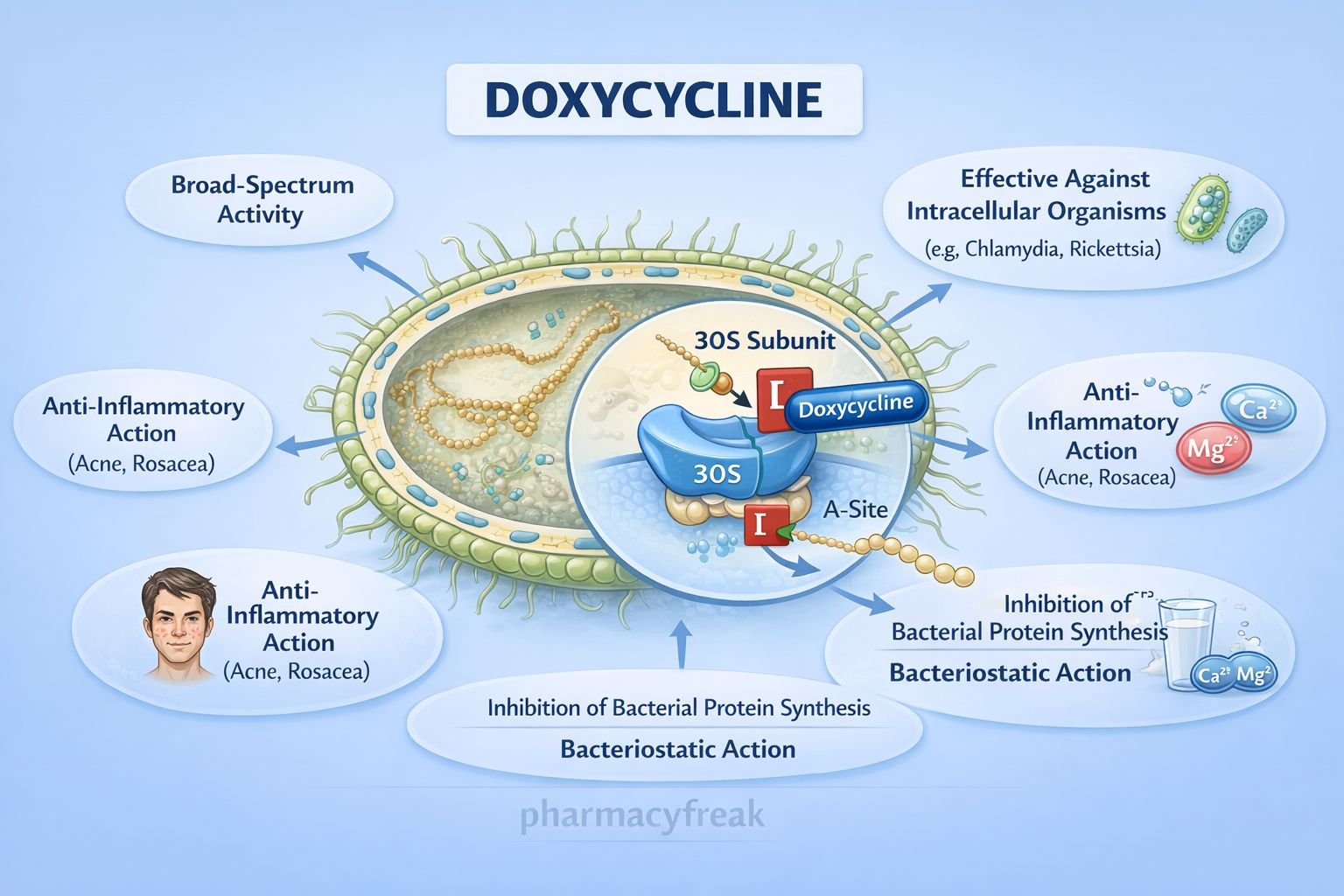
Doxycycline is a second-generation tetracycline antibiotic with broad-spectrum activity against a wide range of Gram-positive, Gram-negative, atypical, and intracellular organisms. It is widely used in respiratory infections, sexually transmitted infections, zoonotic diseases, acne, and malaria prophylaxis. Doxycycline is a high-yield drug in pharmacology and infectious disease examinations because of its protein synthesis inhibition at the 30S ribosomal subunit and its favorable pharmacokinetic profile compared with older tetracyclines.
Mechanism of Action (Step-wise)
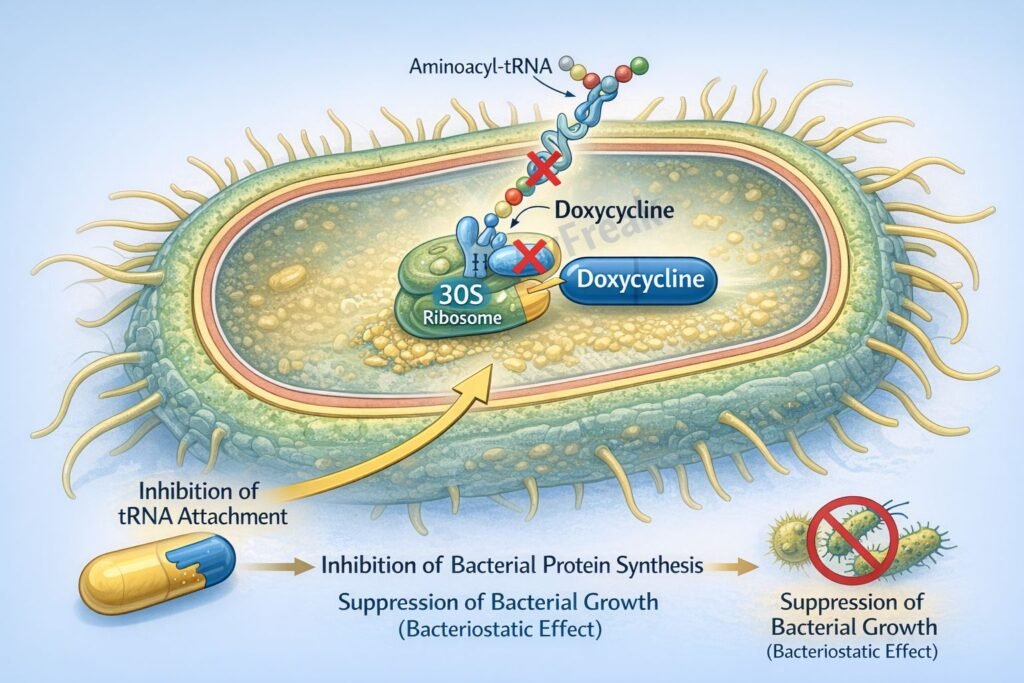
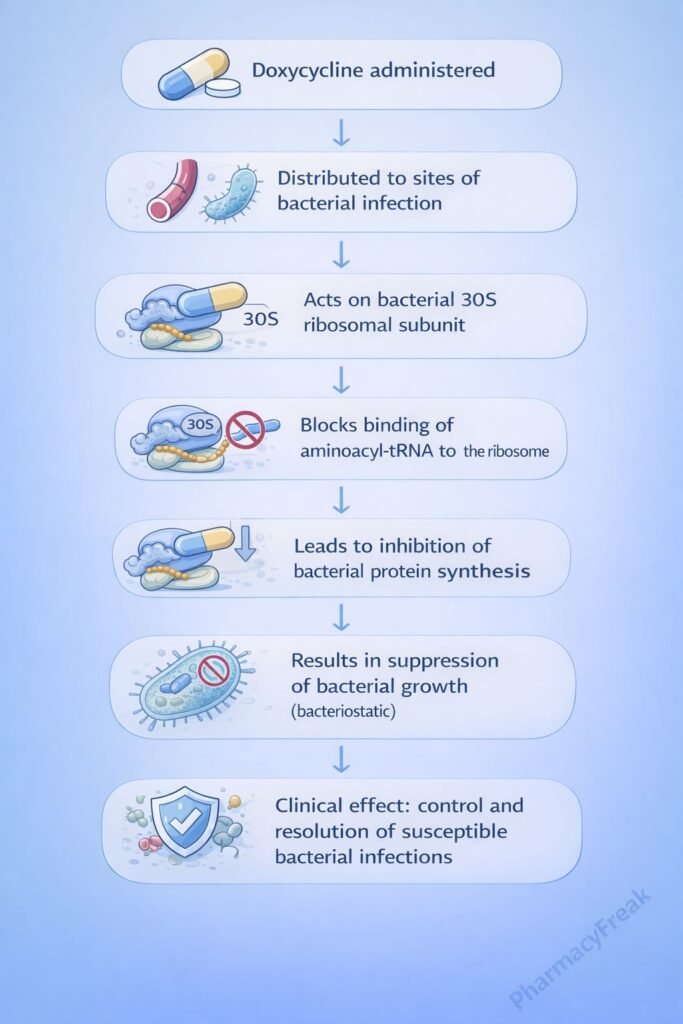
Doxycycline inhibits bacterial protein synthesis by acting on the 30S ribosomal subunit.
- Bacterial Ribosome Structure
Bacterial ribosomes consist of 30S and 50S subunits responsible for translation of mRNA into protein. - Binding to 30S Ribosomal Subunit
Doxycycline reversibly binds to the 30S ribosomal subunit of susceptible bacteria. - Blockade of Aminoacyl-tRNA Attachment
Binding prevents attachment of aminoacyl-tRNA to the A (acceptor) site of the ribosome. - Inhibition of Peptide Chain Elongation
Without incoming tRNA, peptide bond formation cannot proceed. - Suppression of Protein Synthesis
Essential bacterial proteins required for growth and replication are not synthesized. - Bacteriostatic Effect
Doxycycline inhibits bacterial growth rather than causing immediate cell death. - Intracellular Activity
Effective intracellular penetration allows action against organisms such as Chlamydia, Rickettsia, and Mycoplasma.
Pharmacokinetics
- Absorption: Excellent oral absorption
- Effect of food: Minimal (unlike older tetracyclines)
- Distribution: Wide tissue penetration; intracellular accumulation
- Protein binding: High
- Metabolism: Minimal hepatic metabolism
- Elimination: Mainly fecal via bile; minimal renal excretion
- Half-life: Long (18–22 hours)
- Advantage: Safe in renal impairment (dose adjustment usually not required)
Clinical Uses
Doxycycline is used in a wide range of infections:
- Community-acquired pneumonia (atypical pathogens)
- Chlamydial infections
- Rickettsial diseases (drug of choice)
- Lyme disease
- Acne vulgaris
- Sexually transmitted infections
- Malaria prophylaxis
- Brucellosis (in combination)
- Periodontal infections
Adverse Effects
Adverse effects are class-related but generally less severe than older tetracyclines:
- Gastrointestinal:
- Nausea
- Esophagitis (pill-induced)
- Dermatologic:
- Photosensitivity
- Dental/Bone:
- Tooth discoloration (children)
- Inhibition of bone growth (fetuses)
- Others:
- Hepatotoxicity (rare)
- Superinfection with prolonged use
Contraindicated in pregnancy and children <8 years.
Comparative Analysis (must include a table + explanation)
Comparison of Protein Synthesis Inhibitors
| Feature | Doxycycline | Tetracycline | Azithromycin |
|---|---|---|---|
| Ribosomal target | 30S | 30S | 50S |
| Effect | Bacteriostatic | Bacteriostatic | Bacteriostatic |
| Oral absorption | Excellent | Moderate | Excellent |
| Renal safety | Safe | Needs caution | Safe |
| Atypical coverage | Yes | Yes | Yes |
Explanation:
Doxycycline offers improved pharmacokinetics and fewer renal concerns than tetracycline. Azithromycin acts on the 50S subunit and is preferred in patients intolerant to tetracyclines.
MCQs (10–15)
- Doxycycline inhibits bacterial growth by:
a) Cell wall synthesis inhibition
b) DNA gyrase inhibition
c) Protein synthesis inhibition
d) Folic acid synthesis inhibition
Answer: c) Protein synthesis inhibition
- Doxycycline binds to which ribosomal subunit?
a) 50S
b) 70S
c) 30S
d) 40S
Answer: c) 30S
- Doxycycline prevents attachment of:
a) mRNA
b) rRNA
c) Aminoacyl-tRNA
d) Peptidyl-tRNA
Answer: c) Aminoacyl-tRNA
- The antibacterial action of doxycycline is:
a) Bactericidal
b) Fungicidal
c) Bacteriostatic
d) Virucidal
Answer: c) Bacteriostatic
- Doxycycline is the drug of choice for:
a) Tuberculosis
b) Rickettsial infections
c) Syphilis (neurosyphilis)
d) Typhoid fever
Answer: b) Rickettsial infections
- Doxycycline is contraindicated in:
a) Renal failure
b) Liver disease
c) Pregnancy
d) Hypertension
Answer: c) Pregnancy
- A common adverse effect of doxycycline is:
a) Ototoxicity
b) Photosensitivity
c) QT prolongation
d) Hypoglycemia
Answer: b) Photosensitivity
- Doxycycline differs from tetracycline because it:
a) Has poorer absorption
b) Requires renal dose adjustment
c) Has longer half-life
d) Is bactericidal
Answer: c) Has longer half-life
- Doxycycline is eliminated mainly by:
a) Kidney
b) Lungs
c) Bile and feces
d) Sweat
Answer: c) Bile and feces
- Doxycycline acts effectively against intracellular organisms because it:
a) Is bactericidal
b) Penetrates host cells
c) Activates immune cells
d) Stimulates macrophages
Answer: b) Penetrates host cells
FAQs (minimum 5)
- What is the primary mechanism of doxycycline?
Inhibition of bacterial protein synthesis by blocking the 30S ribosomal subunit. - Is doxycycline bactericidal or bacteriostatic?
It is bacteriostatic. - Why is doxycycline preferred over tetracycline?
Better absorption, longer half-life, and safer use in renal impairment. - Why is doxycycline avoided in pregnancy?
Risk of fetal bone growth inhibition and tooth discoloration. - Does doxycycline cover atypical organisms?
Yes, including Chlamydia, Mycoplasma, and Rickettsia. - Can doxycycline be used for malaria prevention?
Yes, it is effective for malaria prophylaxis.
References
- Goodman & Gilman’s The Pharmacological Basis of Therapeutics
https://accessmedicine.mhmedical.com - Katzung BG. Basic and Clinical Pharmacology
https://accessmedicine.mhmedical.com - Tripathi KD. Essentials of Medical Pharmacology
https://www.jaypeebrothers.com - Harrison’s Principles of Internal Medicine
https://accessmedicine.mhmedical.com