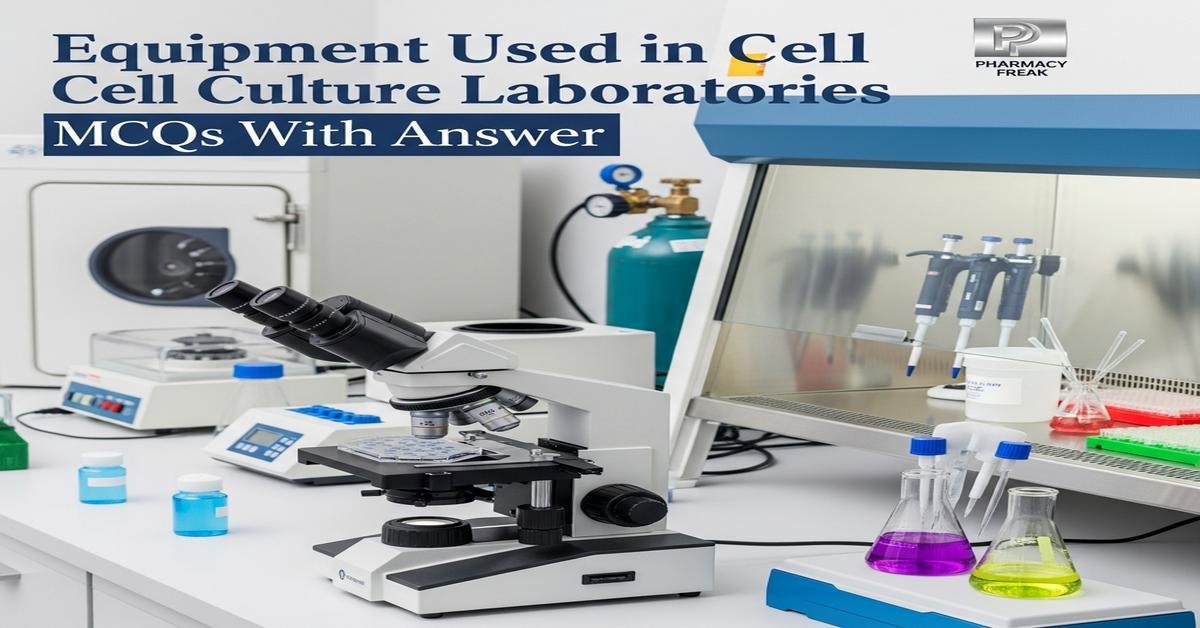
Introduction: This quiz collection on “Equipment used in cell culture laboratories” is designed specifically for M.Pharm students studying Modern Bio-Analytical Techniques (MPA 202T). It focuses on the instruments, devices, and support systems essential for maintaining viable cell cultures, ensuring sterility, and enabling accurate analysis. Questions cover operational principles, key specifications, safety classifications, proper usage and maintenance practices for incubators, biosafety cabinets, microscopes, centrifuges, cryogenic storage and related equipment. The aim is to deepen your practical understanding so you can select, operate and troubleshoot common cell culture tools confidently in research and industrial settings. Answers are provided to aid self-assessment and revision.
Q1. Which feature distinguishes a Class II biological safety cabinet (BSC) from a Class I BSC?
- Provides only personnel protection without product protection
- Has HEPA-filtered downflow air to protect the product and inflow to protect personnel
- Operates without HEPA filtration and relies on open airflow
- Is designed only for chemical fume removal, not biological containment
Correct Answer: Has HEPA-filtered downflow air to protect the product and inflow to protect personnel
Q2. What is the standard CO2 concentration commonly maintained in a mammalian cell culture CO2 incubator?
- 0.03% (ambient level)
- 1% CO2
- 5% CO2
- 20% CO2
Correct Answer: 5% CO2
Q3. For routine thawing of frozen cell vials, which equipment and temperature are recommended?
- An orbital shaker at room temperature
- A 37°C water bath with gentle agitation
- A -80°C freezer for gradual warming
- Direct placement on a heating block at 60°C
Correct Answer: A 37°C water bath with gentle agitation
Q4. Which filter pore size is commonly used to sterilize cell culture media by membrane filtration?
- 5.0 μm
- 0.45 μm
- 0.22 μm
- 50 nm
Correct Answer: 0.22 μm
Q5. Which type of microscope is best suited for observing live adherent cell morphology without staining?
- Transmission electron microscope (TEM)
- Inverted phase-contrast microscope
- Confocal fluorescence microscope with fixed samples only
- Scanning electron microscope (SEM)
Correct Answer: Inverted phase-contrast microscope
Q6. What is the primary purpose of a cryogenic liquid nitrogen storage system in cell culture labs?
- Short-term refrigeration of reagents at 4°C
- Long-term storage of cell lines at around −196°C for viability preservation
- Incubation of cultures at physiological temperature
- Autoclaving glassware under vacuum
Correct Answer: Long-term storage of cell lines at around −196°C for viability preservation
Q7. Which centrifuge rotor type is preferred for pelleting cells gently to preserve viability?
- Fixed-angle rotor run at maximum speed
- Ultracentrifuge rotor for >100,000 x g
- Swinging-bucket rotor with appropriate lower g-force
- High-speed rotor without temperature control
Correct Answer: Swinging-bucket rotor with appropriate lower g-force
Q8. What is the typical cryoprotectant and concentration used when freezing mammalian cells?
- Glycerol 50%
- Dimethyl sulfoxide (DMSO) 10%
- Ethanol 20%
- Sucrose 0.1 M
Correct Answer: Dimethyl sulfoxide (DMSO) 10%
Q9. Which equipment is essential for counting viable cells using Trypan Blue exclusion manually?
- Hemocytometer and light microscope
- Confocal microscope
- Autoclave
- Fume hood
Correct Answer: Hemocytometer and light microscope
Q10. Why are Class II BSCs used instead of laminar flow hoods for work with potentially infectious cell cultures?
- Class II BSCs provide only product protection but no personnel protection
- Laminar flow hoods have HEPA filters that remove all pathogens from air exhaust
- Class II BSCs protect staff, product and environment through directional airflow and HEPA filtration
- Laminar flow hoods operate at lower temperatures suitable for cells
Correct Answer: Class II BSCs protect staff, product and environment through directional airflow and HEPA filtration
Q11. What is the recommended autoclave cycle commonly used to sterilize glassware and media?
- 100°C for 30 minutes at atmospheric pressure
- 121°C at 15 psi (approximately) for 15–20 minutes
- 150°C dry heat for 5 minutes
- 80°C for 2 hours
Correct Answer: 121°C at 15 psi (approximately) for 15–20 minutes
Q12. Which piece of equipment is most appropriate for maintaining sterility of small volumes of reagents during repetitive pipetting in the hood?
- Lithium-ion battery powered micropipette
- Glass Pasteur pipette and rubber bulb
- Positive-displacement pipette with sterile tips
- Open beaker on the bench top
Correct Answer: Positive-displacement pipette with sterile tips
Q13. For culturing cells that require strict hypoxic conditions, which equipment is used to control oxygen tension?
- Standard CO2 incubator without gas control
- Hypoxia chamber or tri-gas incubator with controlled O2 and CO2
- Laminar flow hood with UV light
- Room with sealed windows
Correct Answer: Hypoxia chamber or tri-gas incubator with controlled O2 and CO2
Q14. What is the main role of a water jacket in a CO2 incubator compared to a direct-heated incubator?
- To reduce humidity inside the incubator
- To provide more uniform temperature and thermal inertia for temperature stability
- To sterilize cultures through immersion
- To generate CO2 from heated water
Correct Answer: To provide more uniform temperature and thermal inertia for temperature stability
Q15. Which instrument would you use to quantify DNA, RNA or protein concentrations quickly in cell culture samples?
- Phase-contrast microscope
- Spectrophotometer or microplate reader with appropriate wavelengths
- Biological safety cabinet
- Autoclave
Correct Answer: Spectrophotometer or microplate reader with appropriate wavelengths
Q16. What maintenance task is essential for HEPA filters in biosafety cabinets to ensure continued protection?
- Washing the HEPA filter daily with soap
- Regular certification and replacement according to performance tests
- Exposure to UV light every hour to regenerate filters
- Covering the filter with aluminum foil to prevent dust
Correct Answer: Regular certification and replacement according to performance tests
Q17. When using a mechanical cell counter (automated), which parameter is commonly validated against manual counting?
- Type of culture vessel used
- Cell viability and concentration accuracy compared to hemocytometer counts
- Autoclave cycle time
- CO2 percentage in incubator
Correct Answer: Cell viability and concentration accuracy compared to hemocytometer counts
Q18. Which safety equipment is mandatory when handling cryogenic liquid nitrogen to retrieve frozen vials?
- Standard lab coat without gloves
- Cryogenic gloves, face shield and insulated aprons
- Surgical mask only
- Open-toed shoes to sense cold
Correct Answer: Cryogenic gloves, face shield and insulated aprons
Q19. What is the advantage of using an inverted incubator microscope (live-cell imaging system) over removing cultures to a bench-top microscope?
- It avoids the need for CO2 and temperature control during imaging
- Allows time-lapse imaging under controlled temperature, humidity and CO2 without disturbing cultures
- Is cheaper and less maintenance prone
- Provides higher vacuum for electron imaging
Correct Answer: Allows time-lapse imaging under controlled temperature, humidity and CO2 without disturbing cultures
Q20. Which filtration device is commonly used for sterile filtration of small liquid volumes prior to dispensing into culture vessels?
- Centrifuge with fixed-angle rotor
- Syringe filter with 0.22 μm membrane
- Paper coffee filter
- Glass microfiber filter of 10 μm pore size
Correct Answer: Syringe filter with 0.22 μm membrane

