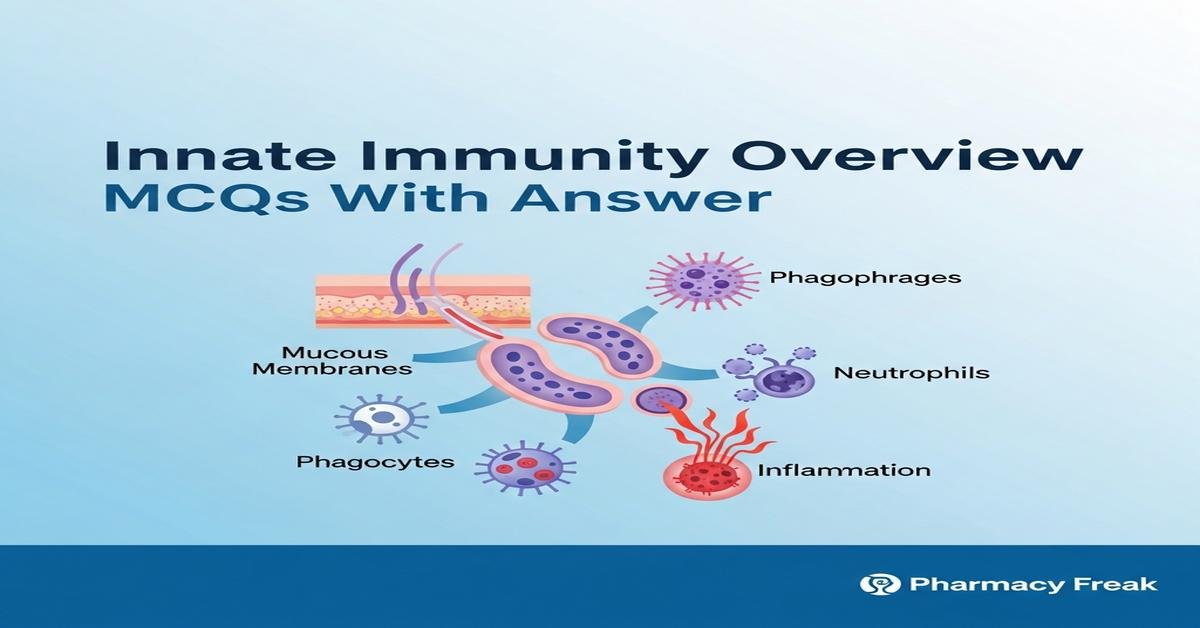
Innate Immunity Overview MCQs With Answer
This quiz set is designed for M.Pharm students to deepen understanding of innate immune mechanisms relevant to pharmacology and immunotechnology. It covers cellular and molecular components such as physical barriers, phagocytes, natural killer cells, pattern recognition receptors (TLRs, NLRs, RIG-I), complement pathways, acute phase proteins, cytokines, inflammasomes, and mechanisms like opsonization, respiratory burst and trained immunity. Questions emphasize mechanistic detail and clinical relevance, including immune evasion and therapeutic targeting. Use these MCQs for revision, self-assessment or classroom discussion to consolidate foundational knowledge required for advanced study and research in immunopharmacology.
Q1. Which of the following best describes a primary function of Toll-like receptors (TLRs) in innate immunity?
- Recognition of antigenic peptides presented by MHC molecules
- Direct killing of infected host cells via perforin
- Detection of conserved pathogen-associated molecular patterns and initiation of pro-inflammatory signaling
- Generation of antigen-specific memory B cells
Correct Answer: Detection of conserved pathogen-associated molecular patterns and initiation of pro-inflammatory signaling
Q2. Which cell type is the most efficient professional phagocyte responsible for early bacterial clearance in tissues?
- Basophil
- Macrophage
- Neutrophil
- Eosinophil
Correct Answer: Neutrophil
Q3. Which complement pathway can be activated directly by pathogen surfaces without antibodies?
- Classical pathway
- Lectin pathway
- Alternative pathway
- IgE-mediated pathway
Correct Answer: Alternative pathway
Q4. Which molecule is primarily responsible for opsonization to enhance phagocytosis?
- C3b
- Interleukin-10
- Perforin
- Histamine
Correct Answer: C3b
Q5. Which of the following is a key difference between PAMPs and DAMPs?
- PAMPs are host-derived; DAMPs are microbial-derived
- PAMPs arise from microbes; DAMPs are endogenous molecules released from damaged cells
- PAMPs only activate adaptive immunity; DAMPs only activate innate immunity
- PAMPs are recognized by MHC; DAMPs are recognized by antibodies
Correct Answer: PAMPs arise from microbes; DAMPs are endogenous molecules released from damaged cells
Q6. Which cytokine is most strongly associated with induction of fever and acute phase protein synthesis in the liver?
- Interleukin-10 (IL-10)
- Interferon-gamma (IFN-γ)
- Interleukin-1 (IL-1) and Interleukin-6 (IL-6)
- Transforming growth factor-beta (TGF-β)
Correct Answer: Interleukin-1 (IL-1) and Interleukin-6 (IL-6)
Q7. Natural Killer (NK) cells detect and kill target cells primarily by sensing:
- Peptide fragments presented by MHC class II
- Absence or downregulation of MHC class I and altered stress ligands
- Antibody-coated bacteria via Fc receptors
- Complement deposition on infected cells
Correct Answer: Absence or downregulation of MHC class I and altered stress ligands
Q8. Which pattern recognition receptor family senses intracellular bacterial peptidoglycan fragments and can form inflammasomes?
- Toll-like receptors (TLRs)
- NOD-like receptors (NLRs)
- RIG-I-like receptors (RLRs)
- C-type lectin receptors (CLRs)
Correct Answer: NOD-like receptors (NLRs)
Q9. The respiratory burst in phagocytes depends on which enzyme complex that generates reactive oxygen species?
- NADPH oxidase
- Cyclooxygenase-2 (COX-2)
- Indoleamine 2,3-dioxygenase (IDO)
- Myeloperoxidase-independent peroxidase
Correct Answer: NADPH oxidase
Q10. Which acute phase protein binds to microbial polysaccharides and can activate the lectin complement pathway?
- C-reactive protein (CRP)
- Serum albumin
- Mannose-binding lectin (MBL)
- Fibrinogen
Correct Answer: Mannose-binding lectin (MBL)
Q11. Trained innate immunity refers to:
- Development of antigen-specific T cell memory in the thymus
- Long-term functional reprogramming of innate immune cells leading to enhanced responses upon re-challenge
- Generation of high-affinity antibodies by B cells
- Permanent deletion of autoreactive innate cells
Correct Answer: Long-term functional reprogramming of innate immune cells leading to enhanced responses upon re-challenge
Q12. Which interferon type is most important for defense against viral infections by inducing an antiviral state in neighboring cells?
- Type II interferon (IFN-γ)
- Type I interferons (IFN-α/β)
- Type III interferons (IFN-λ) only
- Transforming growth factor-beta (TGF-β)
Correct Answer: Type I interferons (IFN-α/β)
Q13. Which of the following describes a key function of the inflammasome?
- Presentation of antigen to CD8+ T cells
- Activation of caspase-1 and processing of IL-1β and IL-18
- Direct neutralization of pathogens in serum
- Production of high-affinity IgG antibodies
Correct Answer: Activation of caspase-1 and processing of IL-1β and IL-18
Q14. Neutrophil extracellular traps (NETs) primarily contribute to innate defense by:
- Presenting antigen to B cells
- Trapping and immobilizing microbes with chromatin and antimicrobial proteins
- Inducing antibody class switching
- Suppressing macrophage activation
Correct Answer: Trapping and immobilizing microbes with chromatin and antimicrobial proteins
Q15. Which complement component forms the membrane attack complex (MAC) that causes lysis of susceptible microbes?
- C3b
- C5b-9
- C1q
- Factor H
Correct Answer: C5b-9
Q16. A common innate immune evasion strategy used by certain bacteria is:
- Upregulation of MHC class I on host cells
- Production of proteases that degrade complement proteins or antibodies
- Increasing ROS production by the host
- Stimulating inflammasome activation to kill host cells
Correct Answer: Production of proteases that degrade complement proteins or antibodies
Q17. Which receptor family recognizes viral RNA in the cytosol and initiates type I interferon responses?
- NOD-like receptors (NLRs)
- Toll-like receptor 4 (TLR4) on the cell surface
- RIG-I-like receptors (RLRs) such as RIG-I and MDA5
- C-type lectin receptors (CLRs)
Correct Answer: RIG-I-like receptors (RLRs) such as RIG-I and MDA5
Q18. Which acute-phase reactant acts as an opsonin and also activates complement via the classical pathway?
- Albumin
- C-reactive protein (CRP)
- Transferrin
- Haptoglobin
Correct Answer: C-reactive protein (CRP)
Q19. Which chemokine receptor interaction is most important for neutrophil recruitment to sites of acute inflammation?
- CCR7 – CCL19/21
- CXCR4 – CXCL12
- CXCR1/CXCR2 – IL-8 (CXCL8)
- CCR5 – CCL3
Correct Answer: CXCR1/CXCR2 – IL-8 (CXCL8)
Q20. Genetic deficiency of which complement regulator predisposes to uncontrolled alternative pathway activation and hemolytic disease?
- Factor H
- C1 inhibitor
- Mannose-binding lectin
- C4b-binding protein
Correct Answer: Factor H

