Table of Contents
Introduction
Chlorhexidine is a broad-spectrum antiseptic and disinfectant widely used in clinical practice for skin preparation, oral hygiene, wound cleansing, surgical scrubs, and catheter care. It is highly effective against gram-positive and gram-negative bacteria, yeasts, and some viruses.
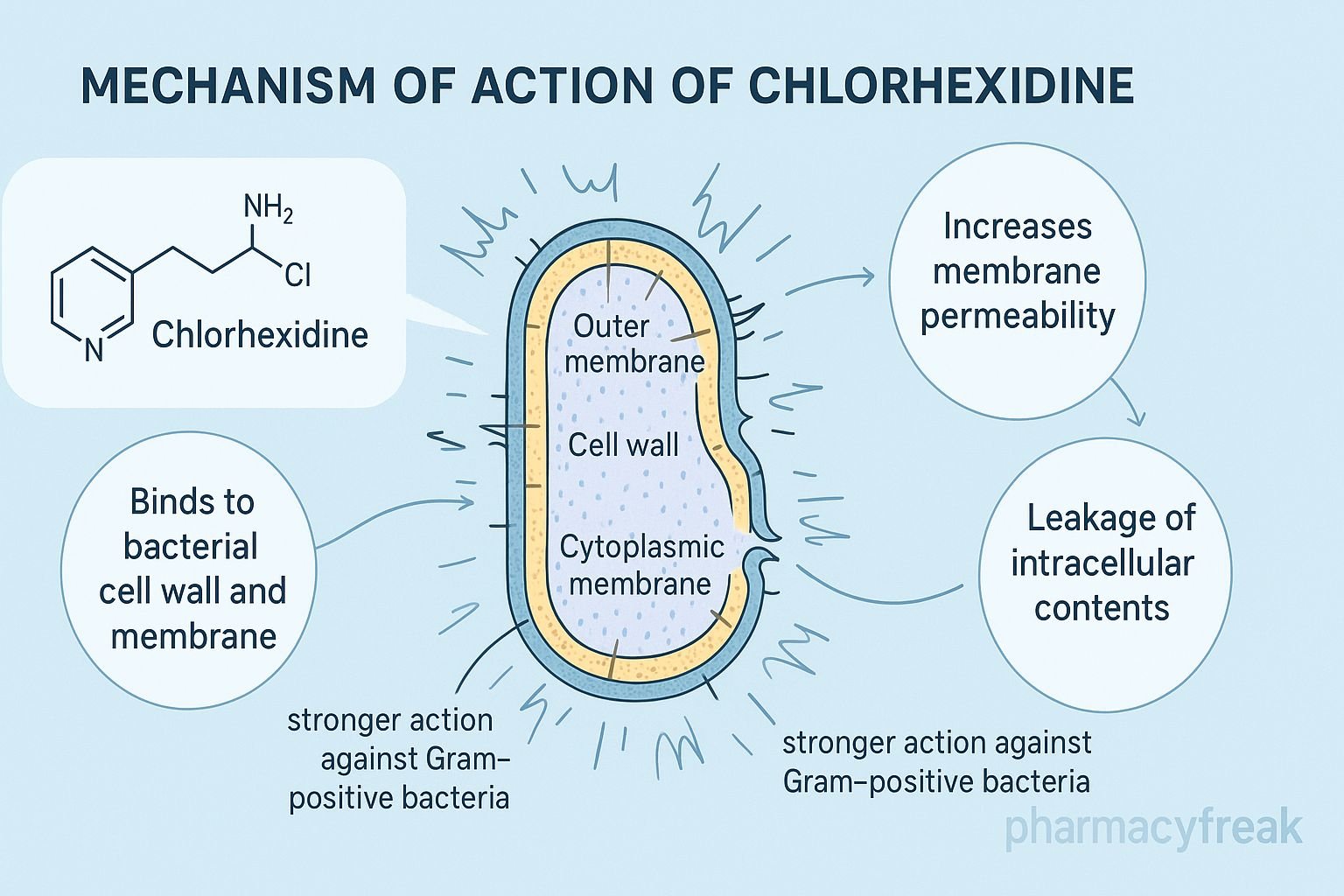
The Mechanism of Action of Chlorhexidine is based on disruption of microbial cell membranes, leading to leakage of intracellular components and eventual cell death. It acts rapidly and has prolonged residual activity on skin and mucous membranes.
Mechanism of Action (Step-wise)
1. Binding to Bacterial Cell Wall
Chlorhexidine is a cationic biguanide.
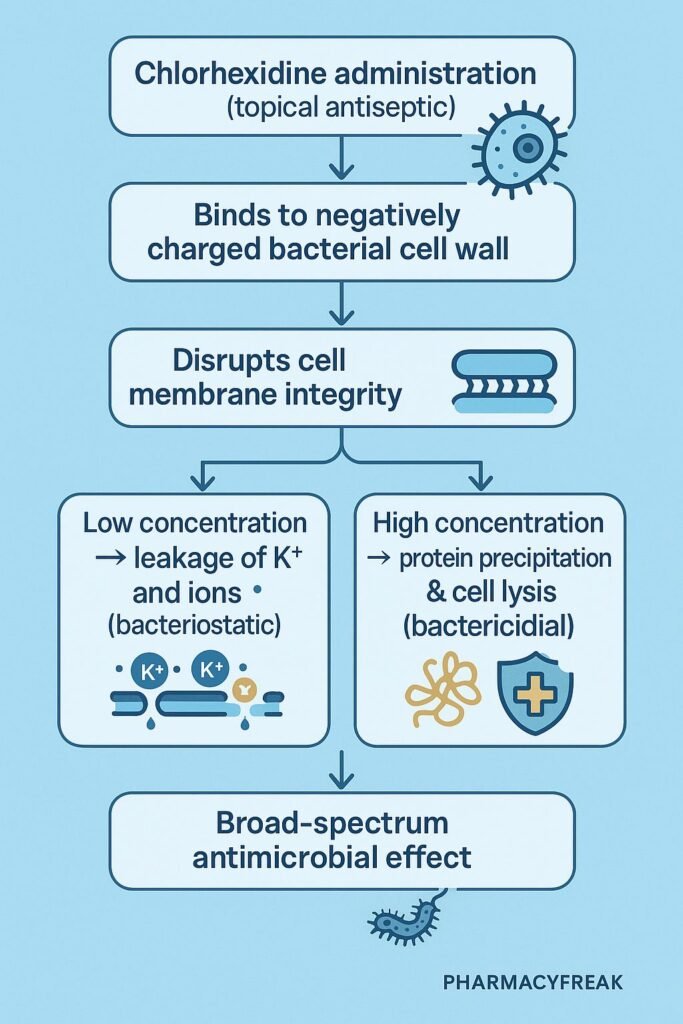
Its positively charged molecule binds electrostatically to the negatively charged phosphate groups on microbial cell walls.
Effects:
- Altered cell wall integrity
- Increased permeability
This is the earliest stage of its antibacterial action.
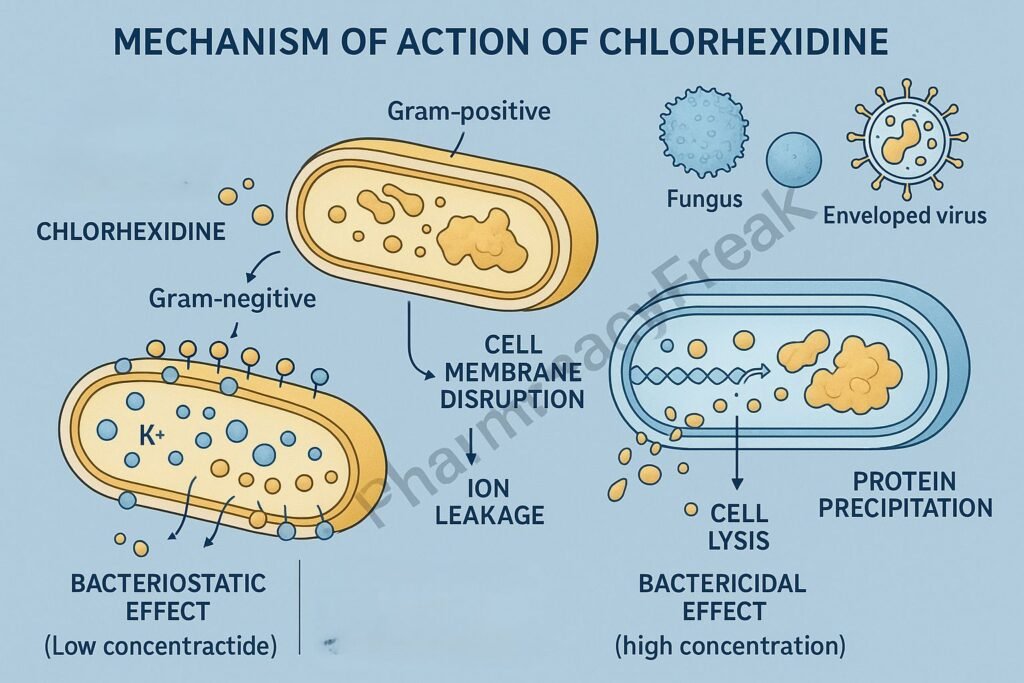
2. Disruption of Cell Membrane Integrity – Primary Mechanism
Once bound to the bacterial surface, chlorhexidine penetrates the cell membrane.
It causes:
- Disruption of phospholipid bilayer
- Leakage of potassium ions
- Loss of essential metabolites
- Enzyme inhibition
At low concentrations, it is bacteriostatic.
At higher concentrations, it is bactericidal.
3. Precipitation of Cytoplasmic Contents
At higher doses, chlorhexidine:
- Coagulates cytoplasmic proteins
- Precipitates nucleic acids
- Causes irreversible cell death
This leads to rapid elimination of bacteria.
4. Broad-spectrum Antimicrobial Activity
Chlorhexidine is effective against:
- Gram-positive bacteria (highly active)
- Gram-negative bacteria (moderately active)
- Yeasts
- Some enveloped viruses
It has limited efficacy against:
- Mycobacteria
- Non-enveloped viruses
- Bacterial spores
5. Residual Antimicrobial Effect
Chlorhexidine binds strongly to skin and mucosal proteins, providing persistent antibacterial action for 6–48 hours, making it ideal for surgical scrubs and catheter site preparation.
6. Summary of Mechanism
| Mechanism | Effect |
|---|---|
| Cell wall binding | Initial disruption |
| Membrane destabilization | Leakage of ions and metabolites |
| Protein coagulation | Cell death |
| Broad-spectrum action | Effective antiseptic |
| Residual binding | Long-lasting effect |
Pharmacokinetics
- Topical & oral use only
- Not absorbed through intact skin
- Minimal systemic absorption when used orally
- Excreted unchanged if swallowed
Clinical Uses
- Surgical hand scrubbing
- Preoperative skin preparation
- Oral rinses for gingivitis and plaque
- Wound cleansing
- Catheter site disinfection
- Vaginal antisepsis
- Care of central lines and dialysis ports
Adverse Effects
Common
- Skin irritation
- Dryness
- Redness
- Bitter taste (oral rinses)
Oral-specific
- Tooth staining
- Altered taste
- Increased calculus formation
Rare
- Anaphylaxis
- Ototoxicity (avoid in middle ear)
- Neurotoxicity if applied to meninges
Contraindications
- Do not use in eyes
- Avoid contact with meninges or middle ear
- Caution in patients with known hypersensitivity
Comparative Analysis
| Feature | Chlorhexidine | Povidone-Iodine | Alcohol |
|---|---|---|---|
| Residual activity | Yes | No | No |
| Spectrum | Broad | Very broad | Broad |
| Skin irritation | Low | Moderate | High |
| Use in surgery | Excellent | Excellent | Poor residual |
MCQs
1. Chlorhexidine kills bacteria primarily by:
a) Inhibiting protein synthesis
b) Inhibiting DNA gyrase
c) Disrupting cell membranes
d) Blocking folate synthesis
Answer: c) Disrupting cell membranes
2. Chlorhexidine is bactericidal at:
a) All concentrations
b) Only very low concentrations
c) High concentrations
d) Only when heated
Answer: c) High concentrations
3. Which organism is least sensitive to chlorhexidine?
a) Gram-positive bacteria
b) Yeasts
c) Non-enveloped viruses
d) Gram-negative bacteria
Answer: c) Non-enveloped viruses
4. A notable adverse effect of chlorhexidine mouthwash is:
a) Myelosuppression
b) Tooth staining
c) Ototoxicity
d) Alopecia
Answer: b) Tooth staining
5. Chlorhexidine provides long-lasting antimicrobial action because:
a) It is absorbed systemically
b) It binds strongly to skin proteins
c) It increases neutrophil function
d) It undergoes enzymatic activation
Answer: b) It binds strongly to skin proteins
FAQs
Q1. Why is chlorhexidine preferred in surgical scrubs?
Due to its rapid onset and long-lasting residual antimicrobial activity.
Q2. Is chlorhexidine safe as a mouthwash?
Yes, but may cause tooth staining and altered taste.
Q3. Can chlorhexidine be used on open wounds?
Diluted solutions can be used, but high concentrations may cause irritation.
Q4. Is chlorhexidine effective against viruses?
Effective mainly against enveloped viruses, less effective against non-enveloped ones.
Q5. Why should chlorhexidine not be used in the ear?
It can cause ototoxicity, especially if the tympanic membrane is perforated.
References
Goodman & Gilman’s Pharmacological Basis of Therapeutics
https://accesspharmacy.mhmedical.com/book.aspx?bookid=2189
Katzung: Basic and Clinical Pharmacology
https://accessmedicine.mhmedical.com/book.aspx?bookid=2464
Tripathi: Essentials of Medical Pharmacology
https://jaypeebrothers.com/
Harrison’s Principles of Internal Medicine
https://accessmedicine.mhmedical.com/book.aspx?bookid=2129